
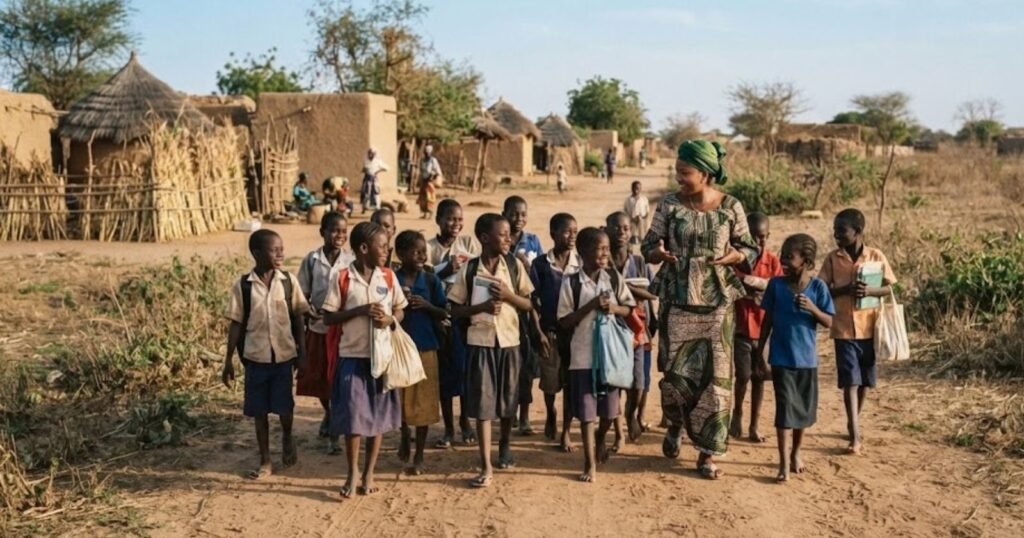
Niger enters 2026 with roughly 28.8 million people and the youngest population profile of any country on Earth. The median Nigerien is 15.7 years old, meaning half the country has not yet finished secondary school age, let alone entered the workforce. No other nation comes close to this combination of scale and youth: Niger is not a small outlier state with a skewed pyramid; it is a country of nearly 29 million people where the typical resident is a teenager or younger.
That single number, a median age under 16, explains more about Niger’s schools, labor markets, food systems, and government budgets than almost any other statistic available. This article works through the data behind it: how the age structure formed, where the population physically sits within Niger’s borders, what a fertility rate still close to six children per woman means for the coming decades, and what the United Nations’ own projections say about Niger’s population size at mid-century and beyond.
Niger Population at a Glance
| Metric | Figure | Year |
|---|---|---|
| Total population | 28.8 million | 2026 |
| Annual growth rate | 3.1% to 3.9% | 2025-26 |
| Median age | 15.7 years | 2026 |
| Total fertility rate | 5.9 to 6.1 children per woman | 2023-24 |
| Urban population share | 18.5% | 2026 |
| Population density | 23 people per km² | 2026 |
| Population aged under 15 | approximately 49% | 2025 |
| Life expectancy at birth | 60 to 62 years | 2023-25 |
| Adult literacy rate | 35% to 38% | 2022 |
| UN medium-variant projection | 48.7 million | 2046 |
Niger ranks 53rd in the world by population, yet it has the world’s highest or second-highest total fertility rate depending on the year and dataset consulted, and the lowest median age of any country with a population over one million. The growth rate itself, above 3% annually, means Niger’s population is on pace to double roughly every 20 to 22 years if current trends hold, a rate matched by very few countries anywhere in the world.
Why Niger Has One of the World’s Youngest Populations
Age structure is the product of two forces working over decades: how many children are born each year, and how many people survive into each subsequent age bracket. In Niger, both forces point in the same direction. Fertility has stayed extraordinarily high, while child mortality, though still elevated by global standards, has fallen substantially since the 1990s, meaning more of the children born each year now survive into adolescence and adulthood.
The result compounds over time. Each cohort of Nigerien children entering their own reproductive years is larger than the cohort before it, because fertility never fell far enough to offset population momentum. World Bank data put Niger’s total fertility rate at 6.06 children per woman in 2023, easing only slightly to roughly 5.9 to 5.94 by 2024 depending on the source. That decline, from a historical average closer to 7.5 children per woman in the 1980s, has been real but gradual, and it has not yet been enough to slow the underlying growth engine.
Demographers describe this dynamic as population momentum: even if fertility fell sharply tomorrow, Niger’s population would keep growing for another generation simply because so many young people are already alive and approaching childbearing age. Niger is a textbook case. The country sits early in what demographers call Stage 2 of the demographic transition, where death rates have fallen, but birth rates remain close to historical highs, a combination that produces the fastest population growth phase any society experiences.
Niger’s Population Pyramid Explained
A population pyramid for Niger looks almost nothing like the pyramid of an aging country such as Japan or Italy. Instead of a narrow base and a wide middle or top, Niger’s chart is a true pyramid: an extremely broad base of children under five, narrowing steadily with each successive five-year age band, and a very thin tip representing the small share of the population over 65.
Roughly 49% of Nigeriens are under the age of 15, according to CIA World Factbook and UN-derived estimates for the mid-2020s. Another large share falls between 15 and 24, meaning close to 70% of the population is under 25. Only around 2.6% to 2.7% of the population is 65 or older, one of the smallest elderly shares recorded anywhere in the world.
This shape has direct arithmetic consequences. The dependency ratio, which measures how many children and elderly people each working-age adult must support, is among the highest in the world. With under half the population in the conventional working ages of 15 to 64, each economically active adult in Niger supports, on average, more dependents than an adult in almost any other country. That imbalance shapes household budgets, government spending priorities, and the demand for schools and clinics well before it shapes the labor market itself.
Fertility Is the Central Driver of Population Growth
Total fertility rate is the single number that explains Niger’s demographic trajectory more than any other. At close to six children per woman, Niger’s fertility is roughly two and a half times the global average of 2.2 to 2.4 children per woman, and nearly three times the replacement level of 2.1 that would eventually stabilize a population.
Several factors sit behind that number, and it is worth being precise about what the evidence actually shows rather than assuming a single cause. Research summarized by the CIA World Factbook’s demographic profile of Niger notes that the country’s total fertility rate remains lower than its stated desired fertility rate, meaning many Nigerien families report wanting large families rather than experiencing high fertility as unwanted. That preference is shaped by rural, agrarian livelihoods where children contribute labor from a young age, by low rates of female secondary education, and by limited contraceptive access, particularly outside Niamey.
Girls’ education is one of the more measurable levers connected to fertility outcomes globally, and Niger’s own numbers illustrate the gap: overall adult literacy sits near 35% to 38%, but the rate is markedly lower for women, at roughly 11% among adult women according to Countrymeters’ compilation of UNESCO data, compared with around 27% for adult men. Youth literacy is higher across both sexes, reflecting recent gains in school enrollment, but girls still trail boys by a wide margin.
Maternal and reproductive health infrastructure also plays a role. Niger’s maternal mortality ratio has been estimated at several hundred deaths per 100,000 live births in recent CIA World Factbook data, reflecting limited access to skilled birth attendance in many rural areas. None of these factors operate in isolation, and no single policy lever fully explains fertility levels this high, but together they describe a society where large families remain both culturally valued and structurally reinforced.
Geography and the Distribution of Niger’s Population
Niger is a landlocked country of roughly 1.27 million square kilometers, more than twice the size of France, yet it holds a population density of only about 23 people per square kilometer, one of the lowest in the world. That low average, however, conceals an extremely uneven distribution.
The great majority of Nigeriens live in a narrow band across the southern part of the country, along the borders with Nigeria and Benin, where rainfall is sufficient to support settled agriculture. The CIA World Factbook’s demographic profile places the population’s core explicitly in this southernmost strip. Moving north, the country transitions into Sahelian scrubland and eventually the Sahara Desert, where population density drops toward zero across enormous stretches of territory. Much of Niger’s northern two-thirds, including large parts of the Agadez region, is desert or near-desert land capable of supporting only scattered nomadic and semi-nomadic communities.
Niamey, the capital, sits on the Niger River in the southwest and anchors the country’s only large urban center. City-level population trackers put metropolitan Niamey at roughly 1.6 million residents in 2025, climbing toward 2 million by the early 2030s on current growth trajectories. No other Nigerien city approaches that scale; secondary centers such as Zinder remain well under one million.
What a Very Young Population Means for Education
Niger’s school-age population is expanding by hundreds of thousands of children every year, a direct consequence of the fertility levels described above. That growth places continuous pressure on a school system that already struggles to keep pace. Literacy figures make the scale of the challenge clear: overall adult literacy near 35% to 38% is among the lowest recorded by any country, and school attendance figures compiled by the CIA World Factbook put overall attendance at roughly one-third of the relevant age group, split unevenly between boys, at closer to 38%, and girls, nearer 27%.
The gender gap in education carries forward into fertility outcomes, workforce participation, and household income, creating a cycle that development agencies and the Nigerien government have both identified as a policy priority. Expanding girls’ secondary education in particular is one of the more evidence-backed levers associated with fertility decline elsewhere in the world, though Niger’s results to date show how slowly that lever moves in a society with strong preferences for large families and limited rural school infrastructure.
Meeting current demand alone, before accounting for future growth, requires a substantial and sustained expansion of classrooms and trained teachers. Because each new cohort of children is larger than the one before it, the country is effectively trying to expand school capacity while running on a treadmill that keeps accelerating.
Youth Employment and the Demographic Challenge
Niger’s working-age population, conventionally defined as ages 15 to 64, will keep expanding rapidly for decades even under optimistic fertility-decline scenarios, simply because of the large cohorts of children already born. That expansion is often framed internationally as an opportunity, the raw material for a demographic dividend, but the dividend is not automatic. It depends on whether the economy can generate enough jobs, and productive enough jobs, to absorb a labor force growing this quickly.
Niger’s economy remains dominated by subsistence and rain-fed agriculture, supplemented by informal trade and, in specific regions, uranium mining, for which Niger is one of the world’s largest sources, producing roughly a fifth of global uranium supply according to demographic profile data referenced in population pyramid research on the country. None of these sectors currently generates formal employment at a scale close to matching the number of young people entering the labor market each year.
The practical result is that most young Nigeriens will continue to work in agriculture or the informal urban economy for the foreseeable future, rather than in the kind of manufacturing or service-sector jobs that historically absorbed large youth cohorts in countries such as South Korea or Vietnam during their own demographic transitions. Converting Niger’s youth bulge into a genuine demographic dividend rather than a source of chronic underemployment will depend heavily on continued investment in vocational skills, agricultural productivity, and the kind of infrastructure that allows small businesses and regional trade to expand.
Urbanization and Population Pressure
Only about 18.5% of Nigeriens lived in urban areas as of 2026, one of the lower urbanization rates in the world, but that share is rising as rural livelihoods come under strain and young people migrate toward Niamey and regional towns in search of work. Niamey’s population has grown from under one million at the 2012 census to a projected 1.6 million or more in 2025, and city-level projections point toward continued growth of 5% to 6% a year through the early 2030s.
That pace of urban growth outstrips most cities’ capacity to expand housing, water systems, and transport infrastructure at matching speed, a pattern common across the Sahel. Informal settlements, strained sanitation networks, and overcrowded transport are among the visible consequences already documented in comparable Sahelian capitals, and Niamey faces similar structural pressure as its population climbs.
Population Growth, Resources and Climate Pressure
Niger sits almost entirely within the Sahel, a climatic transition zone between the Sahara Desert and the more humid savannas farther south, and one of the regions most exposed to rainfall variability worldwide. Population growth does not by itself cause environmental strain, but it does raise the stakes of any given drought, flood, or harvest failure, because more people depend on the same finite base of arable land and water resources each year.
Roughly 80% or more of Niger’s population depends directly on rain-fed agriculture and livestock herding for its livelihood. When rainfall is favorable, this system can meet much of domestic food demand; when it is not, the combination of a large, fast-growing population and limited irrigated agriculture leaves the country vulnerable to recurring food security crises, a pattern documented repeatedly by international food security monitors across the Sahel over the past two decades. Managing this tension, expanding irrigation, improving drought-resistant seed varieties, and diversifying rural livelihoods sit at the center of Niger’s long-term development planning.
Niger’s Future Population
United Nations medium-variant projections, built on the World Population Prospects 2024 Revision, see Niger’s population climbing from roughly 28.8 million in 2026 to approximately 48.7 million by 2046, a 66% increase in just two decades, and to roughly 90 to 92 million by the end of the century. Those figures would move Niger from the 53rd most populous country today to somewhere in the low 40s in the global ranking within 20 years.
Historical and Future Population Table
| Year | Population | Context |
|---|---|---|
| 1950 | 2.5 million | Post-independence baseline population |
| 1970 | 4.2 million | Early rapid-growth phase begins |
| 2000 | 10.5 million | Population crosses 10 million |
| 2012 | 17.1 million | Last full national census year |
| 2026 | 28.8 million | Current UN medium-variant estimate |
| 2046 (projected) | 48.7 million | UN medium-variant projection, +66% vs 2026 |
| 2100 (projected) | 90 to 92 million | UN medium-variant long-range projection |
It is important to treat every figure past 2026 as a projection rather than a certainty. The UN’s medium-variant scenario assumes a continued, gradual decline in fertility over coming decades, broadly consistent with patterns observed elsewhere in West Africa. If fertility declines faster than assumed, perhaps driven by expanded female education and family planning access, population growth would slow more quickly than the medium-variant path suggests.
If fertility remains closer to current levels for longer, Niger’s population could track toward the UN’s high-variant scenario instead, which projects a still-larger population by mid-century. Either way, population momentum guarantees substantial further growth for at least the next generation, regardless of how quickly fertility itself changes from today.
Key Findings
- Niger’s median age of 15.7 years is the youngest of any country in the world, and nearly half the population is under 15.
- Total fertility remains close to six children per woman, roughly three times the global replacement level of 2.1.
- Population growth of 3.1% to 3.9% a year would double Niger’s population in roughly 20 to 22 years if sustained.
- Only 18.5% of Nigeriens live in urban areas, but Niamey’s population is projected to grow from about 1.6 million in 2025 toward 2 million within a decade.
- Adult literacy sits near 35% to 38%, with a wide gender gap that leaves women’s literacy at roughly a third of men’s rate.
- UN medium-variant projections put Niger’s population at 48.7 million by 2046 and roughly 90 million by 2100.
- Niger produces about a fifth of the world’s uranium, yet this resource sector employs only a small fraction of a rapidly growing labor force.
Frequently Asked Questions
1. How many people live in Niger?
Niger’s population is estimated at approximately 28.8 million as of 2026, based on the United Nations World Population Prospects 2024 Revision, medium-fertility variant.
2. Why is Niger’s population so young?
A combination of sustained high fertility, close to six children per woman, and falling child mortality has produced a population where nearly half of all residents are under 15 and the median age is just 15.7 years.
3. What is Niger’s fertility rate?
World Bank data placed Niger’s total fertility rate at 6.06 children per woman in 2023, easing slightly to approximately 5.9 to 5.94 by 2024. This remains among the highest fertility rates recorded anywhere in the world.
4. Will Niger’s population continue growing?
Yes. UN medium-variant projections show Niger’s population rising to roughly 48.7 million by 2046 and approximately 90 to 92 million by 2100, driven largely by population momentum from the country’s already-large youth cohorts.
5. What does Niger’s young population mean for development?
A young, fast-growing population increases demand for schools, healthcare, and jobs faster than infrastructure typically expands. Whether this youth bulge becomes a demographic dividend depends on continued investment in education, especially for girls, and in job creation outside subsistence agriculture.
6. What percentage of Niger’s population lives in cities?
Approximately 18.5% of Nigeriens lived in urban areas as of 2026, one of the lowest urbanization rates in the world, though the share is rising as migration to Niamey and regional towns continues.
7. What is the population of Niamey?
Niamey, Niger’s capital, had a metropolitan population of roughly 1.6 million in 2025, with projections pointing toward close to 2 million residents by the early 2030s.
8. How does Niger’s fertility rate compare with its neighbors?
Niger’s fertility rate of roughly six children per woman is among the highest in the Sahel region, running slightly ahead of neighboring Mali and Chad, both of which also report fertility rates among the world’s highest.
9. Where does most of Niger’s population live geographically?
The large majority of Nigeriens live in the southern strip of the country along the borders with Nigeria and Benin, where rainfall supports settled agriculture. Northern Niger, covering roughly two-thirds of the country’s land area, is largely desert and sparsely populated.
10. Is Niger’s population growth rate slowing down?
Fertility has declined gradually, from roughly 7.5 children per woman historically to close to six today, but the decline has not yet been large enough to meaningfully slow population growth, which remains among the fastest in the world at over 3% a year.
Sources
- United Nations, Department of Economic and Social Affairs, Population Division, World Population Prospects: The 2024 Revision
- World Bank, World Development Indicators, Fertility rate, total (births per woman), Niger
- CIA World Factbook, Niger country profile and demographic data
- Institut National de la Statistique du Niger, national population data
- UNESCO Institute for Statistics, literacy data, via Countrymeters compilation
- UNFPA, World Population Dashboard, Niger country page