The world’s population stood at 8.2 billion in 2024 and is projected to keep growing for another six decades before peaking at roughly 10.3 billion around the mid-2080s, according to the United Nations World Population Prospects 2024 revision. But the aggregate number tells only a fraction of the story. Beneath that steady upward curve sits one of the most uneven demographic transitions in human history: a world where a quarter of the population already lives in a country past its own population peak, where global fertility has fallen to 2.25 births per woman, and where 52 countries are projected to depend on immigration as their main source of growth by 2054.
By 2050, this is a world that will look meaningfully different from today, not primarily because of some single dramatic event, but because several demographic trends already visible in the data today, African population growth, East Asian and European decline, near universal population aging, and continuing urbanization, will have had another twenty five years to compound.
What Will the World Population Look Like in 2050
| Metric | 2024 | Projected 2050 (UN WPP 2024) |
|---|---|---|
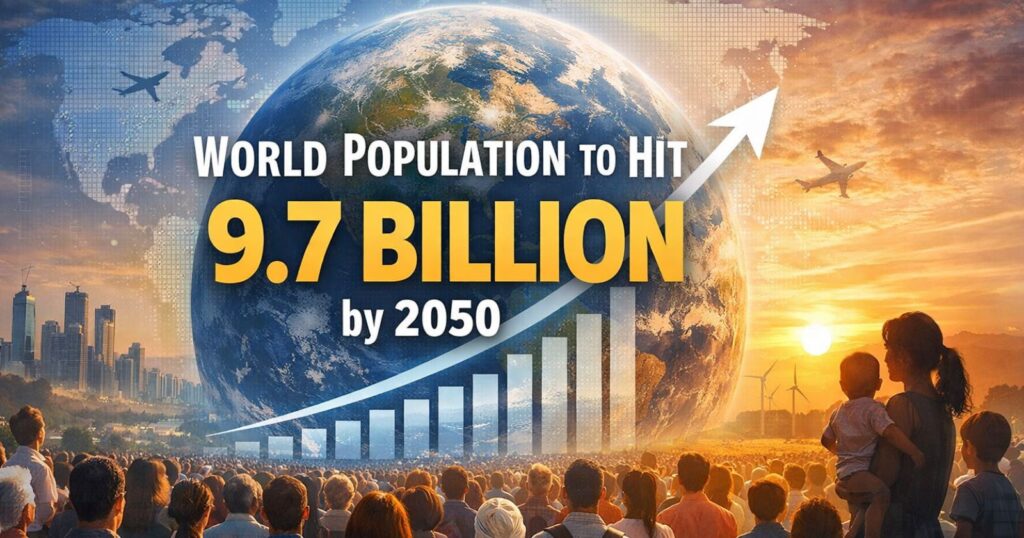
| Global population | 8.2 billion | approx. 9.7 billion |
| Global total fertility rate | 2.25 | Continued gradual decline |
| Population peak year | N/A | Projected mid-2080s at ~10.3 billion |
| Countries already past national peak | Approx. 25% of world population | Higher share expected |
Source: UN World Population Prospects 2024 revision. The 9.7 billion figure for 2050 is the UN’s medium variant projection, meaning it represents a central estimate rather than a certainty, since fertility, mortality, and migration assumptions all carry uncertainty that widens the further out the projection extends.
Where Will Population Growth Be Concentrated
Sub-Saharan Africa
By far the fastest growing major region and the primary engine of remaining global population growth through 2050 and beyond. Fertility rates remain well above replacement level across much of the region, and even as fertility gradually declines, population momentum, the large existing youth cohort now entering childbearing age, will keep total births elevated for decades.
South Asia
Still growing but with population momentum now doing more of the work than high current fertility, since fertility rates across most of South Asia, including India, have already fallen close to or below the replacement level of roughly 2.1 births per woman.
East Asia
Already contracting in China’s case and long past its peak in Japan’s, East Asia as a whole is expected to see continued population decline through 2050, driven by some of the lowest fertility rates recorded anywhere in the world.
Europe
Aging and low fertility continue to define Europe’s trajectory, with population decline offset only partially, and unevenly across countries, by immigration.
The Americas
A more mixed picture, with continued but slowing population growth in Latin America and immigration playing an increasingly central role in sustaining population growth across much of North America.
The Great Demographic Divide
The starkest way to summarize 2050’s population map is as a widening divide between countries still gaining population, overwhelmingly in Africa and parts of South Asia, and countries already losing it, overwhelmingly in East Asia and Europe. One quarter of the global population already lives in a country whose national peak has passed, and that share is expected to grow substantially by 2050 as additional countries, including several in Latin America and Southeast Asia, cross their own peak population thresholds.
The World Will Get Older
Global population aging is one of the most certain of all demographic projections, since the people who will be over 65 in 2050 have, with the exception of migration, already been born. Life expectancy gains continue to add to the older population even as declining fertility shrinks the younger cohort feeding into the workforce, together producing a rising median age nearly everywhere in the world, though the pace and starting point vary enormously between, for example, Niger’s very young population and Japan’s already elderly one.
Fertility Will Reshape the Population Map
Global fertility fell to 2.25 births per woman as of the UN’s 2024 revision, down from levels above 5 children per woman globally as recently as the 1960s, and further decline is projected through 2050. This global average, however, disguises an enormous range: Niger and a handful of other Sub-Saharan African countries remain above 6 children per woman, while South Korea sits below 0.8, meaning the countries at either extreme of the global fertility distribution are experiencing what amount to opposite demographic realities simultaneously.
Migration Will Matter More in Some Countries
The UN’s projection that 52 countries will rely on immigration as their primary driver of population growth by 2054 is one of the most significant findings in the 2024 revision, since it implies that natural increase, births exceeding deaths, will simply stop being sufficient to sustain population in an increasing number of countries over the coming three decades. This dynamic is already visible in Germany, Italy, and several other European countries, where immigration has offset, without fully reversing, the effect of sustained below replacement fertility.
The World Will Become More Urban
Urbanization continues to be one of the most consistent global demographic trends, with the world’s urban population share continuing to rise through 2050, driven overwhelmingly by growth in secondary and mid sized cities across Africa and Asia rather than by further growth in the world’s existing largest megacities, several of which have already begun to see their growth rates slow.
Climate Change and the 2050 Population Map
Climate pressure interacts with population distribution rather than existing separately from it. Water scarcity, coastal flooding, and extreme heat are all expected to influence internal migration patterns within affected countries over the coming decades, as detailed in World Bank Groundswell modeling projecting up to 216 million internal climate migrants by 2050 under a pessimistic scenario, though this figure could fall by as much as 80 percent under a scenario combining strong climate action with inclusive development.
What Happens to Countries That Lose Population
Labor shortages, rising healthcare and pension costs relative to a shrinking working age tax base, school closures, and rural depopulation are already visible consequences in Japan and parts of Eastern Europe, and are expected to intensify across an expanding list of countries through 2050 as more nations cross their own population peaks.
What Happens to Countries That Gain Population Rapidly
Rapid population growth, concentrated overwhelmingly in Sub-Saharan Africa, creates a different set of pressures: enormous demand for education and job creation to absorb a large and growing youth cohort, alongside urban infrastructure and housing needs that in many cases are already struggling to keep pace with current, let alone projected, population growth.
The Population Map of 2050 in One View
| Demographic Category | Representative Region | Trajectory Through 2050 |
|---|---|---|
| Rapid growth | Sub-Saharan Africa | Continued strong growth, driven by momentum and fertility |
| Moderate growth | South and Southeast Asia | Slowing growth as fertility approaches replacement |
| Stabilization | Latin America, parts of Middle East | Growth flattening toward a peak |
| Decline | East Asia | Continued contraction, led by China and Japan |
| Severe aging with partial migration offset | Europe | Decline moderated, not reversed, by immigration |
What Could Change This Forecast
Fertility projections carry the largest single source of uncertainty in any population forecast extending to 2050, since fertility rates have historically shifted more quickly, in both directions, than demographers expected in prior decades. Mortality improvements, migration policy shifts, conflict, and the pace of economic development in currently high fertility regions could all meaningfully alter the specific trajectory described here, even though the broad direction, continued African growth, continued East Asian and European contraction, and near universal population aging, is about as well supported as any long range demographic projection can be.
Key Findings
- Global population is projected to grow from 8.2 billion in 2024 to roughly 9.7 billion by 2050, before peaking near 10.3 billion in the mid-2080s.
- Global fertility has fallen to 2.25 births per woman as of 2024, down from over 5 children per woman globally in the 1960s.
- One quarter of the world’s population already lives in a country whose national population has peaked, a share expected to keep rising through 2050.
- 52 countries are projected to rely on immigration as their primary source of population growth by 2054.
- Sub-Saharan Africa will remain the dominant engine of global population growth through 2050 and well beyond.
- World Bank modeling projects up to 216 million internal climate migrants by 2050 under a pessimistic scenario, or as few as 44 million with strong climate action.
Frequently Asked Questions
1. What will the world’s population be in 2050?
The UN’s medium variant projection puts global population at roughly 9.7 billion by 2050, up from 8.2 billion in 2024, en route to a projected peak of about 10.3 billion in the mid-2080s.
2. Which country will have the largest population in 2050?
Current UN projections indicate India will remain the world’s most populous country, having already overtaken China in the early 2020s, a position it is expected to hold well past 2050 given China’s ongoing population decline.
3. Which countries will lose population by 2050?
China, Japan, and most of Central, Southern, and Eastern Europe are projected to continue losing population through 2050, extending declines that in several cases are already well underway.
4. Where will most population growth occur?
Sub-Saharan Africa will remain by far the largest single source of global population growth through 2050, driven by both continued above replacement fertility and substantial population momentum from its current young population.
5. Will the world be older in 2050?
Yes, close to universally. Rising life expectancy combined with declining fertility is expected to push median age upward in nearly every country by 2050, though starting points and the pace of aging vary enormously by region.
6. How will migration change population by 2050?
The UN projects that 52 countries will depend on immigration as their primary driver of population growth by 2054, reflecting how widespread below replacement fertility has become across large parts of Europe, East Asia, and elsewhere.
7. How urban will the world be in 2050?
The global urban population share is projected to keep rising through 2050, with growth concentrated in secondary and mid sized cities across Africa and Asia rather than further expansion of the world’s largest existing megacities.
8. Will climate change change where people live?
It is expected to influence internal migration patterns within affected countries, particularly around water scarcity, coastal flooding, and extreme heat, though the scale of that effect depends heavily on future climate policy and adaptation investment.
9. Is a global population decline coming by 2050?
No. Global population is still projected to be growing through 2050 and beyond, even though many individual countries will already be well into sustained decline by that point.
10. How reliable are population projections to 2050?
Reasonably reliable for the total number, since most people who will be alive in 2050 have already been born, but far less certain for fertility assumptions in currently high fertility regions, which represent the single largest source of uncertainty in any 2050 population projection.
Sources
- United Nations, World Population Prospects 2024 revision
- United Nations Department of Economic and Social Affairs, Population Division
- World Bank, Groundswell climate migration modeling, 2021