Key Findings
- The Maldives had 515,132 residents at the 2022 census, up 28.1% from 2014, with 25.7% of them foreign nationals.
- National density is about 1,729 per square kilometer, but 41% of residents live in the Malé area on roughly 8.3 square kilometers, a density near 25,500 per square kilometer.
- About 10% of residents live on resort islands and 3% on industrial islands, so a meaningful share of the 298 square kilometers of land is not used for permanent family housing.
- Nearly half of Maldivian residents in Malé, 76,014 of 157,254 (48%), were born in an atoll, which shows how strongly the capital draws internal migrants.
- The 65 and over population grew 27.6% from 2014 to 2022 to 20,850, almost the same rate as the total population, leaving its share at about 4%.
- Households averaged 5.5 people across 94,424 households in 2022, about 3.2 times the 1990 count.
- Tourism contributes 22.5% of GDP, and unemployment was 3% overall (5.1% among Maldivians) in recent census-based data.
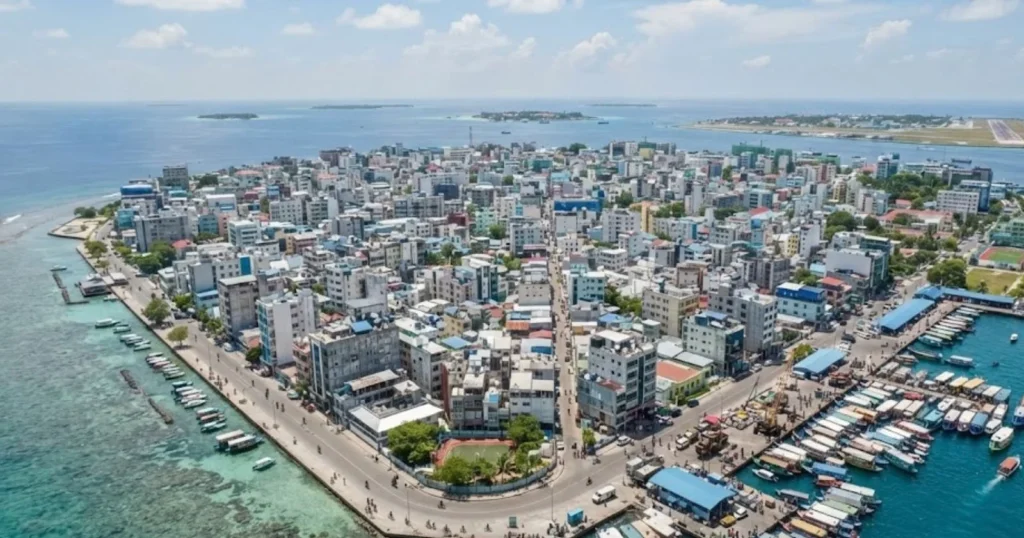
The Maldives has a national population density of about 1,729 people per square kilometer, which already ranks among the highest of any country. Yet that figure understates how crowded daily life is for a large share of Maldivians. The 2022 census found that 41% of the country’s residents live in the Malé area, a cluster of four islands covering roughly 8.3 square kilometers, which is under 3% of the national land area. Divide the same people by that smaller denominator and density rises to about 25,500 per square kilometer, more than fourteen times the national average.
Both numbers are correct. They answer different questions. A country of 298 square kilometers scattered across roughly 90,000 square kilometers of ocean cannot be described with a single density figure, because the land that people actually occupy is a small and uneven fraction of the total. This article separates total land, inhabited land and the Malé urban core, then shows how internal migration, tourism employment and land reclamation produced one of the most concentrated settlement patterns in the world.
Maldives Population and Density at a Glance
The Maldives Bureau of Statistics counted 515,132 residents in its September 2022 census, of whom 382,639 were Maldivian nationals and 132,493 were foreign residents. That total is 28.1% higher than the 2014 count, an increase of roughly 113,000 people in eight years.
| Metric | Figure | Year / Source |
|---|---|---|
| Resident population (census) | 515,132 | 2022 Census, Maldives Bureau of Statistics |
| Resident Maldivians | 382,639 (74.3%) | 2022 Census |
| Resident foreign nationals | 132,493 (25.7%) | 2022 Census |
| UN-based estimate for 2022 | 524,106 | Worldometer, UN-derived |
| Total land area | 298 km² | Maldives Bureau of Statistics / reference sources |
| National density | ~1,729 per km² (census); ~1,772 per km² (2026 estimate) | 2022 / 2026 |
| Inhabited islands enumerated | 186 to 187 | 2022 Census |
| Share of residents in the Malé area | 41% | 2022 Census |
| Households | 94,424 (average size 5.5) | 2022 Census |
| Median age | ~33 years | 2026 estimate, UN-based |
| Urban share | ~40% | 2026 estimate, UN-based |
| Total fertility rate | 1.6 to 1.7 children per woman | 2022 estimates |
| Population aged 65 and over | 20,850 (4%) | 2022 Census |
The census figure and the UN-based figure differ by about 8,974 people, or 1.7%, for the same year. That gap is small by Pacific and Indian Ocean standards, and it reflects different treatment of migrant workers whose residence status changes frequently, rather than a counting failure.
Why National Population Density Can Be Misleading
Density is a ratio, and the answer depends entirely on the denominator. The Maldives illustrates this more sharply than almost any other country, because the same population produces very different results depending on which area is used.
| Denominator | Area | Population Used | Resulting Density |
|---|---|---|---|
| Total national land area | 298 km² | 515,132 | ~1,729 per km² |
| Malé capital city administrative area | 11.22 km² | 211,908 | ~18,890 per km² |
| Malé area (Malé, Hulhumalé, Villimalé, Hulhulé) | ~8.3 km² | 211,908 | ~25,500 per km² |
| Hinnavaru island, Lhaviyani Atoll | ~1.2 km² (derived) | 5,000+ | 4,302 per km² |
| Madaveli island, Gaafu Dhaalu Atoll | 0.338 km² | ~1,219 (derived) | 3,607 per km² |
Two cautions apply. First, the 211,908 figure is the population of the whole Malé area, which is why it matches the 41% share of the national total; sources that attach it to a 1.9 square kilometer central island are mixing a larger population with a smaller area. Second, the 8.3 square kilometer figure comes from the Maldives Bureau of Statistics presentation of the Malé area and has not been cross-checked against an independent land survey in this article, so the 25,500 figure is best read as an order of magnitude.
The national figure also includes land that few people use as housing. Of the 298 square kilometers, a substantial portion consists of uninhabited islands and resort islands. The census records that about 10% of residents live on resort islands and 3% on industrial islands, mostly as workers, so a large share of the country’s land supports tourism rather than permanent settlement.
Malé and Extreme Population Concentration
Malé is the capital, the commercial center and the point through which most government services, ports and airline traffic pass. The Malé area held about 211,908 residents in 2022, according to the Bureau of Statistics, which is 41% of the entire resident population on less than 3% of the country’s land.
This concentration has built up quickly. Households nationally reached 94,424 in 2022, about 3.2 times the 1990 count, and Malé alone holds roughly 45% of them. With little room to spread horizontally, the city has grown upward and outward by reclamation. Hulhumalé, built on reclaimed land beginning on October 16, 1997, now covers about 4 square kilometers at a density near 16,000 per square kilometer, and a second reclamation phase was launched on January 15, 2015. Most Malé residents live in small houses or apartment blocks, often shared with extended family or roommates.
Housing pressure in the capital is therefore a land problem before it is a construction problem. Every additional resident either occupies a taller building, a reclaimed plot or a shared room.
Population Distribution Across the Atolls
The census describes the Maldives as one of the most spread-out countries in the world, with residents counted on 186 to 187 inhabited islands. Outside Malé, most inhabited islands are small, and many are close to full by the measure of land available per person.
| Settlement Type | Share of Resident Population (2022) |
|---|---|
| Malé area (Malé, Hulhumalé, Villimalé, Hulhulé) | 41% |
| Administrative (inhabited local) islands | 46% |
| Resort islands | 10% |
| Industrial islands | 3% |
The 46% living on local inhabited islands is spread across atolls that range from a few hundred residents to several thousand. Felidhoo in Vaavu Atoll had 620 people in 2022, while Velidhoo in Noonu Atoll had 1,832 and Hinnavaru in Lhaviyani Atoll had more than 5,000. Hinnavaru’s density of 4,302 per square kilometer is roughly 2.5 times the national average, which shows that dense settlement is not limited to the capital.
Distance compounds the pattern. Hinnavaru lies about 146 kilometers from Malé, Velidhoo about 167 kilometers and Madaveli about 415 kilometers, so services located in the capital are a boat or flight away for most atoll residents.
Urbanization and Internal Migration
Movement toward Malé is the country’s defining internal migration flow. The Bureau of Statistics census data show that 76,014 of the 157,254 Maldivian residents of Malé, or 48%, were born in an atoll. In other words, nearly half of the Maldivians living in the capital moved there from elsewhere, and 17 of the 20 atolls have fewer residents than the number of people born in them.
Education, specialist healthcare, employment and government services concentrated in Malé explain most of the pull. Estimates put the national urban share at around 40% in 2026, close to the 41% living in the Malé area, which indicates that the capital region is effectively the country’s urban sector.
Age Structure and Household Characteristics
The Maldives is still a relatively young country, though it is aging. The median age is about 33 years in 2026 UN-based estimates, up from 30.3 in the 2022 reference year. The resident Maldivian population aged 15 to 24 accounted for roughly 19% of Maldivians in 2024, and the Bureau of Statistics notes that the median age of the resident Maldivian population is rising.
Residents aged 65 and over numbered 20,850 in 2022, or about 4% of the population, up from 16,337 in 2014. That is an increase of 4,513 people, or 27.6%, almost exactly matching the 28.1% growth of the whole population, so the elderly share has held steady at about 4% rather than climbing. Fertility has declined to roughly 1.6 to 1.7 children per woman, below replacement level, with a 2022 birth rate near 15.5 per 1,000 against a death rate near 4.2 per 1,000.
Household size is large, at an average of 5.5 people across 94,424 households, which reflects both extended family living and the shared accommodation common among migrant workers in Malé. The resident population is also heavily male, with 311,994 men (61%) and 203,138 women (39%), a skew created largely by the foreign workforce.
Tourism and Population Geography
Tourism, at 22.5% of GDP, is the country’s largest single industry and a direct driver of how population is arranged. Resort islands are mostly closed to permanent settlement but employ large numbers of staff who are counted as residents of those islands, which accounts for the roughly 10% of the census population recorded there. Construction, hospitality and services in Malé and Hulhumalé draw both Maldivians from the atolls and foreign workers, many of whom are counted in the 25.7% foreign share.
This produces three distinct population geographies in one country: resort islands with large temporary workforces and few families, local inhabited islands with family-based communities, and the Malé area with a mix of both plus the administrative and commercial economy. Unemployment was 3% overall and 5.1% among Maldivians in the census-based figures, so the capital’s pull is driven more by opportunity and services than by a lack of work elsewhere.
Housing and Infrastructure Pressure
Concentration of this scale puts pressure on housing, water, waste management and transport. Reclamation has been the main response, creating Hulhumalé and extending Malé’s usable land, but reclaimed land still has to be serviced and its housing priced for the people who need it. Within Malé, apartment density, shared rooms and large household sizes reflect the limits of what a small, fully built island can offer.
Comparisons with other dense places need care. Singapore, with about 6.11 million residents in June 2025 on roughly 740 square kilometers, has a national density near 8,300 per square kilometer, about 4.8 times the Maldivian national average. But Singapore’s figure covers an entire country, while the 25,500 figure for the Malé area covers a sub-national urban core. Comparing like with like, the Malé area is about three times denser than Singapore’s national average, though it should be compared with Singapore’s densest districts rather than the national figure.
Future Population Distribution
Several trends point toward continued concentration. Population grew 28.1% between 2014 and 2022, households are multiplying faster than the population, and almost half of Malé’s Maldivian residents arrived from the atolls. Declining fertility will slow natural growth, but migration into the capital region and the foreign workforce attached to tourism and construction remain strong drivers of where people live.
Planning choices therefore matter more than headline growth. Whether the government can shift activity toward other atoll hubs, extend reclamation, or raise the quality of services on inhabited islands will determine whether the share of residents in the Malé area continues to rise above 41%. The 2022 census is the latest full count, so any projection beyond it carries the uncertainty that comes with a population that includes a large and mobile foreign workforce.
Frequently Asked Questions
1. What is the population density of the Maldives?
Nationally, about 1,729 people per square kilometer using the 2022 census count and a land area of 298 square kilometers. UN-based 2026 estimates put it near 1,772. In the Malé area it is far higher, around 25,500 per square kilometer.
2. Why is Malé so densely populated?
Malé is the capital and the main center for government, healthcare, education, ports and commerce. About 41% of the national population lives in the Malé area on roughly 8.3 square kilometers, and reclamation projects such as Hulhumalé have added land to absorb continued migration from the atolls.
3. How many inhabited islands are there in the Maldives?
The 2022 census enumerated residents on 186 to 187 inhabited islands, with sources differing slightly on how the count is made. These include local inhabited islands, resort islands and industrial islands.
4. Where does most of the Maldives population live?
The largest share, 41%, lives in the Malé area. Another 46% lives on administrative inhabited islands across the atolls, 10% on resort islands and 3% on industrial islands.
5. How many people live in the Maldives?
The 2022 census counted 515,132 residents, including 382,639 Maldivians and 132,493 foreign nationals. A UN-based estimate for the same year was 524,106.
6. How many foreign residents does the Maldives have?
The 2022 census recorded 132,493 foreign residents, or 25.7% of the resident population. Many work in tourism, construction, and services.
7. Why can national density be misleading for the Maldives?
The national figure divides the population by all 298 square kilometers of land, including uninhabited and resort islands, so it hides the fact that settlement is concentrated on a small number of islands. Dividing by the Malé area alone gives a figure about fourteen times higher.
8. How does internal migration affect the Maldives?
Many Maldivians move from atolls to Malé for education, healthcare, and jobs. Census data show 48% of Maldivian residents of Malé were born in an atoll.
9. Is the Maldives population aging?
Slowly. The median age rose from about 30.3 in 2022 to about 33 in 2026 estimates, and fertility is around 1.6 to 1.7, but the 65 and over share was still only about 4% in 2022.
10. How does tourism shape where people live in the Maldives?
Tourism, at 22.5% of GDP, creates resort islands with large worker populations and few permanent families, and it draws labor to Malé and Hulhumalé. About 10% of residents were enumerated on resort islands in 2022.
Sources
- Maldives Bureau of Statistics, Population and Housing Census 2022, Summary and Table P5 (Resident Population by Island and Sex)
- Maldives Bureau of Statistics, World Population Day 2024 population dynamics summary
- Maldives Data Explorer (statsmaldives.org), census, economy and tourism statistics based on Census 2022 and the 2024 to 2025 Labour Force Survey
- United Nations, Department of Economic and Social Affairs, Population Division, World Population Prospects (UN-based estimates as presented by Worldometer, 2026)
- Wikipedia, Maldives, Malé, Hulhumalé, Hinnavaru, Madaveli, Felidhoo and Velidhoo (island-level census figures cross-referenced to Maldives Bureau of Statistics tables)
- Singapore Department of Statistics, Population Trends 2025 (comparison figures)