
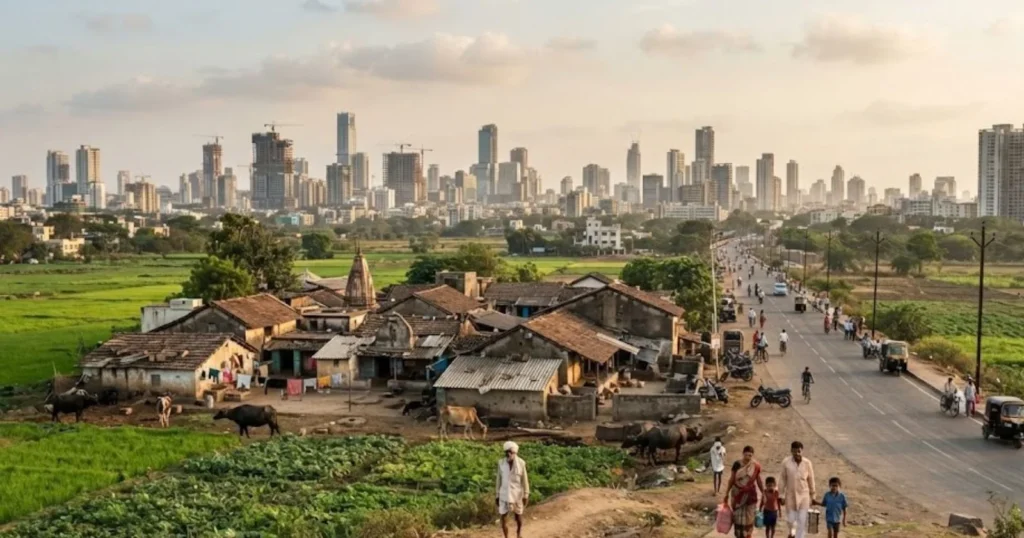
India is often described as a country in the middle of a rural to urban shift, but the shift is slower and more complicated than the headline suggests. At the 2011 census, 31.1 percent of the population was urban and 68.9 percent was rural. The country was still majority rural, yet the number of towns had risen sharply and the absolute increase in the urban population exceeded the absolute increase in the rural population for the first time since independence.
Three different processes drive the urban count, and they are frequently confused. Natural increase adds people through births in cities. Migration moves people from villages and other towns. Reclassification turns places that were rural into official towns when they meet census criteria. Rural populations, meanwhile, are not shrinking everywhere. Many villages are still growing, some are declining, and a large group of settlements sit between the two categories.
How India Defines Rural and Urban Population
The Census of India defines urban areas in two ways.
Statutory towns are places with a municipal corporation, municipality, cantonment board or notified town area committee, regardless of size or economic structure.
Census towns are places that meet three criteria: a population of at least 5,000, at least 75 percent of the male main working population engaged in non-agricultural pursuits, and a population density of at least 400 persons per square kilometer. They are governed as villages but counted as urban for the census.
Everything else is rural. Urban agglomerations combine a town with adjoining outgrowths. Classification can change between censuses, so a place can move from rural to urban purely because it crossed a threshold. State governments also decide whether to convert a village into a statutory town, and some resist because urban local bodies change taxation, scheme eligibility and politics.
| Category | Definition | Governance | Example of counting issue |
|---|---|---|---|
| Statutory town | Notified urban local body | Municipality | Counted urban even if small |
| Census town | Meets size, density and occupation tests | Village panchayat | Counted urban but governed as rural |
| Urban agglomeration | Town plus outgrowths | Mixed | Boundaries differ from city limits |
| Rural | Not meeting urban definition | Panchayat | Includes peri urban areas |
| Peri urban | Rural and urban features mixed | Panchayat or edge of municipality | Often unserved |
Urban population estimates differ between datasets because of definitions. The Census uses administrative and occupation based tests. United Nations World Urbanization Prospects uses national definitions for some editions and a standardized method called the Degree of Urbanisation for others, which can give a much higher share for India. Comparisons should always state the definition.
How India’s Rural and Urban Population Has Changed
India has urbanized steadily but slowly. The 1951 census counted about 17.3 percent urban. The share was 27.8 percent in 2001 and 31.1 percent in 2011.
| Census year | Urban population (millions) | Urban share | Rural population (millions) | Rural share |
|---|---|---|---|---|
| 1951 | 62.4 | 17.3% | about 298 | 82.7% |
| 2001 | 286.1 | 27.8% | 742.6 | 72.2% |
| 2011 | 377.1 | 31.1% | 833.1 | 68.9% |
Between 2001 and 2011, the urban population grew about 31.8 percent and the rural population about 12.3 percent. The urban population increased by about 91 million and the rural by about 90 million, the first decade in which the urban increase matched or exceeded the rural. Rural India added the same number of people as urban India, so the rural population still grew in absolute terms.
The Census is a count taken on a reference date, while later numbers come from projections and surveys. The Technical Group on Population Projections (2020) and UN projections give estimates for later years, but they use different definitions and baselines. Historical census counts should be kept separate from recent estimates.
Which States Are Urbanizing Fastest?
States differ widely. Delhi was almost entirely urban at 97.5 percent in 2011. Goa was 62.2 percent urban, Mizoram 52.1 percent, Tamil Nadu 48.4 percent, Kerala 47.7 percent, Maharashtra 45.2 percent, Gujarat 42.6 percent and Karnataka 38.7 percent. Punjab was 37.5 percent, Haryana 34.9 percent and West Bengal 31.9 percent. At the other end, Bihar was 11.3 percent urban, Odisha 16.7 percent, Assam 14.1 percent, Uttar Pradesh 22.3 percent, Rajasthan 24.9 percent and Madhya Pradesh 27.6 percent.
| State | Urban share, Census 2011 | Pattern |
|---|---|---|
| Delhi | 97.5% | City state |
| Goa | 62.2% | Small, tourism and services |
| Tamil Nadu | 48.4% | Large industrial and towns network |
| Kerala | 47.7% | Dense settlement, many census towns |
| Maharashtra | 45.2% | Metros plus mid size cities |
| Gujarat | 42.6% | Industrial cities |
| Karnataka | 38.7% | Bengaluru centered |
| Punjab | 37.5% | Agricultural market towns |
| West Bengal | 31.9% | Kolkata plus many towns |
| Madhya Pradesh | 27.6% | Few large cities |
| Rajasthan | 24.9% | Growing mid size towns |
| Uttar Pradesh | 22.3% | Large absolute urban population, low share |
| Odisha | 16.7% | Low but growing |
| Assam | 14.1% | Low |
| Bihar | 11.3% | Lowest among large states |
The urban population share and the urban growth rate are different things. Uttar Pradesh has a low share but a very large absolute urban population, because the state is huge. Bihar has the lowest share but fast growth of small towns from a low base. Kerala’s share rose largely because rural settlements met census town criteria, not only because people moved to cities.
Why India’s Cities Are Growing
Urban growth has three components. Studies of 2001 to 2011 by demographers, including work using Census data, found that natural increase accounted for roughly 40 to 45 percent of urban growth, with reclassification and net migration each accounting for roughly a quarter to a third. The exact split depends on method, and all estimates should be treated as approximations.
| Component | Mechanism | Rough contribution 2001 to 2011 | Policy implication |
|---|---|---|---|
| Natural increase | Urban births exceed deaths | About two fifths | Urban health and schools needed for existing residents |
| Reclassification | Villages become towns | About one third | Services must catch up with new status |
| Net migration | People move to towns | About one quarter | Housing and jobs for newcomers |
Migration is often overstated in public discussion. Many movers go from one village to another, often at marriage. Rural to urban moves are a smaller share than all migration. Interstate migration, from states such as Bihar and Uttar Pradesh to Maharashtra, Gujarat, Delhi and the south, feeds large cities and industrial towns.
Urban fertility is lower than rural fertility. SRS 2024 reports urban TFR at about 1.5 and rural at about 2.1. As fertility falls, natural increase will contribute less to urban growth, which raises the relative role of migration and reclassification.
Are India’s Villages Losing Population?
India’s rural population grew by roughly 90 million between 2001 and 2011. Rural decline in absolute terms is rare at the national level, but it is found in certain places.
Slower growth is not decline. Rural growth rates have fallen with fertility, and many villages are growing slowly. Some are shrinking because of out-migration, aging, falling household size and changing work. Hill districts in Uttarakhand, Himachal Pradesh and parts of Odisha, Kerala and Maharashtra show village level decline. Uttarakhand’s Rural Development and Migration Commission, set up in 2017, reported that well over a thousand villages had no permanent residents and many more had very few.
At the same time, many villages near cities and highways grow fast. Large areas of Bihar, Uttar Pradesh and eastern India still have rising rural populations because fertility is higher. Examples of shrinking hamlets cannot be generalized, and national claims need district and village data.
| Pattern | Typical place | Drivers |
|---|---|---|
| Growing villages | Plains of Bihar, Uttar Pradesh, peri urban fringes | Natural increase, access to towns |
| Slow growth villages | Much of rural India | Falling fertility, some out-migration |
| Declining villages | Hill districts, some drylands | Out-migration, aging, loss of services |
| Abandoned villages | Remote hill areas | Combined causes |
Smaller households and aging matter. Rural households have fewer members, and older residents make up a growing share in areas of heavy out-migration. These patterns can cause a village to lose services even when it keeps most of its population.
Work, Education, and the Rural Urban Divide
Rural and urban India differ in employment, education and services, but each group is internally diverse. In PLFS 2023 to 24, agriculture employed about 46 percent of all workers, and a much higher share of rural workers. Rural nonfarm work, including construction, small manufacturing, trade and services, has been rising. Urban workers are concentrated in services, manufacturing, trade and construction.
Educational access, health facilities, electricity, water and sanitation are generally better in urban areas, though slums and informal settlements have major gaps. Household income and consumption are higher in cities on average, though cost of living is higher too. Female labor force participation is higher in rural areas than urban areas, largely because of agricultural work and self-employment.
| Dimension | Rural | Urban |
|---|---|---|
| Main employment | Agriculture, rural nonfarm, construction | Services, manufacturing, trade |
| Fertility (SRS 2024) | About 2.1 | About 1.5 |
| Female participation | Higher, mostly self-employment | Lower |
| Service access | Improving but uneven | Better on average, with slum gaps |
| Housing | Mostly owned, informal | Rented, informal, costly |
Generalizing about rural or urban residents is risky. Rural Kerala and rural Bihar differ more than rural and urban Kerala, and slum residents in a metro may have worse conditions than prosperous villagers.
The Growth of Peri Urban Settlements and Census Towns
Census towns are the fastest growing part of the urban system. Their number grew from 1,362 in 2001 to 3,894 in 2011, while statutory towns went from 3,799 to 4,041. In total, India had 7,935 towns in 2011.
Many census towns are large villages on the edge of cities or along highways, with rapid growth of non-farm work. They are often governed by panchayats that lack the powers and finances of municipalities. That affects planning for roads, drainage, solid waste, water, land use and transport. Conversions to statutory status can bring more funds and capacity, but also higher taxes and loss of rural scheme eligibility, which creates resistance.
| Settlement type | Counted in 2011 | Governance | Planning issue |
|---|---|---|---|
| Statutory towns | 4,041 | Urban local body | Funds and capacity vary |
| Census towns | 3,894 | Panchayat | Urban conditions, rural governance |
| Peri urban villages | Counted as rural | Panchayat | Unplanned growth, land conversion |
Functional urbanization, the actual pattern of economic activity, is wider than the official urban area. Many rural residents commute to towns, and many urban businesses depend on rural labor and markets.
How Rural and Urban Population Change Will Affect Infrastructure
Population change translates into infrastructure needs.
Housing
Cities need more affordable rental housing, especially for migrants. Rural housing programs address gaps and need to include peri urban settlements.
Transport
Growing cities need public transit, and small towns need road connectivity. Rural connectivity under the Pradhan Mantri Gram Sadak Yojana has expanded road access, though quality and maintenance remain issues.
Water and sanitation
Urban water supply, sewage treatment and solid waste are major gaps. Rural programs such as Jal Jeevan Mission and Swachh Bharat Mission raised coverage, with sustainability as the next challenge.
Schools and hospitals
Urban areas need more schools and clinics for growing populations, while rural areas with shrinking populations face the problem of keeping services viable.
Employment centers
Industrial corridors and small town enterprises can reduce long distance migration.
| Infrastructure | Urban challenge | Rural challenge |
|---|---|---|
| Housing | Cost, informality | Quality, materials |
| Transport | Congestion, transit | Connectivity, maintenance |
| Water and sanitation | Capacity, sewage | Reliability, quality |
| Schools | Overcrowding in cities | Viability in shrinking villages |
| Hospitals | Quality and cost | Distance, staffing |
| Jobs | Formal job creation | Nonfarm diversification |
Urban local bodies have limited revenue, and municipal budgets are small relative to needs. The 15th Finance Commission increased grants to urban and rural local bodies, but capacity gaps remain.
India’s Rural Urban Population Outlook
Outlooks depend heavily on definitions. The United Nations World Urbanization Prospects 2018 projected India’s urban share to rise from about 34 percent in 2018 to about 53 percent in 2050 using national definitions. The 2025 edition changed methodology, and results differ substantially, so readers should check the edition and definition before comparing. Official Indian projections use census based classification.
Key uncertainties include reclassification of census towns, the pace of rural to urban migration, fertility trends and economic structure. Will the urban population overtake the rural? On census definitions, probably not before the middle of the century, but using broader functional definitions, India may already be more urban than official figures suggest.
| Scenario | Assumption | Urban share outcome |
|---|---|---|
| Slow urbanization | Limited reclassification, modest migration | Rises gradually |
| Reclassification driven | Many census towns become statutory towns | Rises faster in statistics |
| Migration driven | Strong job growth in cities | Rises with real population shift |
| Functional definition | Degree of urbanisation | Much higher than official share |
Census 2027 will provide the first update to town counts and classification since 2011, and many figures in this article should be revisited when tables appear.
Frequently Asked Questions
1. Does India have more rural or urban residents?
Census 2011 counted 833 million rural and 377 million urban residents, so India was still majority rural.
2. Will India’s urban population overtake its rural population?
Projections vary by definition. On official definitions, not before mid century in most projections, while broader definitions show higher urban shares sooner.
3. Why are some Indian villages losing population?
Out-migration, aging, falling household size and weak local services, especially in hill and remote areas.
4. What is a census town in India?
A place with at least 5,000 people, 75 percent of male workers in non-farm jobs and density of 400 per square kilometer, governed as a village but counted as urban.
5. Which Indian states are urbanizing fastest?
It depends on whether share or growth is measured. Kerala and Tamil Nadu have high shares, while Bihar and Odisha are low but changing from a small base.
6. Is urban growth only due to migration?
No. Natural increase and reclassification together account for a large share.
7. How many towns does India have?
7,935 in Census 2011, including 4,041 statutory towns and 3,894 census towns.
8. How fast did urban population grow between 2001 and 2011?
About 31.8 percent, versus about 12.3 percent for rural.
9. Are all villages shrinking?
No. Many are growing, especially in high fertility states and near cities.
10. What will change with Census 2027?
New counts, town classifications and migration tables.
Sources and Data Notes
- Census of India 2011, Primary Census Abstract and Urban tables; Office of the Registrar General.
- SRS Statistical Report 2024; Ministry of Statistics, PLFS 2023 to 24.
- United Nations, World Urbanization Prospects 2018 and 2025.
- Ministry of Housing and Urban Affairs; Finance Commission reports.
- Uttarakhand Rural Development and Migration Commission reports.
- Data note: decomposition of urban growth varies by study. Verify definitions across datasets.





