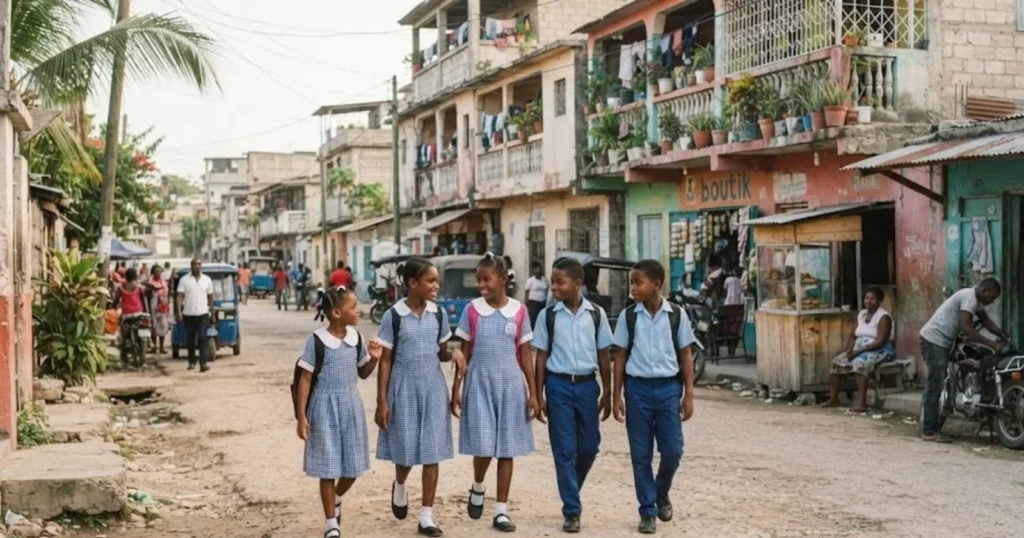
About 236,000 Haitians turn 15 every year. That figure, derived by dividing the UN-based estimate of the 15-to-19 age group (1,180,837 people) by five, is the size of the annual wave of young people reaching working age in a country of 12.04 million. In an economy that is growing, a cohort of that size would be a demographic asset: two thirds of the population is of working age and fewer than one in twenty is over 65. In Haiti, the same cohort enters a labor market that has shrunk for eight consecutive years, a capital city where armed groups control most of the metropolitan area, and a country where 1.47 million people, about 12% of the population, have been forced from their homes.
Haiti’s young age structure is real and measurable. So is the gap between the number of young people and the capacity of the economy, schools, health system and state to absorb them. This article treats those as two separate sets of numbers and shows how far apart they have moved. It does not treat population growth as the cause of Haiti’s poverty. The data point to conflict, economic contraction and weak institutions as the drivers, with demography determining how many people those failures reach.
Haiti Population and Demographic Snapshot
Haiti’s last census was held in 2003, so every current figure is an estimate. The UN’s mid-2026 estimate is 12,037,506. Other sources differ by a few hundred thousand: the World Bank put the 2025 population at about 11.9 million, and the Countrymeters model estimated 12.30 million at the start of 2026.
| Metric | Figure | Year / Source |
|---|---|---|
| Population | 12,037,506 | Mid-2026, UN WPP 2024 |
| Last census | 2003 (listed as 8,812,245) | Wikipedia / national census |
| Annual growth rate | ~+1.1% | 2026, UN WPP 2024 |
| Population density | ~437 per km² | 2026, UN-based |
| Median age | 24.3 years | 2026, UN-based |
| Share aged under 15 | 30.4% | 2026, UN-based |
| Share aged 65 and over | 4.9% | 2026, UN-based |
| Total fertility rate | 2.55 to 2.6 children per woman | 2026 (UN); 2024 (PAHO) |
| Urban share | 62.4% | 2026, UN-based |
| Life expectancy at birth | 65.1 to 65.5 years | 2024 to 2026 |
| Internally displaced people | 1.47 million (~12%) | May 2026, IOM / World Bank |
| Poverty headcount, US$3.00 per day | 49.0% | 2025, World Bank |
The population has grown 3.7 times since 1950, from 3.27 million, and 45% since 2000, from 8.30 million. Against the 2003 census count it is up about 37%. Growth is slowing, though: the UN’s implied average pace falls from about 0.8% a year between 2026 and 2050 to about 0.06% between 2050 and 2100.
| Year | Population (UN) | Change From Previous Point | Note |
|---|---|---|---|
| 1950 | 3,265,707 | n/a | Estimate |
| 2000 | 8,303,151 | +154% | Estimate |
| 2026 | 12,037,506 | +45.0% | Estimate |
| 2050 | 14,710,862 | +22.2% | Projection |
| 2100 | 15,151,093 | +3.0% | Projection |
Haiti’s Young Population
The UN-based age structure for 2026 shows 30.4% of Haitians under 15, 64.7% aged 15 to 64 and 4.9% aged 65 or over. Sources vary: Countrymeters estimates 35.9% under 15, and a 2015 national estimate put the share at 36.2%, so the youth share has been falling, but it remains high.
| Age Group | Population (UN-based, 2026) |
|---|---|
| 0 to 4 | 1,220,820 |
| 5 to 9 | 1,220,688 |
| 10 to 14 | 1,214,865 |
| 15 to 19 | 1,180,837 |
| 20 to 24 | 1,106,577 |
Two features stand out. First, each five-year group of children is almost exactly the same size, about 1.22 million, which means annual births are no longer rising quickly. Second, the groups at ages 15 to 24 are only slightly smaller than the children behind them, so the number entering working age will stay near 240,000 a year for the next decade. The dependency ratio, derived from the age shares, is about 55 people under 15 or over 64 for every 100 of working age, a manageable figure by regional standards. The pressure comes from what happens to the working-age group, not from the dependency burden itself.
Fertility and Population Growth
Haiti has the highest fertility rate in the Caribbean on UN-based figures, at 2.55 children per woman in 2026, close to the 2.6 PAHO reported for 2024. That is only modestly above the replacement level of 2.1. Adolescent fertility has fallen 35.3%, from 76.1 births per 1,000 women aged 15 to 19 in 2000 to 49.3 in 2024.
Haiti’s growth rests mainly on natural increase. The UN’s 2026 yearly change of about 131,400 combined with net migration of negative 31,968 implies roughly 163,000 more births than deaths (a derived figure). That is a natural increase of about 13.6 per 1,000. Demographic momentum explains why growth continues even as fertility falls: the 1.2 million girls and boys in each current five-year group will become parents over the next two decades.
| Comparison, 2026 | Haiti | Dominican Republic |
|---|---|---|
| Population (UN) | 12,037,506 | 11,609,500 |
| Growth rate | +1.08% | +0.75% |
| Total fertility rate | 2.5 to 3.0 | ~2.4 |
| Median age | ~24 | ~28 |
| Change 2026 to 2050 | +22.2% | +11.9% |
| Remittances, share of GDP | ~17% (2024) | 9.7% (2025) |
The two countries share an island and are almost the same size in population, yet Haiti is projected to grow nearly twice as fast to 2050.
Education and the Young Population
Recent national education statistics are scarce, and the figures that exist predate the current crisis. PAHO reports a literacy rate of 83.0% in 2016, nearly identical for men (82.6%) and women (83.4%). World Bank analysis finds that only 78% of 15-year-olds will survive to age 60 and that more than one fifth of children are at risk of cognitive and physical limitations.
Violence has directly disrupted schooling. Human Rights Watch reported that violence and the occupation of school facilities by criminal groups disrupted the lives of 243,000 students and 7,500 teachers. Nearly half of the 1.4 million people displaced as of September 2025 were children, which implies a large cohort whose schooling has been interrupted. For this reason, the age data in this article should be read as a count of potential workers, not of educated or trained ones.
Employment and the Emerging Workforce
ILO-modeled unemployment was 14.9% in 2025. In 2023, women’s unemployment was 18.0% against 12.0% for men, according to PAHO. A headline unemployment rate understates the problem in an economy where much work is informal or subsistence-based and where many working-age people have left the labor force or been displaced.
The economic backdrop is the more important number. The World Bank reports that real GDP declined for an eighth consecutive year in 2026, after falling 2.7% in 2025, with a further 1.5% contraction estimated for 2026. With the population growing at about 1.1% a year, real output per person has therefore fallen every year, roughly 3.8% in 2025 and 2.6% in 2026 (derived). Inflation is 21.5%. A country that adds about 236,000 working-age people a year to an economy that contracts is not converting its age structure into growth.
Migration and the Haitian Diaspora
Migration data must be read carefully because the measures are not interchangeable. Migrant stock, ancestry and forced returns count different things.
| Measure | Figure | Year / Source |
|---|---|---|
| Haitian-born residents of the United States | ~859,000 | 2024, Migration Policy Institute |
| Haitian-born plus Haitian ancestry in the United States | ~1.4 million | 2024, MPI tabulation |
| Haitian migrants in the Dominican Republic | ~535,000 | Latest UN-based estimate, via MPI |
| Total emigrant stock | ~2.0 million (~17% of the resident population, derived) | UN-based, via MPI |
| Unauthorized Haitian immigrants in the U.S. | ~311,000 | Mid-2024, MPI |
| Forced returns to Haiti | 110,000+ | Since January 2026, IOM |
| Immigrants living in Haiti | ~20,000 (0.2%) | UN-based, via MPI |
The Haitian-born population in the United States rose 46% between 2010 (587,000) and 2024 (859,000). Remittances are the economic counterpart. Haiti received about US$4.1 billion in 2024, equal to roughly 17% of GDP, though estimates range from 15.5% to 17.0% because of a revision to the central bank’s series. The share peaked at 22.5% in 2020. Potential rollbacks of Temporary Protected Status and U.S. parole programs are cited by IOM as a threat to flows that exceed 15% of GDP.
Forced returns and displacement now run in the opposite direction. More than 110,000 Haitians were returned to the country in the first months of 2026 alone, many to areas where services have collapsed.
Urbanization and Port-au-Prince
The UN-based urban share is 62.4% in 2026, up from 61.7% in 2025. The size of Port-au-Prince depends entirely on the boundary used.
| Definition | Population | Share of National Population |
|---|---|---|
| Port-au-Prince city proper | 1,234,742 | ~10% |
| Metropolitan area (World Population Review) | 1,633,591 | 13.6% |
| Urban area (Worldometer, 2025) | 1,868,268 | ~15.5% |
| Urban area (PopulationStat) | 2,926,012 | ~24% |
Insecurity has reshaped the capital. Armed groups in the Viv Ansanm coalition control most of the metropolitan area and have expanded into three of the country’s ten departments, according to Human Rights Watch. IOM reported in June 2026 that the number of internally displaced people in Port-au-Prince passed 300,000 for the first time on record, after more than 18,000 people fled Cité Soleil within days. Because displacement is concentrated around the capital, the geographic distribution of the population is changing faster than any official estimate can track.
Poverty and Demographic Conditions
The poverty and hunger data show how far the economy has fallen behind demographic growth. They should not be read as evidence that population size causes poverty.
| Indicator | Figure | Year / Source |
|---|---|---|
| Poverty headcount at US$3.00 per day | 49.0% (44.6% in 2023) | 2025, World Bank |
| Population under US$3.65 per day | Over 66% | World Bank estimates, cited by HRW |
| People facing acute food insecurity | 5.83 million | March to June 2026, World Bank / IPC |
| Internally displaced people | 1.47 million | May 2026, IOM |
| Inflation | 21.5% | 2026, World Bank |
| Real GDP change | –2.7% (2025); –1.5% (2026 est.) | World Bank |
The causal chain runs from violence and institutional weakness to lost output, displacement and food insecurity, and only then to the number of people affected. A country with a stable economy and a similar age structure would face a different set of choices. In Haiti, the demographic structure raises the cost of the instability, because every year of lost output falls on a larger group of young people.
Health and Mortality
Haitian health indicators have improved over the long run but remain among the weakest in the hemisphere. Life expectancy rose 6.9 years between 2000 and 2024, from 58.2 to 65.1. Under-five mortality fell from 144.5 per 1,000 live births in 1990 to 52.8 in 2024.
| Indicator | Figure | Year / Source |
|---|---|---|
| Life expectancy at birth | 65.1 years | 2024, World Bank / PAHO |
| Life expectancy, women / men | 68.8 / 62.2 years | 2026, UN-based |
| Under-five mortality | 52.8 per 1,000 live births | 2024, UNICEF |
| Infant mortality | 39 (UNICEF) to 42.6 (UN-based) per 1,000 | 2024 to 2026 |
| Maternal mortality ratio | 350.4 per 100,000 live births | 2020, PAHO (12.3% lower than in 2000) |
| Children who died before age 5 | ~13,600 | 2024, Our World in Data |
| Share of newborns dying before age 15 | 6.1% | 2024, Our World in Data |
The risk is that these gains reverse. Human Rights Watch reports that displaced families often live in informal sites with little access to food, water, sanitation or health care, and it cites estimates that more than 6 million people, including 3.3 million children, needed urgent humanitarian assistance in 2025.
Haiti’s Demographic Future
The UN projects that Haiti’s population will reach 14.71 million in 2050 and 15.15 million in 2100. That makes Haiti the largest Caribbean population by mid-century, with about 32% of the 28-territory regional total in 2050 and 41% by 2100. The age structure will mature slowly. The working-age population will keep growing for decades even if fertility falls to replacement level, because the large cohorts now under 25 are still moving into their prime working years.
Whether that growth becomes a dividend depends on factors outside demography. A rising working-age share helps only if there are jobs, schools that produce skills, health systems that keep workers alive and an environment safe enough to invest in. The projections also carry specific assumptions: a continuing fertility decline and modest net emigration. Haiti’s displacement, forced returns and potential changes to U.S. immigration programs could alter both. For now the data show an opportunity measured in people, 236,000 new working-age Haitians a year, and a capacity gap measured in lost output, displaced families and hungry households.
Key Findings
- Haiti’s population is 12.04 million (UN, mid-2026), up 3.7 times since 1950 and projected to reach 14.71 million by 2050.
- About 236,000 people turn 15 each year, and the working-age share is 64.7%, with a dependency ratio of about 55 per 100.
- Real GDP has declined for eight consecutive years, so output per person has fallen even as the population grew about 1.1% a year.
- 1.47 million people (about 12%) were internally displaced as of May 2026, with more than 300,000 displaced inside Port-au-Prince.
- 49.0% of Haitians lived below the US$3.00 poverty line in 2025, up from 44.6% in 2023, and 5.83 million faced acute food insecurity.
- The Haitian-born population of the United States reached about 859,000 in 2024, up 46% since 2010, and remittances equal roughly 17% of GDP.
- Life expectancy of 65.1 years and under-five mortality of 52.8 per 1,000 show gradual long-run gains that the current crisis puts at risk.
Frequently Asked Questions
1. How young is Haiti’s population?
Haiti’s median age is about 24.3 years. On UN-based estimates 30.4% of the population is under 15 and only 4.9% is 65 or older.
2. What is Haiti’s population?
The UN estimates 12,037,506 in mid-2026. The World Bank put the 2025 figure at about 11.9 million. Haiti’s last census was in 2003, so all current numbers are estimates.
3. Why is Haiti’s population so young?
Fertility has stayed above replacement, at about 2.55 to 2.6 children per woman, and child survival has improved, so large birth cohorts have been added over several decades. Life expectancy of about 65 years keeps the older age groups small.
4. How does migration affect Haiti?
Emigration removes mostly working-age adults and generates remittances of about US$4.1 billion a year, about 17% of GDP. Since the start of 2026, more than 110,000 Haitians have been forcibly returned, adding pressure on already strained services.
5. What does Haiti’s young population mean for development?
It is a potential workforce of about 7.8 million people aged 15 to 64, but the economy has contracted for eight consecutive years. The benefit depends on jobs, schooling, health and security, not on the age structure alone.
6. How many people are displaced in Haiti?
IOM reported a record 1.47 million internally displaced people in May 2026, about 12% of the population, including more than 300,000 in Port-au-Prince.
7. What is Haiti’s fertility rate?
UN-based estimates put it at 2.55 for 2026, and PAHO reports 2.6 for 2024. That is the highest in the Caribbean but only modestly above the replacement level of 2.1.
8. How big is the Haitian diaspora?
About 859,000 Haitian-born people lived in the United States in 2024, and about 1.4 million had Haitian birth or ancestry. About 535,000 Haitian migrants live in the Dominican Republic, and the total emigrant stock is about 2.0 million.
9. What is Haiti’s poverty rate?
The World Bank estimates that 49.0% of Haitians lived below the US$3.00-a-day line in 2025, up from 44.6% in 2023. Over 66% lived below US$3.65 a day.
10. What will Haiti’s population be in the future?
The UN projects 14.71 million in 2050 and 15.15 million in 2100. Growth is expected to slow sharply after mid-century.
Sources
- United Nations, Department of Economic and Social Affairs, Population Division, World Population Prospects: The 2024 Revision (via Worldometer, StatisticsTimes and PopulationPyramids.org)
- World Bank, Haiti Country Overview and Haiti: Pathways to Growth Amid Rising Risks (2026); World Bank, World Development Indicators
- International Organization for Migration (IOM), Displacement Tracking Matrix reports (March and June 2026) and Haiti Crisis Response Plan 2026
- Human Rights Watch, World Report 2026: Haiti
- Migration Policy Institute, Haitian Immigrants in the United States (2022 and 2024 editions) and Haiti country profile
- Pan American Health Organization (PAHO), Haiti Country Profile; UNICEF DATA, Haiti; Our World in Data, Haiti health profile
- Countrymeters, Haiti population (2026); World Population Review and PopulationStat, Port-au-Prince population estimates
- Haitidocs.org and La Caribeña News summaries of World Bank, IDB and IFAD remittance data
- Wikipedia, Demographics of Haiti and Haitians (2003 census and diaspora figures cross-referenced against national and UN sources)