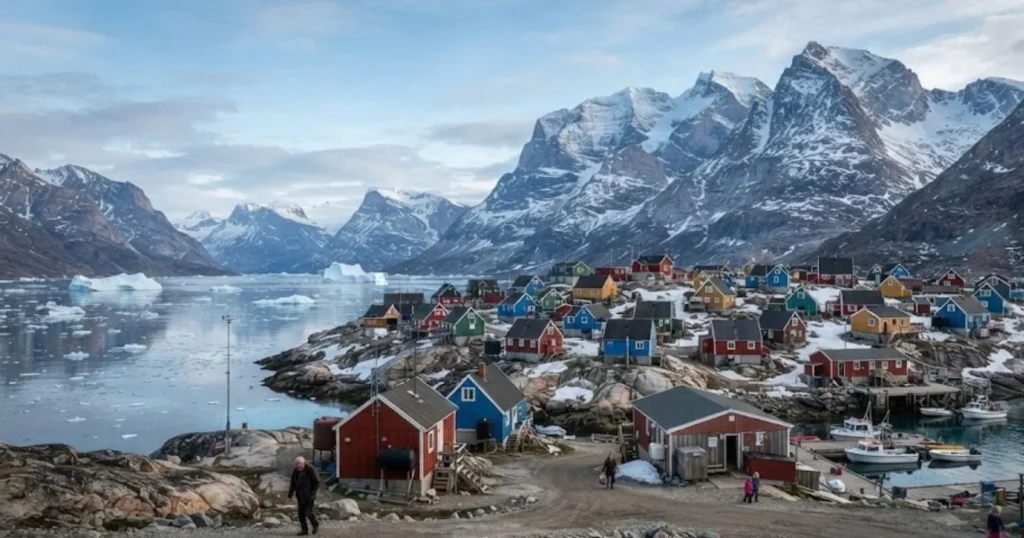
Greenland has roughly one resident for every 38 square kilometers of territory. On Statistics Greenland-based figures, about 56,700 to 56,900 people live across 2,166,086 square kilometers, an area larger than Mexico. Yet that number still overstates how spread out the population is, because about 80% of the territory is permanent ice sheet. On the 410,449 square kilometers that are ice-free, the figure is one person for every 7 square kilometers, and in practice almost everyone lives in a thin ring of coastal towns and settlements.
The more revealing statistic is about movement inside the country. Between 1980 and 2026, Nuuk added 11,221 residents, growing from 9,077 to 20,298. The national population grew by only 6,967 over the same period, which means everywhere outside Nuuk lost 4,254 people, a decline of 10.4%. Greenland’s small population is not simply a fact of climate and geography. It is also a story of a stagnant total and a steady concentration of people into one town.
Greenland Population at a Glance
Greenland’s figures come from register-based estimates published by Statistics Greenland, and different compilations of those figures differ by a few hundred people. The 1 January 2026 estimate is 56,740 in one compilation of Statistics Greenland data and 56,884 in another. Both are shown below where they differ.
| Metric | Figure | Year / Source |
|---|---|---|
| Population | 56,740 to 56,884 | 1 January 2026, Statistics Greenland-based |
| Population, 1 January 2024 | 56,699 (+90, +0.2%) | Statistics Greenland |
| Total area | 2,166,086 km² | Standard reference figure |
| Ice sheet area | ~1.71 to 1.76 million km² (79% to 81%) | CIA / other references |
| Ice-free area | 410,449 km² (19%) | Reference figure |
| Density, total territory | ~0.026 per km² | 2026, derived |
| Density, ice-free land | ~0.14 per km² | 2026, derived |
| Nuuk population | 20,298 (35.8%) | 1 January 2026 |
| Births / deaths | 830 / 462 | 2025 |
| Net migration | –340 | 2025 |
| Total fertility rate | 1.87 to 1.91 children per woman | 2022 to 2025 |
| Population aged 65 and over | 12.5% | 2024, CIA estimate |
| Life expectancy | ~71 to 74.5 years | 2024 estimates, source-dependent |
| Share of Inuit ancestry | ~88% to 90% | Recent estimates |
Greenland is an autonomous territory within the Kingdom of Denmark, not a sovereign state, which matters for the comparisons later in this article.
Greenland’s Enormous Territory
Greenland is the world’s largest island, and the territory measured by the standard reference figure is 2,166,086 square kilometers. About 1.71 million to 1.76 million square kilometers of that is covered by the ice sheet, which is 79% to 81% depending on the source. The difference comes from how ice-covered land is measured, and the 410,449 square kilometers of ice-free land is derived by subtracting the larger ice-sheet figure from the total.
Density therefore depends heavily on which area is used.
| Denominator | Area | Density (population 56,884) | Land per Person |
|---|---|---|---|
| Total territory | 2,166,086 km² | ~0.026 per km² | ~38 km² |
| Ice-free land | 410,449 km² | ~0.14 per km² | ~7.2 km² |
| Sermersooq municipality (24,643 people) | 575,300 km² | ~0.043 per km² | ~23 km² |
Sermersooq, the municipality around Nuuk, is the largest municipality in the world by area, and it still has the highest population in Greenland. Reporting a single national density figure of 0.026 per square kilometer is accurate but incomplete. The settled coastal strip is the relevant space, and the ice sheet is better understood as uninhabitable interior than as sparsely populated land.
Where Greenland’s Population Lives
Settlement is concentrated along the ice-free coast, mainly on the southwest. There are no roads between towns or settlements, so travel is by boat, helicopter, small aircraft and, in winter, dog sled in the north. A first road project connecting settlements has been reported as clearing its final planning hurdle, but the sources retrieved do not show it completed.
The municipality figures from Statistics Greenland show how much of the population sits in one place.
| Year | Greenland | Sermersooq | Sermersooq Share | Nuuk | Nuuk Share |
|---|---|---|---|---|---|
| 1980 | 49,773 | 15,528 | 31.2% | 9,077 | 18.2% |
| 1990 | 55,558 | 18,923 | 34.1% | 12,217 | 22.0% |
| 2000 | 56,124 | 19,549 | 34.8% | 13,445 | 24.0% |
| 2010 | 56,452 | 21,232 | 37.6% | 15,469 | 27.4% |
| 2020 | 56,081 | 23,123 | 41.2% | 18,326 | 32.7% |
| 2026 | 56,740 | 24,643 | 43.4% | 20,298 | 35.8% |
Another municipality, Qeqqata, had 9,179 residents in January 2025. Municipality figures for the remaining three municipalities were not retrieved and are left out.
Nuuk and Greenland’s Urban Population
Nuuk is the capital and by far the largest town, with 20,298 residents on 1 January 2026, and one of the smallest capital cities in the world. Its population has risen 124% since 1980, while Sermersooq as a whole has grown 59%, from 15,528 to 24,643. About 35.8% of Greenlanders live in Nuuk and 43.4% in the Sermersooq municipality that contains it.
| Change, 1980 to 2026 | 1980 | 2026 | Change | % Change |
|---|---|---|---|---|
| Greenland | 49,773 | 56,740 | +6,967 | +14.0% |
| Sermersooq municipality | 15,528 | 24,643 | +9,115 | +58.7% |
| Nuuk | 9,077 | 20,298 | +11,221 | +123.6% |
| Rest of Greenland, excluding Sermersooq | 34,245 | 32,097 | –2,148 | –6.3% |
| Rest of Greenland, excluding Nuuk | 40,696 | 36,442 | –4,254 | –10.4% |
All of the net growth in Greenland since 1980 has been in and around Nuuk. Services, schools, employment and transport links concentrate there, which is the same pattern seen in other small island and Arctic populations, though the sources retrieved here do not break down the reasons for individual moves.
Why Greenland Has Such a Small Population
The physical explanation is straightforward. About four fifths of the territory is permanent ice, the ice-free land is a narrow coastal margin cut by fjords, and communities are connected only by sea and air. The demographic history adds to it. Greenland’s population grew from about 21,000 in 1945 to about 30,000 in 1958 as birth rates reached 47.2 per 1,000 and fertility reached 6.8 children per woman, a rapid expansion that prompted a highly controversial Danish policy response, according to the Demographics of Greenland entry. By 1980 the population was 49,773.
Growth has been almost flat since. The population grew 11.6% in the 1980s (55,558 by 1990), then 1.0% in the 1990s, 0.6% in the 2000s, fell 0.7% in the 2010s and has risen 1.2% since 2020. The ceiling on growth is not a shortage of births. Greenland’s fertility of about 1.9 is below replacement but births still exceed deaths. The binding factor is emigration.
| Decade | Start | End | Change |
|---|---|---|---|
| 1990 to 2000 | 55,558 | 56,124 | +1.0% |
| 2000 to 2010 | 56,124 | 56,452 | +0.6% |
| 2010 to 2020 | 56,452 | 56,081 | –0.7% |
| 2020 to 2026 | 56,081 | 56,740 | +1.2% |
Greenland’s Population by Age and Sex
Greenland’s resident population is notably male. At the end of 2025 there were 30,125 men (53.0%) and 26,759 women (47.0%), a surplus of 3,366 men and a ratio of about 113 men for every 100 women. The sources retrieved do not explain the imbalance, but an older age breakdown shows that among residents aged 65 and over there are 0.84 men per woman, so the imbalance lies in the younger age groups.
The population is aging slowly. The 65-and-over share was about 10.4% in a 2020 estimate and 12.5% in a 2024 estimate, though the two come from different editions and should be read as an indication of direction. Life expectancy is lower than in the Nordic countries: Statistics Greenland-based figures give 69.3 years for men and 73.9 for women, while a CIA estimate for 2024 gives 71.8 and 77.3, a total of 74.5. The gap between the sources is 2.5 years for men and 3.4 years for women, so any single figure should be labeled with its origin.
Migration and Population Change
Greenland’s population is held roughly constant by two opposing flows. In 2025 there were 830 births and 462 deaths, a natural increase of 368, while net migration was negative 340. That leaves population change at plus 28 for the year. The 2023 net migration figure was negative 318, and the CIA estimate for 2025 is negative 4.82 per 1,000, about 270 people, so net outflow of 300 to 340 people a year appears persistent.
Immigrants made up 10.4% of residents in 2024. Reports note a significant increase in immigration from Asia, especially the Philippines, Thailand and China. The sources retrieved do not break down where emigrants go, so this article does not name destinations.
Small Settlements and Population Concentration
Outside the main towns, the population is organized into very small communities. Kapisillit had 43 residents in 2024 and Tasiusaq in the south had 42 in 2025. Most towns and settlements in southern Greenland have shown negative growth over two decades, with many settlements depopulating rapidly. Settlements in the northern half of the island have fared differently: Innaarsuit, where a Royal Greenland plant processes halibut, grew by nearly half relative to its 1990 level.
The challenge for communities of 40 to 100 people is not only demographic. Without roads, each depends on regular ship, helicopter or air links, and a loss of a few families can change whether a school or shop remains viable. The data in this article show the depopulation, not the service decisions that follow from it.
Greenland’s Economic Geography and Population
The sources retrieved for this article do not include employment, income or sector data, so it does not quantify the economy. What the settlement examples indicate is a livelihood pattern tied to place: hunting, fishing and tourism in Kapisillit, and fish processing in Innaarsuit, alongside public-sector and service employment concentrated in the larger towns. Economic geography and population geography run in the same direction, toward fewer, larger centers.
Greenland Population Outlook
An official projection for Greenland was not retrieved for this article, so the outlook below is arithmetic from observed flows rather than a forecast. In 2025 natural increase of 368 almost exactly offset net emigration of 340. If fertility stays near 1.9 and the 65-and-over share keeps rising, deaths will gradually catch up with births, and net emigration of around 300 a year would then produce a slow decline. If emigration eased or immigration from Asia increased, the population would be stable or grow slightly.
| Comparison | Status | Population Density |
|---|---|---|
| Greenland | Autonomous territory (Denmark) | ~0.026 per km² |
| Northern Territory, Australia | Australian territory | ~0.18 per km² |
| Mongolia | Sovereign state | ~2.2 per km² |
Greenland’s density is about seven times lower than that of Australia’s Northern Territory and about 85 times lower than Mongolia’s, a sovereign state. Even on ice-free land alone, Greenland’s 0.14 per square kilometer is about sixteen times lower than Mongolia’s national figure. The comparisons use total territory for each place and should not be read as like-for-like, since the usable share of land differs.
Key Findings
- Greenland has about 56,700 to 56,900 residents on 2,166,086 square kilometers, or one person per 38 square kilometers of territory and one per 7 square kilometers of ice-free land.
- About 79% to 81% of the territory is ice sheet, leaving 410,449 square kilometers of ice-free land.
- Nuuk has grown 124% since 1980 (9,077 to 20,298) and holds 35.8% of the population, while everywhere outside Nuuk has lost 4,254 people (10.4%).
- The national population grew only 14.0% in 46 years, with growth of 0.6% in the 2000s and a 0.7% fall in the 2010s.
- In 2025 births exceeded deaths by 368, but net migration of negative 340 cancelled it, leaving growth of 28.
- Men outnumber women 30,125 to 26,759 (53.0% to 47.0%), a ratio of about 113 to 100.
- Life expectancy is estimated at 69.3 years for men and 73.9 for women on Statistics Greenland-based figures, and about 71.8 and 77.3 in a CIA estimate.
Frequently Asked Questions
1. How many people live in Greenland?
About 56,700 to 56,900 on 1 January 2026, depending on the compilation of Statistics Greenland data. The figure for 1 January 2024 was 56,699.
2. Why is Greenland so sparsely populated?
About 80% of its 2,166,086 square kilometers is permanent ice sheet, the ice-free coast is cut by fjords, and communities are linked only by sea and air. The population has also barely grown since 1990.
3. Where does Greenland’s population live?
Along the ice-free coast, mostly in the southwest. About 43.4% live in the Sermersooq municipality and 35.8% in Nuuk itself.
4. What is Greenland’s population density?
About 0.026 people per square kilometer using total territory, and about 0.14 using ice-free land. Both figures are derived from a population of about 56,900.
5. What is the largest city in Greenland?
Nuuk, the capital, with 20,298 residents on 1 January 2026, up from 9,077 in 1980.
6. Is Greenland’s population growing or shrinking?
It is roughly flat. It grew 0.2% in 2023, and in 2025 births exceeded deaths by 368 while net migration was negative 340. It fell 0.7% in the 2010s and has risen 1.2% since 2020.
7. How large is Greenland’s ice-free area?
About 410,449 square kilometers, or 19% of the territory, according to reference figures, with the ice sheet covering 79% to 81% depending on the source.
8. Are there roads between Greenland’s towns?
No. There are no roads between settlements, and travel is by boat, air or, in winter, dog sled. A first road project between settlements has been reported, but the sources retrieved do not show it completed.
9. How does Greenland compare with other sparsely populated places?
Its density of about 0.026 per square kilometer is roughly seven times lower than Australia’s Northern Territory (about 0.18) and about 85 times lower than Mongolia (about 2.2). Greenland is an autonomous territory, while Mongolia is a sovereign state.
10. What is Greenland’s fertility rate?
Estimates are 1.87 for 2025 and 1.91 for 2022, below the replacement level of 2.1. Fertility reached 6.8 children per woman in 1958.
Sources
- Statistics Greenland, population by locality and municipality (via CityPopulation.de, 1980 to 2026 estimates); Statistics Greenland, population register figures as compiled by Countrymeters (2025 births, deaths, migration and sex distribution)
- Wikipedia, Demographics of Greenland, Nuuk, Sermersooq, Qeqqata and settlement articles (2024 and 2025 figures cross-referenced to Statistics Greenland)
- CIA World Factbook data for Greenland (2024 and 2025 estimates), as reproduced by The World Factbook mirror; IndexMundi Greenland demographics profile
- World Population Review, Nuuk population (2026)
- Geography of Greenland (area, ice sheet and ice-free area references); Theworlddata.com and WifiTalents compilations of Statistics Greenland indicators
- Statista, population of Greenland by age group and gender (Statistics Greenland data)