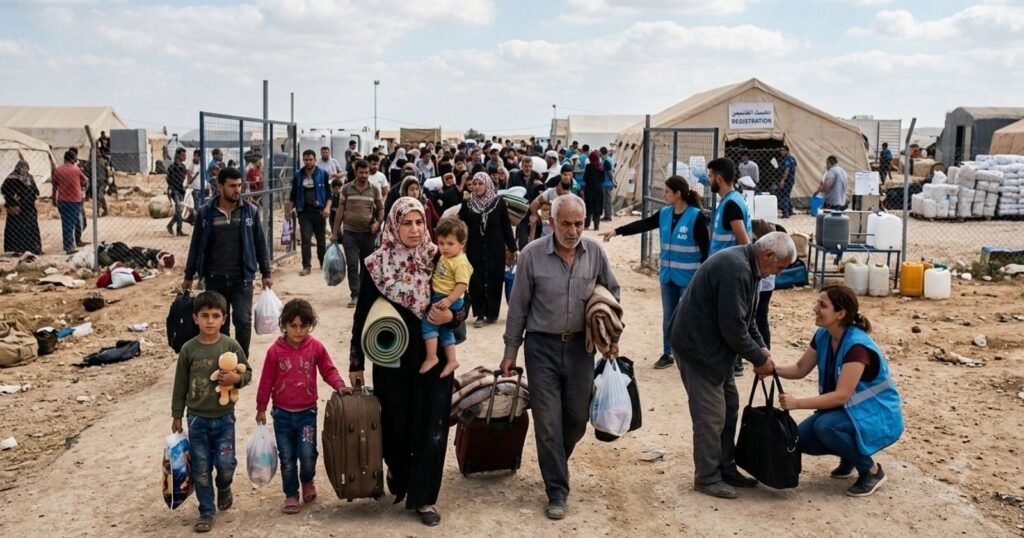
At the end of 2025, there were 41.6 million refugees globally, according to UNHCR’s Global Trends report released in June 2026, a figure that includes refugees under UNHCR’s mandate, people in a refugee-like situation, other people in need of international protection, and Palestine refugees under UNRWA’s mandate. That total actually fell by 3 percent compared with the end of 2024, driven by a sharp increase in returns, mostly to Afghanistan, Syria, and Sudan, though UNHCR cautions that many of those returns occurred under difficult conditions with limited reintegration support.
Terminology matters enormously in refugee statistics, because different reporting categories produce very different headline numbers. The narrower figure UNHCR uses on its core Global Trends page counts 35.6 million refugees, made up of 28.5 million refugees under UNHCR’s mandate plus 7.2 million other people in need of international protection, alongside 6 million Palestine refugees counted separately under UNRWA’s mandate. The broader 41.6 million figure adds those two together. Meanwhile, total forcible displacement worldwide, including internally displaced people and asylum seekers, stood at 117.8 million people at the end of 2025.
How Many Refugees Are There in the World
| Category | End of 2025 |
|---|---|
| Refugees (broad total, incl. Palestine refugees) | 41.6 million |
| – Refugees under UNHCR mandate | 28.5 million |
| – Other people in need of international protection | 7.2 million |
| – Palestine refugees under UNRWA mandate | 6.0 million |
| Asylum seekers pending decision | 9.0 million |
| Internally displaced people (IDPs) | 68.7 million |
| Total forcibly displaced people worldwide | 117.8 million |
Source: UNHCR Global Trends 2025, published June 11, 2026. One in every 70 people on Earth, about 1.4 percent of the global population, is now forcibly displaced.
Refugees, Asylum Seekers, and Other Displaced Groups
A refugee, under the 1951 Refugee Convention, is someone who has crossed an international border due to a well founded fear of persecution based on race, religion, nationality, political opinion, or membership in a particular social group. An asylum seeker is someone who has made that claim but whose case has not yet been decided.
An internally displaced person, or IDP, has fled their home for similar reasons but has not crossed an international border, placing them outside the legal protections of the Refugee Convention even though their circumstances are often just as severe. Stateless people, roughly 4.5 million worldwide, have been denied any nationality at all, cutting them off from rights tied to citizenship regardless of whether they have been displaced.
Where Do the World’s Refugees Come From
Seven in ten refugees and other people in need of international protection under UNHCR’s mandate originate from just six countries: Afghanistan, South Sudan, Sudan, Syria, Ukraine, and Venezuela. This concentration reflects a small number of large, protracted conflicts and political crises rather than a broad distribution of displacement causes across many countries.
Which Countries Host the Most Refugees
According to UNHCR’s High Commissioner, 36 percent of the world’s refugees are hosted by just six countries: Colombia, Germany, Turkey, Uganda, Iran, and Chad. This list reflects a mix of neighboring countries absorbing large regional displacement, such as Turkey’s long standing hosting of Syrian refugees and Uganda’s hosting of refugees from South Sudan and the Democratic Republic of the Congo, alongside European countries like Germany that host refugees who traveled further from their countries of origin.
Where Do Refugees Usually Go
At the end of 2025, 65 percent of refugees were hosted in neighboring countries, a consistent pattern across recent years. Low and middle income countries hosted 68 percent of the world’s refugees and other people in need of international protection, underscoring that the global refugee response is overwhelmingly carried by countries with fewer resources rather than wealthier nations further from conflict zones.
The Long Term Trend
Global forced displacement has grown substantially over the past decade, driven by protracted conflicts in Syria, Afghanistan, and more recently Ukraine and Sudan, alongside the collapse of Venezuela’s economy, which has pushed more than 7.6 million Venezuelans to leave the country since the mid-2010s.
Of those, only 411,000 had been formally granted refugee status as of recent counts, with 1.2 million awaiting asylum decisions and roughly 6 million living in neighboring countries without formal refugee or asylum registration, a gap that illustrates how administrative capacity, not just the scale of displacement, shapes official statistics.
Why Refugee Numbers Rise and Fall
New conflict and political instability drive numbers up. Returns, whether voluntary repatriation, resettlement, or in some cases forced return, drive numbers down. The 3 percent decline recorded in the 2025 Global Trends report was driven primarily by returns to Afghanistan, Syria, and Sudan, alongside similar returns among the world’s internally displaced population, but UNHCR notes that many of these returns occurred under adverse conditions in areas where insecurity persists and basic services remain limited, raising real questions about whether these are durable, sustainable returns or simply a temporary dip in the statistics.
The Demographics of the Global Refugee Population
Refugee populations tend to skew younger than host country populations on average, reflecting both the demographic profile of many origin countries and the particular vulnerability of families with children during conflict. The largest single stateless population in the world, the Rohingya from Myanmar, numbered around 1.8 million as of mid-2025 data, most hosted in Bangladesh’s refugee camps in conditions that have persisted for years with limited prospects for either safe return or permanent resettlement.
What Happens After Refugee Displacement
Three broad outcomes exist for refugee populations over time: voluntary return to the country of origin once conditions allow, local integration into the host country, or resettlement to a third country, which in practice accommodates only a small fraction of the global refugee population each year given limited resettlement quotas among wealthy nations.
Protracted displacement, where refugees remain in limbo for years or decades without any of these three outcomes, remains the reality for a large share of the world’s refugee population, particularly in situations like Afghanistan and Syria where conflict and instability have persisted for well over a decade.
Key Findings
- 41.6 million refugees existed globally at the end of 2025, a 3 percent decline from 2024 driven by returns to Afghanistan, Syria, and Sudan.
- Total forcible displacement worldwide, including IDPs and asylum seekers, reached 117.8 million people, meaning one in 70 people globally is forcibly displaced.
- Seven in ten refugees originate from just six countries: Afghanistan, South Sudan, Sudan, Syria, Ukraine, and Venezuela.
- 36 percent of the world’s refugees are hosted by just six countries: Colombia, Germany, Turkey, Uganda, Iran, and Chad.
- 65 percent of refugees remain in a country neighboring their own, and 68 percent of refugees are hosted by low and middle income countries overall.
- More than 7.6 million Venezuelans have left the country, but only a small fraction hold formal refugee status.
Frequently Asked Questions
1. How many refugees are there worldwide?
41.6 million refugees existed globally at the end of 2025, according to UNHCR’s Global Trends report, a figure that includes people under UNHCR’s mandate and Palestine refugees under UNRWA’s mandate.
2. What is the difference between UNHCR’s 41.6 million and 35.6 million refugee figures?
The 35.6 million figure is UNHCR’s narrower core count, combining 28.5 million refugees under its own mandate with 7.2 million other people needing international protection. The 41.6 million figure adds 6 million Palestine refugees counted separately under UNRWA’s mandate.
3. Which country produces the most refugees?
Seven in ten of the world’s refugees and people needing international protection come from just six countries: Afghanistan, South Sudan, Sudan, Syria, Ukraine, and Venezuela.
4. Which country hosts the most refugees?
Colombia, Germany, Turkey, Uganda, Iran, and Chad together host 36 percent of the world’s refugees, according to UNHCR.
5. Are refugees the same as internally displaced people?
No. Refugees have crossed an international border; internally displaced people have fled their homes but remain within their own country, placing them outside the legal protections of the 1951 Refugee Convention.
6. How many people are internally displaced worldwide?
68.7 million people were internally displaced due to conflict or violence at the end of 2025, according to combined UNHCR and Internal Displacement Monitoring Centre data.
7. Why did the global refugee population fall in 2025?
A 3 percent decline was driven mainly by returns to Afghanistan, Syria, and Sudan, though many of these returns occurred under difficult conditions with limited reintegration support.
8. Do most refugees stay near their home country?
Yes. 65 percent of refugees were hosted in a country neighboring their own at the end of 2025, a consistent pattern in recent years.
9. How many people are stateless worldwide?
Approximately 4.5 million people worldwide are stateless, meaning they have been denied any nationality and lack access to rights tied to citizenship.
10. What is the total number of forcibly displaced people worldwide?
117.8 million people were forcibly displaced worldwide at the end of 2025, combining refugees, asylum seekers, and internally displaced people.
Sources
- UNHCR, Global Trends 2025, published June 11, 2026
- UNHCR, Mid-Year Trends 2025
- UNHCR, Figures at a Glance
- Norwegian Refugee Council, Global Displacement Figures 2025
- Internal Displacement Monitoring Centre (IDMC)