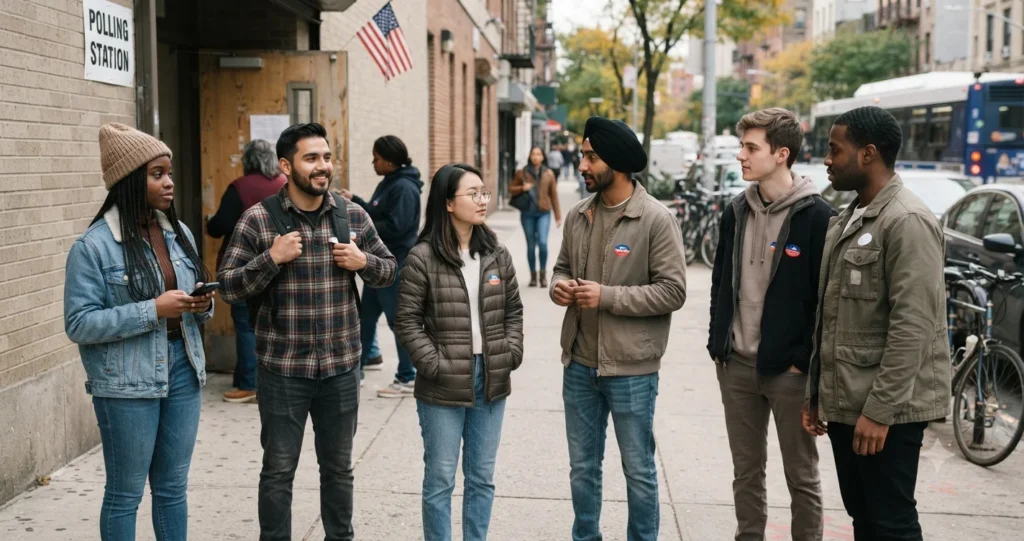
Roughly 41 million members of Generation Z were eligible to vote in the 2024 U.S. presidential election, including 8.3 million who aged into the electorate since the 2022 midterms. Yet within that single generation, 18-to-24-year-olds favored Kamala Harris by 10 points while 25-to-29-year-olds favored Donald Trump by 2, according to AP VoteCast data analyzed by Tufts University’s CIRCLE research center. A five-year age gap inside one generation produced a 12-point swing in outcome. That single fact undercuts most headlines that treat Gen Z as a unified political bloc, even as the generation’s raw electoral weight continues to grow.
Why Gen Z Matters Politically
Generation Z, generally defined as people born between 1997 and 2012, is aging into full electoral eligibility in real time. Each U.S. election cycle adds several million newly eligible Gen Z voters, and by 2024, Gen Z and Millennials combined made up 37 to 40 percent of the American electorate, depending on the estimate. This is not unique to the United States.
In Indonesia’s 2024 elections, the world’s largest single-day vote, Generation Z made up roughly 22.85 percent of registered voters and, combined with Millennials, accounted for more than half the electorate, a pattern echoed in numerous election systems where younger cohorts now form the demographic core of eligible voters.
How Large Is Gen Z
Global population data puts Generation Z’s worldwide size in the range of 2 billion people, comparable to Millennials and Generation Alpha, since annual global births have remained relatively steady across all three generational windows despite falling fertility rates per woman. Within individual countries,
Gen Z’s political weight depends less on its raw size than on its share of the voting-age and voting-eligible population, which varies significantly by country based on each nation’s age structure and, in the case of younger members, how much of the cohort has already reached voting age.
In the U.S. specifically, the Center for Information and Research on Civic Learning and Engagement estimated 40.8 million Gen Z members (ages 18-27 in 2024) were eligible to vote in the 2024 election, a figure that will keep rising through the late 2020s as the remainder of the cohort, born through 2012, reaches voting age.
Gen Z as a Voting Cohort
Turnout among young voters has historically lagged other age groups, but that gap has narrowed in recent U.S. election cycles. The 2018 midterms saw a marked jump in youth turnout, with newly eligible Gen Z voters casting 4.5 million ballots and turning out at roughly 30 percent, a notable increase from prior midterm cycles for first-time young voters, driven partly by expanded voter registration efforts targeting college campuses and younger demographics.
By the 2024 presidential election, turnout patterns among voters under 50 showed a measurable shift compared with 2020, according to Pew Research Center’s validated voter analysis. Voters ages 18 to 49 favored Harris by 7 percentage points in 2024, down sharply from the 17-point margin Joe Biden held with the same age group in 2020. Pew found this shift was driven partly by direct defection: 8 percent of Biden’s 2020 voters under 50 switched to Trump in 2024, while 4 percent moved the opposite direction.
What Recent Elections Reveal
The 2024 U.S. election offers the clearest recent test of Gen Z’s political behavior, and the data resists a simple narrative in either direction. According to Tufts CIRCLE’s analysis of AP VoteCast data, voters aged 18 to 29 overall favored Harris by 4 points (51 percent to 47 percent), a far narrower margin than Biden’s 25-point advantage with the same age group in 2020.
Within that 18-to-29 bracket, the youngest segment, ages 18 to 24, favored Harris by 10 points, while voters 25 to 29 favored Trump by 2 points, a reversal driven substantially by a pronounced gender gap and a shift among moderate-identifying young voters, who backed Trump by 5 points in 2024 after supporting Biden by 20 points in 2020.
Youth Vote Comparison, 2020 vs 2024
| Metric | 2020 | 2024 |
|---|---|---|
| Voters 18-29, Democratic margin | approx. +25 | +4 |
| Voters 18-49, Democratic margin | +17 | +7 |
| Moderate-identifying young voters | Biden +20 | Trump +5 |
| Gen Z eligible voters (U.S.) | approx. 24 million (partial cohort) | approx. 41 million |
This is a genuine narrowing of the Democratic advantage among young voters, not a wholesale flip toward the opposite party, and it varied considerably by age subgroup within Gen Z itself, underscoring how much internal variation exists inside a single generational label.
Gen Z Is Not One Political Group
The gender gap within Gen Z’s 2024 vote was substantial and is one of the more consistently documented findings across multiple surveys, with young men shifting toward Trump by a considerably larger margin than young women did.
Race and ethnicity also produced significant internal variation: Pew’s validated voter data found Asian voters overall favored Harris by wide margins, while other demographic subgroups within the youth electorate showed more mixed patterns. Geography compounds these divisions, since young voters in rural areas voted quite differently from young voters in urban centers, mirroring the broader urban-rural divide that shaped the 2024 election overall.
Educational attainment and income further fragment the cohort. Gen Z members who are current university students, those already in the workforce without a degree, and those not employed or in education at all often hold measurably different political priorities and voting patterns, a distinction national headlines about “the Gen Z vote” routinely collapse into a single figure.
Population Geography and Political Power
Gen Z’s political weight varies enormously by country, driven by underlying demographic structure. In countries with younger overall populations, concentrated in parts of Africa, South Asia, and Southeast Asia, Gen Z and the cohort immediately following it already constitute a majority or near-majority of the electorate. In rapidly aging democracies, including much of Europe, Japan, and South Korea, Gen Z remains a comparatively small share of the voting-age population relative to older cohorts, limiting its electoral leverage even where turnout among young voters is strong.
This geographic variation means “Gen Z’s political power” is not a single global phenomenon but a country-specific outcome shaped by each nation’s underlying age structure, itself a product of that country’s fertility history over the preceding two decades.
How Gen Z Could Affect Future Elections
As the remainder of Generation Z ages into voting eligibility through the late 2020s, and as older, historically more conservative-leaning cohorts continue to shrink through mortality, cohort replacement will mechanically shift more electoral weight toward younger voters in most countries with declining birth rates among older generations. This process, sometimes called generational replacement, does not guarantee any particular political outcome, since voting patterns within a cohort can and do shift over time, as the 2024 U.S. results demonstrate. What it does guarantee is a continued rise in the sheer number of eligible Gen Z and eventually Generation Alpha voters relative to older cohorts, particularly in countries where older generations are large but young cohorts are being at least partially replaced by comparably sized younger ones.
The Difference Between Gen Z Population Size and Political Influence
A generation’s raw population size does not automatically translate into proportional political influence, for several structural reasons. Turnout among younger voters, while improving, still generally trails turnout among older voters in most democracies, meaning Gen Z’s share of actual votes cast is typically smaller than its share of the eligible population.
Institutional factors, including voter registration requirements, redistricting, and the design of electoral systems, can further dampen or amplify a generation’s effective political weight independent of its raw numbers. And within any generation, internal political fragmentation by gender, race, education, geography, and economic status means a large population does not automatically translate into a unified voting bloc capable of consistently swinging elections in one direction.
Key Findings
- Roughly 41 million Gen Z members were eligible to vote in the 2024 U.S. election, including 8.3 million newly eligible since the 2022 midterms, and this number will keep growing through the late 2020s.
- Gen Z is not politically uniform: 18-to-24-year-olds favored Harris by 10 points in 2024 while 25-to-29-year-olds favored Trump by 2 points, a 12-point internal swing within a single generational label.
- The overall youth vote (ages 18-29) favored Harris by just 4 points in 2024, down sharply from Biden’s 25-point margin with the same age group in 2020, reflecting a genuine but partial shift rather than a full reversal.
- Moderate-identifying young voters shifted from a 20-point Biden advantage in 2020 to a 5-point Trump advantage in 2024, one of the largest documented swings within any subgroup of the youth electorate.
- In Indonesia’s 2024 election, the world’s largest single-day vote, Generation Z made up roughly 22.85 percent of registered voters, illustrating that Gen Z’s rising electoral weight is a global pattern, not one specific to the United States.
Conclusion
Gen Z’s political importance is real and growing, driven by straightforward demographic arithmetic: millions of new voters aging into eligibility every election cycle, in the United States and in large democracies worldwide. What the data does not support is the common shorthand that Gen Z votes as a single ideological bloc. The 2024 U.S. election showed a 12-point swing in outcome between voters just five years apart in age, both nominally part of the same generation. Gen Z’s electoral weight is rising. Its political identity remains genuinely contested and internally divided.
Frequently Asked Questions
1. Is Gen Z politically active?
Yes, relative to historical patterns for young voters, though turnout among 18-to-29-year-olds still generally trails older age groups. Youth turnout and registration have both risen over the past several U.S. election cycles compared with earlier decades.
2. How large is Gen Z?
Globally, Generation Z is estimated at roughly 2 billion people, comparable in size to Millennials and Generation Alpha. In the U.S. specifically, approximately 41 million Gen Z members were eligible to vote in the 2024 election.
3. Does Gen Z vote more than Millennials?
Turnout patterns between the two generations have been broadly similar in recent U.S. election cycles, with both groups showing improved participation compared with earlier generations’ youth turnout, though Millennials as a whole vote at somewhat higher rates simply because more of the cohort has been eligible for longer.
4. Is Gen Z politically left or right?
Neither uniformly. In the 2024 U.S. election, younger Gen Z voters (18-24) favored the Democratic candidate while slightly older Gen Z voters (25-29) favored the Republican candidate, and the generation shows significant internal variation by gender, race, geography, and education level.
5. Why did young voters shift toward Trump in 2024 compared with 2020?
Pew Research Center’s validated voter analysis found the shift was driven partly by direct voter defection, with 8 percent of Biden’s 2020 voters under 50 switching to Trump in 2024, alongside a notable shift among moderate-identifying young voters and a pronounced gender gap favoring Trump among young men.
6. Is Gen Z’s political power the same in every country?
No. Gen Z’s electoral weight depends on each country’s underlying age structure. In countries with younger populations, Gen Z already represents a large share of the electorate, while in rapidly aging democracies its share remains comparatively small.
7. How many Gen Z voters were eligible in the 2024 U.S. election?
Approximately 41 million, according to the Center for Information and Research on Civic Learning and Engagement, including 8.3 million who became newly eligible since the 2022 midterm elections.
8. Will Gen Z’s political influence keep growing?
Its raw electoral weight will continue growing through the late 2020s as more of the cohort reaches voting age, though whether that translates into greater political influence depends on turnout, cohesion, and institutional factors specific to each country’s electoral system.
9. What is generational replacement in politics?
It refers to the gradual shift in a country’s electorate as older cohorts leave through mortality and younger cohorts age into eligibility. It changes the composition of the electorate over time but does not by itself determine how any generation will vote.
10. Should Gen Z be treated as a single political bloc?
No. Data from the 2024 U.S. election shows significant internal variation by age within the cohort, gender, and political self-identification, undermining any framing of Gen Z as a unified or predictable voting bloc.
Sources
- Tufts University, Center for Information and Research on Civic Learning and Engagement (CIRCLE), “The Youth Vote in 2024,” analysis of AP VoteCast data
- Pew Research Center, “How voting patterns changed in the 2024 election: A detailed analysis,” June 2025
- Pew Research Center, “Voter turnout in the 2020 and 2024 elections: A detailed analysis,” June 2025
- USA Today, “The 2024 election is shaping up to be a tight race. How big is Gen Z’s voting bloc?” 2024
- Statista, “Indonesia registered 2024 election voters by generation”