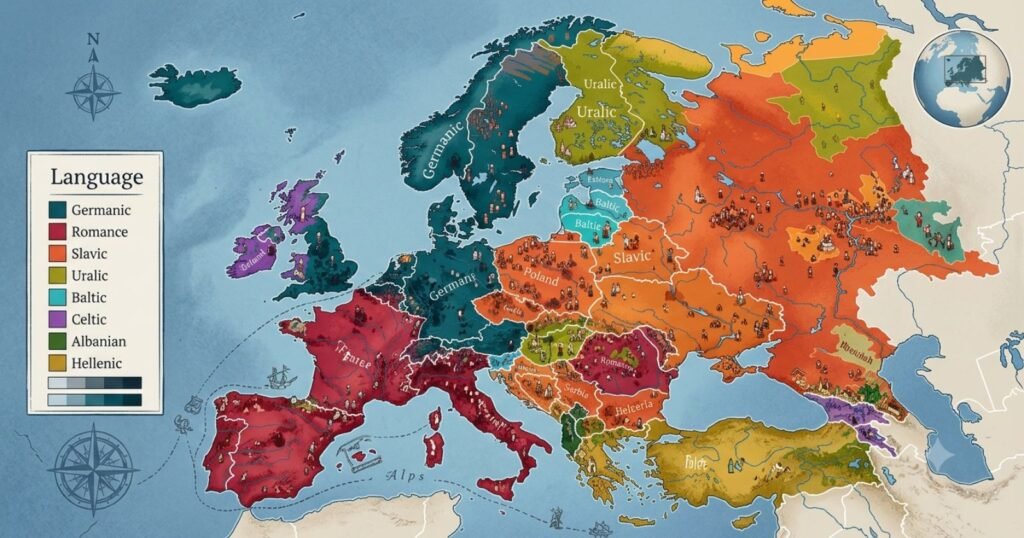
Ask which language dominates Europe and the honest answer depends entirely on what you are counting. Count native speakers and Russian wins. Count everyone who can hold a conversation in it, and English pulls far ahead. Count official recognition and German, spoken across parts of six countries, edges out both. Europe is home to more than 200 languages, but only a handful shape daily life for the majority of its 743 million residents.
Native Language, Mother Tongue, and Proficiency Are Different Questions
Before any ranking, it helps to separate what is actually being measured, since language statistics get muddled more often than almost any other demographic category in this data series.
- Native language or mother tongue, the language a person learned first and typically speaks most fluently, usually fixed for life
- Main language or language spoken at home, which can differ from a person’s native language, especially in migrant households or multilingual regions
- Second language proficiency, the ability to hold a conversation in a language learned later, which can be extensive without ever approaching native fluency
- Official or co-official status, a legal designation a country or region grants a language, independent of how many residents actually speak it
A ranking built on native speakers alone looks very different from one built on total speakers including second-language use, and this article keeps the two separate throughout rather than blending them into a single misleading number.
Europe’s Language Families
Nearly every language spoken natively in Europe belongs to one of three branches of the Indo-European family, plus a handful of important exceptions.
| Language Family | Branch Examples | Approximate Reach |
|---|---|---|
| Indo-European, Slavic | Russian, Polish, Ukrainian, Czech, Serbian, Croatian, Bulgarian | Dominant across Eastern and much of Central and Southeastern Europe |
| Indo-European, Romance | French, Italian, Spanish, Portuguese, Romanian | Dominant across Southern and Western Europe |
| Indo-European, Germanic | German, English, Dutch, Swedish, Danish, Norwegian | Dominant across Northern, Western, and Central Europe |
| Uralic | Finnish, Estonian, Hungarian | Isolated pockets in Northern and Central Europe, unrelated to neighboring languages |
| Turkic | Turkish, spoken by some communities within Europe | Present through migration and, in a small area, Turkey’s European territory |
| Language isolate | Basque | Northern Spain and southwestern France, unrelated to any other living language |
The Native Speaker Ranking
| Rank | Language | Approximate Native Speakers in Europe |
|---|---|---|
| 1 | Russian | 106 to 140 million |
| 2 | German | 95 to 100 million |
| 3 | French | 71 to 81 million |
| 4 | Italian | approx 65 million |
| 5 | English | approx 65 million within Europe specifically |
| 6 | Spanish | approx 46 million |
| 7 | Polish | approx 40 million |
| 8 | Ukrainian | approx 32 million |
| 9 | Romanian | approx 24 to 28 million |
| 10 | Dutch | approx 23 million |
| 11 | Greek | approx 10 million |
| 12 | Czech | approx 10 million |
| 13 | Swedish | approx 10 million |
| 14 | Hungarian | approx 9 million |
Source: Elaborated from Ethnologue-based estimates as compiled by Langoly, Berlitz, and Grokipedia, 2025 figures. Ranges reflect genuine variation between sources, since native-speaker counts depend heavily on census methodology and how bilingual households are classified.
Russian tops the native-speaker ranking because of its status as the primary language across Russia’s enormous population, Belarus, and large parts of Ukraine, along with substantial Russian-speaking minorities in the Baltic states and elsewhere in the former Soviet space.
German’s second-place position often surprises people outside Europe, but it reflects its status as the sole or co-official language across Germany, Austria, Switzerland, Liechtenstein, Luxembourg, and parts of Belgium, giving it Europe’s largest concentrated native-speaker base after Russian.
Total Speakers, Native Plus Second Language
| Rank | Language | Total Speakers in Europe |
|---|---|---|
| 1 | English | approx 260 million |
| 2 | French | approx 210 million |
| 3 | German | approx 170 million |
| 4 | Russian | approx 160 million |
| 5 | Italian | approx 82 million |
| 6 | Spanish | approx 76 million |
| 7 | Polish | approx 40 million |
| 8 | Ukrainian | approx 32 million |
| 9 | Romanian | approx 28 million |
| 10 | Dutch | approx 23 million |
Source: Elaborated from Ethnologue-based estimates as compiled by Langoly, Berlitz, and Grokipedia, 2025 figures.
This is the table that produces the surprising flip, English leaps from fifth or lower on the native-speaker list to first on the total-speaker list, because it functions as Europe’s dominant second language for business, education, science, and travel.
Roughly 38 percent of EU citizens report English as their most useful foreign language, well ahead of French and German, and 54 percent of Europeans can hold a conversation in at least one language beyond their native tongue, with 25 percent able to do so in two.
Europe Language Population Data Table
| Language | Native Speakers (Europe) | Total Speakers (Europe) | Primarily Official In |
|---|---|---|---|
| Russian | 106 to 140 million | approx 160 million | Russia, Belarus |
| German | 95 to 100 million | approx 170 million | Germany, Austria, Switzerland, Liechtenstein, Luxembourg |
| French | 71 to 81 million | approx 210 million | France, Belgium, Switzerland, Luxembourg |
| English | approx 65 million | approx 260 million | United Kingdom, Ireland |
| Italian | approx 65 million | approx 82 million | Italy, Switzerland |
| Spanish | approx 46 million | approx 76 million | Spain |
| Polish | approx 40 million | approx 40 million | Poland |
| Ukrainian | approx 32 million | approx 32 million | Ukraine |
| Romanian | 24 to 28 million | approx 28 million | Romania, Moldova |
| Dutch | approx 23 million | approx 23 million | Netherlands, Belgium |
Source: Elaborated from Ethnologue-based figures, 2025 estimates.
The Romance Languages
France, Italy, Spain, Portugal, and Romania anchor Europe’s Romance language zone, all descended from spoken Latin as the Roman Empire’s linguistic legacy fragmented regionally after its collapse. French carries particular international weight beyond its European speaker count, serving as an official language of 29 countries worldwide and one of the working languages of the UN, EU, and WTO.
Romanian stands apart from its Romance siblings geographically, an island of Latin-derived language surrounded by Slavic and Hungarian speakers, a legacy of the Roman province of Dacia established in the 2nd century.
The Germanic Languages
Germanic languages split into two main branches active in Europe today, West Germanic, covering German, English, and Dutch, and North Germanic, covering Swedish, Danish, Norwegian, and Icelandic. English and German share roughly 60 percent of their vocabulary, a legacy of their shared West Germanic root before centuries of separate development pulled their grammar and pronunciation apart.
The Scandinavian languages remain close enough to each other that Swedish, Danish, and Norwegian speakers can often understand one another with only modest difficulty, a level of mutual intelligibility rare among major European language groups.
The Slavic Languages
Slavic languages dominate Eastern and much of Central and Southeastern Europe, split into West Slavic, Polish, Czech, and Slovak, East Slavic, Russian, Ukrainian, and Belarusian, and South Slavic, Serbian, Croatian, Bulgarian, Slovenian, and the closely related Bosnian and Montenegrin standards.
Polish holds the largest native-speaker base among the West Slavic languages at roughly 40 million, while Russian’s East Slavic dominance reflects both Russia’s population size and the language’s continued use as a second language across much of the former Soviet space, still commonly taught and spoken in Estonia, Latvia, Georgia, and Ukraine despite each country’s own official language.
Europe’s Smaller and Regional Languages
Beyond the major national languages, Europe protects a substantial layer of regional and minority languages through the Council of Europe’s Charter for Regional or Minority Languages, including Basque and Catalan in Spain, Welsh and Irish in the British Isles, Breton in France, Sami languages across Scandinavia’s north, and Maltese, the only Semitic language with official EU status.
Basque stands out linguistically as a genuine isolate, unrelated to any other living language and predating the arrival of Indo-European languages in Europe entirely, a linguistic relic of pre-Roman Iberia. Catalan, despite lacking status as an official EU language, has more native speakers than several fully recognized EU official languages, spoken by an estimated 9 to 10 million people across Catalonia, Valencia, and the Balearic Islands.
English as Europe’s Bridge Language
English’s total-speaker dominance reflects a deliberate multi-decade shift in European education policy rather than any large native-speaker base outside the UK and Ireland. English is now the most-studied foreign language at the upper secondary level across EU countries by a wide margin, taught to more students than every other foreign language combined.
That dominance is a relatively recent development, French and German both held comparable or greater status as Europe’s shared second language through much of the twentieth century, and Russian still functions as a widely understood second language across much of the former Eastern Bloc even where English has since overtaken it among younger generations.
Multilingual Europe
Multilingualism is the norm rather than the exception across much of the continent. Small countries bordering larger neighbors, Luxembourg, Belgium, and Switzerland, function with two or three official languages as a matter of course, and cross-border regions from Alsace to South Tyrol maintain bilingual signage, schooling, and administration as a matter of routine governance.
Migration adds a further multilingual layer, with major cities like London, Paris, Berlin, and Brussels home to dozens of community languages spoken at home even where a single national language dominates public life.
Languages Under Demographic Pressure
Not every language in Europe is growing or even holding steady. Several regional and minority languages face genuine risk of decline as older, rural speaker populations age without being fully replaced by younger generations who increasingly default to a country’s dominant national language for education, work, and social life.
Some Sami languages in Scandinavia’s far north, several Baltic and Uralic minority tongues, and some Romance-family regional languages in Italy and France fall into this category, sustained in practice mainly by government protection policies, minority-language education programs, and cultural revival movements rather than organic generational transmission alone.
How Europe’s Language Map Has Changed Historically
Europe’s current language boundaries owe as much to political history as to organic linguistic evolution. The nineteenth and twentieth centuries’ wave of nation-state formation frequently standardized a single national language for education and administration, often at the expense of regional dialects and minority tongues that had coexisted for centuries.
Border changes following both world wars redrew which populations spoke which language within which state, most visibly in Central and Eastern Europe, where German-speaking populations were displaced westward after 1945 and Polish, Czech, and other national languages consolidated their position within newly redrawn borders.
The Future of Europe’s Languages
Three forces will likely shape Europe’s linguistic map over the coming decades. Continued dominance of English as a second language is likely to persist or deepen given its entrenched position in education systems across the continent, though this affects second-language use far more than any native-speaker count.
Demographic decline in several Eastern and Southern European countries covered elsewhere in this data series will shrink the absolute number of native speakers of languages like Bulgarian, Ukrainian, and several Baltic languages simply because their national populations are themselves shrinking.
Migration will continue adding non-European languages, particularly Arabic and various South Asian languages, to the linguistic landscape of major Western European cities, a trend already well underway and expected to continue as long as current migration patterns hold
Frequently Asked Questions
What is the most spoken language in Europe?
It depends on the measure. Russian has the most native speakers, at 106 to 140 million, while English has the most total speakers once second-language use is included, at approximately 260 million.
How many languages are spoken in Europe?
More than 200, including over 225 indigenous varieties across major language families, though only about 24 hold official status at the EU level.
What is the only language isolate spoken in Europe?
Basque, spoken in northern Spain and southwestern France, is unrelated to any other living language and predates the Indo-European languages that dominate the rest of the continent.
Is German or French more widely spoken in Europe?
German has more native speakers, roughly 95 to 100 million against French’s 71 to 81 million, but French has more total speakers once second-language use is counted, at roughly 210 million against German’s 170 million.
Why is English so widely spoken as a second language in Europe?
Decades of European education policy have made English the dominant foreign language taught at the secondary level across nearly every EU country, reflected in its status as the most useful second language according to roughly 38% of EU citizens surveyed.
Sources
- Ethnologue-based native and total speaker estimates as compiled by Langoly, Berlitz, and Grokipedia, 2025 figures
- Statista
- Eurobarometer surveys on EU language proficiency and foreign language usefulness
- Wikipedia