Someone can be born in Morocco, hold French citizenship, and have lived their entire adult life in Germany. Country of birth, nationality, and country of residence are three separate facts about the same person, and mixing them up is the single most common mistake in casual discussions of migration statistics. This article deals with exactly one of those three facts, where people living in Europe were actually born, using the most detailed data source available for this specific question, Eurostat’s country of birth statistics for the EU’s 27 member states.
Country of Birth Versus Nationality, the Distinction That Matters Most
Before any numbers, one example makes the difference concrete. A woman born in Poland moves to Ireland for work, becomes an Irish citizen after several years of residence, and never returns to Poland to live. Under country of birth statistics, she is counted as Poland-born living in Ireland. Under nationality statistics, once naturalized, she is counted as an Irish citizen, no longer as a Polish national.
Both facts are true about the same person at the same time, and confusing the two, treating naturalized citizens as if they were still counted as foreign nationals, or treating the foreign-born as if all of them lacked citizenship, is a common and avoidable error in how migration statistics get reported and discussed.
How Many People Living in the EU Were Born Abroad
| Category | Population | Share of EU |
|---|---|---|
| Born outside the EU | 46.7 million | 10.4% |
| Born in a different EU country | 18.0 million | 4.0% |
| Total foreign-born | 64.7 million | 14.4% |
| Born in country of residence | remainder | 85.6% |
Source: Eurostat, EU population diversity by citizenship and country of birth, 1 January 2025.
Nearly 1 in 7 people living in the EU were born somewhere else, whether in another EU country or beyond. That combined 14.4 percent foreign-born share puts the EU roughly on par with North America and well ahead of Asia, Africa, and South America, where foreign-born shares of the population typically run in the low single digits.
Countries With the Largest Foreign-Born Populations
| Rank | Country | Foreign-Born Population 2025 | Share of All EU Foreign-Born |
|---|---|---|---|
| 1 | Germany | 17.2 million | approx 27% |
| 2 | France | 9.6 million | approx 15% |
| 3 | Spain | 9.5 million | approx 15% |
| 4 | Italy | 6.9 million | approx 11% |
Source: Eurostat, EU population diversity by citizenship and country of birth, 1 January 2025. These four countries alone hold 66.7% of every foreign-born resident in the entire EU, despite representing only 57.8% of the EU’s total population, meaning foreign-born residents are somewhat more concentrated in Europe’s largest economies than the general population itself.
Countries With the Highest Foreign-Born Share of Population
| Rank | Country | Foreign-Born Share |
|---|---|---|
| 1 | Luxembourg | 51.5% |
| 2 | Malta | 32.0% |
| 3 | Cyprus | 27.6% |
| 4 | Ireland | 23.3% |
| 5 | Austria | 22.5% |
| 6 | Sweden | 20.8% |
| 7 | Germany | 20.5% |
Source: Eurostat, EU population diversity by citizenship and country of birth, 1 January 2025.
Luxembourg is the only country in this entire dataset where more than half the resident population was born somewhere else, a direct product of its unusually deep economic integration with neighboring France, Belgium, and Germany and its position as an EU institutional hub. At the other end, foreign-born residents made up less than 5 percent of the population in Poland, at 2.6 percent, Romania, at 3.6 percent, Bulgaria, at 3.8 percent, and Slovakia, at 4.0 percent, all countries that have historically been sources of emigration rather than destinations for immigration.
European-Born Versus Non-European-Born, an Important Split
Not every foreign-born EU resident came from outside Europe. Of the EU’s 64.7 million total foreign-born residents, 18.0 million, or roughly 28 percent, were born in another EU country entirely, reflecting the intra-EU free movement that lets citizens relocate for work, retirement, or family reasons without the legal hurdles that apply to migration from outside the bloc. The remaining 46.7 million, about 72 percent of the foreign-born total, were born outside the EU altogether.
Notably, in three countries, Luxembourg, Hungary, and Slovakia, the number of intra-EU-born residents actually exceeds the number born outside the EU, a distinctive pattern not seen anywhere else in the bloc.
Major Migration Corridors
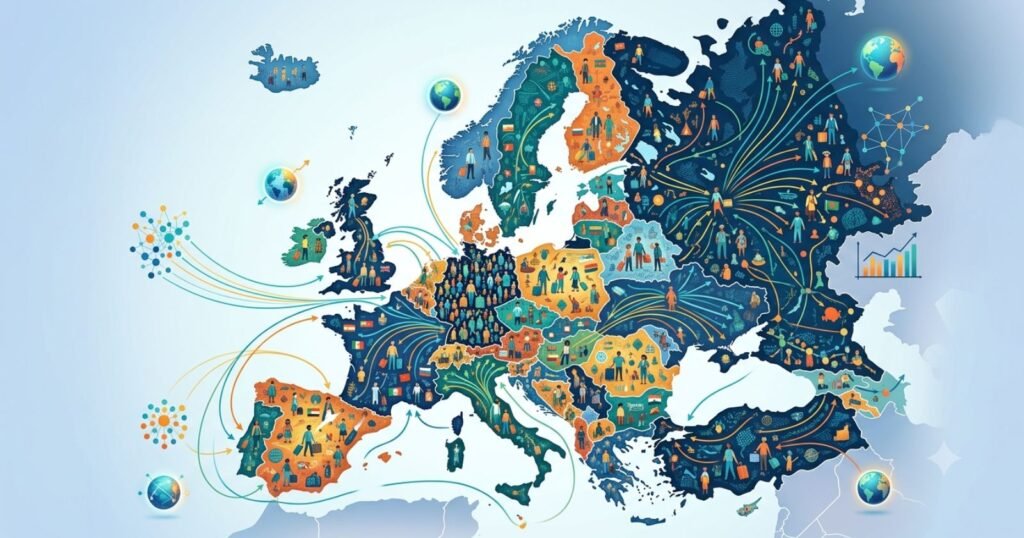
Eurostat’s most detailed origin data identifies the largest specific country-of-birth or citizenship groups moving within and into the EU. Romanian, Italian, and Polish citizens are the three largest groups of EU nationals living in a different EU country from the one where they hold citizenship, reflecting large, long-running labor mobility corridors, Romanians and Poles moving west for wages after their countries’ 2007 and 2004 EU accessions respectively, and Italians moving within the bloc for a mix of economic and lifestyle reasons.
Among non-EU groups, Ukrainian, Turkish, and Moroccan citizens represent the three largest communities living in EU countries, with Ukrainian numbers substantially elevated in recent years by wartime displacement following Russia’s 2022 invasion.
How the Foreign-Born Population Has Changed
Between 1 January 2015 and 1 January 2025, the share of foreign-born residents increased in nearly every EU country, part of a two-decade trend of gradually rising migration into the bloc. Only two countries saw their foreign-born share actually decline over that decade, Latvia, where the share fell as its large Soviet-era Russian-speaking foreign-born population aged and its size relative to the total population shrank, and Greece, where the share also edged down over the same period.
Germany illustrates the scale of the broader trend clearly, its foreign-born population grew from roughly 10 million in 2010 to nearly 18 million by 2025, an increase of about 70 percent in fifteen years, making Germany both the largest absolute recipient of foreign-born residents in the EU and one of the fastest growing in percentage terms among large countries.
Refugee and Humanitarian Migration
A meaningful share of the increase in foreign-born residents since 2022 reflects a specific and well documented driver, the displacement of people from Ukraine following the full-scale Russian invasion. Under the EU’s Temporary Protection Directive, activated in March 2022, people fleeing Ukraine and still resident in an EU country are counted as part of the usually resident population and therefore appear in country of birth and migration statistics, a departure from how many previous refugee movements were tracked.
It is worth noting this is a specific and unusually large humanitarian movement rather than representative of typical migration patterns, and Ukrainian citizens are now among the top three non-EU citizenship groups living in the EU as a direct result.
Poland and Slovakia did not include Ukrainian refugees under temporary protection in their 2025 population and migration statistics, a methodological point worth keeping in mind when comparing those two countries’ figures with the rest of the EU.
Second Generation Europe, What Country of Birth Statistics Miss
Country of birth statistics, by definition, only capture where a person themselves was born. They say nothing about the children of immigrants born within the destination country, who are counted as native-born even though their household, culture, and family history may be shaped substantially by migration. This means the commonly cited foreign-born population figures in this article, and in migration statistics generally, understate the total size of Europe’s immigrant-origin population, since second and third generation descendants of earlier immigrants are statistically indistinguishable from any other native-born resident in birth-based data, even where other characteristics of the population, language, cultural practice, or family ties abroad, continue to reflect that immigrant background for a generation or more.
Age Structure, Foreign-Born Residents Are Younger
Across the EU as a whole, foreign-born residents are somewhat younger than native-born residents, with a median age of 43.1 years compared with 45.2 years for the native-born population as of 1 January 2025.
The foreign-born population also skews more heavily toward working age specifically, with a notably higher share aged 15 to 64 in nearly every EU country, and in Denmark, Greece, Spain, Italy, Cyprus, Luxembourg, Malta, Finland, and Sweden that working-age share runs at least 20 percentage points higher among the foreign-born than the native-born. This pattern is not universal, however.
In seven countries, Estonia, France, Croatia, Latvia, Lithuania, Poland, and Slovakia, the share of residents aged 65 and over is actually higher among the foreign-born population than the native-born, a legacy in several of these cases of older Soviet-era migration flows rather than recent labor migration.
Countries With the Highest Foreign-Born Shares, in Context
| Country | Foreign-Born Share | Likely Driver |
|---|---|---|
| Luxembourg | 51.5% | Deep cross-border economic integration, EU institutions |
| Malta | 32.0% | Small population base, financial and gaming sector migration |
| Cyprus | 27.6% | Tourism, services, historical migration ties |
| Ireland | 23.3% | Tech and pharmaceutical sector labor demand |
| Austria | 22.5% | Long-running labor migration from Central and Southeastern Europe |
| Sweden | 20.8% | Long-running refugee resettlement and labor migration policy |
| Germany | 20.5% | Largest EU economy, decades of labor and refugee migration |
Future Foreign-Born Population
Several factors will shape how the EU’s foreign-born share evolves through 2030 and beyond. Continued labor migration is likely as aging populations and shrinking working-age cohorts in most EU countries sustain demand for foreign workers across healthcare, construction, agriculture, and technology sectors. Naturalization gradually shifts some of today’s foreign-born, foreign-national residents into the foreign-born, native-national category over time, without changing where they were born but changing how they appear in nationality-based statistics.
Mortality among older foreign-born cohorts, particularly the aging Soviet-era migrant populations in the Baltic states, will continue to shrink some of the specific historical foreign-born populations that currently inflate certain countries’ totals. Return migration, some share of any inflow eventually moves back to its country of origin or onward to a third country, a pattern that has historically kept net foreign-born growth more modest than gross inflow figures alone might suggest.
What Country of Birth Data Actually Tells Us
Country of birth statistics answer one specific, well defined question, where was this person born, and they answer it more reliably than almost any other migration-related statistic, since birthplace does not change over a person’s lifetime the way citizenship or residence can.
That reliability is exactly why this article treats country of birth data as a distinct category from nationality data rather than blending the two, even though both measure aspects of the same underlying phenomenon, international migration into and within Europe.
Frequently Asked Questions
How many people in Europe were born abroad?
Within the EU specifically, 64.7 million residents, 14.4% of the population, were born outside their country of residence as of 1 January 2025, combining 46.7 million born outside the EU and 18.0 million born in another EU country.
Which EU country has the most foreign-born residents?
Germany, with 17.2 million foreign-born residents, followed by France at 9.6 million, Spain at 9.5 million, and Italy at 6.9 million.
Which EU country has the highest share of foreign-born residents?
Luxembourg, at 51.5%, the only EU country where a majority of residents were born elsewhere.
Is country of birth the same as nationality?
No. Country of birth never changes over a person’s lifetime, while nationality can change through naturalization. A person can be born in one country, hold citizenship of a second, and live in a third simultaneously.
Are foreign-born residents in the EU younger or older than native-born residents?
Younger on average, 43.1 years versus 45.2 years, though this pattern reverses in seven countries where older, historical migrant populations push the foreign-born median age above the native-born median age.
Sources
- Eurostat, EU population diversity by citizenship and country of birth, data extracted 2 February 2026, reference date 1 January 2025.
- Euronews and The Local, reporting on Eurostat migration statistics releases, 2025 and 2026.