
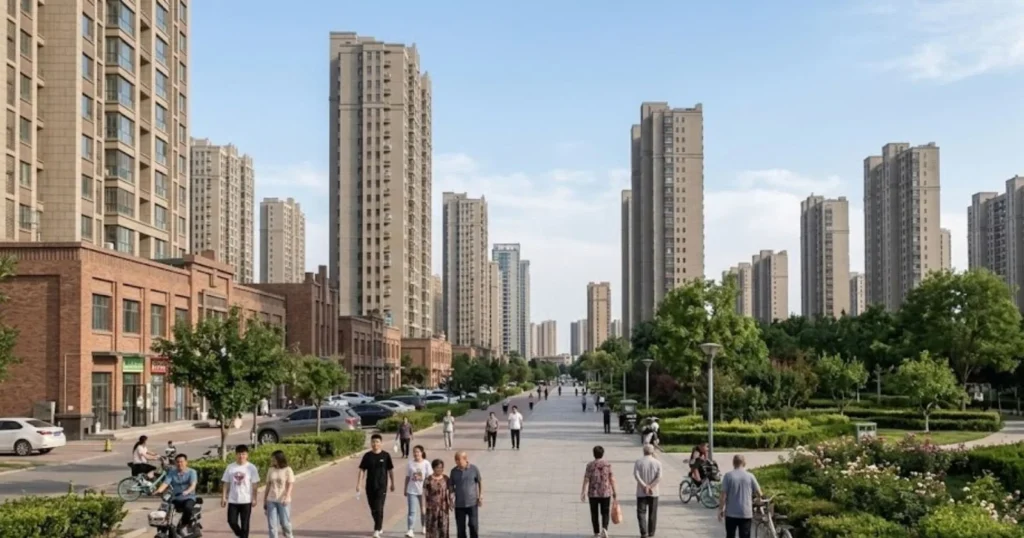
China’s population fell by 3.39 million in 2025, dropping to approximately 1.405 billion, according to National Bureau of Statistics data released in January 2026. It was the fourth consecutive year of decline, and the sharpest yet: only 7.92 million babies were born during the year, China’s lowest birth total since modern record-keeping began in 1949, while deaths climbed to 11.31 million. China’s national birth rate now sits at roughly 5.6 per 1,000 people, a level that places the country closer to the aging economies of Southern and Eastern Europe than to the fast-growing Asia many outside observers still associate with it.
The national number, striking as it is, obscures a more complicated and more useful story: population decline is not happening uniformly across China’s cities. Some, particularly the largest coastal megacities, continue attracting migrants and, in some cases, still grow even as the national total shrinks. Others, especially smaller cities in China’s northeast rust belt, are losing population rapidly, aging faster than the rest of the country, and confronting a very different set of planning challenges.
China’s Population Has Entered a New Demographic Era
Population at a Glance
- Total population (end of 2025): approximately 1.405 billion, down 3.39 million from 2024
- Births (2025): 7.92 million, down from 9.54 million in 2024, the lowest total since 1949
- Deaths (2025): 11.31 million, up from 10.93 million in 2024
- National birth rate: approximately 5.6 per 1,000 people
- Total fertility rate: approximately 1.0 births per woman, well below the 2.1 replacement level, and lower still in major cities including Beijing and Shanghai
- Urbanization rate (2025): approximately 67.9% of the total population living in cities, up from 51% in 2011 and 36% in 2000
- Years of consecutive population decline: 4 (since 2022)
Sources: China National Bureau of Statistics (NBS), January 2026 release; Statista compilation of NBS urbanization data.
China’s population decline began in 2022, the first annual decline in six decades, when deaths first exceeded births nationally. What was initially treated by some demographers as a possible one-off, potentially linked to pandemic-era disruptions, has instead proven to be the start of a sustained structural trend, with each subsequent year, 2023, 2024, and 2025, recording further contraction, and the pace of decline in 2025 exceeding that of 2024.
Population Decline Does Not Affect Every Chinese City Equally
China’s demographic contraction is not spread evenly across its roughly 660 officially designated cities. Research on shrinking cities in China, including a 2025 study published in a peer-reviewed regional science journal, documents substantial variation in the timing, severity, and underlying causes of urban population loss across the country, ranging from resource-depletion-driven decline in former mining and industrial centers to broader demographic aging effects in cities that have not seen major industrial disruption.
Beijing itself offers a useful illustration of how this variation plays out even among China’s most prominent cities. The capital first recorded negative natural population growth, meaning deaths exceeded births among permanent residents, in 2022, with a death rate of 5.72 per 1,000 people against a birth rate of 5.67 per 1,000, according to official Beijing government data. Demographic researchers, including Xiujian Peng of Victoria University’s Centre of Policy Studies, have noted that Beijing’s low birth rate reflects the city’s exceptionally high living and education costs, a pattern consistent with the national trend but more pronounced given Beijing’s status as one of China’s most expensive cities.
China’s Largest Cities May Continue Attracting People
Despite negative natural population growth, meaning more deaths than births among existing residents, several of China’s largest cities have historically continued to grow, or at least maintain population levels, through in-migration from other parts of the country. This distinction between natural population change, births minus deaths, and total population change, which also accounts for migration, is central to understanding why national decline does not necessarily mean every major city is shrinking.
China’s continued urbanization, with the national urban population share climbing to approximately 67.9 percent by 2025, up from just 36 percent in 2000, reflects sustained migration from rural areas and smaller cities toward major urban centers, even as the overall national population contracts. This means China’s largest, most economically dynamic cities, including Shanghai, Shenzhen, and Guangzhou, have generally been better positioned to offset natural population decline through continued in-migration than smaller or economically weaker cities, though provincial-level natural population data for 2024, the most recent year with detailed regional figures available, shows that even Shanghai recorded natural population decline that year, alongside Beijing.
Smaller Cities Face a Different Demographic Challenge
China’s northeastern provinces, Liaoning, Jilin, and Heilongjiang, collectively known as China’s rust belt, recorded some of the country’s steepest natural population declines in 2024, according to National Bureau of Statistics provincial data. Liaoning recorded a natural population decline of 5.3 percent and Heilongjiang 6.3 percent, among the weakest rates nationwide, while Jilin continued a pattern of rapid contraction driven by a combination of low fertility, an aging population, and sustained out-migration of younger workers toward more economically dynamic regions of the country.
This regional pattern reflects the intersection of two distinct pressures documented in shrinking-cities research on China: the long-term industrial decline and resource depletion that has affected many northeastern cities built around heavy industry and mining, following patterns similar to rust belt decline documented in other industrialized economies, and the broader nationwide demographic aging and fertility decline that affects the northeast more severely because it compounds with sustained out-migration of the region’s younger working-age population toward southern and coastal cities.
The Urbanization Story Is Not Over
A frequently overlooked point in discussions of China’s population decline is that national contraction and continued urbanization are not contradictory trends; they can, and currently do, occur simultaneously. China’s urban population share has continued rising even as the national total population has fallen for four consecutive years, because the pace of rural-to-urban migration has, to date, outpaced the rate of overall population decline.
Whether this pattern continues depends heavily on how much further rural-to-urban migration potential remains: China’s rural population, while still substantial, has already shrunk considerably from its historical share, and as the pool of potential rural-to-urban migrants continues to shrink over time, the buffering effect that migration currently provides to major city population levels is likely to weaken in the coming decades.
Housing Markets and City Planning in a Shrinking Population
China’s property sector, already under significant strain from a multi-year debt and housing market downturn affecting major developers, faces an additional structural headwind from a shrinking overall population: fewer new households forming nationally over time reduces the underlying demand growth that has historically supported China’s real estate development model, particularly in smaller and mid-sized cities facing outright population loss rather than merely slowing growth. This dynamic has been widely discussed by Chinese policymakers and economists as complicating Beijing’s broader efforts to boost domestic consumption and manage the country’s substantial local government and property-sector debt burdens.
Aging Will Change the Needs of Chinese Cities
China’s population decline is occurring alongside, and is substantially driven by, rapid population aging, a topic covered in greater depth in this series’ companion article on China’s shrinking youth population. Cities across China, but particularly those in the northeast and other regions experiencing the most severe natural population decline, face a growing need to reallocate infrastructure and public spending priorities: fewer schools and childcare facilities may be needed over time in shrinking cities, even as healthcare, elderly care, and pension-related infrastructure demand rises substantially, a reallocation challenge that Chinese urban planners and local governments are only beginning to systematically address at scale.
Regional Differences Will Become More Important
China’s provincial and city-level demographic data increasingly points toward a bifurcated national picture rather than a uniform national decline: economically dynamic coastal and major urban centers, while not immune to low fertility and natural population decline among existing residents, continue attracting sufficient in-migration to offset at least part of that decline, while interior and, particularly, northeastern regions face compounding pressure from both natural decline and continued out-migration of their working-age populations.
This divergence is likely to become an increasingly important dimension of China’s demographic story over the coming decade, arguably more consequential for day-to-day economic and social planning than the national aggregate population figure that dominates most international coverage of China’s demographic trajectory.
What China’s Cities Could Look Like by 2050
China’s demographic trajectory, with population decline accelerating for four consecutive years and a fertility rate hovering around 1.0, considerably below the replacement level of 2.1, points toward continued and likely deepening national population contraction over the coming decades.
International demographic experience, particularly from South Korea, Japan, and Taiwan’s more advanced low-fertility trajectories covered elsewhere in this series, suggests that once fertility falls to levels as low as China’s current rate, policy interventions alone have rarely been sufficient to reverse the trend, though they can moderate its pace.
For China’s cities specifically, this suggests a probable continuation and likely intensification of the current divergent pattern: further population concentration in a smaller number of highly dynamic, economically strong metropolitan regions, particularly along the eastern and southern coasts, alongside continued and likely accelerating population loss in smaller, economically weaker, and northeastern cities. These are demographic scenarios based on current trends and international comparative experience rather than certainties, and China’s own policy responses, including any future adjustments to family planning incentives, migration (hukou) system reforms, or regional economic development strategy, could meaningfully alter this trajectory in ways not yet reflected in current projections.
Frequently Asked Questions
1. Why is China’s population declining?
China’s population is declining due to a fertility rate of approximately 1.0 births per woman, far below the 2.1 replacement level, driven by high housing, education, and childcare costs, delayed marriage, and changing social attitudes toward family size, combined with an aging population in which deaths now exceed births nationally.
2. Are Chinese cities losing population?
Not uniformly. Several of China’s largest, most economically dynamic cities have continued growing or held population levels through continued in-migration, while smaller cities, particularly in the northeastern rust belt provinces of Liaoning, Jilin, and Heilongjiang, are experiencing significant population loss.
3. Which Chinese cities are growing?
China’s largest coastal and economically dynamic cities have generally been better positioned to offset natural population decline through continued rural-to-urban migration, though even Beijing and Shanghai recorded negative natural population growth, meaning more deaths than births among existing residents, in recent years.
4. Which Chinese cities are shrinking?
Cities in China’s northeastern rust belt provinces, Liaoning, Jilin, and Heilongjiang, have recorded some of the country’s steepest population declines, driven by a combination of industrial decline, resource depletion in former mining and manufacturing centers, low fertility, and sustained out-migration of younger workers.
5. Can urbanization continue during population decline?
Yes, and it has: China’s urban population share rose to approximately 67.9 percent by 2025, up from just 36 percent in 2000, even as the national population has declined for four consecutive years, because rural-to-urban migration has so far outpaced the overall rate of population loss.
6. How will aging affect Chinese cities?
Chinese cities face growing pressure to reallocate infrastructure and public spending away from child-focused services toward healthcare, elderly care, and pension-related needs, a challenge particularly acute in cities with the most severe population decline and fastest aging, concentrated in China’s northeast.
7. Will China’s largest cities continue growing?
Continued growth in China’s largest cities depends substantially on sustained rural-to-urban migration, which has so far offset natural population decline in major urban centers, though this buffering effect may weaken over time as China’s rural population, and therefore its pool of potential urban migrants, continues to shrink.
8. What will Chinese cities look like in 2050?
Based on current trends and international comparative experience from other low-fertility East Asian economies, Chinese cities are likely to see continued divergence, with further population concentration in dynamic coastal metropolitan regions and continued or accelerating decline in smaller, economically weaker, and northeastern cities, though China’s future policy choices could meaningfully alter this trajectory.
Sources
- China National Bureau of Statistics (NBS), national population data release, January 2026, reported via Reuters, NBC News, and Asia Times.
- Statista, China Urbanization Rate compilation of NBS data, 2025-2026.
- ScienceDirect, “Shrinking cities in China: A long-term metropolitan perspective,” peer-reviewed regional science research, 2025.
- Beijing Municipal Bureau of Statistics, natural population growth data, 2022-2024, reported via Reuters.
- Asia Times, “China’s demographic crisis has moved from theory to fact,” February 2026.





