Key Findings
- Pension and health spending rise with age structure largely as a mechanical function of a growing eligible population, independent of any change in benefit generosity.
- Long-term care is expected to be the fastest-growing category of age-related public spending as the oldest age brackets expand fastest in most high-income countries.
- Education spending faces new trade-offs as school-age populations shrink alongside rising pension and health costs, though outcomes vary substantially by country’s specific policy choices.
- Immigration policy debates gain salience in aging countries as a potential partial offset to workforce contraction, though migration alone rarely fully reverses the underlying demographic trend.
- Countries with similar age structures, such as Italy and the Netherlands, can adopt very different policy responses, showing that demographic pressure sets the scale of a challenge without dictating the specific response.
When a country’s median age rises by a decade, as has happened across much of East Asia and Southern Europe over the past generation, the demand for what government provides shifts with it, often well before any political party changes its platform to reflect that shift. Pension and healthcare spending rise because more people are eligible to draw on them. Housing needs change shape. Labor markets tighten in ways that reshape immigration debates. None of this requires a change in political ideology to occur; it follows fairly directly from the arithmetic of an aging population interacting with a fixed set of public institutions.
Population Structure Shapes Government Demand
Government spending responds, at least in part, mechanically to population composition. A country with a rising share of residents over 65 will see rising demand for pension payments and age-related healthcare services even if benefit levels per person remain completely unchanged, simply because more people qualify. This mechanical effect is distinct from, though it interacts with, political decisions about how generous those benefits should be, a distinction explored in more depth in this series’ analysis of the intergenerational tax bill.
Pensions Become More Prominent
Pension spending is the clearest example of demand rising with age structure. Across the OECD, public pension expenditure averaged 8.8% of GDP in 2023-24 and is projected to reach 10.0% by 2050, an increase the OECD attributes mainly to demographic change. As the number of beneficiaries grows relative to the working-age population funding the system, pension policy tends to command a growing share of legislative and budgetary attention, reinforced by the political durability of existing pension commitments, which are difficult to reduce for people already retired or near retirement.
Healthcare and Long Term Care Gain Importance
Public health spending, averaging 5.8% of GDP across the OECD, tends to rise with a population’s age structure, since healthcare utilization generally increases in the decades after 65. Long-term care, a smaller category today, is widely expected to grow fastest of all age-related spending categories as populations age further, since the need for sustained daily care assistance concentrates heavily in the oldest age brackets, a group expanding faster than any other in most high income countries.
Housing and Age Friendly Infrastructure
As populations age, housing policy priorities shift to include accessibility modifications, aging-in-place support, and location-specific concerns such as proximity to healthcare services, alongside the housing affordability concerns more commonly associated with younger, first-time buyers. These are not mutually exclusive priorities, but they do compete for the same pool of housing policy attention and public investment.
Labor Market Policy Changes
Aging populations tend to see growing policy interest in extending working lives, through changes to retirement age, incentives for continued employment among older workers, and reforms aimed at improving labor force participation among groups with historically lower participation rates. Countries facing acute labor shortages tied to shrinking working-age populations, described in detail in the accompanying analysis of the worker-to-retiree ratio, often turn to a combination of these labor market reforms alongside immigration policy adjustments.
Education and Youth Spending Can Face New Tradeoffs
As the school-age population shrinks in most aging countries, alongside rising pension and health costs described above, education spending can face pressure within a fixed or slow-growing overall budget, even though education costs are only partially variable with enrollment due to relatively fixed expenses like staffing and facilities.
Whether this produces an actual reduction in education spending, a redirection toward quality over quantity given fewer students, or protected spending funded through other budget adjustments varies considerably by country and reflects specific policy choices as much as demographic pressure alone.
Migration Can Become a Policy Priority
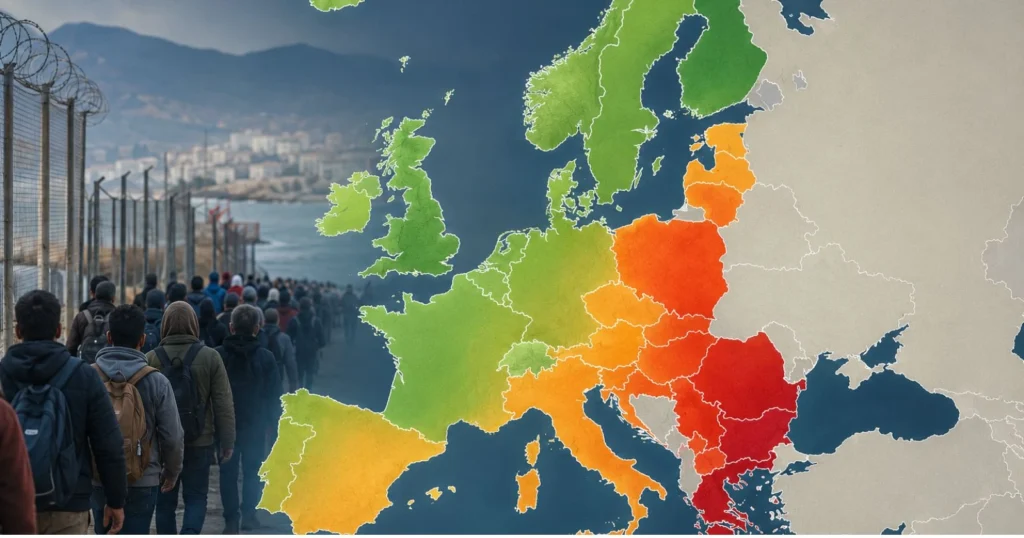
Countries facing significant workforce contraction due to population aging frequently see immigration policy rise in political salience, both as a potential partial offset to shrinking working-age populations and as a subject of political contest in its own right. Japan’s active recent efforts to expand pathways for working-age immigration illustrate how demographic pressure can shift immigration policy debates even in countries with historically restrictive approaches, though the scale of migration typically achievable falls well short of fully reversing the underlying demographic trend on its own.
Political Parties Adapt to Changing Electorates
As described in this series’ analysis of age and political power, older voters turn out more reliably than younger voters across most studied democracies, and this turnout advantage compounds with a growing older population share in aging countries specifically. Political parties competing for electoral support have some incentive to weight their platforms toward the policy priorities most salient to larger, more consistently voting older cohorts, a dynamic that can reinforce, though does not fully explain on its own, the fiscal and policy shifts described above.
Aging Does Not Produce One Universal Policy Agenda
Countries with broadly similar age structures can and do adopt quite different policy responses, reflecting differences in political institutions, fiscal capacity and cultural attitudes toward the role of the state. Italy and the Netherlands, discussed in this series’ analysis of the generational budget battle, show markedly different approaches to funding pension commitments despite comparable elderly population shares, one relying heavily on public pension spending, the other shifting much of that burden toward funded, private pension arrangements. This variation is a useful reminder that demographic pressure sets the scale of a challenge without determining any single policy response to it.
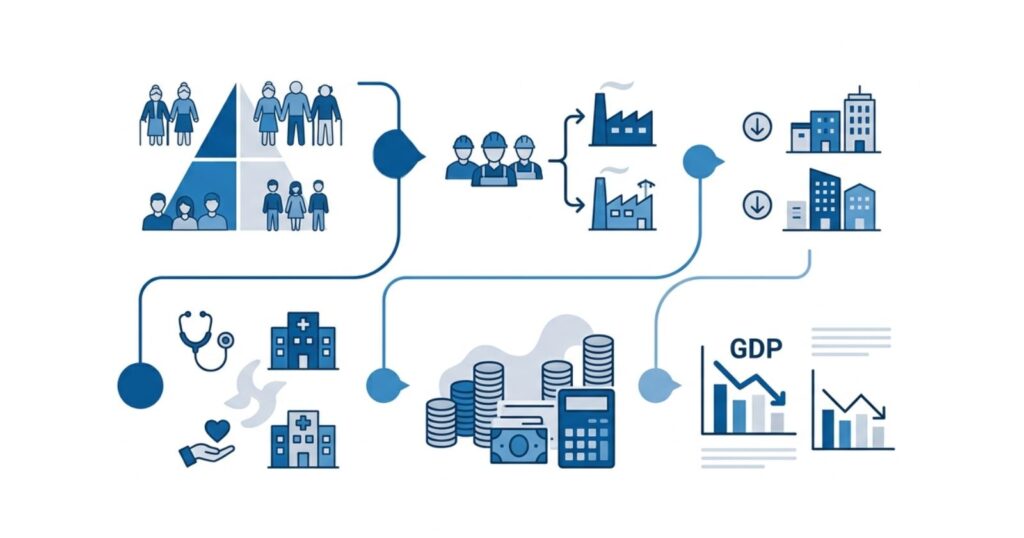
| Policy area | How aging changes demand | Example dynamic |
|---|---|---|
| Pensions | Rising eligible population | OECD spending projected 8.8% to 10.0% of GDP by 2050 |
| Healthcare | Rising utilization with age | Public health spending averages 5.8% of GDP, higher in older countries |
| Long-term care | Fastest-growing category | Demand concentrated in oldest age brackets |
| Housing | New accessibility and aging-in-place needs | Competes with affordability-focused housing policy |
| Labor markets | Pressure to extend working lives | Retirement age reform, older-worker incentives |
| Education | Shrinking client base, largely fixed costs | Tradeoffs vary by country’s specific fiscal choices |
| Immigration | Rising salience as partial workforce offset | Japan’s expanded working-age immigration pathways |
Conclusion
Population aging changes what governments are asked to do well before it changes any political party’s stated ideology, simply by shifting the composition of who needs what from the state. Pension and healthcare demand rise mechanically with an aging population, long-term care looms as the fastest-growing pressure point, and education, housing and immigration policy all face new tradeoffs shaped by the same underlying demographic shift. What Italy and the Netherlands demonstrate, despite facing comparable demographic pressure, is that the specific policy response remains a matter of national choice, not demographic destiny.
Frequently Asked Questions
1. What government priorities change when populations age?
Pension spending, healthcare and long-term care typically see rising demand and political attention, while housing policy incorporates new accessibility concerns, labor market policy shifts toward extending working lives, and immigration policy often rises in salience as a partial workforce offset.
2. Does population aging reduce education spending?
Not automatically. School-age population decline creates pressure within fixed budgets, but education costs are only partially variable with enrollment, and outcomes depend heavily on specific policy choices about whether to protect, redirect, or reduce education spending.
3. Why does healthcare spending rise with an aging population?
Healthcare utilization generally increases in the decades after 65, so a growing older population share raises overall healthcare demand even without any change in per-person benefit generosity or system efficiency.
4. Can immigration fully offset the effects of an aging population on policy priorities?
Immigration can meaningfully affect working-age population size, and Japan’s recent efforts illustrate active policy use of this lever, but it typically offsets only a portion of the underlying demographic shift rather than reversing it entirely.
5. Do all aging countries make the same policy choices?
No. Italy and the Netherlands, both with comparable elderly population shares, have adopted very different pension financing models, showing that demographic pressure does not determine a single universal policy response.
6. Why does long-term care get less policy attention than pensions or healthcare today?
It remains a smaller spending category currently, but it is widely projected to grow fastest among age-related spending categories, since demand concentrates in the oldest age brackets, which are expanding faster than any other in most aging countries.
7. How does political party behavior change in aging societies?
Parties have some incentive to weight platforms toward policy priorities salient to larger, more reliably voting older cohorts, a dynamic connected to the turnout patterns described in this series’ analysis of age and political power.
8. Does population aging affect housing policy specifically?
Yes, by introducing new priorities around accessibility and aging-in-place support alongside existing housing affordability debates more commonly associated with younger, first-time buyers.
9. Is labor market reform a common response to aging?
Yes. Extending working lives through retirement age changes and incentives for older workers, alongside efforts to raise labor force participation among underrepresented groups, are widely discussed policy responses to workforce contraction linked to aging.
10. Is there a single “aging policy agenda” that all countries follow?
No single universal agenda exists. While the categories of pressure, pensions, healthcare, housing, labor markets, education and immigration, are broadly similar across aging countries, the specific policy responses adopted vary considerably based on each country’s institutions and political choices.
Sources
- OECD, Pensions at a Glance 2025, “Public expenditure on pensions” and “Long-term projections of public pension expenditure”
- OECD, Society at a Glance 2024, “Social spending”
- OECD, Employment Outlook 2025, “Setting the scene: Demographic change, economic growth and intergenerational inequalities”
- World Bank, World Development Indicators, Age dependency ratio, old
- UN World Population Prospects 2024, UN Population Division