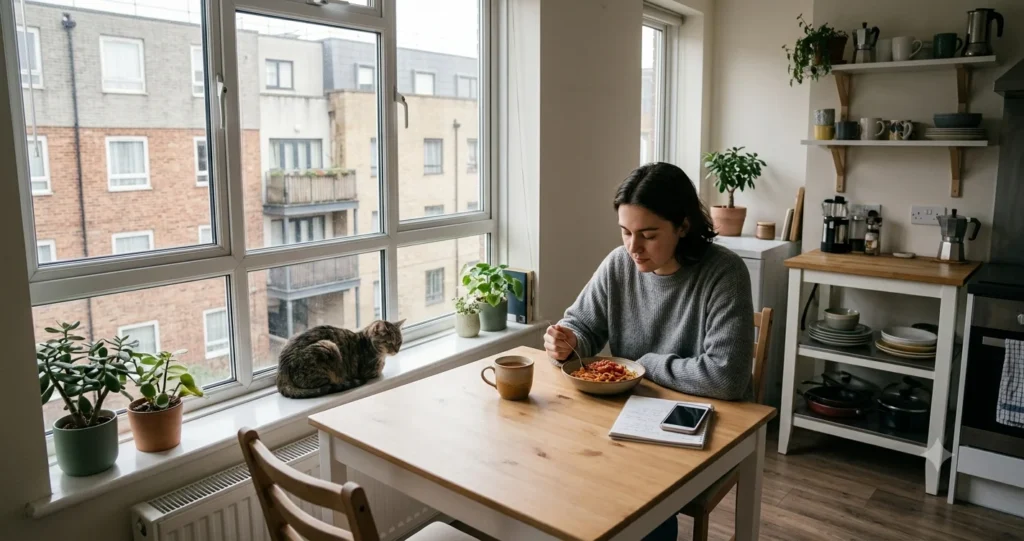
Solo living overtook every other household arrangement in the United States by 2015, when 28% of all U.S. households consisted of a single person living alone, more than the share made up of married couples with children. By the most recent Census Bureau estimates, more than 37 million Americans live alone, representing about 29% of all households, nearly triple the 13% share recorded in 1960.
Across the Atlantic, Finland (41%) and Norway (40%) now report that roughly two out of every five households consist of a single occupant, a threshold that, historically, almost no country anywhere in the world had crossed before the late twentieth century.
Key Findings
- Solo living became the single most common U.S. household type in 2015, and more than 37 million Americans, about 29% of all households, now live alone, nearly triple the 1960 rate.
- Twelve countries, mostly in Northern and Western Europe, now report that more than a third of all households consist of a single person, led by Finland (41%) and Norway (40%).
- EU single-adult households without children numbered 75 million in 2024, the largest household category in the bloc, ahead of couples with or without children.
- Single-adult EU households grew 16.9% between 2015 and 2024, nearly three times the 5.8% growth rate for all households combined.
- Older women are disproportionately represented among people living alone at advanced ages, primarily due to widowhood and sex differences in life expectancy.
- Living alone is a household measure, not a measure of loneliness or social isolation; the two are related but distinct.
How Many People Live Alone?
Global estimates are complicated by inconsistent household survey methodology across countries, but available data converges on a clear pattern: solo living has grown from a rare arrangement, under 10% of households in most places less than a century ago, into one of the fastest-growing household types worldwide.
The UN Economic Commission for Europe’s household composition data identifies 12 countries where more than a third of all households consist of a single person: Luxembourg, Belgium, Estonia, France, Latvia, and Liechtenstein at 33–34%, the Netherlands at 35%, Austria at 36%, Germany at 37%, Switzerland at 38%, Norway at 40%, and Finland at 41%.
In the European Union as a whole, single-adult households without children numbered roughly 75 million in 2024, the largest single household category among the EU’s 202 million total households, more numerous than couples without children (49.1 million) or couples with children (30.3 million).
One-Person Household Shares, Selected Countries Worldwide
| Country | Share of Households That Are One-Person | Approx. Year |
|---|---|---|
| Finland | 41% | 2024, UN ECE |
| Norway | 40% | 2024, UN ECE |
| Sweden | ~40% (approaching half per national data) | 2024 |
| South Korea | 36.1% | 2024, national factbook |
| Switzerland | 38% | UN ECE |
| Germany | 37% | UN ECE |
| Austria | 36% | UN ECE |
| Netherlands | 35% | UN ECE |
| Luxembourg | 33-34% | UN ECE |
| Belgium | 33-34% | UN ECE |
| Estonia | 33-34% | UN ECE |
| France | 33-34% | UN ECE |
| Latvia | 33-34% | UN ECE |
| Liechtenstein | 33-34% | UN ECE |
| Iceland | 31.0% | Our World in Data |
| United Kingdom | 29.5% | 2024, ONS |
| United States | ~29% | U.S. Census Bureau |
| Canada / Australia / South Africa | Roughly 25-33% | Comparative estimate |
| Philippines, Comoros, Nicaragua, Guinea, Jordan | Under 5% | Our World in Data |
| South Sudan, Guatemala, Sierra Leone, Palestine, Cambodia | Under 5% | Our World in Data |
| Niger, Tajikistan, Yemen, Bangladesh | Under 5% | Our World in Data |
| Iraq | 1.2% | Our World in Data |
| Pakistan | 1.1% | Our World in Data |
| Afghanistan | 0.2% (lowest documented globally) | Our World in Data |
Where Is Living Alone Most Common?
Northern and Western Europe consistently show the highest concentrations of one-person households globally, a pattern researchers attribute to a combination of high per-capita income (enabling people to afford independent housing), strong welfare-state support for older adults living independently, and comparatively high rates of divorce and delayed or forgone marriage.
Nearly all of the countries exceeding 33% one-person households are Nordic or Northern European, with Estonia the notable Baltic exception. At the opposite end of the spectrum, countries with strong extended-family living norms and lower per-capita income, Afghanistan is frequently cited as having among the lowest rates globally, show solo living remains rare, often in the low single digits of all households.
How Living Alone Has Changed Over Time
The historical trajectory is consistent across most high-income countries: solo living was a rarity through the mid-twentieth century, began rising steadily from the 1960s and 1970s onward, and has continued climbing through the most recent available data. In the U.S., the share of households consisting of a person living alone rose from about 13% in 1960 to roughly 29% today, crossing the threshold to become the single most common household type by 2015.
In the EU, single-adult households without children grew by 16.9% between 2015 and 2024 alone, nearly three times faster than the 5.8% growth rate for all EU households combined over the same period, indicating the trend is still actively accelerating rather than leveling off.
Who Is Most Likely to Live Alone?
Two distinct age groups drive most solo living, for very different reasons. Younger adults living alone are disproportionately concentrated among people delaying marriage, prioritizing career establishment, or simply preferring independent living arrangements once they can afford them.
Older adults living alone, historically the larger of the two groups, are shaped primarily by widowhood: because women statistically outlive male partners in most countries, older women make up a disproportionate share of solo dwellers at advanced ages. Marital status is the strongest overall predictor across age groups: never-married, divorced, and widowed adults are all substantially more likely to live alone than married or partnered adults.
Why Are One-Person Households Growing?
Several converging demographic and economic forces explain the sustained global rise in solo living:
- Population aging. As populations age and life expectancy rises, more people spend more years as widows or widowers, typically living alone following a spouse’s death.
- Marriage postponement. Rising median age at first marriage across most high-income and many middle-income countries extends the years young adults spend unmarried and, increasingly, living independently rather than with parents.
- Divorce. Higher divorce rates in many countries directly increase the number of adults who transition into solo living, at least temporarily, following marital dissolution.
- Widowhood. Longer life expectancy combined with persistent sex gaps in mortality means more older adults, disproportionately women, outlive a spouse and live alone in later life.
- Childlessness. Rising childlessness in many countries removes one traditional pathway back into multigenerational or shared living arrangements in old age.
- Urbanization. Cities offer denser housing stock better suited to single occupants and stronger labor markets that support economic independence, both of which favor solo living relative to rural areas.
- Economic independence. Rising incomes, particularly among women, have expanded the share of the population that can afford to live alone rather than needing to share housing costs.
Older Adults and Living Alone
Because women live longer than men in virtually every country with reliable mortality data, older women are consistently overrepresented among people living alone at advanced ages. UN DESA’s Database on the Households and Living Arrangements of Older Persons, covering roughly 98% of the global population aged 60 and older across 181 countries and territories, tracks this pattern specifically, measuring what share of older people reside in one-person households versus with a spouse only or with extended family, and finds substantial variation by region and income level, generally with higher rates of older-adult solo living in wealthier countries with stronger pension systems and social safety nets that make independent living financially viable.
Living Alone Is Not the Same as Social Isolation
An important conceptual distinction runs through all research on this topic: living alone describes a household arrangement, not a person’s social connectedness.
Many people who live alone maintain extensive social networks, regular contact with family and friends, and strong community ties; conversely, some people who live with others report significant social isolation or loneliness. This distinction, and the more complex, evidence-based relationship between household composition and loneliness, is explored in depth separately in coverage of loneliness demographics.
Where Could Living Alone Go Next?
Given that population aging, continued marriage postponement in many regions, and sustained urbanization show few signs of reversing, most demographic projections point toward continued growth in the global share of one-person households over coming decades, though the pace will vary substantially by region depending on economic development, housing markets, and cultural norms around family living arrangements.
The EU’s most recent data, 16.9% growth in single-adult households over just nine years, against 5.8% overall household growth, suggests this trend remains firmly in an accelerating phase in at least some regions rather than approaching a plateau.
Conclusion
The global rise of solo living represents one of the most significant, if under-discussed, household transformations of the past half-century, a shift from an arrangement once considered rare and even socially unusual to, in a growing number of countries, the single most common way people live.
Twelve countries now report more than a third of households occupied by one person, and the trend shows no clear sign of plateauing, with EU data showing single-adult households growing nearly three times faster than the overall household count in less than a decade.
Understanding this shift as a household statistic, separate from questions of loneliness or social isolation, is the necessary starting point for any deeper analysis of what rising solo living means for housing markets, care systems, and social policy going forward.
Frequently Asked Questions
1. How many people live alone worldwide?
Global figures are harder to pin down precisely due to inconsistent survey methodology, but solo living has grown from under 10% of households in most countries a century ago to well over a third of households in a dozen countries today, led by Finland and Norway.
2. Which countries have the most people living alone?
Finland (41%) and Norway (40%) have the highest documented shares of one-person households, followed by Switzerland, Germany, Austria, and the Netherlands, all above 35%.
3. Are older adults more likely to live alone?
Older women in particular are disproportionately likely to live alone, primarily due to widowhood, since women statistically outlive male partners in nearly every country.
4. Why are one-person households increasing?
Population aging, marriage postponement, rising divorce rates, widowhood, growing childlessness, urbanization, and rising economic independence are all documented contributing factors.
5. Is living alone the same as loneliness?
No. Living alone describes a household arrangement; loneliness is a subjective emotional state. Many people who live alone are well-connected socially, and the relationship between the two is examined separately in dedicated loneliness demographics research.
6. What share of U.S. households consist of a person living alone?
About 29%, or more than 37 million people, up from 13% in 1960, making solo living the single most common U.S. household type since 2015.
7. Which country has the lowest rate of people living alone?
Afghanistan is frequently cited among countries with the lowest documented rates of solo living, reflecting strong extended-family and multigenerational living norms.
8. Is the share of one-person households still growing?
Yes, in most regions with available data. EU single-adult households grew 16.9% between 2015 and 2024, nearly three times faster than overall household growth.
9. What age groups are most likely to live alone?
Two groups dominate: younger adults delaying marriage or prioritizing independence, and older adults, especially widowed women, living alone following a spouse’s death.
10. Does urbanization increase solo living?
Yes. Cities typically offer housing stock and labor markets better suited to single-occupant households, and urban areas generally show higher rates of solo living than rural areas within the same country.
Sources
- United Nations Economic Commission for Europe (UNECE), Data Portal, “Proportion of one-person households in all households.”
- Eurostat, “Household composition statistics,” 2025 (data extracted May 2025).
- United Nations, Database on the Households and Living Arrangements of Older Persons 2026, UN DESA Population Division.
- U.S. Census Bureau, household composition data.
- Our World in Data, “Percentage of one-person households” and “Solo living has become the most common arrangement for households in the United States.”
- Psychology Today, “Where in the World Do People Live Alone?”