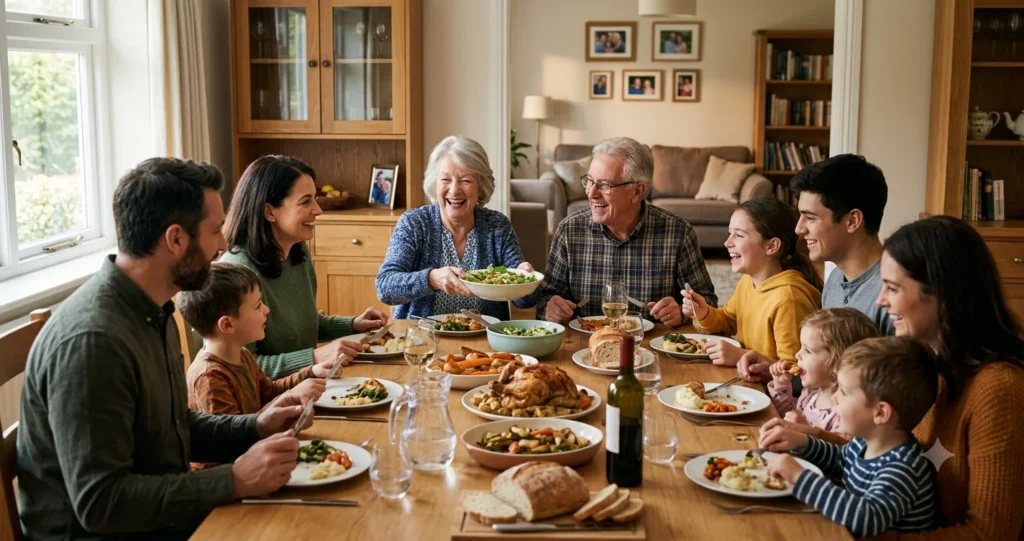
In March 2021, 59.7 million people in the United States were living in a multigenerational household, 18% of the entire U.S. population, and roughly four times the number recorded five decades earlier. That figure, drawn from Pew Research Center’s analysis of U.S. Census data, is one of the most detailed national estimates of a demographic pattern that is reshaping households across income levels and immigrant generations alike: the population of people living with two or more adult generations under one roof.
What Counts as a Multigenerational Household?
Pew Research Center and the U.S. Census Bureau define a multigenerational household as one that includes two or more adult generations (typically ages 25 and older), or one that includes grandparents living with grandchildren younger than 25. This definition captures a range of specific arrangements: adult children living with parents, grandparents living with adult children and grandchildren, three-generation households, and less common four-generation arrangements. It is a broader category than “skip-generation” households, in which grandparents raise grandchildren without a parent present, a distinct pattern covered separately in analysis of grandparents raising grandchildren.
How Large Is the Multigenerational Population?
U.S. data offers the most granular long-run trend available internationally. The share of the U.S. population living in multigenerational households declined from 21% in 1950 to a low of 12% in 1980, then rebounded steadily: 16.1% by 2008 (49 million people), 20% by 2016 (a then-record 64 million people), and 18% by 2021 (59.7 million people), according to successive Pew Research Center analyses of Census Bureau data. From 1971 (7% of the population) to 2021 (18%), the multigenerational population more than doubled as a share of the total, while the raw number of people living in these households roughly quadrupled, far outpacing growth in other household types over the same period.
The Long-Run Trajectory of U.S. Multigenerational Living
| Year | Share of U.S. Population | Estimated Population |
|---|---|---|
| 1950 | 21% | , |
| 1971 | 7% | , |
| 1980 | 12% (low point) | ~28 million (est.) |
| 2008 | 16.1% | ~49 million |
| 2016 | 20% (then-record) | ~64 million |
| 2021 | 18% | 59.7 million |
Source: Pew Research Center analysis of U.S. Census Bureau / Current Population Survey data.
Internationally comparable figures at this level of granularity are harder to obtain, since household survey definitions and census categories vary substantially by country; the UN DESA household composition database provides the most consistent cross-national framework currently available, though comparisons should be treated cautiously given definitional differences across national statistical systems.
Within the EU specifically, Eurostat data on households with children identifies Romania (36.5%), Bulgaria (35.7%), and Spain (34.5%) as having the highest shares of multigenerational or extended-family living arrangements among households with children, categories that fall outside the standard single-parent or couple-with-children classifications used elsewhere in the bloc, while Slovakia (41.1%) and Croatia (36.9%) show the highest shares of “other type” household arrangements, which include multigenerational co-residence, among households with children.
Multigenerational or Extended-Family Household Share Among Households With Children, Selected EU Countries
| Country | Share of Households With Children in Multigenerational/Other Arrangements |
|---|---|
| Slovakia | 41.1% |
| Croatia | 36.9% |
| Romania | 36.5% |
| Bulgaria | 35.7% |
| Spain | 34.5% |
Source: Eurostat, “Young people – family and society,” Statistics Explained, 2025 (2024 data, lfst_hhnhtych).
Where Is Multigenerational Living Most Common?
Within the United States, multigenerational living varies sharply by region, race and ethnicity, nativity, and age. Geographically, residents of Western states (21%) are more likely to live multigenerationally than those in the Midwest (14%), South (19%), or Northeast (19%), according to Pew’s 2021 analysis.
By race and ethnicity, about a quarter of Asian (24%), Black (26%), and Hispanic (26%) Americans lived in multigenerational households in 2021, compared with 13% of White Americans. Immigration status compounds this pattern: 26% of foreign-born Americans lived multigenerationally in 2021, compared with 17% of U.S.-born Americans, a gap that persists even after accounting for the different racial and ethnic composition of the immigrant population.
Which Generations Are Living Together?
Multigenerational households take several distinct forms. The most common U.S. arrangement among young adults involves adult children living with one or both parents, accounting for the large majority of young-adult multigenerational households, according to Pew’s research, with a smaller share (about 14%) headed by someone other than a parent, such as a grandparent or other relative. Three-generation households, in which grandparents, parents, and grandchildren share a home, are a substantial secondary category; among Asian Americans specifically, Pew’s earlier analysis found 43% of multigenerational households were three-generation arrangements, compared with 55% two-generation and just 1% skip-generation. Four-generation households remain comparatively rare, though rising life expectancy is gradually increasing their frequency, as more people live long enough to see great-grandchildren.
Why Families Live Across Generations
Multiple, often overlapping factors drive multigenerational living:
- Economic conditions: Finances are consistently identified as the leading reason U.S. adults cite for living multigenerationally, particularly amid rising housing costs and student debt.
- Housing affordability: Combining households reduces per-person housing costs, a particularly strong driver in high-cost metropolitan areas.
- Caregiving: Multigenerational households allow families to share childcare and eldercare responsibilities directly, reducing reliance on costly formal care.
- Cultural norms: Communities with stronger traditions of extended-family co-residence, reflected in the consistently higher multigenerational rates among Asian, Black, Hispanic, and immigrant populations in the U.S., sustain higher rates independent of economic conditions alone.
- Demographic timing: Delayed marriage, delayed childbearing, and longer life expectancy mean more adults spend more years of their lives with living parents and grandparents than previous generations did, mechanically increasing the pool of people who could live multigenerationally even before any household decision is made.
Multigenerational Living and Population Aging
Longer life expectancy directly expands the multigenerational population by increasing the number of years during which three or even four generations of a family are alive simultaneously. As global life expectancy climbs toward a projected 77.4 years by 2054, and as the population aged 80 and older grows faster than any other age group, the underlying demographic “raw material” for multigenerational households, living grandparents and great-grandparents, is expanding even independent of any change in household preferences or housing economics.
Multigenerational Living by Income and Geography
Economic vulnerability and multigenerational living show a consistent protective relationship in U.S. data: poverty rates are lower among people in multigenerational households than among otherwise similar people in other living arrangements. For adults 85 and older, 8% living multigenerationally were below the poverty line, compared with 13% of those in other households.
The gap was even larger among groups with lower median household incomes: 13% poverty in multigenerational households versus 19% in other arrangements for Hispanic Americans, and 15% versus 21% for Black Americans. Among White Americans, who have higher median household incomes as a group, the poverty-reduction advantage of multigenerational living was more modest.
Is Multigenerational Living Rising Everywhere?
The clearest U.S. trend data shows growth has been fastest among young adults: 25% of Americans ages 25 to 34 lived in a multigenerational household in 2021, up from just 9% in 1971, nearly a threefold increase, and faster growth than any other age group over the same period. The increase has been especially pronounced among young adults without a college degree, where multigenerational living roughly tripled between 1971 and 2021, compared with roughly doubling among those with at least a bachelor’s degree.
Whether this represents a genuinely global pattern or primarily a U.S. and high-income-country phenomenon is harder to establish given the scarcity of comparable international time-series data; the underlying demographic driver, rising life expectancy expanding the years multiple generations overlap, is global, even where housing and cultural factors that shape actual living arrangements vary substantially by country.
Conclusion
The multigenerational population in the United States has grown from a demographic footnote in 1980 to a mainstream living arrangement encompassing nearly one in five Americans by 2021, a shift driven by housing economics, caregiving needs, immigration patterns, and the simple demographic fact that people now live long enough for three or four generations of a family to overlap for decades.
As global life expectancy continues rising toward a projected 77.4 years by 2054, the underlying conditions that produced this U.S. trend are becoming more common worldwide, even where the specific household arrangements families choose continue to vary by culture, income, and housing market.
Key Findings
- 59.7 million Americans, 18% of the U.S. population, lived in a multigenerational household as of March 2021, up from just 7% in 1971.
- The multigenerational population in the U.S. roughly quadrupled between 1971 and 2021, far outpacing growth in other household types.
- Multigenerational living is most common among Asian (24%), Black (26%), and Hispanic (26%) Americans, compared with 13% of White Americans.
- Foreign-born Americans (26%) are notably more likely than U.S.-born Americans (17%) to live multigenerationally.
- Growth has been fastest among young adults: 25% of 25-to-34-year-olds lived multigenerationally in 2021, up from 9% in 1971, a nearly threefold increase.
- Multigenerational living is associated with meaningfully lower poverty rates among Hispanic, Black, and elderly populations compared with otherwise similar people in other household arrangements.
Frequently Asked Questions
1. What is a multigenerational household?
A household that includes two or more adult generations (typically ages 25 and older), or one that includes grandparents living with grandchildren younger than 25, according to the definition used by Pew Research Center and the U.S. Census Bureau.
2. How many people live in multigenerational households in the U.S.?
59.7 million people, or 18% of the U.S. population, as of March 2021, up from 7% of the population in 1971.
3. Why are multigenerational households increasing?
Financial pressures including housing costs and student debt are the most commonly cited reasons, alongside caregiving needs, cultural norms, and rising life expectancy, which extends the years multiple generations of a family are alive at once.
4. Which groups are most likely to live in multigenerational households?
In the U.S., Asian, Black, and Hispanic Americans, along with foreign-born residents, have consistently higher rates of multigenerational living than White or U.S.-born Americans.
5. Are multigenerational households becoming more common everywhere?
The clearest long-run data comes from the United States, where the trend is well documented; comparable international time-series data is more limited, though the underlying driver, rising life expectancy, is a global demographic trend.
6. What is the difference between a multigenerational and a skip-generation household?
A multigenerational household includes multiple adult generations, often with parents present. A skip-generation household specifically means grandparents raising grandchildren without a parent in the home, a distinct and separately measured pattern.
7. Are young adults driving the rise in multigenerational living?
Yes. Growth has been fastest among adults ages 25 to 34, whose multigenerational living rate rose from 9% in 1971 to 25% in 2021, nearly triple.
8. Does multigenerational living reduce poverty?
U.S. data shows lower poverty rates among people in multigenerational households compared with otherwise similar people in other arrangements, particularly among Hispanic, Black, and elderly populations.
9. What is the most common type of multigenerational household?
Households where adult children live with one or both parents are the most common arrangement in the U.S., followed by three-generation households combining grandparents, parents, and grandchildren.
10. How does population aging affect multigenerational living?
Longer life expectancy increases the number of years during which grandparents and even great-grandparents are alive alongside younger generations, expanding the demographic pool available to form multigenerational households.
Sources
- Pew Research Center, “The Demographics of Multigenerational Households,” 2022 (analysis of 2021 Census data).
- Pew Research Center, “Multigenerational living is growing fastest among young Americans,” 2022.
- Pew Research Center, “A Record 64 Million Americans Live in Multigenerational Households,” 2018.
- Pew Research Center, “The Return of the Multi-Generational Family Household,” 2010.
- National Low Income Housing Coalition, “Data Show a Surge in Multi-Generational Households.”
- United Nations, World Population Prospects 2024: Summary of Results, UN DESA Population Division.