
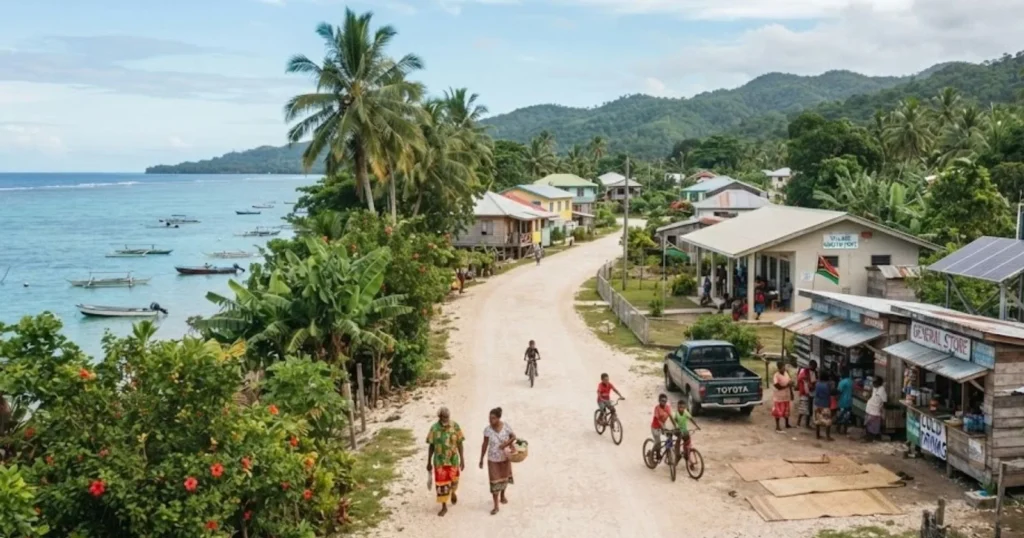
When a magnitude 7.3 earthquake struck near Port Vila on December 17, 2024, the United Nations estimated that 116,000 people, roughly one in three residents of Vanuatu, were directly affected. Almost every house in the capital sustained damage, and 16 people died. Less than a decade earlier, Category 5 Cyclone Pam had already devastated the same city.
Vanuatu’s population is growing at one of the faster rates in the Pacific, expanding by more than 2% a year, even as the country ranks among the most disaster-exposed nations on Earth. That combination, rapid demographic growth layered onto extreme natural hazard exposure and a genuinely difficult island geography, defines Vanuatu’s population challenge more than any single statistic.
Vanuatu’s 2020 National Population and Housing Census recorded 300,019 residents, spread across 83 main islands, of which roughly 63 are permanently inhabited. By 2026, that figure has grown to an estimated 342,600 to 343,200, a gain of more than 40,000 people in just six years.
Vanuatu Population at a Glance
| Metric | Figure | Year / Source |
|---|---|---|
| Resident population (census) | 300,019 | 2020 Census, Vanuatu Bureau of Statistics |
| Resident population (estimate) | 342,600–343,200 | 2026, UN-based estimates |
| Land area | 12,190–12,281 km² | UN Statistics Division / Vanuatu Bureau of Statistics |
| Population density | ~28 per km² | 2026 estimate |
| Annual population growth rate | 2.16–2.21% | 2026 estimate |
| Median age | 20.3–21.4 years | 2026 estimate |
| Urban population share | 22.3% (2020 Census); 25.5% (2026 est.) | Vanuatu Bureau of Statistics / UN |
| Total fertility rate | 2.66–2.87 children per woman | Recent estimates |
| Life expectancy | 72–75.1 years | 2022–2026 estimates |
| Number of indigenous languages | 138 | Vanuatu Bureau of Statistics |
Where Vanuatu’s Population Lives
Vanuatu is divided into six provinces: Torba, Sanma, Penama, Malampa, Shefa and Tafea. The 2020 Census recorded Shefa, home to the capital Port Vila on the island of Efate, as the most populous province at 54,953 residents, followed by Tafea at 45,714 and Sanma at 43,165. Torba, the northernmost and most remote province, recorded just 11,330 people, the smallest of the six.
Port Vila itself held 49,034 residents at the 2020 Census, or 16.3% of the national population, making it comfortably the largest urban center. Luganville, the country’s second city, located on Espiritu Santo island in Sanma Province, held 17,719 residents. Combined, Vanuatu’s two urban centers accounted for 66,753 people, or 22.25% of the national population, while 233,266 people, nearly 78%, lived in rural, largely dispersed island and village settings.
| Province | 2020 Census Population | Share of National Total | Capital / Main Town |
|---|---|---|---|
| Shefa | 54,953 | 18.3% | Port Vila |
| Tafea | 45,714 | 15.2% | Isangel |
| Sanma | 43,165 | 14.4% | Luganville |
| Malampa | 42,499 | 14.2% | Lakatoro |
| Penama | 35,607 | 11.9% | Saratamata |
| Torba | 11,330 | 3.8% | Sola |
| Urban total (Port Vila + Luganville) | 66,753 | 22.3% | — |
| Rural total | 233,266 | 77.8% | — |
Why Vanuatu’s Population Is Growing
Vanuatu’s population growth rate of roughly 2.16% to 2.21% a year is well above the global average and among the higher rates in the Pacific Islands region, though it has eased from a peak of around 3.1% in 1978. This growth is driven overwhelmingly by natural increase: a birth rate around 21.6 per 1,000 population against a death rate of just under 4 per 1,000, combined with a comparatively small net migration rate of roughly negative 1.3 per 1,000, meaning migration has only a minor dampening effect on growth, unlike in Fiji, Samoa or Tonga.
Vanuatu’s total fertility rate of 2.66 to 2.87 children per woman, while above global replacement level, has declined from considerably higher levels in past decades, part of a gradual but still incomplete demographic transition. Life expectancy at birth of 72 to 75 years, similar to regional peers, reflects steady if uneven improvements in healthcare access.
Vanuatu’s Young Population
Vanuatu’s median age of 20.3 to 21.4 years places it among the youngest populations globally. Detailed 2021 age-sex estimates based on the 2020 Census show close to 39% of the population under 15, with the largest single five-year cohort being children aged 0 to 4, who make up nearly 14% of the total population. This youthful pyramid narrows sharply after the 20 to 24 age bracket, a pattern consistent with a population still in the middle of its fertility transition, where large numbers of children born in recent decades have not yet been matched by equivalent cohorts moving through working age and older brackets.
This age structure creates a specific development pressure: Vanuatu’s school-age population continues to grow year over year, requiring sustained investment in primary and secondary education infrastructure even as the country works to expand formal employment opportunities for the wave of young adults who will enter the labor market over the next decade.
Population Growth and Infrastructure
Vanuatu’s rapid population growth collides directly with the country’s dispersed, disaster-exposed geography. With 83 main islands spread across roughly 1,300 kilometers of ocean and only about 63 of them permanently inhabited, extending consistent roads, electricity, water, sanitation and healthcare to the entire population is logistically far more expensive per capita than in a geographically compact country of similar population size.
Rural areas, home to nearly 78% of Vanuatu’s population, generally have less reliable access to paved roads, grid electricity and piped water than Port Vila and Luganville, though rural electrification and mobile phone coverage have both expanded substantially over the past decade.
Natural disasters compound this challenge in ways that repeatedly set back infrastructure gains. Cyclone Pam, a Category 5 storm that struck in March 2015, caused extensive damage to Port Vila and outer islands alike. Less than ten years later, the December 2024 magnitude 7.3 earthquake near Port Vila damaged almost every house in the capital and directly affected an estimated 116,000 people, close to a third of the country’s population, according to UN humanitarian assessments. Each major disaster event forces Vanuatu to rebuild infrastructure even as its population and corresponding service demands continue to grow.
Urbanization and Port Vila
Port Vila’s urban population grew from a much smaller base in the mid-20th century to 49,034 residents by 2020, concentrating an increasing share of Vanuatu’s economic activity, government administration and formal employment on a single, relatively compact urban footprint on Efate island. This concentration brings its own pressures: urban land availability, housing affordability and municipal service capacity in Port Vila have all come under strain as the city’s population share of the national total has climbed toward 16% to 17%, with informal and semi-formal settlements expanding on the city’s outskirts to absorb continued rural-to-urban migration.
Geographic Fragmentation
Vanuatu’s insular geography means that infrastructure investment cannot simply follow a single national grid model. Each of the six provinces spans multiple islands, some of which have no reliable inter-island transport beyond small boats or infrequent flights. This fragmentation means the cost of delivering a school, clinic or reliable power supply to a remote island community in, for example, Torba Province, Vanuatu’s smallest and most northern province at just 11,330 people, is disproportionately higher per resident than delivering the same services in the more concentrated population centers of Shefa or Sanma provinces.
Natural Disasters and Population Resilience
Vanuatu consistently ranks among the world’s most disaster-prone countries relative to its population, owing to its location on the Pacific Ring of Fire and its exposure to tropical cyclones. This vulnerability directly intersects with population planning: disaster response and recovery infrastructure, evacuation routes, cyclone-resistant building codes, and health system surge capacity; all have to be sized not just for Vanuatu’s current population of roughly 343,000 but for a population that continues to grow by more than 2% annually even as it faces recurring, large-scale disaster displacement. The 2024 earthquake’s displacement of a third of the national population within a single event illustrates just how quickly disaster impact can outpace even well-planned infrastructure investment in a country this geographically exposed.
Future Population and Infrastructure Needs
Long-range population projections put Vanuatu’s population at well over 860,000 by the end of the century under continued growth assumptions, more than double the current population. Even under more conservative medium-variant projections, Vanuatu’s population is expected to keep growing steadily through at least mid-century, driven by fertility still above replacement level and a youthful age structure that guarantees continued population momentum for decades regardless of any near-term fertility decline.
This trajectory means Vanuatu’s infrastructure planning challenge will intensify rather than ease in the coming years. A rural, dispersed, disaster-exposed population that is both growing quickly and increasingly urbanizing toward Port Vila requires simultaneous investment in outer-island resilience and urban capacity, a dual burden that few countries of Vanuatu’s size and resource base have to manage at once.
Key Findings
- Vanuatu’s population grew from 300,019 at the 2020 Census to an estimated 342,600-343,200 by 2026, an increase of more than 40,000 people, or roughly 14%, in six years.
- Vanuatu’s population growth rate of 2.16% to 2.21% annually is driven almost entirely by natural increase, with net migration playing only a minor role compared with Fiji, Samoa or Tonga.
- Nearly 78% of Vanuatu’s population lives in rural areas spread across dozens of islands, while just 22.3% lives in the country’s two urban centers, Port Vila and Luganville.
- The December 2024 magnitude 7.3 earthquake near Port Vila directly affected an estimated 116,000 people, roughly a third of Vanuatu’s national population, in a single event.
- Vanuatu’s median age of 20.3 to 21.4 years and nearly 39% under-15 population share point to sustained demographic momentum and continued school-age population growth for years to come.
- Shefa Province, home to Port Vila, is Vanuatu’s most populous province at 54,953 residents, while Torba Province, the most remote, has just 11,330.
- Vanuatu’s population is projected to more than double by the end of the century under current UN medium-variant assumptions, driven by fertility that remains above replacement level.
Frequently Asked Questions
1. What is Vanuatu’s population?
Vanuatu’s 2020 census recorded 300,019 residents. Current estimates for 2026 put the population at approximately 342,600 to 343,200.
2. How fast is Vanuatu growing?
Vanuatu’s population is growing at approximately 2.16% to 2.21% per year, among the faster growth rates in the Pacific Islands, though down from a peak of around 3.1% in 1978.
3. Which islands have the largest populations?
Efate, home to the capital Port Vila, is Vanuatu’s most populated island. Santo Island in Sanma Province is the largest island by land area but is less densely populated than Efate.
4. Why is infrastructure difficult to provide in Vanuatu?
Vanuatu’s population is spread across 83 main islands, of which about 63 are permanently inhabited, meaning roads, electricity, water and healthcare infrastructure must be extended across dispersed, often hard-to-reach communities rather than a single connected landmass.
5. Is Vanuatu mostly rural?
Yes. Approximately 78% of Vanuatu’s population lives in rural areas, according to the 2020 Census, with just 22.3% living in the urban centers of Port Vila and Luganville.
6. How many people live in Port Vila?
Port Vila, Vanuatu’s capital and largest city, had 49,034 residents at the 2020 Census, representing 16.3% of the national population.
7. How young is Vanuatu’s population?
Vanuatu’s median age is 20.3 to 21.4 years, and close to 39% of the population is under 15, making it one of the youngest national populations in the Pacific.
8. How many languages are spoken in Vanuatu?
Vanuatu is home to 138 indigenous languages, alongside Bislama, English and French, which hold official status. Bislama, a creole, is understood by the large majority of the population as a common language.
9. How vulnerable is Vanuatu to natural disasters?
Vanuatu is one of the most disaster-exposed countries in the world relative to its population. The December 2024 earthquake near Port Vila directly affected an estimated 116,000 people, about a third of the national population, following earlier widespread damage from Cyclone Pam in 2015.
10. What will Vanuatu’s population be in the future?
Long-range projections suggest Vanuatu’s population could exceed 860,000 by the end of the century, more than double the current population, driven by a fertility rate that remains above replacement level and a young age structure.
Sources
- Vanuatu Bureau of Statistics, 2020 National Population and Housing Census, Basic Tables Report Volume 1
- Pacific Community (SPC), Statistics for Development Division, Vanuatu 2020 Census Analytical Report Volume 2
- United Nations, Department of Economic and Social Affairs, Population Division, World Population Prospects: The 2024 Revision
- United Nations Office for the Coordination of Humanitarian Affairs (OCHA), December 2024 Vanuatu earthquake situation reports
- Wikipedia, Demographics of Vanuatu and Port Vila (population and age-structure data cross-referenced against Vanuatu Bureau of Statistics sources)
- World Bank, World Development Indicators, Vanuatu population growth data
- Geodatos, Vanuatu population indicators (2026)





