Afghanistan has a very young population and one of the highest fertility rates outside sub-Saharan Africa. Those facts describe demographic potential. Whether the potential becomes human capital, meaning the education, health and skills that let people work and earn, depends on access to schools, health services and jobs. On current evidence, that access is narrowing for large groups, most visibly for girls and women.
Afghanistan’s Population Size and Demographic Structure
Population estimates vary because there is no recent census. Afghanistan’s National Statistics and Information Authority published estimates of roughly 32 to 33 million for the early 2020s, based on a 2003 to 2005 household listing and projections.
United Nations estimates are higher, at roughly 41 to 43 million for the mid 2020s, which reflects different assumptions about fertility, mortality, and the return of refugees. The difference of close to ten million is a measure of data uncertainty, not a rounding gap.
| Source | Approximate population | Basis |
|---|---|---|
| National Statistics and Information Authority (pre 2021) | About 32 to 33 million | Projections from earlier listings |
| United Nations World Population Prospects | About 41 to 43 million | Model-based estimates |
| World Bank | Follows UN series | Model based |
Age structure is clearer in direction. About two-fifths of residents are under 15, and the median age is around 17 to 18 years, among the lowest in the world. Population growth is estimated at roughly 2.4 to 2.8 percent a year in recent UN series, though large return flows and migration make year-to-year numbers volatile.
Because of the missing census, every Afghanistan population figure should be stated with its source, year, and method. Comparisons across sources should not be treated as precise, and national projections should be seen as ranges.
Why Afghanistan Has a Young Population Structure
A young structure comes from high fertility and, historically, high child mortality, which together produce large cohorts of children. The total fertility rate is estimated at about 4.8 to 5 births per woman in recent UN series, and the 2015 Afghanistan Demographic and Health Survey recorded a higher rate near 5.3. Household sizes are large, and women often marry young.
| Factor | Role | Evidence |
|---|---|---|
| High fertility | Large birth cohorts | TFR about 4.8 to 5 |
| Child mortality decline | More children survive | Under-five mortality fell but remains high |
| Early marriage | Longer reproductive span | Survey data |
| Low contraceptive use | Fewer birth spacing options | Survey data |
| Past conflict and displacement | Disrupted services, return flows | UN and agency reports |
A large youth population does not automatically create an economic dividend. A dividend requires that the large share of young people become educated, healthy and employed. If it does not, the same age structure produces high dependency, heavy demand for services and pressure on households.
Education and the Foundations of Human Capital
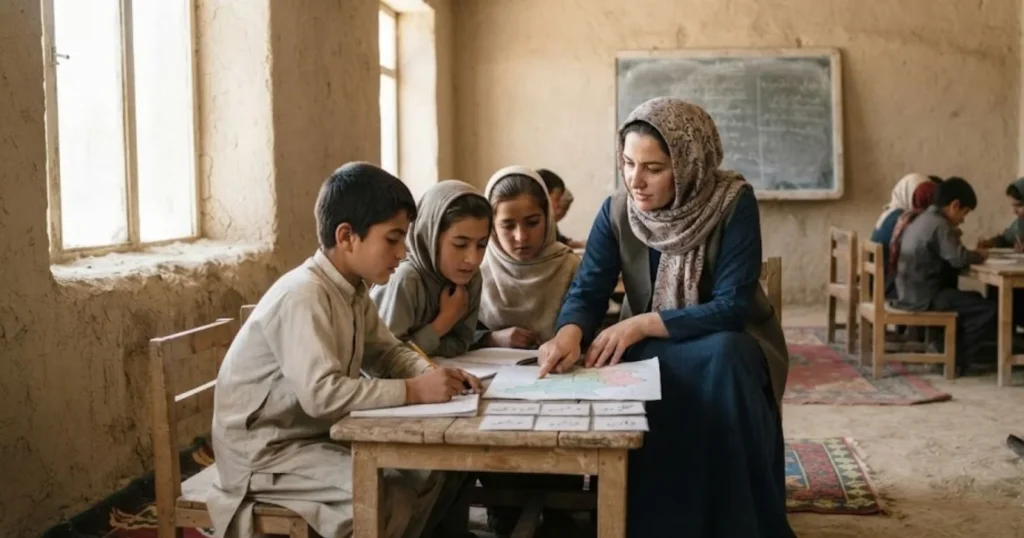
Education is the area with the clearest recent evidence. UNESCO reported in 2026 that more than half of primary school-age children are completely out of school, that over 90 percent of 10-year-olds cannot read a simple text, and that learning outcomes are very weak for those who attend. Enrollment, attendance, completion, and learning are different measures, and Afghanistan performs poorly on all four.
| Stage | Access | Learning | Notes |
|---|---|---|---|
| Primary | More than half of primary-age children out of school, per UNESCO 2026 | Over 90% of 10-year-olds cannot read simple text | Girls and rural children most affected |
| Secondary | Closed to girls since March 2022 | Not applicable for girls | Boys attend with teacher shortages |
| Higher education | Closed to women since December 2022 | Not applicable for women | Men’s institutions face funding limits |
| Technical and vocational | Limited provision | Varied | Women barred in most programs |
Data limits are serious. Administrative reporting has changed, household surveys have limited coverage, and access constraints affect fieldwork. Conclusions should rest on multiple sources and carry caveats about coverage.
Opportunity also differs by location. Urban children in Kabul, Herat, or Mazar have more schools than rural children in remote provinces, and community-based education supported by UNESCO and UNICEF has become an important alternative.
Girls’ and Women’s Education as a Human Capital Issue
Verified policy status as of the latest reporting in August 2026 is as follows. Girls were barred from secondary school in March 2022. Women were barred from universities in December 2022. UNESCO said Afghanistan remains the only country in the world that formally bans girls and women from secondary and higher education.
Reports in late 2024 also described closures of nursing and midwifery training for women, which removed one of the last remaining paths to professional training. These facts are time-sensitive and should be checked again at publication.
| Indicator | Figure | Source and date |
|---|---|---|
| Girls denied secondary education | About 2.4 million | UNESCO, August 2026 |
| Increase over previous year | About 200,000 | UNESCO, August 2026 |
| Earlier estimate | 2.2 million | UNESCO and UNICEF, January 2026 |
| Projection if ban persists | Nearly 4 million by 2030 | UNESCO, August 2026 |
| Girls enrolled in secondary in 2021 | Nearly 1 million | UNESCO |
| Estimated cumulative income loss | US$9.6 billion by 2066 | UNESCO estimate |
| Women potentially leaving the workforce | About 600,000 by 2066 | UNESCO estimate |
| Female teacher deficit | More than 11,000 by 2030 | UNESCO estimate |
The consequences for skills formation are direct. Without secondary and university education, women cannot become doctors, teachers, engineers, or managers, and the pool of trained female health workers shrinks at a time when women can often only be treated by women. Measured outcomes such as the number of girls out of school are firm. Long-term projections of income loss and workforce effects are model-based estimates that depend on assumptions about how long restrictions last and how the economy evolves, and they should not be presented as certain.
Restrictions also affect boys indirectly. UNESCO noted that the shortage of female teachers has left boys taught by less qualified teachers, and the loss of women teaching boys reduces teaching quality.
Maternal Health, Child Health, and Nutrition
Health indicators are among the weakest in the region. UN estimates put maternal mortality at about 620 deaths per 100,000 live births in 2020, among the highest outside Africa. Under-five mortality is estimated at roughly 55 to 60 per 1,000 births. More than a third of children are stunted according to recent nutrition surveys, and acute malnutrition spikes in conflict, drought, and displacement.
| Indicator | Approximate level | Source type |
|---|---|---|
| Maternal mortality | About 620 per 100,000 live births (2020) | UN estimates |
| Under-five mortality | Roughly 55 to 60 per 1,000 | UN IGME |
| Child stunting | More than one-third | Nutrition surveys |
| Vaccination | Coverage gaps, polio endemic | WHO, UNICEF |
| Health workforce | Shortage of female staff | Agency reports |
Health affects education and productivity. Stunted children learn less and earn less as adults, and maternal deaths deprive households of caregivers. Access to care depends on female health workers, so education restrictions that prevent training of midwives and nurses compound the health challenge. Aid funding cuts in recent years have also reduced clinics in some areas, and the effects should be monitored using WHO and OCHA reporting.
Employment, Skills, and the Future Workforce
The economy is largely informal, dominated by agriculture, small trade and services, with a large share of workers in unstable day labor. Women’s employment fell sharply after 2021 as restrictions limited work outside the home, and international agencies including the ILO documented large declines in female employment. Youth unemployment is high, though reliable figures are limited. The population estimates cited earlier are not employment estimates, and population-based projections of workers should not be mistaken for jobs.
| Workforce issue | Condition |
|---|---|
| Informality | Most work is informal and insecure |
| Women’s work | Sharply restricted since 2021 |
| Skills | Weak formal training, education interrupted |
| Youth | Large cohorts entering working age, few formal jobs |
| Remittances and aid | Important sources of household income |
Without education, the large youth cohort has little opportunity to build the skills required for higher productivity work. Vocational training and community programs exist at a small scale, and results are uneven.
Migration, Displacement, and Population Distribution
Different categories of people on the move need to be kept separate.
Refugees are people who crossed borders and are recognized by host states or the UN. Large Afghan refugee populations have lived in Pakistan and Iran for decades.
Internally displaced persons are people forced to leave homes who remain inside Afghanistan, whether because of conflict, drought, or disasters such as the 2023 Herat earthquakes and the 2025 earthquake in the east.
Returnees are people who came back from abroad. Since 2023, Pakistan and Iran have pressured or forced the return of well over two million Afghans, according to UNHCR and IOM reports, and many arrived in areas with little housing or work.
Other migrants include labor migrants and people moving to cities or abroad for economic reasons.
| Group | Definition | Pressure |
|---|---|---|
| Refugees abroad | Registered or undocumented in host countries | Legal status, deportation |
| Internally displaced persons | Moved within Afghanistan | Shelter, food |
| Returnees | Came back from Pakistan, Iran, and elsewhere | Housing, jobs, services |
| Labor migrants | Seasonal or longer work abroad | Remittances, risk |
| Permanent relocation | Resettled in another place | Integration |
Large returns increase population in receiving provinces and change the age and sex mix. They also add to demand for schools and clinics where capacity is already limited. The humanitarian caseload remains very large, with United Nations appeals counting more than 20 million people needing assistance.
Geographic and Regional Differences in Human Capital
Conditions differ across provinces and between urban and rural areas. Kabul, Herat, Balkh and Nangarhar have larger populations and more services. Remote provinces in the central highlands, the northeast and the south have fewer schools, clinics and roads. Conflict, drought and earthquake damage affect some provinces more than others.
Data are incomplete, so a complete provincial ranking cannot be responsibly produced. What can be said is that the urban-rural and province gaps in school access, health facilities, and economic opportunity are large, and that comparable provincial indicators need surveys that cover remote areas.
| Dimension | Urban | Rural |
|---|---|---|
| Schools | More available | Distance and shortages |
| Health services | Hospitals, clinics | Few facilities, fewer female staff |
| Employment | Informal services, trade | Agriculture, seasonal labor |
| Connectivity | Better | Limited roads and electricity |
Poverty, Household Resources, and Human Capital Investment
Poverty is widespread, and household resources limit investment in children. Food insecurity, high food prices, and loss of aid have reduced incomes, and families face trade-offs between feeding children, paying for schooling, and treating illness. Education costs include supplies, transport and lost child labor. Direct survey evidence from the World Bank, WFP and UN agencies documents these constraints, while wider development analysis supplies context.
| Trade off | Household decision | Effect on human capital |
|---|---|---|
| Food versus school costs | Children may work | Lower attendance |
| Health spending | Delay treatment | Worse health |
| Early marriage | Reduces cost of daughters | Ends education |
| Migration | Send members abroad | Remittances, family separation |
What Afghanistan Needs to Improve Human Capital
| Need | Reasoning | Evidence level |
|---|---|---|
| Restoring girls’ and women’s access to secondary and higher education | Largest single loss of human capital | Strong evidence of harm from restrictions |
| Community-based education | Reaches children outside schools | Program evaluations are limited |
| Support for female teachers and health workers | Restores service capacity | Strong rationale |
| Nutrition and maternal health services | Raises survival and learning | Strong |
| Vocational training and jobs | Turns skills into income | Mixed |
| Better data and a census | Planning basis | Strong rationale |
Some recommendations are well supported by evidence, such as maternal health interventions and nutrition programs. Others, such as the effects of specific vocational programs in current conditions, need further evaluation. Policy choices depend on political conditions that analysts cannot assume will change.
Afghanistan’s Population and Human Capital Outlook Through 2050
UN medium variant projections show Afghanistan’s population continuing to grow rapidly through 2050, with fertility declining but remaining above replacement, so the population could approach or exceed 60 million by mid-century depending on the scenario. The projections are uncertain because of the missing census, migration swings, and the unpredictable effect of fertility change.
| Scenario | Fertility | Education access | Outcome |
|---|---|---|---|
| Restoration of access | Declines faster as girls’ schooling returns | Improving | Lower growth, higher human capital over time |
| Status quo | Declines slowly | Restricted | High growth, weak human capital |
| Deterioration | Little decline | Worse | Heavy dependency, humanitarian need |
Demographic projections should be kept separate from education and economic scenarios, and none should be treated as a precise forecast of income. UNESCO’s own estimates of income loss are conditional on the persistence of restrictions.
Frequently Asked Questions
1. How large is Afghanistan’s population?
Estimates range from about 32 to 33 million (pre-2021 national estimates) to roughly 41 to 43 million (United Nations), because there is no recent census.
2. Why is Afghanistan’s population relatively young?
High fertility, around 4.8 to 5 births per woman, and historically high child mortality created large cohorts of children.
3. How does education affect Afghanistan’s human capital?
Education builds skills and health knowledge, and with more than half of primary-age children out of school and weak learning, human capital is low.
4. How do restrictions on girls’ education affect future development?
UNESCO reports 2.4 million girls barred from secondary school and estimates large long-run income and workforce losses if the ban persists, though those projections are estimates.
5. How will Afghanistan’s population change by 2050?
UN projections show continued growth, with uncertainty from fertility, migration, and data limits.
6. How does displacement affect Afghanistan’s demographic outlook?
Returns of well over two million people since 2023 and internal displacement change local populations and strain services.
7. What is the maternal mortality ratio?
About 620 deaths per 100,000 live births in 2020, according to UN estimates.
8. When were girls barred from secondary school?
March 2022, with universities closed to women in December 2022.
9. Is Afghanistan the only country with such a ban?
UNESCO says it is the only country that formally bans girls and women from secondary and higher education.
10. Why do population estimates differ?
No comprehensive census has been completed, so models rely on assumptions.
Sources and Data Notes
- UNESCO press statements and briefings (January and August 2026); UNICEF Afghanistan.
- United Nations, World Population Prospects 2024; UN IGME; WHO and UN maternal mortality estimates.
- UNHCR, IOM and OCHA reporting on returns and humanitarian needs; World Bank; ILO.
- Afghanistan National Statistics and Information Authority (pre-2021 estimates); Afghanistan Demographic and Health Survey 2015.
- Data note: education policy status and return figures are time-sensitive. Verify before publication. Income loss figures are UNESCO estimates.