
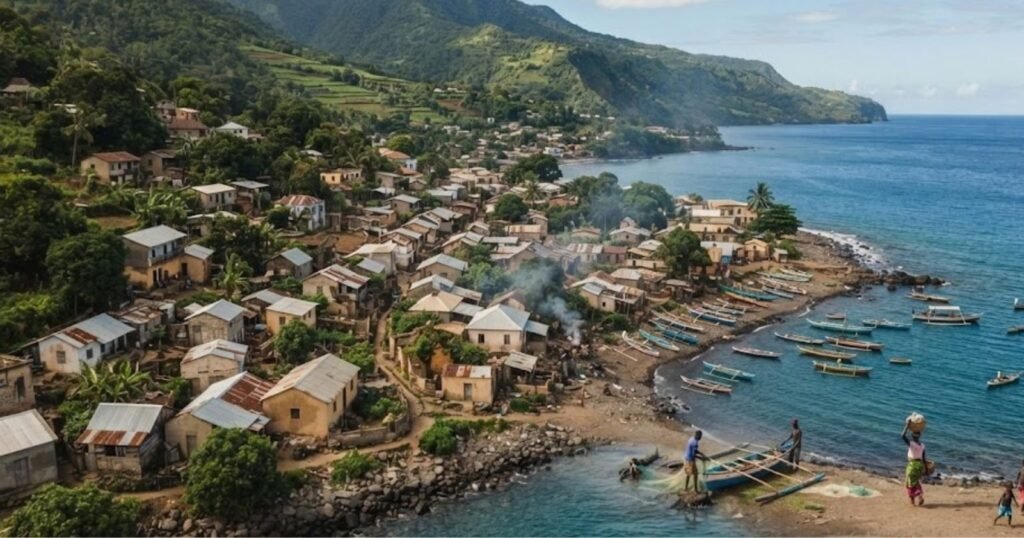
Comoros counted approximately 869,000 to 912,000 residents in 2025-26, packed onto three volcanic islands, Grande Comore, Anjouan, and Mohéli, with a combined land area of just 2,235 square kilometers, smaller than the U.S. state of Rhode Island. That produces a national population density of roughly 483 to 533 people per square kilometer, among the highest in Africa, but even that striking average understates the crowding on Comoros’s most populous island: Anjouan alone reached a density of 772 people per square kilometer as far back as 2017.
Comoros’s demographic story cannot be separated from its political history. Since gaining independence from France in 1975, the country has experienced six successful coups, in 1975, 1978, 1989, 1999, 2008, and 2011, along with numerous attempted coups, a level of institutional instability that has shaped everything from public investment capacity to the scale of emigration toward France and its nearby territory of Mayotte, which together host one of the largest Comorian diaspora communities relative to the size of the home population found anywhere in the world.
Comoros Population at a Glance
| Metric | Figure | Year |
|---|---|---|
| Total population | 869,000 to 992,000 | 2023-26 |
| Annual growth rate | 1.3% to 2.4% | 2023-26 |
| Median age | 20.7 to 21.7 years | 2026 |
| Total fertility rate | 3.6 to 4.3 children per woman | 2025-26 |
| Population density (national average) | 483 to 533 people per km² | 2026 |
| Anjouan population density | 772 people per km² | 2017 |
| Grande Comore population density | 331 to 450,000 residents (2024 est.) | 2017-24 |
| Mohéli population density | 178 people per km² | 2017 |
| Life expectancy at birth | 67.5 years | 2026 |
| GDP per capita | approximately $408 to $1,600 (estimates vary widely) | 2024-26 |
| Remittances as share of GDP | approximately 20% to 25% | recent estimate |
The wide range in GDP per capita estimates, from $408 according to WorldPopulationClock.net’s analysis to $1,500 to $1,600 according to Africa Research’s compilation, reflects genuinely different methodologies and reference periods, but every source agrees Comoros ranks among the poorest countries in the world, with WorldPopulationClock.net specifically noting Comoros’s per capita income trails only the Central African Republic among African nations on some measures.
Population by Island
Comoros’s population distribution across its three islands reveals sharp differences in density and settlement pressure. Anjouan, the most crowded island, recorded a population density of 772 people per square kilometer as of 2017, making it one of the most densely populated pieces of land anywhere in the Indian Ocean region.
Grande Comore, the largest island by area and home to the capital, Moroni, recorded a somewhat lower density of 331 people per square kilometer in the same year, though its population has continued growing, reaching an estimated 450,000 residents by 2024 according to Wikipedia’s compilation of island-level data, more than double its 2003 census figure of 295,700. Mohéli, the smallest and least populous of the three main islands, recorded the lowest density, at 178 people per square kilometer as of 2017.
For comparison, Wikipedia’s demographic profile notes that these densities sit within a range similar to other Indian Ocean island microstates as of a 1993 comparison, from Seychelles at 241 people per square kilometer to the Maldives at 690, underscoring that extreme land pressure is a structural feature of small island nations in this part of the world rather than something unique to Comoros alone.
Why Population Density Matters in an Island State
Comoros’s combination of high population density and severely limited arable land creates persistent pressure on food production, housing, and basic infrastructure that differs meaningfully from population pressure in larger, less geographically constrained countries.
With virtually no capacity to expand agricultural land beyond what each island’s volcanic terrain already supports, population growth in Comoros translates more directly and more quickly into land scarcity and housing pressure than it would in a country with a larger reserve of uncultivated but usable land.
This land constraint has historically been a significant driver of Comorian emigration, both toward Mayotte, the neighboring island that remains a French department and has attracted large numbers of Comorian migrants seeking better economic opportunity just a short sea crossing away, and toward mainland France itself, where an established and economically significant Comorian diaspora community has developed over several decades.
Fertility and Youth Structure
Comoros’s total fertility rate is estimated between 3.6 and 4.3 children per woman depending on the source, producing a youthful population pyramid with a median age of just 20.7 to 21.7 years as of 2026. WorldPopulationClock.net’s analysis notes that Comoros’s population has grown from just 250,000 at the time of independence in 1975 to its current level near 869,000 to 912,000, driven by sustained high fertility despite the extreme poverty and political instability that has characterized much of the country’s post-independence history.
Population growth peaked at approximately 3.42% annually in 1974, according to Geodatos’s demographic analysis, and has since moderated to approximately 1.34% to 2.4% depending on the specific year and source, though this remains above the global average and continues to add meaningful pressure to an already land-constrained country.
Migration and the Comorian Diaspora
The Comorian diaspora in France and Mayotte represents one of the most economically significant migration relationships found anywhere relative to a home country’s population size. Africa Research’s statistical profile describes remittances from this diaspora as functioning as a de facto social safety net for many Comorian families, with World Bank data putting remittances at roughly 20% to 25% of Comoros’s GDP, one of the highest such ratios recorded anywhere in Africa.
This remittance dependence reflects the structural reality of Comoros’s economy: a narrow export base built around vanilla, cloves, and ylang-ylang essential oil, for which Comoros has historically ranked among the world’s top producers, generates significantly less revenue than the country’s import needs, with remittances from the diaspora bridging much of that gap. Net migration figures reflect this same pattern, with Comoros recording consistent net emigration in recent annual demographic data, meaning more Comorians leave the country each year than arrive.
Urbanization and Economic Opportunity
Comoros remains only modestly urbanized, with roughly 34% of the population living in urban areas as of 2026, and even the largest urban centers remain small in absolute terms. Moroni, the capital on Grande Comore, holds an estimated metropolitan population of approximately 74,700 to 90,400 depending on the boundary used, representing roughly 8% to 10% of the national population, while Moutsamoudou on Anjouan and Fomboni on Mohéli follow as substantially smaller secondary centers, with an estimated 26,300 and 17,300 residents respectively.
This limited urbanization, combined with the country’s narrow economic base and history of political instability, has constrained the development of large-scale formal employment opportunities within Comoros itself, reinforcing the economic importance of diaspora remittances and continued emigration as pressure-release mechanisms for a population that continues to grow within a fixed and very limited land area.
Climate and Environmental Constraints
Comoros’s volcanic island geography brings both fertile soil, useful for the vanilla, clove, and ylang-ylang cultivation that anchors the country’s export economy, and significant environmental vulnerability, including active volcanism on Grande Comore, where Mount Karthala remains one of the most active volcanoes in the world, alongside exposure to cyclones and rising sea levels that threaten low-lying coastal settlements across all three islands.
These environmental pressures compound the land scarcity already created by high population density, leaving limited buffer capacity to absorb the effects of natural disasters or climate-related disruption to agriculture, a vulnerability shared broadly across small island developing states but intensified in Comoros’s case by the country’s already constrained economic and institutional capacity.
Comoros Population Outlook
World Population Review’s long-range projection puts Comoros’s population at approximately 1.89 million by 2097, more than double its current level, driven by continued, if moderating, population momentum from the country’s still-youthful age structure. Whether this projected growth can be accommodated within Comoros’s severely limited land area without intensifying the food security, housing, and environmental pressures already evident on Anjouan in particular will depend heavily on continued economic diversification, further improvements in agricultural productivity, and the continued role of diaspora remittances and emigration as a release valve for population pressure that the islands’ own land base cannot fully absorb.
Continued political stability, following the pattern of relative calm since the last successful coup in 2011, will also likely play a significant role in determining whether Comoros can attract the kind of sustained public and private investment needed to expand economic opportunity within the country itself, rather than continuing to rely so heavily on emigration and remittances as its primary economic pressure valve.
Key Findings
- Comoros’s population reached approximately 869,000 to 992,000 in 2025-26, packed onto just 2,235 square kilometers across three volcanic islands.
- Anjouan, the most densely populated island, reached 772 people per square kilometer as of 2017, among the highest densities recorded anywhere in the Indian Ocean region.
- Comoros has experienced six successful coups since its 1975 independence, creating decades of institutional instability that has shaped both economic development and emigration patterns.
- Remittances from the Comorian diaspora in France and Mayotte represent an estimated 20% to 25% of GDP, one of the highest such ratios in Africa.
- Fertility remains estimated between 3.6 and 4.3 children per woman, producing a young population with a median age of just 20.7 to 21.7 years.
- Only about 34% of Comorians live in urban areas, with Moroni, the largest city, holding fewer than 100,000 residents.
- Long-range projections put Comoros’s population at approximately 1.89 million by 2097, more than double current levels, within a land area that offers little room for expansion.
Frequently Asked Questions
1. How many people live in Comoros?
Comoros’s population is estimated at approximately 869,000 to 992,000 as of 2025-26, depending on the data source, based on UN World Population Prospects 2024 Revision figures and national statistical estimates.
2. Which Comoros island has the largest population?
Grande Comore, home to the capital Moroni, is the largest island by both area and population, with an estimated 450,000 residents as of 2024, though Anjouan is more densely populated, at 772 people per square kilometer as of 2017 compared with Grande Comore’s 331.
3. Why is Comoros densely populated?
Comoros packs its population onto just 2,235 square kilometers of volcanic island terrain with severely limited arable land, producing a national population density of 483 to 533 people per square kilometer, among the highest in Africa.
4. How important is the Comorian diaspora?
The Comorian diaspora in France and its nearby territory of Mayotte sends remittances estimated at 20% to 25% of Comoros’s GDP, one of the highest remittance-to-GDP ratios in Africa, functioning as a de facto social safety net for many families.
5. What is Comoros’s fertility rate?
Estimates place Comoros’s total fertility rate between 3.6 and 4.3 children per woman as of the mid-2020s, producing a youthful population with a median age of just 20.7 to 21.7 years.
6. How has political instability affected Comoros’s population?
Comoros has experienced six successful coups since its 1975 independence, creating decades of institutional instability that has constrained economic development and reinforced emigration toward France and Mayotte as an economic pressure valve.
7. What is Comoros’s main export economy?
Comoros’s economy relies on a narrow export base of vanilla, cloves, and ylang-ylang essential oil, for which the country has historically ranked among the world’s top producers, though this generates significantly less revenue than the country’s import needs.
8. How urbanized is Comoros?
Only about 34% of Comorians lived in urban areas as of 2026, with Moroni, the capital and largest city, holding an estimated 74,700 to 90,400 residents, representing roughly 8% to 10% of the national population.
9. What environmental risks does Comoros face?
Comoros faces active volcanism, particularly from Mount Karthala on Grande Comore, one of the most active volcanoes in the world, alongside cyclone exposure and rising sea levels that threaten low-lying coastal settlements across all three islands.
10. What will Comoros’s population be in the future?
Long-range projections put Comoros’s population at approximately 1.89 million by 2097, more than double current levels, a trajectory that will place continued pressure on the country’s severely limited land area and arable land base.
Sources
- United Nations, Department of Economic and Social Affairs, Population Division, World Population Prospects: The 2024 Revision
- CIA World Factbook, Comoros country profile and demographic data
- Wikipedia, Demographics of the Comoros, Grande Comore
- Africa Research, Comoros statistics: population, economy, trade and telecom
- WorldPopulationClock.net, Comoros Population Live Clock
- Geodatos, Population of Comoros 2026
- World Population Review, Comoros Population 2026





