
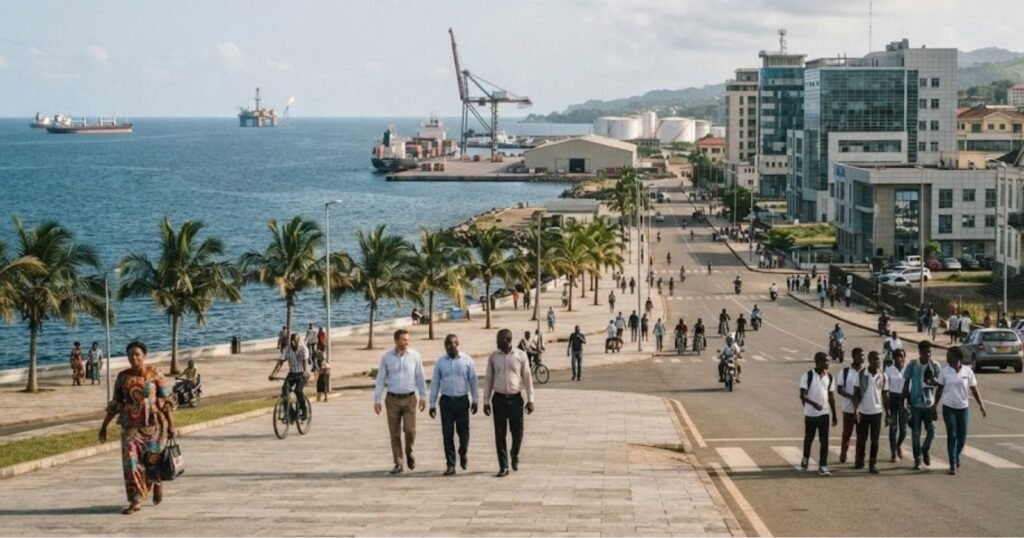
Equatorial Guinea’s population stood at approximately 1.8 to 1.98 million as of 2024-26, one of the smallest national populations in mainland Africa, spread across a country of just 28,000 square kilometers split between a mainland region, Río Muni, and several islands, most notably Bioko, where the long-standing capital of Malabo sits. That small population base, combined with oil reserves discovered in 1996 that made Equatorial Guinea the third-largest oil producer in sub-Saharan Africa by the mid-2000s, produced one of the most dramatic GDP-per-capita transformations recorded anywhere in the world.
The uncomfortable second half of that story is that Equatorial Guinea’s oil wealth has not been distributed anywhere close to evenly. Despite ranking among Africa’s wealthiest nations by GDP per capita in nominal dollar terms during the oil boom years, roughly half the population lived below the national poverty line as of the most recent 2024 household survey, and the country now faces a shrinking oil sector without a clearly established alternative source of broad-based income growth.
Equatorial Guinea’s Population at a Glance
| Metric | Figure | Year |
|---|---|---|
| Total population | 1.8 to 1.98 million | 2024-26 |
| Citizens (Equatoguinean nationals) | approximately 950,000 of 1.6 million residents (older estimate) | recent years |
| GDP per capita (nominal) | approximately $5,000 to $7,750 | 2024-25 |
| GDP per capita (PPP) | approximately $15,450 to $20,170 | 2024-25 |
| Population below national poverty line | approximately 50.7% to two-thirds | 2020-24 |
| Population in extreme monetary poverty | 11.3% (approximately 181,000 people) | 2024 |
| Human Development Index | 0.650 to 0.674 (medium) | 2022-25 |
| Unemployment rate | 8.3% to 8.7% | 2023-25 |
| Ethnic composition | approximately 85% Fang, 6.5% Bubi | 2025 |
| Urban population share | approximately 75% | 2019 |
Sources: World Bank, African Development Bank, UNICEF Equatorial Guinea Annual Report 2025, Wikipedia Economy of Equatorial Guinea, ISS Africa Futures, World Atlas.
The gap between GDP per capita figures, which briefly made Equatorial Guinea appear as wealthy as several wealthy European nations during the peak of the oil boom in the mid-2000s, and the reality that roughly half the population remains below the national poverty line as of the latest 2024 survey, is one of the starkest examples anywhere in the world of how aggregate resource wealth can diverge from household living standards.
Population Distribution Across the Mainland and Islands
Equatorial Guinea’s territory is split between Río Muni, the mainland portion bordering Cameroon and Gabon, and several islands in the Gulf of Guinea, most significantly Bioko Island, where Malabo, the country’s long-standing capital, is located. Bata, on the mainland, is Equatorial Guinea’s largest city by population, even though Malabo has functioned as the political capital for decades.
In 2026, the government designated Ciudad de la Paz, a newly built city on the mainland, as the official capital by presidential decree, though ministries continued operating from Malabo and Bata as the transition proceeded.
ISS Africa Futures data from 2019 noted that Equatorial Guinea’s largest cities, Bata and Malabo, both had fewer than 200,000 inhabitants at that time, reflecting how genuinely small the country’s urban population remains even relative to its already small national population. Roughly three-quarters of Equatorial Guinea’s population lived in urban areas as of that same 2019 assessment, concentrated primarily in these two centers plus the emerging Ciudad de la Paz development.
Oil Changed the Economic Meaning of Population Size
Equatorial Guinea’s economic trajectory changed fundamentally with the discovery of large oil reserves in 1996. Wikipedia’s compilation of the country’s economic history notes that economic growth rates regularly exceeded 20% a year until 2008, an extraordinary pace driven almost entirely by rapidly expanding oil production and rising global oil prices.
By 2004, Equatorial Guinea had become the third-largest oil producer in sub-Saharan Africa, and ISS Africa Futures found that whereas the country had the fourth smallest economy in Africa in 1995, by 2019 it ranked as the 28th largest, a dramatic reordering driven by oil revenue alone rather than by underlying population or productivity growth.
Because that oil revenue was divided across a population of well under 2 million people, Equatorial Guinea’s GDP per capita figures during the boom years reached levels that briefly placed the country among the wealthiest in Africa and, in nominal terms, comparable to some middle-income European economies, an outcome made possible specifically by the arithmetic of dividing substantial resource revenue by a very small population base.
Why High GDP Per Capita Does Not Tell the Whole Story
ISS Africa Futures states the core problem plainly: little of Equatorial Guinea’s oil wealth has trickled down to the general population, producing a large misalignment between the country’s economic status, as measured by GDP, and its actual development indicators, including extreme poverty and inequality. The most recent data available makes this gap concrete: the 2024 National Household Survey found that half of the population lives below the national monetary poverty line, despite Equatorial Guinea being classified as an upper-middle income country with a GDP per capita of approximately $9,400 in 2021 purchasing power parity terms according to UNICEF’s 2025 country report.
Extreme poverty, defined as being unable to access a basic food basket sufficient for minimum caloric intake, affected an estimated 11.3% of the population, roughly 181,000 people, as of the 2024 survey, while UNICEF projected that around 60% of the population faced a meaningful likelihood of falling below the poverty line within the following two years, reflecting significant economic fragility even among households not currently classified as poor.
Wikipedia’s economic profile further notes that only 950,000 of a previously estimated 1.6 million inhabitants held Equatoguinean citizenship, giving the country the largest ratio of expatriates to residents in Africa, a reflection of the substantial foreign workforce drawn into the country’s oil, construction, and services sectors even as national poverty among citizens themselves remained widespread.
Demographic Structure and the Labor Force
Equatorial Guinea’s population remains predominantly composed of the Fang ethnic group, at approximately 85% as of 2025 estimates, with the Bubi people, indigenous to Bioko Island, forming the second largest group at roughly 6.5%. The country’s labor force reflects the dual nature of its economy: a relatively small, highly capital-intensive oil and gas sector employing a modest number of workers directly, alongside fishing, saw-milling, and a growing services sector that together with the substantial expatriate workforce make up the balance of formal and informal employment.
Unemployment has been recorded at a relatively modest 8.3% to 8.7% in recent years, though this figure should be read alongside the poverty data above: modest unemployment combined with roughly half the population living below the poverty line suggests that a substantial share of employed Equatoguineans work in low-income, informal, or subsistence activity rather than in the formal, oil-linked sectors that drive the country’s headline GDP figures.
Urbanization and Economic Concentration
Malabo and Bata, despite their relatively modest populations by regional standards, both under 200,000 as of 2019 assessments, function as Equatorial Guinea’s dominant economic and administrative centers, drawing both domestic migration and a substantial expatriate workforce tied to the oil and construction sectors. The government’s decision to build and designate Ciudad de la Paz as the new official capital reflects an attempt to diversify this concentration and to establish a mainland administrative center less dependent on Bioko Island’s historical role as the seat of government since the Spanish colonial era.
Economic Diversification and the Population Future
Equatorial Guinea’s near-term economic outlook is dominated by hydrocarbon decline. The economy contracted by 6.0% in 2025, following just 0.9% growth in 2024, driven substantially by a 16.8% decline in oil production caused by temporary shutdowns, aging fields, and a lack of new production sites, according to African Development Bank analysis. GDP per capita fell by an estimated 4% in 2025 alone, and the economy is projected to contract further, by 1.7% in 2026 and 1.4% in 2027, as hydrocarbon output continues declining even as the nonoil sector, led by fisheries and construction, shows more modest but positive growth.
Government reform efforts under the country’s Agenda 2035 diversification plan focus on developing what officials describe as blue, green, yellow, and digital economic sectors, alongside tourism, aiming to reduce dependence on a hydrocarbon sector that is now in structural decline rather than growth. Whether this diversification can generate broad-based employment and income growth for a population where poverty already affects roughly half of all households, even during the peak of the oil era, remains the central open question shaping Equatorial Guinea’s demographic and economic future as its defining resource endowment diminishes.
Key Findings
- Equatorial Guinea’s population reached approximately 1.8 to 1.98 million as of 2024-26, one of the smallest national populations in mainland Africa.
- Oil discovered in 1996 drove economic growth exceeding 20% annually until 2008, transforming Equatorial Guinea from Africa’s fourth-smallest economy in 1995 to its 28th largest by 2019.
- Despite peak GDP per capita figures among the highest in Africa, roughly half the population lived below the national poverty line as of the 2024 household survey.
- Extreme poverty affected an estimated 11.3% of the population, approximately 181,000 people, as of 2024, with about 60% of the population at meaningful risk of falling into poverty within two years.
- Only about 950,000 of a previously estimated 1.6 million residents held Equatoguinean citizenship, giving the country Africa’s highest ratio of expatriates to residents.
- Malabo and Bata, Equatorial Guinea’s two dominant urban centers, both had fewer than 200,000 inhabitants as of 2019, reflecting the country’s genuinely small urban population base.
- The economy contracted by 6.0% in 2025 and is projected to keep contracting through 2027 as oil production declines, intensifying pressure to diversify beyond hydrocarbons.
Frequently Asked Questions
1. What is Equatorial Guinea’s population?
Equatorial Guinea’s population is estimated at approximately 1.8 to 1.98 million as of 2024-26, based on World Bank and national demographic data, making it one of the smallest national populations in mainland Africa.
2. Why is Equatorial Guinea so wealthy in per capita terms?
Oil reserves discovered in 1996 drove extraordinary economic growth, regularly exceeding 20% annually until 2008, and because that revenue was divided across a population of under 2 million, GDP per capita figures reached levels among the highest in Africa during the peak of the oil boom.
3. Where does the population live?
Equatorial Guinea’s population is split between the mainland region of Río Muni and several islands, most notably Bioko Island, where the long-standing capital Malabo is located, with Bata on the mainland serving as the country’s largest city.
4. Is oil wealth improving living standards in Equatorial Guinea?
Not evenly. Despite high aggregate GDP per capita figures, roughly half the population lived below the national poverty line as of the 2024 household survey, with 11.3% in extreme poverty, indicating that oil revenue has not translated broadly into improved household living standards.
5. How many people in Equatorial Guinea are citizens versus foreign residents?
An earlier estimate found only about 950,000 of 1.6 million residents held Equatoguinean citizenship, giving the country the largest ratio of expatriates to residents in Africa, reflecting the substantial foreign workforce drawn into the oil, construction, and services sectors.
6. What is the capital of Equatorial Guinea?
Malabo, on Bioko Island, has long served as the capital, though the government designated Ciudad de la Paz, a newly built mainland city, as the official capital by presidential decree in 2026, while ministries continued operating from Malabo and Bata during the transition.
7. Is Equatorial Guinea’s economy still growing?
No. The economy contracted by 6.0% in 2025 following weaker growth in 2024, and further contraction is projected for 2026 and 2027, driven by declining oil production from aging fields and a lack of new production sites.
8. What percentage of Equatorial Guinea’s population lives in poverty?
Approximately 50.7% to two-thirds of the population lived below the national poverty line according to various recent estimates, with 11.3%, or roughly 181,000 people, in extreme poverty as of the 2024 National Household Survey.
9. What is Equatorial Guinea’s ethnic composition?
The Fang people make up approximately 85% of Equatorial Guinea’s population, while the Bubi people, indigenous to Bioko Island, form the second-largest group at roughly 6.5%.
10. How urbanized is Equatorial Guinea?
Approximately three-quarters of Equatorial Guinea’s population lived in urban areas as of a 2019 assessment, concentrated primarily in Malabo and Bata, both of which had fewer than 200,000 inhabitants at that time.
Sources
- World Bank, Equatorial Guinea country overview
- African Development Bank, Equatorial Guinea Economic Outlook
- UNICEF Equatorial Guinea, Annual Report 2025
- Institute for Security Studies, African Futures, Equatorial Guinea Development Futures
- Wikipedia, Economy of Equatorial Guinea
- World Atlas, Equatorial Guinea Population, GDP and Key Statistics
- Trading Economics, Equatorial Guinea GDP per capita





