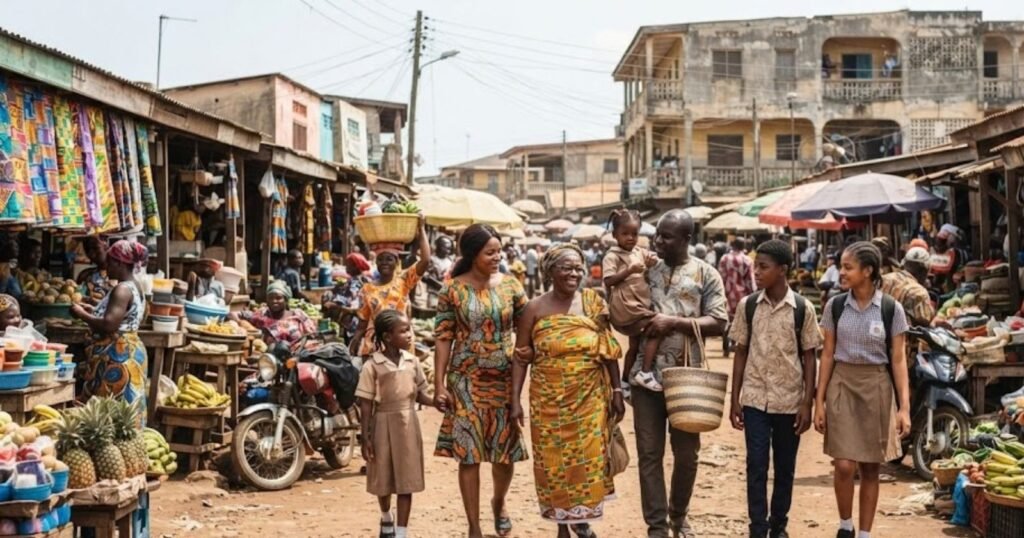
Ghana’s total fertility rate has fallen from around 7 children per woman in the 1980s to roughly 3.4–3.9 today, one of the steadier, longer-running fertility declines in West Africa. That shift is now visibly reshaping the country’s age structure: the median age has climbed to approximately 21–22 years, up nearly four years since 1970, even as the population continues to grow toward an estimated 35–36 million in 2026. Ghana is not yet an aging society, and won’t be for decades, but it is unmistakably past the point of peak youthfulness that still defines many of its regional neighbors. This is what a demographic turning point looks like in the data.
Key Facts & Findings
- Ghana’s fertility rate has fallen from roughly 6.5–7.0 children per woman in the early 1980s to an estimated 3.4–3.9 today, one of the more sustained fertility declines in West Africa.
- The median age has risen by approximately 3.7 years in recent decades, reaching roughly 21–22 years by 2025–2026, even as total population continues to grow.
- Greater Accra alone, with roughly 5 million residents across its metropolitan area, accounts for close to 14% of Ghana’s national population.
- The population aged 65 and older reached 4.4% by 2022, a modest but rising share that points toward a longer-term aging trend well beyond Ghana’s current planning horizon.
- UN-based projections put Ghana’s population at approximately 52 million by 2050, an increase of close to 48% over the current level.
Ghana’s Population Today
Ghana’s population was estimated at approximately 35.7 million as of a January 2026 baseline, according to Ghana Statistical Service figures reflected in worldpopulationclock.net’s UN WPP 2024-based tracking, up from 33,107,275 in a 2022 CIA-sourced estimate.
The World Bank’s World Development Indicators reported Ghana’s 2025 population at roughly 35.1 million with an annual growth rate of about 1.8%, though the exact figure depends on the specific revision cycle used; Worldometer’s UN-based elaboration for 2026 similarly points to a population in the mid-30-million range with growth continuing to moderate.
Ghana’s population density reached approximately 157 people per square kilometer in 2026 on a land area of 227,540 km², according to Worldometer’s calculation, a level of density that, combined with rising urbanization, places real and growing pressure on housing and infrastructure in the country’s largest cities.
Key Facts
| Metric | Figure | Year |
|---|---|---|
| Total population | approx. 35.1–35.7 million | 2025–2026 |
| Annual population growth rate | approx. 1.8%–2.05% | 2025–2026 |
| Median age | 21–22 years | 2025–2026 |
| Total fertility rate | approx. 3.4–3.9 children/woman | 2023–2026 |
| Population under age 15 | 35.4%–37.4% of total | 2022–2025 |
| Population aged 65 and older | 4.4% of total | 2022 |
| Life expectancy at birth | 65.5–69.4 years | 2022–2023 |
| Urban population share | 59.2% | 2026 |
| Projected population | approx. 52 million | 2050 |
From High Fertility to Demographic Transition
Ghana’s fertility decline is one of the more clearly documented in the region, though even here the exact current rate differs by source and year: Our World in Data reported 3.4 births per woman for 2023, while Worldometer’s 2026 UN-based figure is 3.9 and worldpopulationclock.net cites “around 3.9” for the same period. Taking the range as a whole, Ghana’s fertility rate has almost certainly fallen from roughly 6.5–7.0 children per woman in the early 1980s to somewhere between 3.4 and 3.9 today, a decline of nearly half over four decades, driven by rising female education, expanding urban living, and increased use of family planning.
Mortality has fallen in parallel. Life expectancy at birth rose to 69.37 years by a 2022 CIA-sourced estimate, though Our World in Data’s 2023 figure of 65.5 years suggests some divergence between estimation methods; both nonetheless represent a substantial improvement from the roughly 45–50 years typical of Ghana in the 1960s. Infant mortality stood at 32.59 deaths per 1,000 live births in 2022 estimates, down sharply from historical levels, though still notably higher than in upper-middle-income economies.
The net effect of falling fertility alongside falling mortality is a median age that has risen by approximately 3.7 years, according to populationpyramids.org’s analysis, even as the population continues to expand in absolute terms. This is the defining feature of a demographic transition in progress: total population keeps growing due to demographic momentum from earlier high-fertility decades, even as the pace of growth and the underlying age structure both shift toward a more mature profile.
Ghana’s Changing Age Structure
Roughly 35–37% of Ghana’s population remains under age 15, still a substantial youth cohort but meaningfully smaller, proportionally, than in countries like Somalia (42–47%) or Senegal (around 40%) that sit earlier in their own demographic transitions.
At the other end of the age spectrum, the population aged 65 and older reached 4.4% by 2022, still small by global standards, but among the higher shares recorded in West Africa, and a leading indicator of the aging pressures Ghana will need to plan for over subsequent decades.
Age Structure Table
| Age Group | Share of Population | Year |
|---|---|---|
| 0–14 years | 35.4%–37.4% | 2022–2025 |
| 15–64 years (working age, approx.) | 58%–60% | 2022–2025 |
| 65 and older | 4.4% | 2022 |
Urbanization and Population Distribution
Ghana crossed the majority-urban threshold some years ago and continues to urbanize steadily: Worldometer’s 2026 estimate puts the urban share at 59.2%, or roughly 21.1 million people. Accra, the capital, anchors this shift, with approximately 2.5 million residents in the city proper and around 5 million across its wider metropolitan area, according to Geography Worlds’ 2025 compilation of Ghana Statistical Service data, meaning Greater Accra alone accounts for roughly 14% of Ghana’s national population. Kumasi ranks as the country’s second-largest urban center, though with a considerably smaller population than Accra.
This concentration of population growth in and around Accra has consequences that extend well beyond city boundaries: as worldpopulationclock.net’s analysis notes, the growing population continues to put pressure on schools, hospitals, housing, and transport networks, particularly in the fast-expanding capital region, even as some of the more rural and northern parts of the country retain both lower urbanization and comparatively higher fertility rates.
The Economic Meaning of Ghana’s Demographic Shift
A population with a rising median age and a growing working-age share, even as total population keeps expanding, has direct implications for labor supply, consumer markets, and productivity. Ghana’s population aged roughly 15–64 makes up somewhere close to 58–60% of the total, a share that has been edging upward as the youngest cohorts shrink proportionally. In principle, a growing working-age share relative to dependents (children plus the elderly) is precisely the condition that creates room for a demographic dividend, provided that growing cohort finds productive employment rather than joining the ranks of the underemployed.
Ghana’s economic growth and consumer market expansion over the past two decades have coincided with, though are not necessarily solely caused by, this demographic shift; disentangling the economic contribution of demographic change specifically from other drivers (oil production, cocoa and gold exports, services sector growth) is beyond what population data alone can establish, and this article does not claim a precise causal weighting between them.
Education, Employment, and the Demographic Dividend
Whether Ghana converts its expanding working-age population into a genuine demographic dividend depends on continued investment in education and on the economy’s capacity to generate formal employment fast enough to absorb new labor market entrants.
Ghana has made real, well-documented progress on primary and secondary school enrollment over recent decades relative to many regional peers, though this article does not have precise, current national enrollment percentages verified against a primary source strong enough to state with confidence; readers seeking exact current enrollment figures should consult Ghana Statistical Service or UNESCO Institute for Statistics data directly, as the underlying figures were not consistently available across the sources reviewed for this piece.
What is clear from the age-structure data is the direction of travel: Ghana’s youth dependency burden (the ratio of children to working-age adults) has been falling as fertility declines, gradually easing one of the two components of the overall dependency ratio, even as the elderly dependency component very slowly begins to rise from its current low base of 4.4%.
Is Ghana Beginning to Age?
Ghana is not an aging society in the conventional sense, a median age of 21–22 years remains firmly on the youthful side of the global distribution, well below the world median of roughly 31 years. But the trajectory is unmistakable: a rising median age, a shrinking under-15 share, and a slowly growing 65-plus share (currently 4.4%) all point toward a longer-term aging process that will accelerate in the second half of the century if fertility continues its decline.
Ghana’s pension system, elderly healthcare infrastructure, and family-based old-age support systems will need to evolve over coming decades to accommodate this shift, even though the most acute aging pressures remain well beyond the current planning horizon.
Ghana’s Population Outlook
Demographers project Ghana will reach approximately 52 million people by 2050, according to Geography Worlds’ compilation of UN-based projections, an increase of roughly 45–48% over the current population of around 35–36 million. This is a medium-variant projection dependent on fertility continuing its gradual decline without reversal; a slower-than-expected fertility decline, or a resumption of higher fertility, would push the 2050 figure higher, while a faster decline (more consistent with the low-fertility scenarios many demographers now use for West Africa) would push it somewhat lower.
Population Growth and Projection Table
| Year | Population | Basis |
|---|---|---|
| 2000 | approx. 19,000,000 | Ghana Statistical Service / UN estimate |
| 2022 | 33,107,275 | CIA World Factbook-derived estimate |
| 2025 | approx. 35,100,000 | World Bank WDI |
| 2026 | approx. 35,700,000 | Ghana Statistical Service / UN WPP 2024 Revision |
| 2050 | approx. 52,000,000 | UN medium-variant projection |
Conclusion
Ghana’s population data describe a country genuinely mid-transition: fertility has fallen by nearly half since the 1980s, the median age has climbed by nearly four years, and the population aged 65 and older, while still small, is edging upward. None of this makes Ghana an aging society today, a median age in the low twenties keeps it firmly among the world’s younger populations, but the direction of travel distinguishes Ghana from regional peers still earlier in their own transitions.
The open question for the coming decades is not whether Ghana’s population will keep growing (UN-based projections of roughly 52 million by 2050 suggest it will) but whether the shrinking youth dependency burden translates into the kind of productive employment growth that turns a favorable age structure into an actual demographic dividend.
Frequently Asked Questions
1. What is Ghana’s current population?
Estimates for 2025–2026 place Ghana’s population at approximately 35.1 to 35.7 million people, according to the World Bank and Ghana Statistical Service data reflected in UN Population Division figures.
2. Is Ghana’s population growing?
Yes, at an annual rate of approximately 1.8% to 2.05% as of the mid-2020s, positive but slower than the 2.2%–2.5% rates recorded in the early 2000s, reflecting Ghana’s ongoing fertility decline.
3. Is Ghana’s fertility rate declining?
Yes. Ghana’s total fertility rate has fallen from roughly 6.5–7.0 children per woman in the early 1980s to an estimated 3.4–3.9 today, according to sources including Our World in Data and UN Population Division-based trackers.
4. Is Ghana becoming an aging population?
Not yet in absolute terms, Ghana’s median age of 21–22 years remains well below the global median of about 31, but the trend is toward gradual aging, with the population aged 65 and older reaching 4.4% by 2022, up from lower historical shares.
5. What is Ghana’s median age?
Approximately 21 to 22 years as of 2025–2026, according to UN Population Division-based estimates, up nearly four years since 1970.
6. How urbanized is Ghana?
Ghana was estimated to be 59.2% urban as of 2026 according to Worldometer’s UN-based figures, with Accra’s metropolitan area alone housing around 5 million people.
7. What is Ghana’s population projected to be in 2050?
Demographic projections put Ghana’s population at approximately 52 million by 2050, an increase of roughly 45–48% over the current population of about 35–36 million.
8. How does Ghana’s demographic transition compare to its neighbors?
Ghana’s fertility decline has progressed further than in countries such as Somalia (fertility near 6.0) or Senegal (fertility near 3.8–4.3), placing Ghana somewhat further along its demographic transition, though still well short of the low-fertility profiles seen in North Africa.
9. What is Ghana’s population density?
Approximately 157 people per square kilometer as of 2026, according to Worldometer’s calculation based on a land area of 227,540 square kilometers.
10. What share of Ghana’s population is under 15?
Approximately 35% to 37% as of the mid-2020s, a declining share compared to earlier decades as fertility has fallen, though still a substantial cohort that will continue driving demand for education and eventually jobs for years to come.
Sources
- Ghana Statistical Service (GSS), national population estimates
- World Bank, World Development Indicators, Ghana population, growth rate
- UN Department of Economic and Social Affairs, Population Division, World Population Prospects (2024 Revision)
- Our World in Data, Ghana Population and Demography Country Profile
- Worldometer, Ghana Population and Demographics (UN WPP 2024 Revision elaboration)
- populationpyramids.org, Ghana Population Pyramid and fertility trend analysis
- Geography Worlds, Population of Ghana (2025) compilation
- worldpopulationclock.net, Ghana Population 2026 tracker
- Wikipedia, “Demographics of Ghana”, historical age structure and vital statistics