
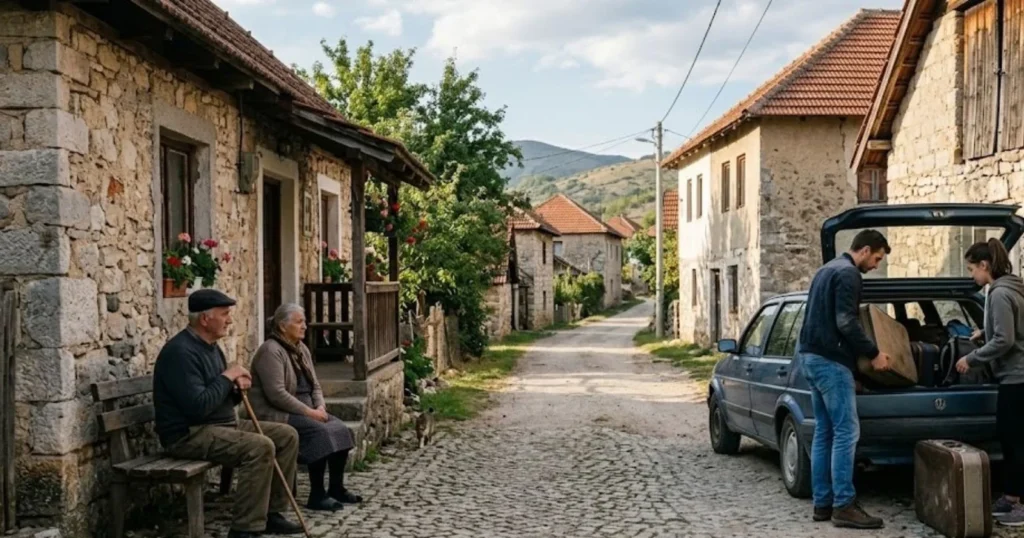
One in five citizens of the six Western Balkan countries now lives abroad. In Bosnia and Herzegovina, that figure reaches 47 percent, and in Montenegro, 45 percent, according to World Bank data. Over the past two decades, the region’s population has fallen by nearly 2.5 million people, according to the OSW Centre for Eastern Studies, a decline driven by a combination that few other world regions face simultaneously: sustained mass emigration and fertility rates too low to replace the population that remains.
Key Findings
- The six Western Balkans countries have lost nearly 2.5 million people over the past two decades, now totaling just over 16 million, roughly one in five of whom lives abroad.
- Bosnia and Herzegovina (47%) and Montenegro (45%) have the highest shares of citizens living abroad in the region, both far above the roughly 11 percent EU average.
- Serbia’s population is projected to decline 19 percent between 2020 and 2050, the steepest of four Western Balkans countries among the world’s top 20 for projected population loss.
- The region’s working-age population fell by more than 400,000 people in just five years even as unemployment hit historically low levels, reflecting severe age-selective emigration.
- The World Bank projects at least one in five Western Balkans residents will be over 65 within the next decade, among the most rapid aging trajectories anywhere in Europe.
Which Balkan Countries Are Losing Population?
The six Western Balkans countries, Albania, Bosnia and Herzegovina, Montenegro, Kosovo, North Macedonia, and Serbia, collectively referred to as WB6, now hold just over 16 million people combined, down from close to 18.5 million two decades earlier, a loss the OSW Centre for Eastern Studies attributes to the compounded effects of the 1990s conflicts, the economic disruption of post-socialist transition, and a subsequent generation of sustained emigration.
Research examining current trends estimates that between 2020 and 2050, Serbia’s population will decrease by 19 percent, Bosnia and Herzegovina’s by 18.2 percent, Albania’s by 16 percent, and North Macedonia’s by 11 percent, a study cited by the Center for Research and Policy Making (CRPM) that places four Western Balkan countries among the top 20 countries in the world for projected population decline, a list otherwise dominated by other Southern, Southeastern, and Eastern European countries alongside Japan and Cuba.
Population Living Abroad, Selected Western Balkans Countries
| Country | Share of Citizens Living Abroad |
|---|---|
| Bosnia and Herzegovina | 47% |
| Montenegro | 45% |
| Albania | 41% |
| Kosovo | 30% |
| North Macedonia | 30% |
| Serbia | 18% |
| EU average (for comparison) | ~11% |
The Role of Emigration
The scale of Western Balkans emigration is unusual even among high-emigration regions. World Bank figures put the number of people born in the Western Balkans and living abroad at approximately 5 million, close to 25 percent of the region’s total population base, a level the World Bank’s June 2025 report on migration in the region describes as making the Western Balkans “heavily impacted by migration.”
High unemployment remains the leading driver historically. Albania’s Institute of Statistics (INSTAT) has found that 84 percent of Albanians who emigrate cite job-seeking as their reason for leaving. Bosnia and Herzegovina, North Macedonia, and Kosovo have recorded youth unemployment rates above 50 percent at points in the past decade, alongside overall unemployment roughly ten times the EU average in some assessments, conditions that have pushed poverty to affect nearly 30 percent of the region’s population by some estimates.
Fertility and Natural Population Decline
Emigration is only part of the story. The Western Balkans also face what the OSW Centre for Eastern Studies describes as a challenge more typically associated with wealthier nations: low birth rates. Fertility across the region has fallen broadly in line with wider European trends, with some Western Balkans countries recording rates in the same low range as Southern Europe, comparable to figures around 1.2 to 1.3 children per woman seen in Italy, Spain, Greece, and Portugal.
Albania illustrates how fertility decline and emigration can compound each other even without the disruption of war. The country’s statistical agency notes that births peaked in 1990 and have declined every year since, a pattern researchers attribute to falling fertility rather than conflict, since Albania, unlike Bosnia, Kosovo, or Serbia, was not directly affected by the wars of the 1990s. Albania’s 2023 census recorded a loss of approximately 400,000 inhabitants over the preceding 12 years, placing it among the fastest-shrinking populations in the world according to Kosovo Online’s reporting on the census results.
Young People and the Working Age Population
The Regional Cooperation Council, a Sarajevo-based body encompassing 46 countries and organizations, reported that the Western Balkans’ working-age population declined by more than 400,000 people in just five years, even as regional unemployment reached historically low levels, an apparent paradox explained by the fact that fewer than half of the region’s working-age citizens hold jobs at any given time, with joblessness concentrated disproportionately among younger workers.
Emigration is heavily age-selective. Comparing Albania’s 2011 and 2023 census results, researchers found that the millennial generation accounted for more than half of all emigrants, confirming that the region’s outflow disproportionately removes its most economically productive age cohort rather than affecting the population evenly across age groups.
Rural Depopulation and Urban Concentration
Within Western Balkans countries, population loss is not evenly distributed geographically. Rural and peripheral areas, particularly those furthest from capital cities and major regional employment centers, have generally experienced steeper relative decline than urban centers, a pattern consistent with broader European depopulation trends but intensified in the Balkans by the added weight of international, not just internal, migration pulling working-age residents toward Western Europe.
Why People Leave
Multiple overlapping factors drive Western Balkans emigration, and researchers caution against attributing it to any single cause. The GIS Reports analysis identifies socioeconomic drivers, including joblessness, poor career prospects, and economic insecurity; political drivers, including weak governance and corruption; and in some cases criminal drivers, including extortion and human trafficking networks that exploit migration routes.
The Hungarian Institute of International Affairs adds an institutional dimension: weakened trust in government institutions and rising social polarization mean that young people in the region often struggle to see a long-term future for themselves domestically, even where financial family-support incentives exist, making purely financial policy responses of limited effectiveness on their own.
EU accession dynamics have also shaped emigration patterns directly. When Croatia joined the EU in 2013, about 230,000 people left the country within three years seeking employment in Western Europe, according to GIS Reports, a pattern echoed when Bulgaria and Romania joined the EU and lost roughly 20 percent of their populations to subsequent emigration, illustrating how EU membership itself, by opening legal migration pathways, can accelerate departure even as it improves a country’s long-term economic prospects.
Which Countries Are Most Affected?
Serbia and Bosnia and Herzegovina currently have the highest shares of elderly residents in the Western Balkans, with people aged 65 and over comprising 20 percent of the population in both countries, according to OSW Centre for Eastern Studies data. In three countries, Bosnia and Herzegovina, Serbia, and North Macedonia, the median age is now close to or exceeds the EU average of 44.5 years, a striking benchmark for countries with considerably lower per-capita income than the EU average. Montenegro’s statistical agency (Monstat) reported in an October data release that the country’s average population age reached 39.7 years, two and a half years older than at the previous census.
Economic and Social Consequences
The World Bank’s Fall 2025 Western Balkans Regular Economic Report identifies the region’s aging population as a direct constraint on growth, projecting that at least one in five people in the region will be over 65 within the next decade, one of the most rapid aging trajectories in Europe. The report frames “mobilizing underutilized human capital” as central to the region’s near-term economic prospects, since compounding out-migration of working-age people, including both college graduates and manual workers, continues shrinking the base of available labor even as regional unemployment falls.
Can Immigration and Return Migration Reverse the Trend?
Facing sustained labor shortages, several Western Balkans countries have themselves become migration destinations, drawing foreign workers, particularly from Southeast Asia, into construction, agriculture, tourism, and healthcare roles that domestic workers increasingly do not fill, according to OSW Centre analysis.
Some regional analysts and UN-linked reporting suggest that countries such as Serbia and Montenegro might achieve a degree of population stabilization through deliberate immigration policy, though this is explicitly described as requiring significant reform rather than something likely to occur passively.
Return migration remains a smaller factor than either emigration or inbound labor migration for now, though researchers and regional bodies increasingly frame creating economic opportunity for the diaspora as one of the more promising levers available to policymakers, alongside family-friendly policies such as affordable childcare, housing support, and paid parental leave aimed at the fertility side of the equation.
The Balkans’ Demographic Outlook
The trajectory across the Western Balkans through 2050, an 11 to 19 percent population decline depending on the country, reflects the compounded effect of two distinct trends, emigration and low fertility, operating together rather than the effect of either factor alone. Countries not directly affected by the 1990s wars, such as Albania, show that emigration and fertility decline alone can produce population loss comparable to, or in some measures faster than, that seen in countries that also endured wartime disruption, indicating the region’s demographic challenge is now structural rather than a lingering aftereffect of a specific historical event.
Conclusion
The Western Balkans illustrate a depopulation pattern distinct from most of the rest of Europe: it is not simply an aging, low-fertility problem, the kind found across Germany, Italy, or Japan, but a combination of that pattern with emigration rates among the highest recorded anywhere in the world outside active conflict zones.
Nearly a quarter of the population born in the region now lives somewhere else, and the working-age citizens who remain face job markets tight enough to draw in foreign labor even as unemployment statistics stay historically low, a contradiction that captures just how selectively the region’s outflow has hollowed out its labor force.
Frequently Asked Questions
1. Why are Balkan populations declining?
Western Balkans population decline results from the combined effect of sustained high emigration, driven mainly by unemployment and limited economic opportunity, and low fertility rates that have converged toward wider European patterns over the past three decades.
2. Which Balkan countries are losing population fastest?
Serbia (projected −19% by 2050), Bosnia and Herzegovina (−18.2%), and Albania (−16%) rank among the steepest projected declines in the Western Balkans and globally, according to research cited by the Center for Research and Policy Making.
3. Are young people the main emigrants?
Yes. Comparative Albanian census data found that millennials accounted for more than half of all emigrants between 2011 and 2023, confirming emigration disproportionately removes the region’s working-age and most economically productive population.
4. How many Western Balkans citizens live abroad?
Approximately 5 million people born in the Western Balkans live abroad, close to 25 percent of the region’s population base, according to World Bank data.
5. Which country has the highest share of citizens abroad?
Bosnia and Herzegovina has the highest share, at 47 percent, followed closely by Montenegro at 45 percent, both far above the roughly 11 percent EU average.
6. Is emigration the only cause of Balkan depopulation?
No. Low fertility, now broadly similar to rates seen in Southern Europe, compounds emigration’s effect; Albania’s population decline, for instance, is driven substantially by falling births rather than the wartime disruption that affected other countries in the region.
7. How aging is the Western Balkans population?
Serbia and Bosnia and Herzegovina already have 20 percent of their populations aged 65 or older; the World Bank projects at least one in five residents across the region will be over 65 within the next decade.
8. Are Western Balkans countries also receiving immigrants?
Yes. Facing labor shortages, several Western Balkans countries have become destinations for foreign workers, particularly from Southeast Asia, filling roles in construction, agriculture, tourism, and healthcare.
9. Did the wars of the 1990s cause the region’s population decline?
The wars contributed substantially to earlier population loss, but subsequent decades of economic-driven emigration and low fertility, including in countries like Albania that were not directly affected by the wars, show the current decline is now driven mainly by ongoing structural rather than historical wartime factors.
10. Can EU membership reverse Balkan depopulation?
EU accession has historically accelerated emigration in the short term, as seen when Croatia, Bulgaria, and Romania joined and lost significant population shares to subsequent outmigration, though it may improve long-term economic conditions that could eventually support return migration.
Sources
- OSW Centre for Eastern Studies, “The vanishing Balkans: The region’s demographic crisis,” March 2025
- World Bank, Western Balkans Regular Economic Report, Fall 2025
- World Bank, “Unlocking the Development Potential of Migration in the Western Balkans,” June 2025
- Hungarian Institute of International Affairs, “The Silent Killer of the Western Balkans: Demographic Decline and Human Capital Loss,” June 2026
- Center for Research and Policy Making (CRPM), “The Demographic Challenges of the Western Balkans”
- GIS Reports Online, “Depopulation in the Western Balkans,” 2025
- Kosovo Online, “Alarming Demographic Data: Depopulation of the Western Balkans,” January 2025
- Radio Free Europe/Radio Liberty, “Depopulation Disaster: The Balkans and Its Creeping Demographic Crisis”





