
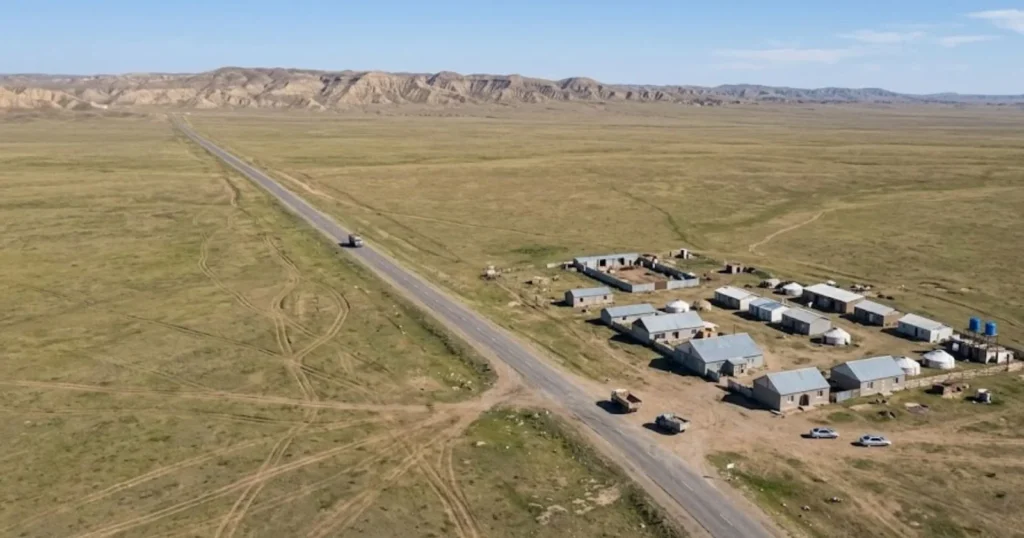
Kazakhstan’s population reached 20,478,879 as of December 1, 2025, according to the Bureau of National Statistics, spread across the ninth largest country on Earth by land area, 2.72 million square kilometers, at an average density of just 7.4 people per square kilometer. But that average conceals a population geography that is anything but even: Almaty alone holds over 2.34 million residents at a density exceeding 3,100 people per square kilometer, while the sparsely settled Ulytau region, home to just 219,200 people, sits at the opposite extreme of Kazakhstan’s demographic map.
Kazakhstan’s story is not one of universal emptiness in the way Mongolia’s is. It is a story of sharp contrasts: dense urban and southern concentration set against vast, thinly populated steppe and desert regions in the country’s north, west, and interior, shaped by a distinctive settlement history running through Soviet-era agricultural and industrial development, and by a capital that was itself relocated and renamed multiple times as part of a deliberate national development strategy.
Kazakhstan’s Population Is Small Relative to Its Territory
Population at a Glance
- Total population (December 1, 2025): 20,478,879, up from 20,283,399 at the start of 2025
- Total land area: 2,724,910 square kilometers (9th largest country globally)
- National population density: approximately 7.4 to 7.5 people per square kilometer
- Urban population: 13,013,064 (as of end-2025), roughly 63.5% of the total
- Rural population: 7,465,815, roughly 36.5% of the total
- Total fertility rate: 2.8 children per woman (2024 estimate), above replacement level
- Median ethnic composition: Kazakh 71.5%, with Russian, Uzbek, and other minorities making up the remainder
- Life expectancy: 73.3 years (69.0 for men, 77.9 for women)
Sources: Bureau of National Statistics of the Agency for Strategic Planning and Reforms of the Republic of Kazakhstan; CIA World Factbook, 2024-2025 estimates.
Where Kazakhstan’s Population Is Concentrated
As of the most recent Bureau of National Statistics regional dashboard, Almaty remains Kazakhstan’s most populous city by a wide margin, with 2,345,012 to 2,373,772 residents depending on the exact reference date, followed by the Turkistan Region in the south with over 2.1 to 2.68 million people, Astana, the capital, with approximately 1.63 to 1.68 million, and the Almaty Region surrounding but administratively separate from Almaty city, with approximately 1.59 to 1.61 million residents. Several other regions and cities also exceed the one-million population mark, including Shymkent, Zhambyl Region, and Karagandy Region.
Kazakhstan’s Largest Population Centers (Late 2025 / Mid-2026)
| Region / City | Population |
|---|---|
| Almaty city | 2,345,012 – 2,373,772 |
| Turkistan Region | 2,145,680 – 2,148,168 |
| Astana city (capital) | 1,630,640 – 1,682,721 |
| Almaty Region | 1,592,652 – 1,612,393 |
| Shymkent city | 1,291,011 – 1,310,681 |
| Zhambyl Region | 1,212,698 – 1,215,892 |
| Karagandy Region | 1,130,377 – 1,131,438 |
At the other end of the scale, Ulytau Region has the smallest population of any Kazakh region at approximately 218,015 to 219,200 people, followed by North Kazakhstan Region at roughly 511,982 to 514,732, and Abai Region at around 592,895 to 596,000, illustrating just how concentrated Kazakhstan’s population has become in its southern and major urban regions relative to its northern and central territories.
Almaty and Astana Have Become Major Population Magnets
Almaty and Astana occupy distinct roles in Kazakhstan’s population geography. Almaty, Kazakhstan’s largest city and historical capital until 1997, sits at a density exceeding 3,100 people per square kilometer within its compact 682 square kilometer administrative area, according to 2022 census-based figures, reflecting its long-established status as the country’s commercial, cultural, and, until the late 1990s, political center.
Astana, which took on the national capital role from Almaty in 1997 as part of a deliberate government relocation strategy and has since been renamed multiple times, reflecting Kazakhstan’s political history, has grown dramatically from a population of just 613,006 in 2009 to over 1.3 to 1.68 million by the mid-2020s, a growth rate far outpacing the national average and reflecting sustained government investment in building out the new capital’s population base through both public sector relocation and targeted economic development.
Geography, Climate and History Explain the Population Pattern
Kazakhstan’s uneven population distribution traces back through multiple historical layers. The country’s vast northern and central steppe regions, well suited to extensive grain agriculture and livestock grazing but historically sparsely settled, saw significant population growth during the Soviet-era Virgin Lands Campaign of the 1950s and 1960s, when the Soviet government relocated substantial populations, including many ethnic Russians and other Soviet nationalities, to Kazakhstan to expand agricultural production on previously uncultivated steppe land. This campaign left a lasting demographic imprint still visible in the ethnic composition of Kazakhstan’s northern regions today.
Southern Kazakhstan, by contrast, benefited from longer-established agricultural traditions tied to river valley irrigation and proximity to historical Silk Road trade routes, contributing to the region’s continued high population density, exemplified by Turkistan Region’s position as one of Kazakhstan’s most populous administrative units despite covering a comparatively modest land area relative to Kazakhstan’s vast northern and western regions.
Kazakhstan’s Ethnic and Migration Geography Has Changed
Kazakhstan’s population is approximately 71.5 percent ethnic Kazakh, according to official statistics, with ethnic Russians, Uzbeks (at 678,487 people, or 3.3 percent, as of the beginning of 2025), and smaller communities including ethnic Azerbaijanis, estimated at 155,364 in 2025, and other groups making up the remainder.
This ethnic composition has shifted substantially since Kazakhstan’s independence in 1991, driven by significant emigration of ethnic Russians and other Soviet-era settler populations toward Russia and other destinations in the years following independence, alongside continued natural population growth within the ethnic Kazakh community, which maintains higher fertility rates than the country’s Slavic and other minority populations.
Kazakhstan’s net migration rate stood at approximately -0.4 migrants per 1,000 population as of 2024 estimates, indicating the country remains a modest net exporter of population overall, even as it simultaneously experiences substantial internal migration toward Almaty, Astana, and other major urban centers.
Urbanization Is Reshaping Population Distribution
Kazakhstan’s urban population reached 13,013,064 as of the end of 2025, against a rural population of 7,465,815, putting the national urbanization rate at roughly 63.5 percent. This national average, however, obscures dramatic regional variation: the share of urban population is highest in Karagandy Region at 82.0 percent, Ulytau Region at 79.4 percent, and Aktobe Region at 75.6 percent, reflecting these regions’ industrial and mining-based economies, while urbanization is lowest in Almaty Region at just 19.4 percent, Turkistan Region at 25.1 percent, and Zhambyl Region at 43.8 percent, reflecting these southern regions’ continued reliance on agriculture and more traditional rural settlement patterns even as the cities of Almaty and Shymkent themselves, administratively separate from their surrounding regions, register overwhelmingly urban populations.
Northern and Southern Demographic Differences
Kazakhstan’s age structure also varies meaningfully by region. According to Bureau of National Statistics data for the beginning of 2025, the population aged 63 (61 for women) and older is most concentrated in Almaty city at 11.4 percent, Karagandy Region at 7.5 percent, and Turkistan Region at 7.2 percent, while the youngest population share, aged 0-15, is most concentrated in Turkistan Region at 13.4 percent, Almaty city at 9.9 percent, and Almaty Region at 8.1 percent.
This pattern reflects Kazakhstan’s broader north-south demographic divide: southern regions, including Turkistan, tend to maintain higher fertility and younger population structures, consistent with their more traditional and agriculturally oriented economies, while some northern and industrial regions show somewhat more advanced aging, a pattern that echoes, at a smaller scale, the broader demographic divide observed across Central Asia in this series’ regional comparison article.
Kazakhstan’s Future Population Geography
Kazakhstan’s population grew by approximately 195,480 people during 2025 alone, according to Bureau of National Statistics data, a growth rate that, combined with a fertility rate of 2.8, well above replacement level, points toward continued national population growth over the coming decades.
Given the persistent and, in some cases, deliberately reinforced concentration of that growth in Almaty, Astana, and Kazakhstan’s southern regions, alongside continued government investment in developing Astana as a modern administrative and economic capital, Kazakhstan’s population geography seems likely to continue trending toward greater urban concentration rather than a more even geographic distribution, even as its vast northern and central territories remain, in relative terms, some of the most sparsely populated agricultural and industrial land anywhere in Central Asia.
Frequently Asked Questions
1. Why is Kazakhstan sparsely populated?
Kazakhstan’s low overall population density, approximately 7.4 to 7.5 people per square kilometer, reflects its vast territory, the ninth largest in the world, combined with harsh continental steppe and desert climates across much of its northern, central, and western regions that historically supported only extensive agriculture and pastoral herding rather than dense settlement.
2. Where do most people in Kazakhstan live?
Most of Kazakhstan’s population is concentrated in Almaty, the country’s largest city with over 2.3 million residents, the southern Turkistan Region with more than 2.1 million people, and the capital Astana, with approximately 1.6 to 1.7 million residents.
3. What is Kazakhstan’s population density?
Kazakhstan’s national population density is approximately 7.4 to 7.5 people per square kilometer, though this varies enormously by region, from over 3,100 people per square kilometer in Almaty city to well under 5 people per square kilometer in Kazakhstan’s most sparsely populated regions.
4. Is Astana growing?
Yes, substantially. Astana’s population grew from 613,006 in 2009 to approximately 1.6 to 1.7 million by the mid-2020s, a growth rate far exceeding Kazakhstan’s national average, driven by its designation as the national capital in 1997 and sustained government investment in the city’s development.
5. Is Almaty Kazakhstan’s largest city?
Yes. Almaty remains Kazakhstan’s most populous city, with over 2.3 million residents as of the mid-2020s, despite losing its status as national capital to Astana in 1997.
6. How is migration changing Kazakhstan?
Kazakhstan’s net migration rate stands at approximately -0.4 migrants per 1,000 population, reflecting a modest net outflow overall, even as substantial internal migration continues toward Almaty, Astana, and other major urban centers from Kazakhstan’s more sparsely populated rural and northern regions.
7. Which regions have the highest population growth?
Kazakhstan’s southern regions, including Turkistan and the areas surrounding Almaty, along with the capital Astana, have shown the strongest population growth in recent years, driven by both higher regional fertility rates in the south and sustained internal migration toward major urban centers.
8. What will Kazakhstan’s population look like in 2050?
Kazakhstan’s population grew by approximately 195,480 people during 2025 alone, and with a fertility rate of 2.8, above replacement level, the country is positioned for continued population growth over the coming decades, likely concentrated further in Almaty, Astana, and Kazakhstan’s southern regions.
Sources
- Bureau of National Statistics of the Agency for Strategic Planning and Reforms of the Republic of Kazakhstan, regional population dashboard, 2025-2026.
- The Astana Times, “Kazakhstan’s Population Exceeds 20.4 Million as Urbanization Continues to Rise,” January 2026.
- CIA World Factbook, Demographics of Kazakhstan, 2024-2026 estimates.
- Bureau of National Statistics of Kazakhstan, Population by Ethnic Groups and Age Groups (beginning of 2025).
- Bureau of National Statistics of Kazakhstan, Population by Gender and Type of Locality (January 1, 2025).
- Wikipedia compilation, Regions of Kazakhstan and Demographics of Kazakhstan, sourced from national statistics.





