
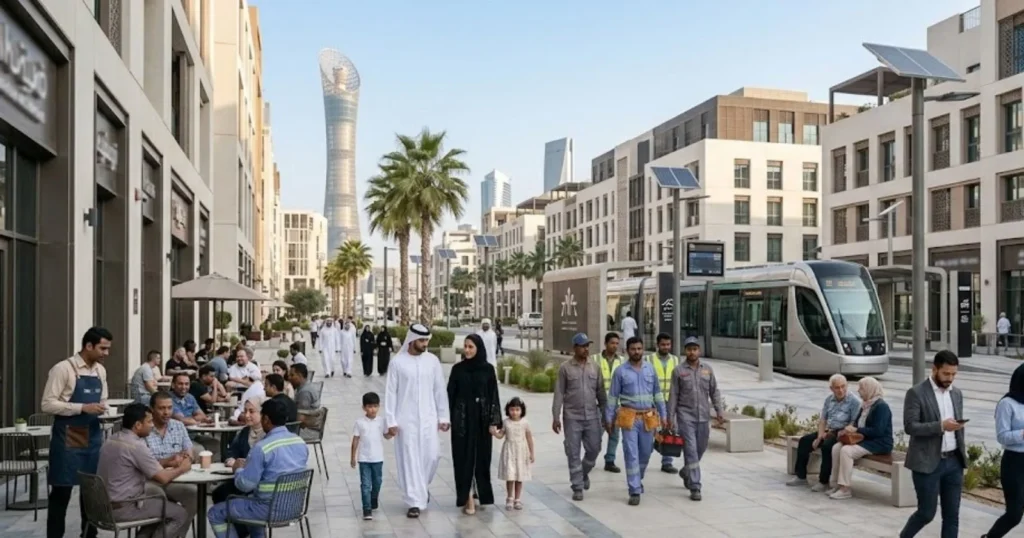
Qatar’s population reached 3,214,609 people by the end of December 2025, according to the National Planning Council, yet Qatari citizens account for only around 10 to 12 percent of that total. Put another way, for every Qatari citizen living in Qatar, there are roughly seven to nine foreign residents. It is one of the most extreme citizen-to-resident ratios of any country in the world, exceeded by few beyond Vatican City and the UAE.
Qatar’s population has grown by more than 12,700 percent since 1950 and nearly doubled since 2010, when it stood at roughly 1.7 million. Almost none of that growth reflects Qatari births. It reflects one of the most sustained labor migration programs in the modern Gulf, built first around energy exports and then accelerated by a decade of infrastructure investment tied to hosting the 2022 FIFA World Cup and Qatar’s broader National Vision 2030 development goals.
Qatar Has One of the World’s Most Unusual Population Structures
Population at a Glance
- Total population (December 2025): 3,214,609 (National Planning Council), up 2.3% from December 2024
- Qatari citizens: approximately 10 to 12% of the total, or roughly 320,000 to 385,000 people
- Expatriate residents: approximately 88 to 90% of the total, or roughly 2.8 to 2.9 million people
- Population growth since 2010: from approximately 1.7 million to over 3.2 million
- Total fertility rate: 1.7 to 1.9 children per woman, below the replacement level of 2.1
- Sex ratio: approximately 3.36 males per female overall
- Age structure: approximately 14% aged 0-14, 83-85% aged 15-64, only about 1.2% aged 65 and older
- Migrant share of workforce: approximately 95%
Sources: Qatar National Planning Council, December 2025 release; CIA World Factbook; UN World Population Prospects 2024 revision; Global Media Insight compilation.
The age structure alone tells the core story: with 83 to 85 percent of the population concentrated in the working-age bracket and only about 1.2 percent aged 65 or older, Qatar’s population pyramid looks nothing like a population shaped primarily by births and deaths. It looks like a workforce, imported and rotated according to labor demand, with citizens forming a comparatively small, more conventionally structured population layered underneath it.
How Many Qataris and Foreign Residents Live in Qatar?
Estimates of the precise citizen share vary modestly by source and year, generally falling in a range of 10 to 12 percent, or in absolute terms, roughly 320,000 to 385,000 Qatari nationals depending on which year’s total population figure is used as the base.
One widely cited 2025 breakdown put Qatari nationals at approximately 0.35 million, or 10.5 percent of the total, with expatriates making up approximately 2.76 million, or 88.4 percent. Other estimates place the range slightly wider, at 10 to 15 percent citizens, reflecting differences in survey timing and methodology rather than a genuine dispute about the broad picture: Qatari citizens are a small minority in their own country by a wide margin.
Why Qatar Relies So Heavily on Migrant Labor
Qatar’s economic model, built on natural gas exports since the discovery and development of the North Field, one of the world’s largest natural gas reservoirs, required importing skilled engineering, technical, and management labor from the earliest stages of its energy sector development.
That foundational reliance on foreign expertise expanded dramatically over the following decades into construction, infrastructure, hospitality, and domestic services, driven further by a sustained construction boom tied to World Cup 2022 preparation and continuing under Qatar National Vision 2030 infrastructure and diversification goals.
Migrant workers make up approximately 95 percent of Qatar’s total workforce, according to demographic research cited in country profiles of Qatar, meaning the citizen labor force plays a proportionally small role even in sectors where Qatari citizens are actively employed, since public administration, security, and select professional roles are where citizen employment concentrates most heavily.
The Gender Imbalance Has a Demographic Explanation
Qatar’s overall sex ratio, at roughly 3.36 males per female according to CIA World Factbook estimates, is among the most heavily male-skewed in the world. This imbalance is a direct byproduct of labor migration patterns rather than any imbalance among Qatari citizens themselves: construction, engineering, and manual labor sectors, which employ a large share of Qatar’s migrant workforce, draw predominantly single male workers on employment contracts, often without accompanying family members.
Birth-level sex ratios and citizen household structures remain close to global norms, at approximately 1.02 males per female at birth, underscoring that the aggregate imbalance is a workforce phenomenon layered on top of a demographically ordinary citizen population.
Qatar’s Population Can Change Quickly
A population driven overwhelmingly by labor migration behaves very differently from one driven by natural increase. Qatar’s population growth rate has fluctuated notably from year to year depending on infrastructure project cycles and labor demand: reported growth reached as high as 5.3 percent year-on-year in November 2025 before settling near 2.3 percent by December, according to National Planning Council figures, reflecting the kind of short-term volatility that a migration-driven population can display and that a birth-driven population typically cannot. This volatility is a defining structural feature of Qatar’s demographic model, not a data anomaly.
Historical Population Growth
| Year | Population | Notes |
|---|---|---|
| 2010 | 1.71 million | |
| 2020 | 2.80 million | |
| 2024 | 3.14 million | Crossed 3 million mark |
| 2025 | 3.21 million (Dec) | +2.3% year-on-year |
| 2026 (est.) | ~3.37 million |
Where Qatar’s Migrant Population Comes From
Qatar’s expatriate population draws heavily from South Asia, with India representing the single largest origin country, alongside significant populations from Pakistan, Sri Lanka, Nepal, and Bangladesh. The Philippines contributes an estimated 7.35 percent of the total population, and Egypt around 9.35 percent, with other significant groups from Sudan, Syria, Jordan, and Lebanon, along with smaller communities from the United States and Kenya.
Societal and workplace divisions exist along these origin lines: European, North American, and Arab expatriates typically secure better-compensated positions and greater social privileges than South Asian and sub-Saharan African workers, a well-documented pattern across Gulf labor markets generally.
Population Geography Inside Qatar
Qatar’s population concentrates overwhelmingly in and around Doha, the capital, which anchors the country’s financial, administrative, and diplomatic activity along with a substantial share of its foreign professional workforce. Industrial and energy sector employment, particularly tied to natural gas processing and export facilities, concentrates in areas outside the capital, including Ras Laffan and Mesaieed, drawing a distinct segment of the migrant workforce focused on technical and industrial roles rather than the services and finance-oriented employment concentrated in Doha itself.
Economic Advantages and Demographic Vulnerabilities
Qatar’s migration-driven population model has delivered clear advantages: a highly flexible labor supply that expanded rapidly to meet World Cup 2022 construction demands and can, in principle, be scaled up or down according to project cycles, along with global talent access across finance, energy, and professional services.
The tradeoff is a level of demographic dependency on external labor supply that is more extreme than almost anywhere else in the world. Housing markets, infrastructure planning, and consumption patterns are all built around a population that can shift meaningfully within a single year, as the 2.3 to 5.3 percent swings in year-on-year growth during 2025 illustrate.
What Qatar’s Population Could Look Like in the Future
Qatar has pursued a long-running Qatarization initiative aimed at increasing the share of Qatari citizens employed across public and private sector core industries, with a stated target of 50 percent citizen representation in key sectors under Qatar National Vision 2030.
Whether this materially shifts the aggregate population balance, currently around 10 to 12 percent citizens, is a separate question from whether it succeeds in specific sectors, since Qatarization targets are about employment share within particular industries rather than an attempt to change the country’s overall demographic composition.
Given that Qatar’s fertility rate, at 1.7 to 1.9 children per woman, sits below replacement level even among citizens, and that continued economic diversification under Vision 2030 will likely sustain demand for skilled and unskilled foreign labor alike, the most probable trajectory is continued population growth driven predominantly by migration, with the citizen share remaining a small minority for the foreseeable future absent a substantial change in either fertility trends or immigration and naturalization policy.
Frequently Asked Questions
1. How many foreigners live in Qatar?
Approximately 2.8 to 2.9 million foreign residents lived in Qatar as of 2025, representing roughly 88 to 90 percent of the country’s total population of about 3.2 million.
2. What percentage of Qatar’s population is Qatari?
Qatari citizens make up approximately 10 to 12 percent of the total population, or roughly 320,000 to 385,000 people, depending on the specific year and source used.
3. Why does Qatar have so many migrant workers?
Qatar’s economy has relied on imported labor since the early development of its natural gas industry, expanding into construction, infrastructure, and services, with demand accelerating further during a decade of World Cup 2022 preparation and continuing under Qatar National Vision 2030 diversification goals.
4. Why does Qatar have more men than women?
Qatar’s sex ratio, at roughly 3.36 males per female overall, reflects the concentration of migrant labor in construction, engineering, and manual labor sectors, which draw predominantly single male workers on employment contracts rather than families.
5. Where do Qatar’s migrants come from?
Qatar’s expatriate population is drawn predominantly from South Asia, led by India, alongside Pakistan, Sri Lanka, Nepal, and Bangladesh, with significant communities from the Philippines, Egypt, Sudan, Syria, Jordan, and Lebanon.
6. Are migrant workers included in Qatar’s population statistics?
Yes. Qatar’s National Planning Council population figures include all residents regardless of nationality, meaning the 3.2 million total reported for December 2025 includes both citizens and the much larger expatriate population.
7. What is Qatar’s population by nationality?
Qatari nationals make up roughly 10 to 12 percent of the population. Among the remaining expatriate majority, Indian nationals form the single largest group, with Egyptian residents at approximately 9.35 percent and Filipino residents at approximately 7.35 percent of the total population.
8. Could Qatar’s population shrink?
Qatar’s population has shown short-term volatility tied to labor demand and infrastructure project cycles, with year-on-year growth ranging from 2.3 to 5.3 percent across different months of 2025, meaning the total population could contract if labor demand fell significantly, unlike populations driven primarily by natural increase.
Sources
- Qatar National Planning Council, population data release, December 2025, reported via Marhaba Qatar and The Peninsula Qatar.
- CIA World Factbook, Demographics of Qatar, 2022-2024 estimates.
- United Nations, Department of Economic and Social Affairs, Population Division. World Population Prospects 2024 Revision.
- UNFPA World Population Dashboard, Qatar country data, 2025.
- Global Media Insight, Qatar Population Statistics 2026, compilation of NPC and UN data.
- Wikipedia compilation, Demographics of Qatar, sourced from UN and national data.





