More than half the world’s population lives within one hour of a major city, yet roughly 10 percent of Earth’s land area sits more than 48 hours of travel time from any urban center of consequence. Those two facts, from the European Commission’s Joint Research Centre and World Bank agglomeration index research, capture the central paradox of global accessibility: humanity is overwhelmingly clustered near cities even as vast stretches of the planet remain genuinely remote.
The research also found that 95 percent of the world’s population lives on just 10 percent of the world’s land, a concentration figure closely related to, but distinct from, accessibility itself. Distance from a city and remoteness are not automatically the same thing; a population can be geographically close to a city yet poorly connected to it by road, and can be geographically far yet well connected by transport infrastructure.
What Does Access to a City Actually Mean
Accessibility researchers generally avoid a single distance threshold because a universal number of kilometers is misleading across different terrains and transport systems. Instead, the standard approach, developed jointly by the Joint Research Centre and the World Bank for the 2009 World Development Report, uses an agglomeration index combining population density with modeled travel time to cities of at least 50,000 people, accounting for terrain, road quality, and available transport infrastructure rather than straight line distance.
How Many People Live Far From Major Urban Centers
| Accessibility Measure | Finding |
|---|---|
| Population living on 10% of land | 95% of world population |
| Population within 1 hour of a major city | Over 50% |
| Land area more than 48 hours from a city | Approx. 10% of Earth’s land |
| Developed world within 1 hour of a city | 85% of population |
| Developing world within 1 hour of a city | 35% of population |
Source: European Commission Joint Research Centre / World Bank agglomeration index research. The gap between the 85 percent figure in developed countries and the 35 percent figure in developing countries reflects both the smaller number of large cities in many developing regions and generally lower quality transport infrastructure connecting rural populations to whatever cities do exist.
Where Are the World’s Most Remote Populations
Central Africa
Vast forested and sparsely settled areas of the Congo Basin remain among the least accessible inhabited regions on Earth, where road density is extremely low and travel between rural communities and urban centers can take days.
The Amazon Basin
Despite supporting tens of millions of people overall, huge portions of the Amazon basin’s interior lack road access entirely, with river transport remaining the primary connection to urban centers for many riverine communities.
Siberia and Arctic Regions
Extreme cold, permafrost terrain, and vast distances between settlements make much of Siberia and the Arctic among the most remote inhabited land on Earth relative to any urban center.
Central Asian Interiors
Mountainous and desert terrain across parts of Central Asia limits road connectivity, isolating rural and pastoral communities from regional cities for significant portions of the year.
The Australian Interior
Australia’s interior is sparsely populated and, despite reasonably developed road infrastructure by global standards, still involves multi hour or multi day travel times to reach substantial cities for many remote communities.
Mountain Regions Generally
As explored in dedicated research on global mountain populations, terrain itself is one of the most consistent drivers of poor urban accessibility worldwide, independent of a region’s overall level of economic development.
Why Some Populations Remain Far From Cities
Terrain is the most fundamental constraint, since mountains, dense forest, and desert all raise the cost of road construction dramatically compared with flat, temperate terrain. Historical settlement patterns also matter: many remote populations settled in these locations generations or centuries ago for reasons, such as agricultural land, mineral resources, or cultural and religious significance, that predate any consideration of transport access. Protected areas and conservation zones, particularly across parts of the Amazon and Central Africa, deliberately limit road construction, trading accessibility for environmental protection.
What Distance From Cities Means for Everyday Life
Healthcare access is the most immediate and consequential impact of poor urban accessibility, since remote populations often face multi hour or multi day travel times to reach hospitals capable of handling serious medical emergencies. Education access, formal employment opportunities, and government services all follow similar patterns, concentrated in or near urban centers and progressively harder to access as travel time increases. Market access for agricultural goods is also directly affected, since perishable produce loses value quickly when transport to market takes days rather than hours.
Rural Isolation Versus Rural Population Density
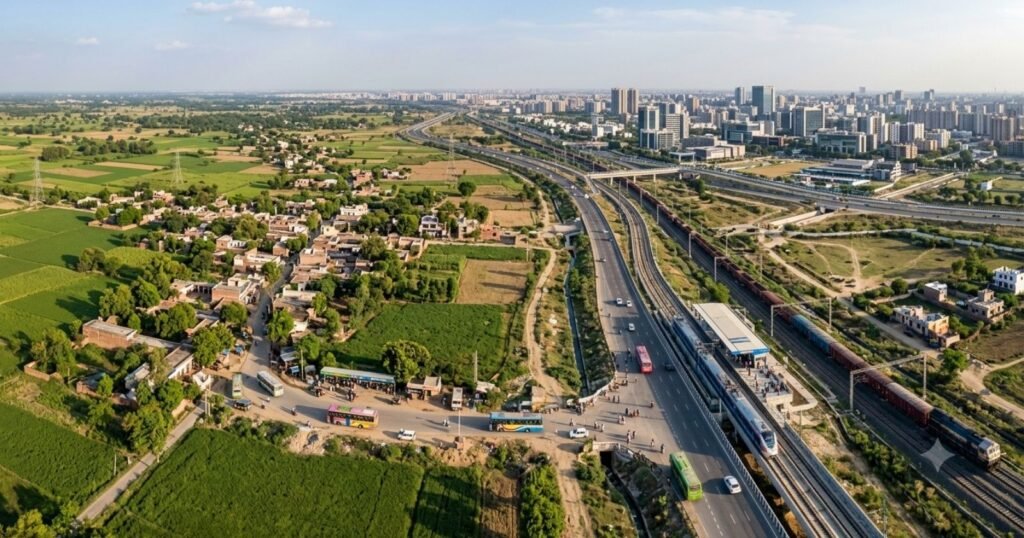
These are frequently confused but analytically distinct concepts. A rural population can be large in absolute numbers, as in much of rural India or China, while still being relatively well connected to nearby cities through dense road and rail networks.
Conversely, a much smaller rural population in Siberia or the Australian interior can be genuinely isolated despite representing a tiny fraction of national population, because the road and transport infrastructure simply does not exist at any meaningful scale.
Roads, Transport, and Digital Connectivity
Physical road infrastructure remains the single largest determinant of effective accessibility in most developing regions, but mobile phone and internet connectivity have begun to reduce some forms of effective isolation even where physical distance to a city remains unchanged.
Mobile banking, telemedicine consultations, and remote education access have all expanded meaningfully in rural Sub-Saharan Africa and South Asia over the past decade, even in areas where road infrastructure has improved only marginally, illustrating that digital connectivity and physical accessibility do not have to move in lockstep.
Is the World Becoming More Connected
Road network expansion, particularly in South and Southeast Asia and parts of Sub-Saharan Africa, has meaningfully reduced average travel times to cities over the past two decades, even as urbanization itself continues to draw rural populations toward cities directly through migration.
Both trends point in the same direction: a shrinking share of the world’s population living in genuinely remote, poorly connected locations, even as absolute numbers in the most extreme remote categories, such as the deep Amazon interior or high Arctic settlements, remain relatively stable due to the fundamental terrain constraints involved.
Key Findings
- 95 percent of the world’s population lives on just 10 percent of Earth’s land, according to Joint Research Centre and World Bank agglomeration index research.
- More than half the world’s population lives within one hour of a major city, but the figure is 85 percent in developed countries versus only 35 percent in developing countries.
- Roughly 10 percent of Earth’s land area remains more than 48 hours of travel time from any city of consequence.
- Terrain, not just economic development level, is one of the most consistent predictors of poor urban accessibility worldwide.
- Digital connectivity has begun to reduce some effective isolation even in areas where physical road access to cities has improved only marginally.
Frequently Asked Questions
1. How many people live far from cities?
A precise global count depends on the accessibility threshold used, but research shows 95 percent of the world’s population lives on just 10 percent of Earth’s land, while roughly 10 percent of land area sits more than 48 hours from any significant city.
2. What is the agglomeration index?
A measure developed jointly by the World Bank and the European Commission’s Joint Research Centre that combines population density with modeled travel time to cities of at least 50,000 people, accounting for terrain and transport infrastructure rather than straight line distance alone.
3. Which regions have the most remote populations?
The Congo Basin in Central Africa, the interior Amazon, Siberia and Arctic Russia, and parts of Central Asia and the Australian interior all contain some of the world’s most travel time isolated inhabited areas.
4. Does living far from a city always mean being isolated?
Not necessarily. Improved digital connectivity, including mobile banking and telemedicine, has reduced some forms of effective isolation in rural Sub-Saharan Africa and South Asia even where physical distance to cities and road quality have changed only modestly.
5. Why does access to a city matter for healthcare?
Because most advanced medical care is concentrated in or near cities, remote populations often face multi hour or multi day travel times to reach hospitals capable of handling serious emergencies, directly affecting survival rates for time sensitive conditions.
6. Is the world becoming more connected to cities over time?
Yes, on average. Road network expansion in South and Southeast Asia and parts of Sub-Saharan Africa has reduced average travel times over the past two decades, even as the most extreme remote regions remain largely unchanged due to terrain.
7. What is the difference between rural isolation and rural population density?
Rural population density measures how many people live in a rural area; rural isolation measures how well connected that population is to urban centers by transport infrastructure. A densely populated rural area can still be poorly connected, and a sparsely populated one can be well connected.
8. Why do protected areas limit road access?
Conservation policy in regions like the Amazon and Central Africa deliberately restricts road construction to reduce deforestation and habitat disruption, which limits urban accessibility for communities within or near those protected zones.
9. What percentage of developed country populations live within an hour of a city?
Approximately 85 percent, compared with about 35 percent in developing countries, reflecting differences in both the number of large cities and the quality of connecting transport infrastructure.
10. Can accessibility improve without new roads?
To some degree. Mobile connectivity and digital services have expanded access to banking, education, and healthcare information in some remote areas even without significant new road construction, though physical transport access remains essential for many needs, including emergency medical care and goods transport.
Sources
- European Commission Joint Research Centre, global urbanization and accessibility mapping
- World Bank, World Development Report 2009, agglomeration index
- FAO and Mountain Partnership Secretariat, terrain and accessibility data