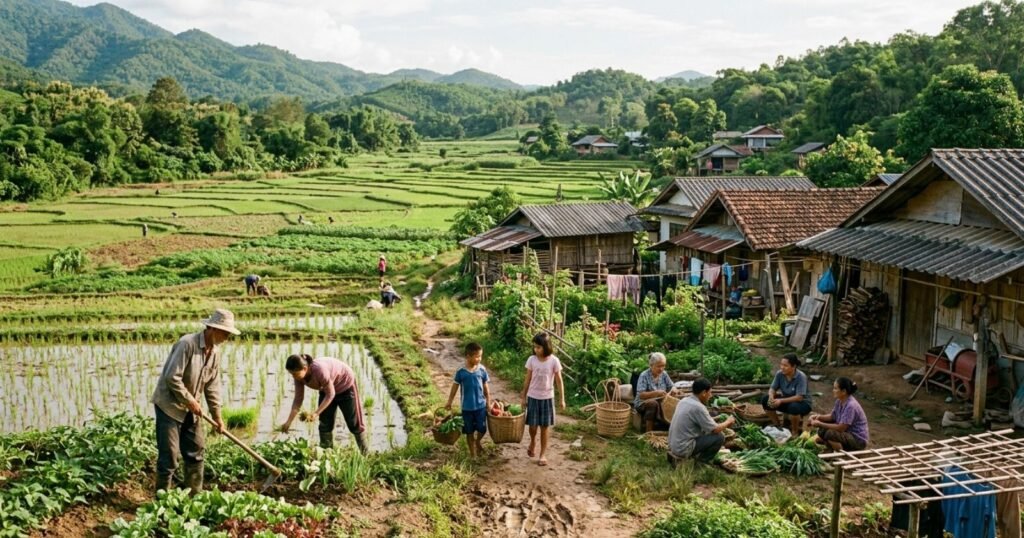
Roughly 1.5 billion people. That is the world’s rural population under the United Nations’ newly standardized Degree of Urbanization framework introduced in 2025, just 19% of humanity, down from around 38% only a few decades ago. Under the older, more familiar national-definitions measure, the figure is dramatically higher, closer to 3.4 to 3.5 billion people, over 40% of the world’s population. Both numbers describe the same underlying group of human beings; they simply draw the line between “rural” and “not rural” in very different places. Whichever measure is used, one fact holds steady across both: the rural population is not vanishing. It is approaching its historical peak size and is expected to plateau before beginning, for the first time in recorded history, a gradual decline, even as the world’s total population keeps growing.
How Many People Live in Rural Areas?
Under traditional national definitions, the global rural population stood at close to 3.4 billion as of recent UN estimates, home to nearly 90% of the population within Africa and Asia specifically. Under the UN’s newer, spatially standardized Degree of Urbanization framework, which classifies settlements into cities, towns and rural areas using a globally consistent density and size grid rather than relying on each country’s own definition, the rural share for 2025 falls to just 19% of the world’s 8.2 billion people, or roughly 1.5 to 1.6 billion, reflecting the fact that many settlements counted as “rural” under looser national definitions are reclassified as “towns” under the newer standard.
Global Rural Population, Key Figures
| Metric | Figure | Framework/Year |
|---|---|---|
| Global rural population (national definitions) | ~3.4 billion | UN DESA, mid-2010s estimate |
| Global rural population share (national definitions) | ~38-43% | Recent years |
| Global rural population share (UN Degree of Urbanization) | 19% | 2025 |
| Global rural share, 1950 (Degree of Urbanization) | ~38-40% | 1950 |
| Projected global rural population (national definitions) | ~3.1 billion | 2050 |
| Rural population share expected to peak | 2040s | Degree of Urbanization framework |
Source: UN DESA, World Urbanization Prospects 2025 and earlier revisions.
What Counts as Rural?
“Rural” is, in practice, defined by exclusion, whatever a given classification system does not count as urban, and since urban definitions vary enormously by country, so too do rural ones. Most countries use their own population thresholds, administrative status or density criteria to draw the line, producing wide inconsistency when rural population figures are compared directly across countries. The UN’s 2025 Degree of Urbanization framework was introduced specifically to address this problem, applying a single, spatially consistent global standard, using a population density and settlement size grid, rather than deferring to each country’s own definition. Under this newer standard, a meaningful share of settlements that many countries would traditionally classify as urban or, at minimum, would not classify as strictly rural, are instead grouped into a distinct intermediate “town” category, which is the primary reason the rural population share looks so different (19%) under the new framework compared with older, national-definitions-based estimates (closer to 40%).
Rural Versus Urban Population Worldwide
The long-term trajectory has been a steady inversion of what was, for most of human history, an overwhelmingly rural species. As recently as 1950, only about 30% of the world’s population, under the traditional national-definitions measure, lived in urban areas, meaning around 70% was rural. By 2025, under the same traditional framework, that has essentially reversed: roughly 57.5% urban versus 42.5% rural. Under the UN’s stricter, newer Degree of Urbanization framework, the rural share has fallen even further, from around 38-40% in 1950 down to just 19% by 2025, a decline of roughly half.
Rural Population Share Over Time (Degree of Urbanization Framework)
| Year | Rural Share of World Population |
|---|---|
| 1950 | ~38-40% |
| 2025 | 19% |
Source: UN DESA, World Urbanization Prospects 2025: Summary of Results.
Where the World’s Rural Population Lives
Rural population, much like urban population, is highly concentrated geographically rather than evenly spread. Africa and Asia together were home to nearly 90% of the world’s entire rural population as of recent UN estimates, a concentration that closely mirrors the underlying reality that these two regions also account for the large majority of the world’s total population and remain, on average, the least urbanized major world regions. As of 2025, rural areas remain the most common form of residence, meaning the largest single settlement category, in 62 countries worldwide, spanning much of sub-Saharan Africa alongside several European countries, including France, Poland and Romania, a reminder that “predominantly rural” is not a status limited only to low-income countries.
Countries With the Largest Rural Populations
India has consistently held the position of the country with the largest absolute rural population in the world across every recent UN estimate, though the precise figure varies somewhat by reference year and data source.
Largest Rural Populations by Country (Selected Recent Estimates)
| Country | Rural Population | Approx. Year |
|---|---|---|
| India | ~857-945 million (varies by source/year) | 2014-2026 |
| China | ~469-635 million (varies by source/year) | 2014-2026 |
| Pakistan | ~156 million | recent |
| Bangladesh | ~118 million | recent |
| Indonesia | among top 5-6 globally | recent |
Note: figures vary meaningfully across sources because of differing reference years and rural/urban definitional methodology; StatisticsTimes’ most recent compilation puts India’s rural population at 945 million and China’s at 469 million, while earlier UN DESA reports (2014-2018) recorded lower figures for India (857-908 million) and higher figures for China (578-635 million), reflecting both genuine demographic change and definitional shifts over time.
India and China together account for a substantial share of the entire world’s rural population, a direct consequence of their enormous total populations combined with rural population shares that, while declining, remain significant, particularly in India’s case, where rural residents still outnumber urban residents nationally even as the country’s cities continue growing rapidly.
Countries With the Highest Rural Shares
Separating absolute rural population from rural population share as a percentage of a country’s total population surfaces a very different group of countries, generally smaller, lower-income nations where urbanization has progressed more slowly rather than the large-population countries that dominate the absolute rankings.
How the Rural Population Has Changed
The defining feature of recent and projected rural population trends is not primarily a decline but the ending of continuous growth after roughly a century of steady, if slowing, increase. Under national definitions, the global rural population has grown slowly since 1950, and multiple UN World Urbanization Prospects revisions have consistently projected it approaching its historical peak size, variously estimated as occurring sometime between the early 2020s and the 2040s depending on the specific revision and framework used, before beginning a gradual decline toward roughly 3.1 billion by 2050. Under the UN’s newer Degree of Urbanization framework, the rural population is expected to peak specifically in the 2040s.
Why Rural Population Shares Are Falling
Several distinct mechanisms drive the declining rural share even in countries where the absolute rural population remains large or is still growing modestly:
- Rural-to-urban migration remains the most direct driver, as residents move toward cities in search of employment, services and opportunity, a pattern especially pronounced across rapidly urbanizing regions of sub-Saharan Africa and South Asia.
- Differential natural increase, meaning urban populations in many countries now grow through births as fast as or faster than rural populations, compounds the shifting balance even independent of migration.
- Administrative reclassification, where a settlement’s designated status shifts from rural to urban, or in the newer UN framework, to “town,” as population density and size cross defined thresholds, without necessarily requiring any migration at all.
- Urban boundary expansion, where growing metropolitan areas physically absorb what were previously separate, more sparsely populated rural or peri-urban settlements into their urban footprint.
What Life in Rural Population Systems Looks Like
Rural populations worldwide remain disproportionately engaged in agriculture, though the specific balance varies enormously by country and region. Access to services, education, healthcare and digital connectivity in particular, typically lags meaningfully behind urban areas across most low- and middle-income countries, a gap that shapes both migration incentives and the broader development challenge of rural regions. The world’s rural population also holds a disproportionate share of global poverty: the majority of the world’s poorest population continues to reside in rural areas, sustained primarily through farming, a pattern that has persisted even as urban poverty has grown in absolute terms alongside rapid, sometimes under-resourced urbanization across many developing countries.
Is the Rural Population Actually Shrinking?
This is the single most commonly misunderstood aspect of rural population statistics, and it deserves direct clarification: the rural population’s declining share of world population, from around 40% to 19% under the newer framework since 1950, is not the same statement as the rural population’s absolute number declining. For most of the period since 1950, the rural population has continued growing in absolute terms even as its share of the faster-growing total world population has fallen, simply because global population growth has been so substantial that both urban and rural populations could grow simultaneously in absolute terms while urban growth vastly outpaced rural growth in percentage terms. Only recently, and only in current UN projections looking forward, is the rural population’s absolute size expected to actually begin declining, a genuinely new development in the more than 200 years since global population growth accelerated during the Industrial Revolution.
The Future of Rural Populations
Regional divergence is expected to define the coming decades. Africa and Asia, which together hold nearly 90% of the world’s current rural population, are projected to see rural populations decline unevenly: some African countries are expected to continue adding rural residents in absolute terms even as their rural population share falls, given how much total population growth these countries still have ahead of them, while several Asian countries with more advanced urban transitions, China chief among them, are already seeing rural populations decline in both absolute and percentage terms simultaneously. The 62 countries where rural remains the most common settlement type as of 2025, spanning much of sub-Saharan Africa alongside several European nations including France, Poland and Romania, are likely to see that status persist for at least the medium term, even as their overall rural share continues gradually eroding.
Key Findings
- The global rural population stands at roughly 3.4 billion under traditional national definitions, or about 1.5 to 1.6 billion (19% of world population) under the UN’s newer, stricter Degree of Urbanization framework introduced in 2025.
- Africa and Asia together hold nearly 90% of the world’s entire rural population, a direct consequence of both regions’ large total populations and comparatively lower urbanization levels.
- India has the world’s largest rural population of any single country, estimated at somewhere between roughly 857 million and 945 million depending on the specific year and data source consulted.
- The rural population’s declining share of world population, from roughly 40% in 1950 to 19% today under the newer framework, is a different statement from its absolute size declining; the rural population has continued growing in absolute numbers for most of this period even as its share fell.
- Rural areas remain the most common form of settlement in 62 countries as of 2025, including several European nations such as France, Poland and Romania, alongside much of sub-Saharan Africa.
- The global rural population is projected to reach its historical peak size sometime in the 2040s under the UN’s newest framework, then begin a gradual decline even as total world population continues growing.
Frequently Asked Questions
1. How many people live in rural areas worldwide?
Under traditional national definitions, roughly 3.4 billion people live in rural areas globally. Under the UN’s newer, stricter Degree of Urbanization framework introduced in 2025, the figure is about 1.5 to 1.6 billion, or 19% of the world’s population.
2. What percentage of the world population is rural?
Depending on methodology, either roughly 42.5% (traditional national definitions) or 19% (UN’s 2025 Degree of Urbanization framework) of the world’s population currently lives in rural areas.
3. Which country has the largest rural population?
India has the world’s largest rural population of any country, estimated at somewhere between approximately 857 million and 945 million depending on the reference year and data source, followed by China.
4. Is the world’s rural population declining?
Its share of total world population has been declining for decades, but its absolute number has continued growing for most of that period. UN projections anticipate the absolute rural population reaching its historical peak sometime in the 2040s before beginning to decline.
5. Why are rural population shares declining as a share of the world?
Rural-to-urban migration, faster natural population increase within cities in many countries, administrative reclassification of settlements, and physical expansion of urban boundaries into previously rural areas all contribute to the declining rural share.
6. Which countries remain predominantly rural?
As of 2025, rural areas remain the most common settlement type in 62 countries, including much of sub-Saharan Africa alongside several European countries such as France, Poland and Romania.
7. What is the difference between the traditional and newer UN measures of rural population?
The traditional measure relies on each country’s own national definition of “rural” and “urban,” while the UN’s newer Degree of Urbanization framework applies a single, spatially consistent global standard, classifying settlements into cities, towns and rural areas using population density and size rather than national definitions.
8. Do rural populations have less access to services than urban populations?
Generally, yes. Access to healthcare, education and digital connectivity typically lags in rural areas compared with urban areas across most low- and middle-income countries, a gap that also factors into rural-to-urban migration decisions.
9. Is most global poverty rural or urban?
The majority of the world’s poorest population continues to live in rural areas, sustained primarily through agriculture, even as urban poverty has grown in absolute terms alongside rapid urbanization in many developing countries.
10. When will the global rural population start declining?
Under the UN’s newest Degree of Urbanization framework, the global rural population is projected to reach its peak size sometime in the 2040s before beginning a gradual decline, a genuinely new development after roughly two centuries of continuous absolute growth.
Sources
- United Nations Department of Economic and Social Affairs (UN DESA), Population Division, World Urbanization Prospects 2025: Summary of Results, November 2025
- UN DESA, “World’s population increasingly urban,” 2014 Revision of World Urbanization Prospects
- UN DESA, “68% of the world population projected to live in urban areas by 2050,” 2018 Revision of World Urbanization Prospects
- StatisticsTimes.com, “Countries by urban population 2026”
- JIRCAS, “World Urbanization Prospects 2025” summary, December 2025
- Yahoo Finance / World Population Review, “20 Countries with the Largest Rural Population in the World”