
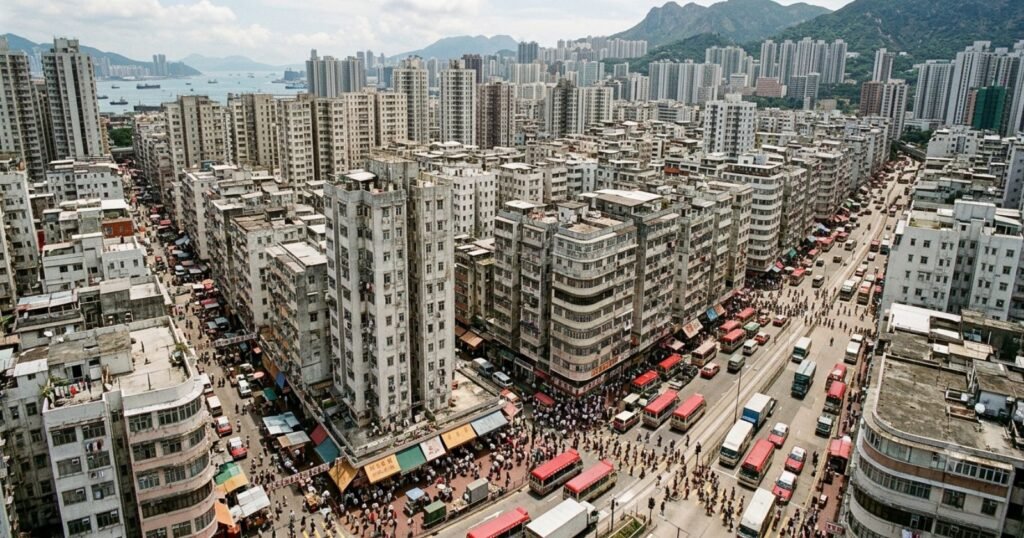
Monaco packs roughly 26,000 people into every square kilometer of its territory. Bangladesh, a country of over 170 million people, packs in “only” about 1,350 per square kilometer, and yet Bangladesh is the far more instructive case, because Monaco’s extreme figure says almost nothing about crowding in any meaningful sense and everything about how small a single square kilometer actually is. Understanding which countries are genuinely the most densely populated requires separating two entirely different phenomena that happen to produce similar-looking numbers: tiny, wealthy city-states where a modest population occupies a minuscule footprint, and large, populous nations where tens or hundreds of millions of people are genuinely packed into limited habitable land.
How Population Density Is Calculated
Population density is calculated by dividing a country’s total population by its total land area, conventionally expressed as people per square kilometer. The land area denominator is where much of the interpretive difficulty in density rankings originates: most standard calculations use a country’s total land area, including uninhabitable or sparsely habitable terrain such as deserts, mountains and, in a handful of countries, ice sheets, rather than isolating only the land actually available for settlement and agriculture. This means two countries with identical land-per-person ratios in their genuinely habitable regions can post very different headline density figures if one has a much larger share of uninhabitable interior territory than the other.
The Most Densely Populated Countries
Ranked without any population-size threshold, the list is dominated overwhelmingly by small city-states and microterritories.
Most Densely Populated Countries and Territories, 2025
| Rank | Country/Territory | Density (people/km²) |
|---|---|---|
| 1 | Monaco | ~25,732-25,969 |
| 2 | Macao SAR (China) | ~22,508-23,167 |
| 3 | Singapore | ~8,539-8,596 |
| 4 | Hong Kong SAR (China) | ~6,729-6,747 |
| 5 | Gibraltar | ~3,933-4,013 |
| 6 | Bahrain | ~1,765-2,052 |
| 7 | Maldives | ~1,759 |
| 8 | Malta | ~1,713-1,731 |
| 9 | Bangladesh | ~1,333-1,350 |
| 10 | Sint Maarten | ~1,275 |
Source: Visual Capitalist, “Ranked: The 20 Most Densely Populated Countries and Territories,” August 2025; StatisticsTimes.com; Academic Block, 2025.
Every one of the top eight entries on this list has a total population below 10 million, and several, Monaco chief among them, have populations only in the tens of thousands. Only these top two territories, Monaco and Macao, exceed 10,000 people per square kilometer, a threshold no country with a larger, more geographically typical land area comes remotely close to reaching.
Why Small Countries Often Dominate Density Rankings
The mathematics here is straightforward but easy to lose sight of: density is a ratio, and a country can post an extreme value either by having an enormous population or by having a tiny land area, and the tiny-land-area route is, in practice, far easier to achieve. Monaco’s entire territory covers roughly 2 square kilometers, smaller than many individual big-city neighborhoods; its high density says essentially nothing about crowding in the everyday sense and everything about how a modestly sized population of around 40,000 people distributes across an extremely small footprint. Macao (33 square kilometers) and Singapore (about 730 square kilometers) follow a similar logic at a somewhat larger scale, both highly urbanized city-territories where nearly the entire land area is developed and essentially none is set aside for the agricultural or wilderness land that dilutes density figures in larger countries.
Countries With Large Populations and High Density
A genuinely more informative ranking excludes microstates and asks instead: among countries with substantial populations, which are the most densely settled? This is where Bangladesh’s position becomes remarkable rather than merely statistical.
Most Densely Populated Countries With 10 Million or More People
| Rank | Country | Density (people/km²) | Approx. Population |
|---|---|---|---|
| 1 | Bangladesh | ~1,333-1,350 | ~175 million |
| 2 | Taiwan | ~652.7 | ~23 million |
| 3 | Rwanda | ~601.8 | ~14 million |
| 4 | Burundi | ~554.5 | ~13 million |
| 5 | Netherlands | ~544.9 | ~18 million |
Source: StatisticsTimes.com, Countries by population density 2025.
Bangladesh stands apart even within this list: it is roughly twice as dense as the second-ranked large country, Taiwan, and houses a population comparable to Russia’s across a land area smaller than the U.S. state of Iowa. This makes Bangladesh the single most instructive case study in the entire density conversation, since its density figure reflects genuine large-scale human settlement pressure on land, not a small population occupying a small footprint.
What Makes These Countries So Densely Populated?
Several distinct and overlapping forces explain sustained high density in countries with large populations rather than tiny territories:
- Fertile river delta geography. Bangladesh’s density traces directly to the Ganges-Brahmaputra Delta, one of the most agriculturally productive and historically food-secure regions on Earth, capable of supporting dense agrarian populations for centuries before industrialization or urbanization played any meaningful role.
- Historical agricultural intensity. Rwanda and Burundi’s high densities similarly reflect a long history of intensive smallholder agriculture across fertile highland terrain, sustained over generations even amid limited industrialization.
- Land reclamation and deliberate urban planning. The Netherlands has actively expanded its usable land area through centuries of engineered land reclamation (polders), while simultaneously developing one of the world’s most methodically planned dense settlement patterns, illustrating that high density in a wealthy country can be a product of deliberate infrastructure investment rather than land scarcity alone.
- Economic concentration in city-states and territories. Singapore, Hong Kong, Macao and Bahrain all combine limited land area with concentrated modern economic activity, finance, trade, tourism and gaming among them, drawing dense settlement as a direct consequence of their economic role rather than agricultural land pressure.
Population Density Versus Urban Crowding
It is worth stating plainly: national population density is not the same thing as household or lived crowding, and conflating the two produces a misleading picture in both directions. A national density figure blends a country’s cities together with its agricultural land, forests and any uninhabited terrain into a single average, meaning even Bangladesh’s remarkable 1,333-per-square-kilometer national figure sits well below the density experienced within its own major cities, particularly Dhaka, whose local density figures far exceed the national average once averaged only across its dense urban core. Conversely, a country’s high national density figure driven mainly by a small land area, as with Monaco or Singapore, does not necessarily correspond to overcrowded housing or strained infrastructure; both are wealthy, well-planned territories where high density coexists with high living standards, extensive vertical housing, and efficient public transit.
How Density Rankings Have Changed
Long-run population growth has pushed density figures upward across nearly every country over the past several decades, though the pace of change varies enormously. Countries already at the extreme high end of the ranking, Monaco, Macao, Singapore, have limited remaining capacity to grow density much further given how comprehensively developed their land area already is; further population growth in these territories increasingly depends on vertical development rather than any expansion of usable land. Bangladesh, by contrast, has seen its density climb substantially over recent decades as its population has grown from under 100 million in the 1980s to roughly 175 million today, even as its land area has remained essentially fixed, illustrating how quickly density figures can rise in countries still experiencing substantial population growth.
Population Density and Future Growth
Because national land area is essentially fixed while population continues changing, future density rankings will be driven almost entirely by population growth or decline trajectories rather than any territorial change. Countries still experiencing substantial population growth, several across sub-Saharan Africa in particular, are likely to see density figures rise meaningfully over coming decades, while countries facing population decline, a growing number across East Asia and parts of Europe, may see density figures plateau or even decline for the first time in their modern history, a genuinely novel demographic pattern that most currently high-density countries have not previously experienced.
Key Findings
- Monaco is the world’s most densely populated territory, at roughly 25,700 to 26,000 people per square kilometer, though its tiny 2-square-kilometer land area means this figure reflects territorial scale rather than genuine crowding.
- Among countries with populations over 10 million, Bangladesh is by far the densest, at roughly 1,333 to 1,350 people per square kilometer, nearly double the second-ranked large country, Taiwan.
- Every one of the eight most densely populated territories in the unrestricted global ranking has a total population under 10 million, underscoring how strongly land-area size, rather than population size, drives the extreme end of density rankings.
- Bangladesh’s density traces directly to the exceptional agricultural productivity of the Ganges-Brahmaputra Delta, a geographic feature capable of supporting dense populations since long before industrialization.
- National density figures, even extreme ones like Bangladesh’s, sit well below the density actually experienced within a country’s largest cities, since national figures average dense urban cores together with less densely populated rural and agricultural land.
- The Netherlands demonstrates that high density in a wealthy, developed country can result from deliberate land reclamation and urban planning rather than land scarcity or agricultural necessity alone.
Frequently Asked Questions
1. Which country is the most densely populated?
Monaco is the most densely populated sovereign territory in the world, at roughly 25,700 to 26,000 people per square kilometer, though this reflects its extremely small 2-square-kilometer land area rather than a large population.
2. What are the top densely populated countries?
Beyond microstates like Monaco and Macao, Bangladesh is the most densely populated country with a substantial population, at roughly 1,333 to 1,350 people per square kilometer, followed by Taiwan, Rwanda, Burundi and the Netherlands.
3. Does high population density mean overcrowding?
Not necessarily. High national density can coexist with high living standards and efficient infrastructure, as demonstrated by Singapore, Hong Kong and the Netherlands, all of which combine high density with strong economic development and planned urban design.
4. Why are some small countries so densely populated?
Because density is a ratio of population to land area, a very small territory can produce an extreme density figure even with a modest total population, which is why nearly every country at the very top of unrestricted global density rankings has a population under 10 million.
5. Why is Bangladesh so densely populated?
Bangladesh’s density stems from the exceptional agricultural productivity of the Ganges-Brahmaputra Delta, which has supported dense human settlement for centuries, combined with a large and still-growing population of roughly 175 million within a comparatively small national land area.
6. Is population density the same everywhere within a country?
No. National density figures are averages that blend dense urban centers together with less densely populated rural, agricultural and any uninhabited land, meaning the density experienced within a country’s largest cities is typically far higher than its national average.
7. Which large, populous countries are surprisingly dense?
Beyond Bangladesh, Taiwan, Rwanda and Burundi all combine substantial populations, in the tens of millions, with comparatively high national density figures driven by limited habitable land and, in Rwanda and Burundi’s case, a long history of intensive agricultural settlement.
8. How is population density calculated?
Population density is calculated by dividing a country’s total population by its total land area, typically expressed as people per square kilometer, though the exact land area used, total versus habitable land, can vary between sources and affect the resulting figure.
9. Are density rankings changing over time?
Yes. Countries still experiencing substantial population growth are seeing density rise, while countries facing population decline may see density figures plateau or decline for the first time in their modern history.
10. What is the difference between national density and city density?
National density averages an entire country’s land area, including agricultural and uninhabited land, together with its cities, while city-specific density measures only the population within a defined urban boundary, typically producing a much higher figure than the national average.
Sources
- Visual Capitalist, “Ranked: The 20 Most Densely Populated Countries and Territories,” August 2025
- StatisticsTimes.com, “Countries by population density 2025”
- Academic Block, “Top 10 Countries with Highest Population Density,” 2025
- World Population Review, “Countries by Population Density 2026”
- Aviation A2Z, “Most Densely Populated Countries in the World in 2025,” June 2025