
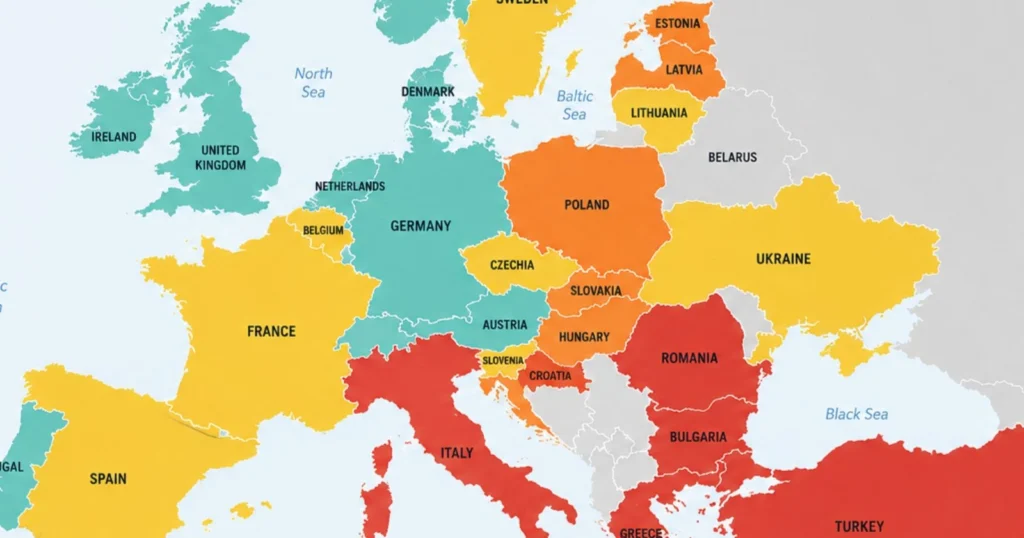
Europe’s migration story in 2026 is not a single crisis but five very different ones unfolding at the same time. While Spain grapples with a historic surge at its African enclave of Ceuta, Italy is celebrating its steepest decline in irregular arrivals in years.
Greece is fighting a fresh wave hitting Crete even as its overall numbers fall, France continues to carry the EU’s third largest asylum backlog, and the United Kingdom is seeing Channel crossings drop after three straight years of records. Taken together, these five countries offer a clear picture of how divergent Europe’s migration reality has become, and why no single policy fix is working the same way twice.
Spain: A Sharp Local Crisis Inside a National Decline
Spain presents the starkest contradiction on the continent right now. Nationally, irregular arrivals have been falling. Interior Ministry data showed a nearly 50 percent drop in arrivals during the first quarter of 2026 compared with the same period a year earlier, and irregular arrivals across the rest of the country fell from roughly 17,990 in the first half of 2025 to 12,138 in the first half of 2026.
Yet Ceuta, the small Spanish enclave on Africa’s northern coast, has moved in the opposite direction. Land crossings into Ceuta jumped by as much as 435 percent in early 2026 compared with the previous year, according to reporting citing Interior Ministry figures, and the trend culminated in a single catastrophic event on July 30 and 31, when tens of thousands of migrants crossed the border in roughly 24 hours, a surge equivalent to as much as 70 percent of the enclave’s entire population. Dozens of people died in the process, most while attempting to swim across coastal waters.
Spanish officials have linked the Ceuta surge to a June 29 Supreme Court ruling that limited the summary return of migrants who arrive by sea, arguing that smuggling networks spread a misleading interpretation of the decision across Moroccan social media to encourage crossings.
Nationally, Spain also stands out for taking the opposite policy approach from most of its neighbors, having moved in 2026 to grant legal status to roughly 500,000 undocumented migrants already living in the country, a program tied partly to concerns about an aging population and long-term labor shortages.
Italy: Meloni’s Numbers Success Meets a Quiet Legal Migration Expansion
Italy offers the most striking policy success story of the group, at least by the government’s own measurements. Interior Minister Matteo Piantedosi presented figures in mid 2026 showing a 77 percent reduction in irregular sea arrivals compared with 2023 and a 52 percent drop compared with the same period in 2025.
Repatriations have also climbed sharply, rising more than 40 percent since Prime Minister Giorgia Meloni took office in October 2022, with a further 30 percent increase recorded in early 2026 alone. The share of new arrivals who are actually repatriated has grown from just 3 percent in 2023 to 31 percent in early 2026.
The government attributes the turnaround to a combination of bilateral agreements with North African countries, the controversial offshore migrant processing center built in Albania, tighter restrictions on NGO rescue vessels operating near Libyan waters, and a new bill advanced in February 2026 that allows temporary naval blockades on sea arrivals when authorities judge there to be a serious threat to public order.
What complicates Italy’s narrative, however, is a parallel and less publicized policy shift. Even as irregular arrivals fall, Meloni’s government has set targets to issue new legal work visas to hundreds of thousands of non-EU migrants between 2026 and 2028, aiming to offset chronic labor shortages tied to Italy’s aging population and low birth rate. Analysts have noted the apparent contradiction between the government’s hardline rhetoric on illegal immigration and its growing reliance on legal migration to fill workforce gaps, a tension that is likely to shape Italian politics well beyond this year.
France: Steady Pressure and the Largest Backlog in Western Europe
France has not experienced a single dramatic crisis event on the scale of Ceuta or Crete in 2026, but it continues to carry one of the European Union’s heaviest structural migration burdens. As of March 2026, France had 148,585 pending asylum applications, the fourth highest total in the EU behind Germany, Spain, and Italy, and representing more than 12 percent of the roughly 1.19 million cases awaiting decisions across the bloc.
France’s asylum numbers have shown a slight cooling trend at the registration stage, with 157,947 people registering asylum applications in 2024, down from 167,432 the year before, though the country continues to see rising acceptance rates for those whose cases are approved. France has also taken a firmer enforcement posture at its own borders in recent years, including expanded police deployment near frontier regions and continued cooperation with Morocco on returns.
Perhaps most significant for the wider European picture is France’s political reaction to events elsewhere. Following the Ceuta crisis, French Interior Minister Laurent Nuñez ordered an immediate reinforcement of checks at the Spanish border, illustrating how a crisis at one corner of the EU’s external frontier can quickly ripple into internal Schengen zone controls hundreds of miles away.
Greece: Falling Numbers Overall, But Crete Becomes the New Flashpoint
Greece shows a pattern that closely mirrors Spain’s split personality between national trends and a single overwhelmed hotspot. Nationally, irregular arrivals fell sharply, dropping 27 percent in the first half of 2026 alone, building on a 25 percent reduction the previous year. Arrivals by sea specifically fell 27 percent in the first half of 2026, with the Aegean route down 62 percent, largely credited to expanded cooperation with the Turkish coast guard.
Crete, however, has become Greece’s version of Ceuta. Migrant landings on Crete and the neighboring island of Gavdos quadrupled in 2025 compared with the prior year, reaching 20,187 arrivals, most of them departing from Libya rather than Turkey. The pressure became severe enough that Greece’s government briefly suspended asylum applications for arrivals from North Africa in mid 2025 after more than 2,500 people arrived on Crete in a single week, a move Migration Minister Thanos Plevris described using the same word Spanish officials would later apply to Ceuta: an invasion. Arrivals to Crete alone reached roughly 8,552 in just the first half of 2026, according to refugee rights monitors, even as the government pursued new fast-track deportation rules requiring rejected asylum seekers to leave within 14 days and expanded the EU-Turkey return agreement to migrants who arrived after March 20, 2026.
Greece has paired this enforcement push with a rise in returns, reporting a 20 percent increase in migrant returns and a 41 percent jump in forced deportations during the first half of 2026 compared with the same period the year before.
Related Article:
- Why Tens of Thousands of Migrants Stormed Into Spain’s Ceuta in a Single Day
- Inside the Night Ceuta’s Border Fell: 60,000 Migrants, Dozens Dead
- Inside the Smuggling Networks Turning TikTok Videos Into Ceuta Border Crossings
- Ranking Europe’s Toughest and Softest Migration Policies in 2026
The United Kingdom: Channel Crossings Finally Trend Downward
Outside the EU but firmly inside the broader European migration conversation, the United Kingdom has recorded one of its more encouraging years in recent memory after a long run of records. Small boat crossings fell 12 percent in the first half of 2026 compared with the same period in 2024, with June 2026 registering the lowest monthly total for that month since 2021. Roughly 39,000 people arrived by small boat in the year ending March 2026, down from a 2022 peak of around 46,000, though still historically high by pre 2020 standards.
The UK government has credited a mix of measures for the shift, including a three year, 662 million pound agreement with French authorities to fund expanded beach patrols, restrictions on the supply of small boat parts, and a pilot one in, one out returns arrangement with France introduced in August 2025 that allows the UK to return some Channel arrivals in exchange for accepting an equivalent number of asylum seekers who have not attempted the crossing. Home Secretary Shabana Mahmood has also floated more contentious proposals, including a plan requiring asylum seekers to eventually repay up to 10,000 pounds toward their own housing and support costs, structured similarly to a student loan.
Net migration to the UK overall fell 48 percent to about 171,100 in 2025, the lowest level since 2012 outside the pandemic years, a figure the government has pointed to as evidence its broader immigration strategy is working, even as opposition politicians argue crossing numbers remain unacceptably high in historical terms.
Five Countries, Five Different Stories
| Country | 2026 Trend | Key Policy Driver | Flashpoint Location |
|---|---|---|---|
| Spain | National arrivals falling, Ceuta surging | Supreme Court ruling on sea arrivals; mass regularization program | Ceuta |
| Italy | Sharp overall decline in irregular arrivals | Albania processing deal, naval blockade law, NGO restrictions | Central Mediterranean route |
| France | Persistent high backlog, modest cooling | Border reinforcement, EU’s Pact on Migration and Asylum | Alpes Maritimes border zone |
| Greece | National decline, Crete surging | Asylum suspension, EU-Turkey return deal, fast-track deportations | Crete and Gavdos |
| United Kingdom | Crossings falling after years of records | UK France returns pilot, beach patrol funding, asylum system overhaul | English Channel |
What Ties These Countries Together
Despite their differences, a few threads run through every country on this list. First, enforcement-heavy policies are producing measurable results almost everywhere at the national level, whether through Italy’s offshore processing, Greece’s asylum suspensions, or the UK’s cross-Channel returns pilot.
Second, and just as consistently, tighter controls in one location tend to push pressure toward a new and less prepared entry point, as seen in the shift from Spain’s mainland to Ceuta, and from Greece’s Aegean islands to Crete’s Libya-facing coastline. Third, courts continue to play an outsized role in shaping outcomes, whether through Spain’s Supreme Court ruling on sea arrivals or Italy’s repeated legal battles over its Albania agreement.
Finally, every government on this list is simultaneously tightening irregular migration enforcement while quietly expanding legal migration pathways, reflecting the same underlying demographic pressure of aging populations and shrinking workforces across Western Europe. The politics of border security and the economics of labor supply are pulling in opposite directions in nearly every capital, and 2026 has made that tension harder to ignore than ever before.
As the European Union’s new Pact on Migration and Asylum continues rolling out following its formal application from June 2026, the coming months will test whether a genuinely coordinated European response is possible, or whether each country will keep managing its own crisis in isolation while quietly hoping the next flashpoint appears somewhere else.