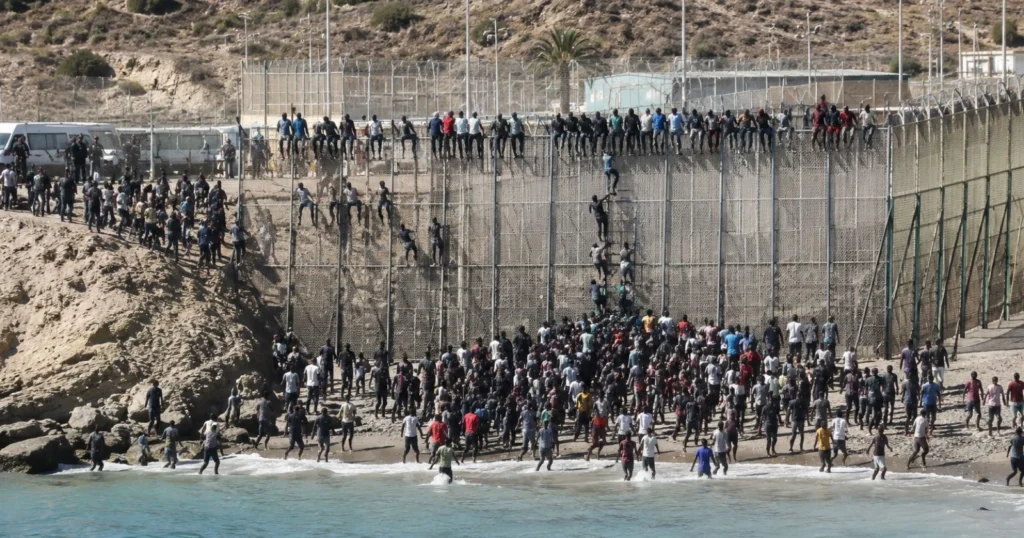
A wave of roughly 60,000 migrants surged into the Spanish North African enclave of Ceuta from Morocco over 24 hours beginning Thursday, July 30, 2026, in what officials are calling one of the most dramatic border breaches in the region’s recent history. The figure, confirmed by Ceuta’s regional president Juan Jesús Vivas, is equivalent to nearly 70 percent of the city’s entire population of approximately 83,500 residents.
The scale of the crossing overwhelmed Spain’s Guardia Civil border police almost instantly. Video footage and eyewitness accounts described crowds of young men, along with women, children, and even infants, swimming around breakwater fences, scaling rocks near the Tarajal border checkpoint, and pouring onto beaches in scenes that residents said they had never witnessed before. Officials estimated that at least 7,000 of those who entered were minors, many of them unaccompanied.
By Friday afternoon, the situation had begun to shift. Spain’s Interior Ministry reported that roughly 25,000 people, close to half of those who arrived, had already made the voluntary journey back across the border into Morocco, discouraged by dire conditions, food shortages, and a lack of shelter inside Ceuta.
Death Toll Climbs as Reports Vary Across Sources
The human cost of the crossing has been severe, though exact figures vary depending on the source and the hour at which they were reported. Local police and workers association leader Rachid Sbihi told the Associated Press that at least 41 migrants died, some by drowning and others in a stampede while attempting to scale the breakwater fence at Tarajal beach. Spanish language media outlets cited by the BBC put the toll as high as 57. At the same time, earlier reporting from Deutsche Welle placed the figure at 18 fatalities before updated counts emerged later in the day.
| Source | Reported Deaths | Reported Arrivals |
|---|---|---|
| Local Ceuta police and workers association (via AP) | At least 41 | Approximately 60,000 |
| Spanish language media (via BBC) | At least 57 | Approximately 60,000 |
| Deutsche Welle (early reporting) | At least 18 | Approximately 60,000 |
| Spain’s Interior Ministry | Not specified | Approximately 50,000 |
Regardless of the precise count, authorities agree that many of the deaths occurred either in open water during the swim from Moroccan territory or in the crush of bodies attempting to cross the breakwater barrier simultaneously. Discarded life jackets, inflatable tubes, rubber boats, and personal belongings were later seen floating near the border fence and scattered along the shoreline.
What Triggered the Sudden Surge
Spanish Prime Minister Pedro Sánchez, who traveled to Ceuta on Friday alongside Interior Minister Fernando Grande Marlaska, pointed directly at organized trafficking networks for orchestrating the crisis. He described the mass crossing as a clear violation of Spanish territorial integrity and said human smugglers had deliberately spread a distorted interpretation of a recent legal ruling.
At the center of the confusion is a decision issued by Spain’s Supreme Court on July 8, 2026. The ruling clarified that migrants intercepted at sea while trying to reach Ceuta or Melilla, Spain’s other North African enclave, could not be summarily returned to Morocco in the same way that those who cross by land or scale border fences can be. The ruling applied narrowly to interceptions in open water, such as the Strait of Gibraltar, rather than to swimmers rounding a coastal barrier, but according to Sánchez, trafficking networks twisted that nuance into a rumor that anyone who entered Ceuta “by sea” would automatically be allowed to stay.
“What has emerged from our talks with Moroccan authorities is that trafficking mafias took a self-serving interpretation of a Supreme Court ruling,” Sánchez said, adding that the claim “spread like wildfire” through smuggling networks in the hours before the surge began.
Not everyone accepts that explanation at face value. Some rights activists in Morocco expressed skepticism that the court decision alone could explain the scale of the movement, arguing that most migrants attempting such a dangerous journey would likely have had little direct knowledge of a foreign court’s legal reasoning. Analysts have also pointed to broader regional pressures, including Morocco’s persistently high youth unemployment, which fueled a wave of Gen Z-led anti-government protests across the country last year as young people demanded better job prospects and improved public services.
Personal Accounts From the Ground
Interviews conducted by Reuters and the Associated Press captured the exhaustion and disillusionment felt by many who made the crossing only to turn back within a day. Abdulah Buji, a 21 year old from Tetouan, told the AP that limited opportunity at home pushed him toward Ceuta, but the chaos he encountered left him with little choice but to return. “There’s nothing at home. I’d have to work 12-hour shifts for a meager wage. That’s why I came here. But I haven’t found any opportunities here either, so I have to go back,” he said.
Residents of Ceuta described the atmosphere as frightening and unlike anything they had witnessed before, including a previous surge in 2021 that brought roughly 8,000 people into the city. One resident, Carmen Gonzalez Bermudez, told the BBC she saw “thousands and thousands and thousands of people in swimming costumes and all wet, just coming from the sea.” She added that while she believed most of the arrivals were simply seeking a better future, the city’s infrastructure could not absorb them. Another resident, Víctor Ortiz Sotomayor, said he had “never seen anything like it,” describing streets and squares packed with migrants searching for food while many stores closed on police advice.
Spain Deploys Military as Ceuta Declares Emergency
In response to the breakdown of border control, Spain rushed armed forces and additional police units to Ceuta and to Melilla, where between 300 and 400 additional crossings were reported over the same period. Ceuta’s mayor, Juan Jesús Vivas, appeared on Spanish radio calling the situation a “national disaster” and urging Madrid to declare a formal state of emergency, describing the pressure on the small city as “absolutely unsustainable.”
The crisis has also become a flashpoint in Spanish domestic politics. Alberto Núñez Feijóo, leader of the main opposition People’s Party, wrote on social media that the government could not “turn a blind eye” and framed the events as a national security crisis. Conservative politician Isabel Díaz Ayuso went further, accusing Sánchez’s government on social media platform X of allowing Ceuta to be “invaded.”
Sánchez, a Socialist, defended his broader immigration record on Friday and distanced it from the events in Ceuta. Earlier in 2026, his government had launched a program offering residency and work permits to hundreds of thousands of undocumented migrants already living in Spain, a policy his administration argued would help offset the country’s aging population and address labor shortages.
That program reportedly drew more than one million applications, and the government allocated roughly 505 million euros toward vocational training and language education for migrants. Migrants who entered Spain irregularly after January 1, 2026 were excluded from that regularization effort, and the Spanish government issued a statement rejecting claims that the policy was connected to the Ceuta breach.
Related Article:
- Why Tens of Thousands of Migrants Stormed Into Spain’s Ceuta in a Single Day
- Europe’s 2026 Migration Crisis: A Country by Country Snapshot
- Inside the Smuggling Networks Turning TikTok Videos Into Ceuta Border Crossings
- Ranking Europe’s Toughest and Softest Migration Policies in 2026
Diplomatic Fallout Spreads Across Europe
The images emerging from Ceuta quickly drew reaction from leaders well beyond Spain’s borders. European Commission President Ursula von der Leyen called the scenes “unacceptable” and said dangerous crossings must stop immediately, while insisting that smuggling networks be dismantled and that returns proceed swiftly under existing EU rules.
Italy’s right-wing Prime Minister Giorgia Meloni described the footage as shocking and called it evidence of an uncontrolled immigration threat to European security. By Friday, Italy had moved to suspend elements of the Schengen free movement arrangement with Spain, a largely symbolic step given that the two countries share no land border, though it is expected to translate into additional checks on air travelers.
Denmark’s Prime Minister Mette Frederiksen echoed the call, urging the EU to consider halting Schengen cooperation with Spain entirely, while Finland’s Interior Minister Mari Rantanen and Czech leader Andrej Babiš voiced similar support for reviewing Spain’s status within the passport-free zone.
France’s Interior Minister Laurent Nunez announced that Paris would immediately strengthen checks at its own border with Spain and activate a rapid intervention border force for enhanced screening. Italian Foreign Minister Antonio Tajani went further, criticizing Spain’s earlier decision to grant residency to undocumented migrants as a policy that fueled trafficking, prompting Spain’s Foreign Minister José Manuel Albares to summon Italy’s ambassador in protest, calling the remarks improper for a friendly European partner.
Spain pushed back firmly against the criticism. Sánchez, writing on X, stated that solidarity and empathy were optional but that respect for European treaties was not. Even United States President Donald Trump weighed in, calling the situation in Ceuta a catastrophe and attributing it to weak law and poor management, underscoring how the episode has resonated well beyond European borders into the broader global immigration debate.
Context: Why Ceuta Keeps Making Headlines
Ceuta has been under Spanish control since 1580 and, along with Melilla, remains one of only two places where the European Union shares a land border with the African continent. Sitting roughly 14 kilometers from the Strait of Gibraltar at its narrowest point, the enclave has long functioned as a gateway for migrants hoping to reach mainland Europe, and its proximity to Morocco has made it a recurring flashpoint in relations between Madrid and Rabat.
According to migration data reviewed by BBC Verify, crossings into Ceuta and Melilla had already been climbing well before Thursday’s surge, with 2,826 people entering Ceuta and 181 entering Melilla in the first two weeks of July 2026 alone. That pace already outstripped full-year totals from recent years, which stood at 994 crossings in 2025, 476 in 2024, and 467 in 2023, suggesting that pressure had been building steadily before the Supreme Court ruling became a flashpoint.
The Schengen Area itself, the passport-free zone now under scrutiny because of the crisis, spans 29 European countries that have formally eliminated checks at their shared internal borders. Any sustained suspension involving Spain would mark a significant shift in a system that has underpinned free movement across the continent for decades, and it illustrates how a localized border emergency in a small North African enclave can quickly ripple into a continent-wide policy debate.
What Comes Next
Spanish officials say they are working with Moroccan counterparts to manage returns and reinforce the physical border, while Morocco’s ambassador to Spain, Karima Benyaich, expressed hope that those who crossed would continue returning voluntarily, describing the situation as difficult and one that unfolded against Morocco’s wishes. Moroccan police reportedly used water cannons and fired warning shots to try to prevent additional crossings, and clashes were also reported in Bni Nsar, the Moroccan town bordering Melilla, where security forces and migrants exchanged rocks and vehicles were set ablaze.
For now, the scenes from Ceuta have become a defining moment in Europe’s ongoing struggle to balance humanitarian obligations with border security, reigniting a debate that stretches from Madrid to Brussels to Washington. With thousands still deciding whether to stay or return, and with European capitals now openly discussing changes to decades-old free movement rules, the aftershocks of this single, chaotic day are likely to shape immigration policy across the continent for months to come.