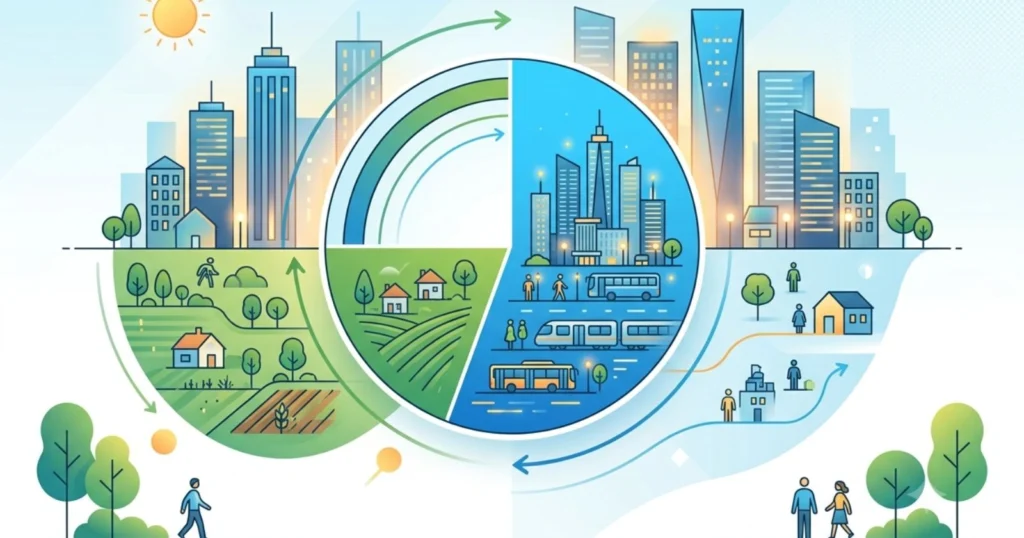
More people live in cities today than at any other point in human history. According to the United Nations, roughly 57 to 58 percent of the global population currently lives in urban areas under the traditional national definitions used by most countries. But a newer and more detailed UN measurement system, released in late 2025, tells a more layered story. It shows that 45 percent of people worldwide live in cities specifically, another 36 percent live in towns, and only 19 percent live in truly rural settlements. Combined, that means more than 80 percent of humanity now lives in some form of urban or semi-urban settlement.
This article breaks down exactly what these numbers mean, how the definition of urban has changed, and how urbanization varies dramatically from one region of the world to another. We rely on data from the United Nations Population Division, the World Bank, and the UN World Urbanization Prospects 2025 report, the most comprehensive urbanization dataset ever produced.
The Short Answer
Under the classic UN and World Bank measurement, which relies on how each country defines its own urban boundaries, the world’s urban population stood at about 57.7 percent in 2024. That figure has been climbing steadily for more than a century.
Under the newer Degree of Urbanization framework introduced in the World Urbanization Prospects 2025 report, the picture is broken into three tiers instead of two:
– Cities, home to 45 percent of the global population, around 3.69 billion people
– Towns and semi-dense areas, home to 36 percent, around 2.9 billion people
– Rural areas, home to the remaining 19 percent
Both figures agree on one central fact. The majority of humanity now lives somewhere other than a traditional rural village, and that share is growing every year.
Why There Are Two Different Numbers
Anyone researching this topic will notice that different sources report different urbanization percentages, sometimes with a 20 to 25 point gap between them. This is not a data error. It comes down to definitions.
For decades, the UN relied on each country’s own definition of what counts as urban. Some nations define a town of a few thousand residents as urban. Others only count areas above 20,000 or 50,000 people, or apply administrative rules such as counting only provincial capitals. This patchwork approach is why the world’s official urbanization rate has historically hovered near 56 to 58 percent, even though satellite imagery clearly shows dense human settlement covering a much larger share of the population.
To fix this inconsistency, the UN Population Division adopted the Degree of Urbanization method for the 2025 revision of the World Urbanization Prospects. This approach uses satellite-based population density grids from the Global Human Settlement Layer, combined with national census data, to classify every square kilometer of inhabited land into one of three categories: city, town or semi-dense area, and rural area. Because it applies one consistent global standard rather than 237 different national definitions, it captures a large population that older data classified as rural, even though people were living at urban density levels.
The result is that the new methodology finds a significantly higher combined urban and town population, around 81 percent, compared to the roughly 58 percent found using the older national definitions.
For most everyday purposes, when people ask what percentage of the world lives in cities, the answer that best matches common usage is the traditional urban population figure of approximately 57 to 58 percent, since it reflects how national governments themselves classify their populations. When precision about settlement density is needed, the newer 45 percent cities plus 36 percent towns breakdown is more accurate.
How Urbanization Has Changed Since 1950
Urban living is a relatively recent phenomenon in the arc of human history. As recently as 1800, less than 10 percent of the world’s population lived in anything resembling a city. The real shift began in the twentieth century and accelerated sharply after World War II.
| Year | Share Living in Urban Areas | Approximate Urban Population |
|---|---|---|
| 1950 | Around 30 percent | 750 million |
| 1970 | Around 37 percent | 1.35 billion |
| 1990 | Around 43 percent | 2.3 billion |
| 2007 | Just over 50 percent (urban majority reached) | 3.4 billion |
| 2024 | Around 58 percent | 4.7 billion |
| 2050 (projected) | Around 68 percent | 6.7 billion |
Note: figures use the traditional UN national definition of urban population and are rounded to the nearest whole percentage or nearest 50 million people. Source: United Nations World Urbanization Prospects and World Bank Development Indicators.
Two milestones stand out. First, 2007 marked the year humanity crossed the halfway mark, with more people living in urban areas than rural ones for the first time in recorded history. Second, the pace of change has not slowed. The UN projects that by 2050, roughly two out of every three people on the planet will live in a city.
Under the newer Degree of Urbanization dataset, the shift looks even more dramatic. In 1950, just 20 percent of people lived in cities, and 40 percent lived in towns, meaning 60 percent lived in a city or town of some kind. By 2025, the city share alone had more than doubled to 45 percent, while the combined city and town share reached 81 percent.
Urbanization by Region
Urbanization is far from evenly distributed. Wealthier regions urbanized decades ago and have largely plateaued, while lower-income regions, especially in Africa and parts of Asia, are still in the middle of rapid urban transition.
| Region | Approximate Urban Population Share | Trend |
|---|---|---|
| North America | Above 80 percent | Stable, slow growth |
| Latin America and the Caribbean | Above 80 percent | Stable, among the most urbanized regions globally |
| Europe | Around 75 percent | Slow, steady growth |
| Oceania | Around 68 percent | Moderate growth |
| Middle East and North Africa | Above 65 percent | Steady growth |
| East Asia | Around 65 percent | Rapid growth, led by China |
| Southeast Asia | Around 52 percent | Rapid growth |
| South Asia | Around 37 percent | Fast-growing but still majority rural |
| Sub-Saharan Africa | Below 45 percent | Fastest growth rate in the world |
Note: figures are rounded approximations based on UN and World Bank regional urbanization data for the mid 2020s. Actual figures vary by source and year of measurement.
A few patterns are worth calling out.
- North America and Latin America are the most urbanized regions on the planet, both sitting above the 80 percent mark. This has been true for decades and reflects long-term rural to urban migration that mostly played out in the twentieth century.
- Africa remains the least urbanized major region, with less than half of its population living in cities under traditional definitions. However, Africa is also urbanizing faster than any other region, and UN projections show its urban population roughly doubling by 2050.
- Asia holds a unique position. It is home to well over half of the world’s total population, and while its urbanization rate is still below the global average in South and Southeast Asia, its sheer population size means Asia contributes more new city dwellers each year than any other region.
The Rise of Megacities
A megacity is defined as an urban agglomeration with more than 10 million residents. These giant metropolitan areas capture public attention, but they represent a smaller share of the world’s urban population than most people assume.
Key data points on megacities include the following.
- There were only 8 megacities in the world in 1975.
- By 2025, that number had grown to 33 megacities.
- More than half of today’s megacities are located in Asia.
- Roughly one in eight people worldwide lives in a megacity.
- Under the newer Degree of Urbanization methodology, Jakarta is now measured as the world’s most populous city, with close to 42 million residents, ahead of the traditional frontrunner Tokyo.
- Other leading urban agglomerations include Delhi, Shanghai, Mexico City, Sao Paulo, Cairo, Mumbai, Beijing, and Dhaka, each with close to 20 million or more residents.
- Dhaka is projected to become the world’s largest city by the middle of this century, while Tokyo is expected to fall to around seventh place as its population gradually declines.
- Aside from Cairo, every one of the world’s ten largest cities is located in Asia.
Despite the attention megacities receive, most urban residents do not live in them. Close to half of the world’s urban dwellers live in smaller settlements with fewer than 500,000 residents. The fastest-growing urban areas today are often mid-sized cities in Africa and Asia rather than the well-known global megacities.
Where Most Urban Dwellers Actually Live
The story of global urbanization is not really a story about a handful of giant cities. It is a story about thousands of small and mid-sized cities growing steadily.
- The total number of cities worldwide with at least 50,000 residents more than doubled between 1975 and 2025, rising to roughly 12,000 cities today.
- The UN projects that the number of cities could exceed 15,000 by 2050.
- Most newly emerging cities have populations between 50,000 and 250,000 residents.
- Of the cities that grew faster than 4 percent annually over the past decade, about one-third were located in sub-Saharan Africa and another quarter in central and southern Asia.
- Seven countries, India, Nigeria, Pakistan, the Democratic Republic of Congo, Egypt, Bangladesh, and Ethiopia, are expected to account for more than 500 million new city residents between 2025 and 2050. That is over half of the roughly 982 million new city dwellers projected globally in that period.
Interestingly, growth is not universal even among cities. Around 3,000 cities saw population declines between 2015 and 2025, mostly smaller cities under 250,000 residents. About one-third of these shrinking cities are located in China, and roughly one-fifth in India, showing that rapid growth and localized decline can occur within the same country at the same time. Even some very large cities, including Mexico City and Chengdu, have recently recorded population decreases.
Towns Versus Cities Under the New UN Classification
One of the more useful contributions of the 2025 UN methodology is separating out towns and semi-dense areas as their own category, rather than lumping them in with either cities or fully rural populations.
- Around 2.9 billion people worldwide currently live in towns or semi-dense areas.
- Roughly 40 percent of that town population, about 1.2 billion people, lives in just two countries, India and China.
- Towns remain the single most common settlement type in 71 countries around the world, including Germany, India, Uganda, and the United States.
- While city populations are growing fastest overall, town populations in sub-Saharan Africa and central and southern Asia are also expected to see strong growth in the coming decades, bucking the trend seen in regions where town growth has leveled off as residents move directly into cities.
This distinction matters because it shows urbanization is not a simple binary of city versus countryside. A large share of humanity lives in a middle tier of semi-urban settlements that function differently from both dense metropolitan cores and traditional rural villages.
Urban Slums and Informal Settlements
Urbanization brings economic opportunity, but it has also created significant challenges around housing and inequality. According to the UN Population Fund, around 1.1 billion people currently live in slums or slum like conditions within cities.
The trend here is mixed. On one hand, the share of the world’s urban population living in slum conditions fell substantially, from about 46 percent in 1990 to about 24 percent in 2020. On the other hand, because the total urban population has grown so quickly, the actual number of people living in slums has continued to rise even as the percentage has fallen. The UN projects that without intervention, an additional 2 billion people could end up in slum or slum like conditions over the next three decades.
Slum growth is concentrated in a handful of regions where urbanization is fastest, and housing supply has not kept pace, particularly in parts of sub-Saharan Africa and South Asia.
Land Use and Urban Sprawl
A common assumption is that expanding cities are consuming enormous amounts of the planet’s land. The data tells a more nuanced story.
- Less than 2 percent of the world’s total land area is classified as settlement or infrastructure, even after a century of rapid urban growth.
- However, built-up urban land has expanded almost twice as fast as the global population between 1975 and 2025, a pattern known as urban sprawl.
- The average amount of built-up land used per person rose from about 44 square meters in 1975 to about 63 square meters in 2025.
- Sprawl is most pronounced in Europe, North America, Australia, and New Zealand, where residents use more built-up land per person than in most other regions.
- Latin America and the Caribbean have the second-highest land use per person, while central and southern Asia have the lowest, reflecting much denser urban development in those regions.
- Rural land use per person has also expanded significantly, roughly doubling since 1975 despite slow or negative rural population growth in many countries, making rural land use notably less efficient than urban land use on a per-person basis.
Projections Through 2050
Every major projection points in the same direction, toward a more urban world.
- The UN projects the traditional global urbanization rate will reach around 68 percent by 2050, based on national definitions.
- Roughly two-thirds of all global population growth between now and 2050 is expected to occur within cities.
- The world’s rural population, in aggregate, has already peaked and is expected to decline gradually while the urban population continues to grow.
- Between 2025 and 2050, the world is projected to add close to 982 million new city residents.
- Seven new megacities are expected to emerge by 2050, including cities such as Kuala Lumpur and Addis Ababa.
- By 2030, the combined population living in cities and towns is expected to reach approximately 5 billion people.
Why Urbanization Matters
Urbanization is not just a demographic curiosity. It shapes economic output, infrastructure planning, public health systems, and environmental policy at a global scale.
- Cities and towns are estimated to generate more than 80 percent of global gross national product, making urban economic performance central to overall global growth.
- Rapid urban growth places direct pressure on housing, transportation, energy systems, water supply, and healthcare access, particularly in low- and lower-middle-income countries where urbanization is fastest.
- Urban areas generally offer greater access to education, employment, and health services, including reproductive health care, which is part of why cities continue to attract migration from rural areas, especially among young women seeking greater independence.
- The United Nations Sustainable Development Goal 11 specifically calls for making cities inclusive, safe, resilient, and sustainable, recognizing that how the world manages urban growth over the next 25 years will substantially determine whether that growth improves living standards or deepens inequality.
Frequently Asked Questions
What percentage of the world’s population lives in cities right now?
Using the traditional UN and World Bank definition, approximately 57 to 58 percent of the global population lives in urban areas. Using the newer UN Degree of Urbanization framework, 45 percent live specifically in cities, with another 36 percent in towns, bringing the combined urban and town share to about 81 percent.
When did the world become more urban than rural?
The global population crossed the 50 percent urban threshold in 2007, according to United Nations data. Before that year, a majority of humanity lived in rural areas for all of recorded history.
Which region of the world is the most urbanized?
North America, Latin America, and the Caribbean are the most urbanized regions, with more than 80 percent of their populations living in urban areas.
Which region is the least urbanized?
Sub-Saharan Africa has the lowest urbanization rate of any major world region, with less than half of its population currently living in cities under traditional definitions, although it also has the fastest urban growth rate in the world.
What percentage of the world will live in cities by 2050?
The United Nations projects the global urbanization rate will reach approximately 68 percent by 2050 under traditional definitions, with roughly two-thirds of all population growth between now and then occurring within cities.
What is the largest city in the world?
Under the newer Degree of Urbanization methodology, Jakarta is now measured as the world’s largest urban agglomeration with close to 42 million residents, surpassing Tokyo, which had long held that position under older measurement standards.
How many megacities are there in the world?
There are 33 megacities, defined as urban areas with more than 10 million residents, as of the 2025 UN revision. That number has grown from just 8 megacities in 1975 and is expected to reach around 40 by 2050.
Sourcing note: Figures in this article are drawn from the United Nations Population Division’s World Urbanization Prospects 2025 revision, the UN Population Fund, and World Bank Development Indicators. Traditional urban population figures reflect each country’s own national definition of urban areas as compiled by the UN. Figures describing the newer Degree of Urbanization framework, including the 45 percent cities and 36 percent towns breakdown, come from the World Urbanization Prospects 2025 Summary of Results, published in November 2025. All percentages and population figures are rounded for readability. Where the two methodologies diverge, this article notes both figures explicitly rather than presenting a single blended number.