Europe’s religious landscape has undergone one of the most significant transformations of any region in the modern world. A continent that was almost entirely Christian at the start of the twentieth century has become one of the most religiously diverse and, at the same time, one of the most secular regions on earth.
Today, roughly two out of every three Europeans identify as Christian, a quarter describe themselves as religiously unaffiliated, and small but growing communities of Muslims, Jews, Hindus, and Buddhists round out the picture.
This article examines the full arc of that transformation. It looks at where European religious identity started, how it shifted over the past decade, where it stands today, and where demographers expect it to head by the middle of this century. Data is drawn primarily from the Pew Research Center’s Global Religious Landscape studies, the World Religion Database, Eurobarometer surveys, and United Nations population estimates, with figures rounded for clarity.
Overview of Religion in Europe Today
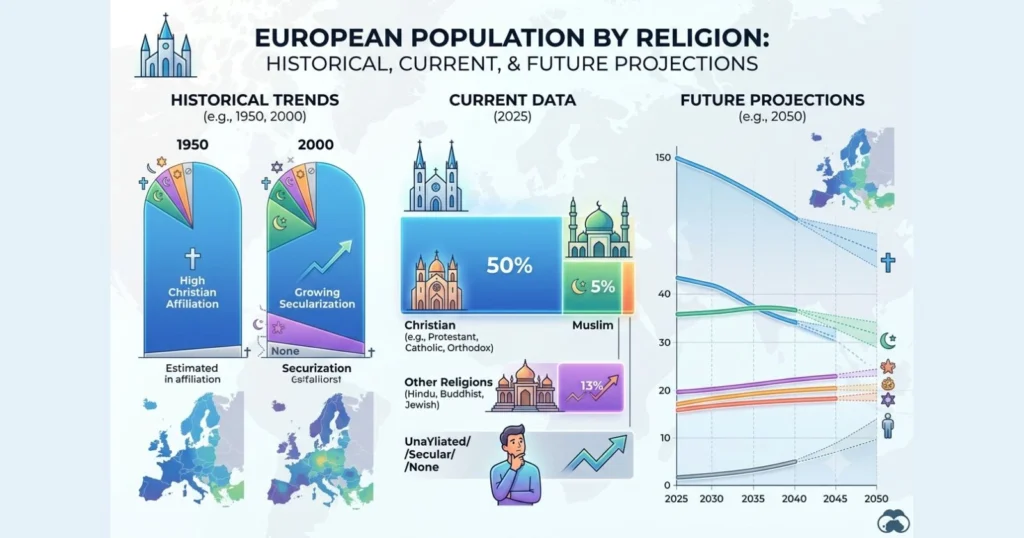
As of 2020, Europe was home to approximately 753 million people, a figure that had grown only 2 percent since 2010, making it one of the slowest-growing regions in the world. Within that population:
- Christians remain the largest group, at roughly 505 million people, or 67 percent of the population
- The religiously unaffiliated, often called “nones,” number about 190 million, or 25 percent
- Muslims account for about 46 million people, or 6 percent
- Jews number approximately 1.3 million, or 0.2 percent
- Hindus number about 2 million, or 0.3 percent
- Buddhists and members of other faiths make up the remainder, each under 1 percent
These figures represent a continent in the middle of a long transition away from near universal religious affiliation and toward a more mixed model in which secular identity competes directly with organized religion for the largest share of the population.
Historical Background and Past Trends in European Religion
Religious record-keeping across Europe has never been uniform. Some countries have asked about religion in every national census for over a century, while others stopped decades ago or never asked at all. Even so, long-run estimates compiled by researchers such as the World Religion Database and the World Christian Encyclopedia allow for a reasonably clear picture of how the continent’s religious composition has moved since 1900.
At the start of the twentieth century, Europe was overwhelmingly Christian. Two world wars, the Holocaust, decades of state atheism under communist governments in Eastern Europe, and a long-term drift toward secularism in Western Europe reshaped that picture dramatically over the following century.
Past Population Trends (1900 to 2010)
| Year | Total Population (approx) | Christian % | Unaffiliated % | Muslim % | Jewish % | Other Religions % |
|---|---|---|---|---|---|---|
| 1900 | 408 million | 95.0% | 0.4% | 2.0% | 2.4% | 0.2% |
| 2010 | 738 million | 74.6% | 18.7% | 5.2% | 0.2% | 1.3% |
Key points from this century long shift include the following.
- Nearly 95 percent of Europeans identified as Christian in 1900, a share that had fallen below 75 percent by 2010
- The religiously unaffiliated population, which was statistically negligible in 1900 at under half a percent, had grown to nearly one in five Europeans by 2010
- Europe’s Jewish population fell from roughly 2.4 percent of the continent in 1900 to about 0.2 percent by 2010, a decline driven overwhelmingly by the Holocaust, together with later waves of emigration to Israel, the United States and elsewhere
- The Muslim share of the population rose steadily across the century, driven first by Ottoman-era communities in the Balkans and later by twentieth-century labor migration and refugee movements from North Africa, Turkey, and the Middle East
- State-enforced atheism across much of Eastern Europe between the late 1940s and 1989 suppressed religious practice and affiliation for several generations, though many of those populations reported a return to religious identity, particularly Orthodox Christianity, after the fall of communism
The Last 10 Years of European Religious Change (2010 to 2020)
The most detailed and internationally comparable data available today covers the period from 2010 to 2020, based on more than 2,700 censuses and surveys compiled by the Pew Research Center. This decade captured several pivotal developments, including the migration and refugee movements linked to the Syrian civil war, continued secularization across Western Europe, and the loss of Christian majorities in two of the continent’s largest countries.
Last 10 Years Population Trends (2010 to 2020)
| Religious Group | 2010 Population (approx) | 2010 Share | 2020 Population (approx) | 2020 Share | Change in Count |
|---|---|---|---|---|---|
| Christians | 554 million | 74.6% | 505 million | 67.1% | Down 9% |
| Religiously Unaffiliated | 139 million | 18.7% | 190 million | 25.3% | Up 37% |
| Muslims | 40 million | 5.2% | 46 million | 6.0% | Up 16% |
| Jews | 1.4 million | 0.2% | 1.3 million | 0.2% | Down 8% |
| Hindus | 1.5 million | 0.2% | 2 million | 0.3% | Up 30% |
| Other and Unspecified | approx 2 million | 0.3% | approx 2.4 million | 0.3% | Slight increase |
| Total Population | 738 million | 100% | 753 million | 100% | Up 2% |
Several developments defined this decade.
- France and the United Kingdom both lost their Christian majorities between 2010 and 2020, a shift attributed primarily to religious disaffiliation rather than migration
- The Netherlands moved from a Christian plurality to an unaffiliated majority during this period, with the non-religious share rising from around 45 percent in 2010 toward the majority mark by the mid-2020s
- Twenty-three European countries experienced a change of five percentage points or more in at least one religious group’s share of the population, and in every one of those cases, the shift reflected a declining Christian share
- Religious switching, meaning people raised in one tradition who later identify with another or with no religion at all, was the single largest driver of change, with the flow overwhelmingly moving out of Christianity and into the unaffiliated category
- Muslim population growth was concentrated in a handful of countries that accepted large numbers of refugees from Syria and other conflict zones, most notably Sweden, Austria, and Germany, though the overall Muslim share of Europe’s population rose by less than one percentage point across the whole continent
- Sweden saw one of the sharpest increases in Muslim population share, roughly doubling from about 4 percent in 2010 to about 8 percent in 2020
- Germany’s Muslim population rose to approximately 7 percent of its residents by 2020, up from around 5 to 6 percent in 2010, despite the high-profile political debate surrounding refugee admissions during that period
The Current Religious Landscape in Europe
By the mid-2020s, the trends established over the previous decade had continued largely unchanged, with secularization advancing further in several countries and religious diversity becoming more visible in major cities.
Regional Patterns Across the Continent
- Central, Eastern, and Southern Europe remain considerably more religious than Western and Northern Europe, with countries such as Romania, Poland, Greece, and Bosnia and Herzegovina reporting some of the highest shares of adults who say religion is very important in their lives
- Romania and Malta report the smallest shares of non-believers on the continent, with Romania’s unaffiliated population estimated at around 1 percent
- Czechia stands out as Europe’s most secular country, with the unaffiliated share of the population at roughly 72 percent overall and rising to an estimated 91 percent among adults aged 16 to 29
- Estonia and Sweden also rank among the most secular countries in Europe, alongside the Netherlands
- Bosnia and Herzegovina and the partially recognized state of Kosovo are the only parts of Europe where Islam forms a population majority
- Catholicism remains the largest Christian tradition in Europe, accounting for close to half of all European Christians, followed by Eastern Orthodoxy and Protestantism
- Russia is home to Europe’s largest Christian population in absolute numbers, with over 100 million adherents, the majority belonging to the Russian Orthodox Church
Age Structure and Fertility
The demographic profile of each religious group in Europe plays a major role in shaping future projections.
- Muslims are the youngest religious group in Europe, with a median age of about 34
- The religiously unaffiliated have a median age of about 39
- Hindus have a median age of about 36
- Buddhists have a median age of about 40
- Christians have a median age of about 45
- Jews are the oldest religious group in Europe, with a median age of approximately 52 to 53
- Muslims in Europe have historically recorded the highest total fertility rate among religious groups, estimated at around 3.1 children per woman during the 2010 to 2015 period, compared with about 2.7 for Christians and considerably lower rates among the unaffiliated, Buddhists, and other groups
Migration as a Driver of Change
Migration has played an outsized role in reshaping Europe’s Muslim population specifically, even though it has had little effect on the size of other religious groups at the continental level. Europe’s total Muslim population grew by an estimated 6.2 million people between 2010 and 2020, of which roughly 3.5 million were Muslims born outside Europe who arrived through migration. Refugee flows tied to the Syrian conflict were a particularly significant factor in this period, concentrated heavily in a small number of receiving countries.
Future Projections for European Religion Through 2050
Long-range demographic projections, most notably the Pew Research Center’s “Future of World Religions” modeling, forecast continued secularization alongside modest but steady growth in Europe’s Muslim population, driven primarily by younger age structures and higher fertility rates rather than by migration alone.
Future Projected Population Trends (2030 to 2050)
| Year | Christian Population (approx) | Christian Share | Unaffiliated Population (approx) | Unaffiliated Share | Muslim Population (approx) | Muslim Share |
|---|---|---|---|---|---|---|
| 2030 | 490 million | 64% | 172 million | 22% | 55 million | 7.2% |
| 2040 | 470 million | 61% | 168 million | 22% | 63 million | 8.2% |
| 2050 | 454 million | 58% | 162 million | 21% | 71 million | 9.2% |
Notes on the projected figures above.
- The 2050 figures are drawn directly from Pew Research Center modeling, which projects Christianity’s share of Europe’s population falling from around 75 percent in 2010 to about 65 percent by 2050 under some scenarios, with the Christian population declining from roughly 553 million to about 454 million
- Europe’s Muslim population is projected to increase by approximately 63 percent between 2010 and 2050, growing from about 43 million to roughly 71 million
- The religiously unaffiliated population is projected to grow modestly in absolute terms, from about 140 million in 2010 to around 162 million in 2050, even though its share of the total population is expected to plateau or dip slightly as Europe’s overall population shrinks and ages
- The 2030 and 2040 figures presented here are interpolated estimates based on the trajectory established by Pew’s 2010 to 2050 modeling and should be read as directional rather than precise forecasts
- Europe’s below-replacement fertility rate, estimated at around 1.6 children per woman overall, is a central driver of these projections, particularly for Christians and the unaffiliated, both of which have fertility rates below the 2.1 replacement threshold
- Migration policy, war, and refugee movements remain the largest source of uncertainty in any long-range projection, as demonstrated by the impact of the Syrian refugee crisis on the 2010 to 2020 figures
Europe’s Religious Composition from 1900 to 2050
| Year | Christian Share | Unaffiliated Share | Muslim Share | Jewish Share | Other Religions Share | Total Population (approx) |
|---|---|---|---|---|---|---|
| 1900 | 95.0% | 0.4% | 2.0% | 2.4% | 0.2% | 408 million |
| 2010 | 74.6% | 18.7% | 5.2% | 0.2% | 1.3% | 738 million |
| 2020 | 67.1% | 25.3% | 6.0% | 0.2% | 0.6% | 753 million |
| 2030 (projected) | 64% | 22% | 7.2% | 0.2% | 0.6% | approx 745 million |
| 2050 (projected) | 58% | 21% | 9.2% | 0.2% | 0.6% | approx 710 million |
This combined view highlights the two defining forces reshaping European religious identity across the full 150-year span covered here. The first is a long, steady decline in Christian affiliation that began well before 2010 and shows no sign of reversing. The second is the rise of two very different growth stories running in parallel, the expansion of the religiously unaffiliated population through disaffiliation from Christianity, and the more modest but sustained growth of the Muslim population through younger age structures, higher fertility, and migration.
Key Drivers Shaping Europe’s Religious Future
- Religious switching out of Christianity, primarily into the unaffiliated category, remains the single largest force reshaping Europe’s religious composition
- Below replacement fertility across nearly every religious group except Muslims is contributing to Europe’s broader population slowdown and reshaping the relative size of each group over time
- Aging populations mean that Christian and Jewish communities in particular are seeing more deaths than births within their own ranks in many countries
- Migration policy will remain the largest swing factor in Muslim population growth, as it was during the 2010 to 2020 period
- Urbanization and generational change continue to push younger Europeans, especially in traditionally Catholic and Protestant countries, away from formal religious affiliation
- A small but geographically concentrated Orthodox Christian revival has been observed in parts of Eastern Europe since the end of communist rule, offsetting some secularizing pressure in that subregion
Conclusion
Europe’s religious composition tells the story of a continent moving through a long and still unfinished transition. What began the twentieth century as one of the most religiously uniform regions in the world has become a mixed landscape where organized religion, and Christianity in particular, competes directly with secular identity for the largest share of the population. Muslim communities, though still a modest share of the overall population, are positioned for continued growth through the middle of this century, driven by demographic fundamentals rather than migration alone.
Whatever the exact trajectory ahead, the data from the past century and the last ten years both point in the same direction, toward a Europe that is steadily more secular, moderately more religiously diverse, and less uniformly Christian than at any point in its recent history.
Frequently Asked Questions
What is the largest religion in Europe today?
Christianity remains the largest religion in Europe, accounting for roughly 67 percent of the population as of 2020, though its share has been declining for decades.
Which European countries no longer have a Christian majority?
France and the United Kingdom both lost their Christian majorities between 2010 and 2020. The Netherlands has moved toward an unaffiliated majority over the same period.
Is Islam the fastest-growing religion in Europe?
In percentage growth terms, the religiously unaffiliated population grew faster than the Muslim population between 2010 and 2020, expanding by 37 percent compared with 16 percent for Muslims. However, Islam is projected to see continued growth through 2050, driven by younger demographics and higher fertility.
Which European country is the most secular?
Czechia is generally regarded as Europe’s most secular country, with roughly 72 percent of the population religiously unaffiliated, a figure that rises to around 91 percent among adults under 30.
Will Christians remain the majority in Europe by 2050?
Most demographic projections suggest Christians will remain the largest single religious group in Europe through 2050, though their share of the total population is expected to continue declining from around two-thirds today toward roughly 58 to 65 percent.
How large is Europe’s Jewish population today?
Europe’s Jewish population is estimated at 1.3 million people as of 2020, or roughly 0.2 percent of the continent’s population, down significantly from the early twentieth century due to the Holocaust and subsequent emigration.