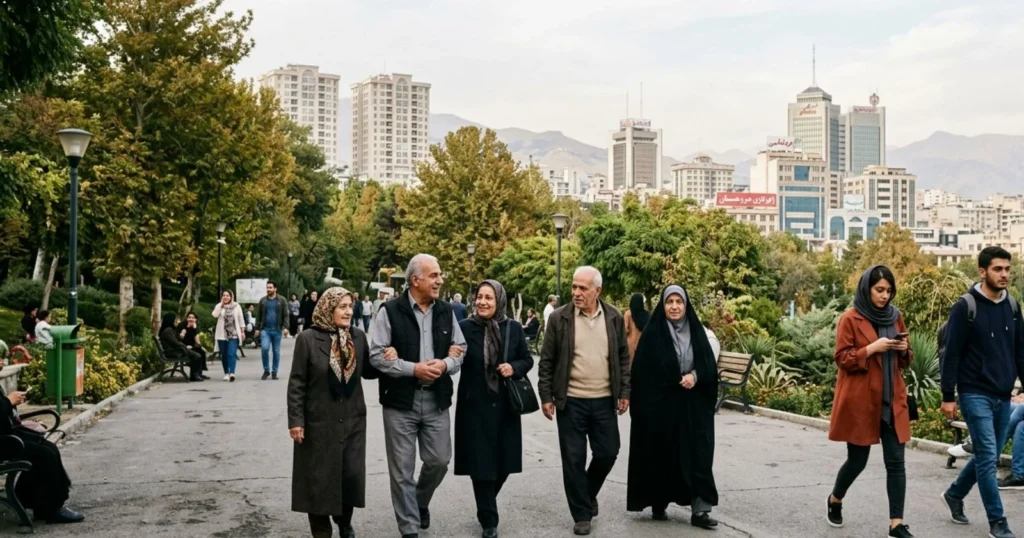
Iran’s median age has nearly doubled in a single generation, climbing from 17.1 years in 1990 to roughly 34 years in 2025, according to the United Nations World Population Prospects 2024 revision. Fertility fell even faster: from 6.6 children per woman in 1980 to 1.7 in 2023, a decline of about 75 percent in four decades and one of the sharpest drops ever recorded outside of East Asia. Iran is no longer simply a large Middle Eastern population. It is rapidly becoming an old one, and that shift is starting to reshape the economic and strategic assumptions built around the country’s size.
This is not a story of population collapse. Iran’s population is still growing, from about 92.4 million in 2025 toward a projected peak near 101.9 million around mid-century under the UN’s medium-fertility scenario. The story is about composition. The number of Iranians entering working age each year is shrinking relative to the number retiring, and that arithmetic touches everything from pension solvency to military recruitment to how much economic weight Iran can bring to its regional ambitions.
Iran’s Demographic Profile Is Changing Rapidly
Data Snapshot
- Total population (2025): approximately 92.4 million (UN WPP 2024, medium variant)
- Median age (2025): approximately 34.0 years, up from 17.1 in 1990
- Population aged 0-14: approximately 22-23% of the total
- Population aged 15-64 (working age): approximately 69-70%
- Population aged 65 and older: approximately 7-8.6%, roughly double the 1990 share
- Total fertility rate (2023): 1.7 children per woman, below the 2.1 replacement threshold
- Life expectancy at birth: approximately 75.6 years (CIA World Factbook, 2024 estimate)
- Projected population (2050): approximately 101.9 million, with median age rising to about 43.5
Iran is still, technically, in the later stages of demographic transition rather than in outright decline. Roughly seven in ten Iranians are of working age, a share that looks enviable next to Japan or Italy. The concern is trajectory, not the current snapshot.
The United Nations Population Division projects that Iran’s 65-and-older share, currently around 8 percent, will climb past 22 percent by 2050; a shift that took some European countries a full century to complete and that Iran is on pace to complete in roughly half that time.
Historical Population and Age Structure
| Year | Population | Median Age | 65+ Share |
|---|---|---|---|
| 1990 | 58.9 million | 17.1 | 3.5% |
| 2000 | 65.5 million | 21.2 | 4.4% |
| 2010 | 74.5 million | 26.9 | 5.3% |
| 2020 | 88.6 million | 31.7 | 6.6% |
| 2025 | 92.4 million | 34.0 | ~8.0% |
| 2050 (projected) | 101.9 million | 43.5 | ~22% |
Source: UN World Population Prospects 2024 revision, medium-fertility variant. The 2050 figures are model projections and not observed data.
The critical distinction is between aging and decline. Iran’s total population is still rising and will likely continue rising for another two decades under most UN scenarios, because past high-fertility cohorts are still working their way through the age structure; a phenomenon demographers call population momentum. But the internal balance is shifting fast: each year, smaller cohorts of young Iranians are entering the labor force behind much larger cohorts approaching retirement.
How Iran Moved From High Fertility to Low Fertility
Iran’s fertility decline is one of the fastest and most policy-driven in modern demographic history. The total fertility rate stood at 6.63 in 1980, in the years immediately following the 1979 revolution, when early pronatalist rhetoric and the Iran-Iraq War encouraged large families. That rate held near 6.0 through most of the 1980s.
The reversal came quickly after 1988. Facing strained public services and a recognition that rapid population growth was outpacing economic capacity, Iran launched a national family planning program in 1989 that expanded contraceptive access, required premarital family-planning counseling, and promoted smaller families through mass media and religious endorsement. Fertility fell from above 6.0 in the late 1980s to 2.0 by exactly the year 2000; a drop of roughly two-thirds in a single decade, among the fastest sustained fertility declines ever documented.
The decline continued through the 2000s and 2010s despite a brief pronatalist policy reversal after 2012, when the government scaled back subsidized contraception and family planning services in an effort to reverse the trend. Fertility dipped as low as 1.7 in the mid-2010s, recovered modestly to around 2.05 in 2015-2016, then resumed its decline. By 2023 it stood at 1.7 children per woman, and UN and World Bank estimates for 2024-2025 put it closer to 1.67-1.68.
Several forces sit behind the numbers beyond formal policy:
- Rapid urbanization moved families away from agricultural household structures that favored large families
- Women’s education expanded sharply, with female enrollment now exceeding male enrollment at the university level in Iran
- Rising marriage age and housing costs delayed household formation, a pattern echoed across the region
- Economic uncertainty, inflation, and sanctions-related pressure on household income discouraged larger families
The lesson from Iran’s experience, one that recurs across this demographic series, is that fertility declines driven by social and economic change tend to be far harder to reverse than pronatalist policy alone can manage. Iran’s 2012-era attempt to walk back family planning access barely moved the fertility rate.
Iran’s Working Age Population Is Becoming More Important
Labor Force Reality Behind the Age Structure
A large working-age share on paper does not automatically translate into a large active labor force. Iran’s overall labor force participation rate (ages 15+) was 40.2 percent in 2024, according to World Bank data compiled from ILO modeled estimates; well below the global average of roughly 60.6 percent. The gap is driven overwhelmingly by female labor force participation, which stood at only about 14.0 percent in 2025, among the lowest rates in the world for a country of Iran’s income level. Youth labor force participation (ages 15-24) was just 21.9 percent in 2024.
| Indicator | Iran | Global Average |
|---|---|---|
| Total labor force participation (15+) | 40.2% (2024) | 60.6% |
| Female labor force participation | 14.0% (2025) | 51.4% |
| Youth labor force participation (15-24) | 21.9% (2024) | — |
Source: World Bank World Development Indicators, ILO modeled estimates, 2024-2025.
This gap matters enormously for how Iran’s demographic transition plays out. A country with 70 percent of its population in the working-age bracket but only 40 percent labor force participation is not fully using its demographic dividend; the temporary economic boost that comes from having many workers relative to dependents. If Iran raised female labor force participation toward regional or global norms, it could substantially offset the shrinking pipeline of young workers entering the labor market over the next two decades. That untapped capacity is arguably a larger lever than migration or fertility policy, but it depends on social, legal, and economic conditions that are not purely demographic.
The Economic Cost of a More Aged Population
Iran’s old-age dependency ratio; the number of people 65 and older relative to the working-age population has been rising steadily, though it remains comparatively low today near 11-12 dependents per 100 working-age adults. The concern is the pace of change ahead. UN projections put Iran’s elderly dependency burden on a trajectory that could roughly triple by 2050 as the large cohorts born during the high-fertility 1980s move into retirement.
That shift will pressure several systems simultaneously:
- Pension systems. Iran’s social security and retirement funds already report actuarial deficits tied to a pay-as-you-go structure that assumes a growing contributor base. A shrinking ratio of active contributors to retirees strains that model directly.
- Healthcare demand. Older populations consume disproportionately more healthcare resources, particularly for chronic disease management, at a time when Iran’s health system is already under strain from sanctions-related import constraints on medical equipment and pharmaceuticals.
- Household structures. Traditional multigenerational elder care in Iran is weakening as urbanization and smaller family sizes reduce the number of adult children available to support aging parents, pushing more of the burden onto formal state systems that are not yet built to absorb it.
- Public finances. Aging-related spending competes directly with other government priorities, including subsidies, infrastructure, and defense, at a time when oil revenue volatility and sanctions already constrain the budget.
Can Immigration Offset Iran’s Demographic Aging?
Iran is a net recipient of migrants in a narrow but important sense: it hosts one of the largest Afghan refugee and migrant populations in the world, with estimates commonly ranging from 3.5 million to more than 4.5 million Afghans in the country, a mix of registered refugees, undocumented migrants, and more recent arrivals following the 2021 Taliban takeover. On paper, this looks like exactly the kind of working-age migration that could offset domestic aging.
In practice, the offsetting effect is limited for several reasons. Most Afghan migrants in Iran work in low-wage informal sectors such as construction and agriculture rather than filling the mid- and high-skill roles where Iran’s demographic transition will eventually create the sharpest shortages. Iran has also periodically restricted residency and work permits for Afghan migrants and has carried out deportation waves, most recently intensifying in 2023-2025, which works against treating this population as a stable, integrated demographic offset. Iran’s net migration rate for its citizen population is negative; the CIA World Factbook estimates around -0.3 migrants per 1,000 population for 2024; reflecting ongoing emigration of skilled and educated Iranians, a trend commonly described as brain drain, driven by economic conditions, sanctions, and social and political constraints.
The net effect is that Iran’s migration picture works in the opposite direction from what a targeted demographic-offset immigration policy would require: it gains low-skill labor from Afghanistan while losing higher-skill labor to Europe, North America, and the Gulf.
What Aging Could Mean for Iran’s Military and Regional Influence
Discussions connecting demography to geopolitical power require care. Population size alone has never reliably predicted military or geopolitical outcomes; economic capacity, technology, alliances, and state cohesion matter at least as much. Iran’s own history illustrates this: it fought an eight-year war with Iraq in the 1980s while its population was much younger and smaller than it is today, and its regional influence since then has been built primarily through asymmetric capabilities, proxy networks, and missile and drone technology rather than through raw manpower.
That said, the military-age population, typically defined as males aged 18 to 49, is a real input into recruitment capacity, and Iran’s cohort in this range will begin shrinking in relative terms as the large 1980s birth cohorts age out and are replaced by the much smaller cohorts born after the 1990s fertility collapse. Iran’s conscript-based Artesh and the Islamic Revolutionary Guard Corps currently draw on a large pool, but that pool will be measurably smaller in the 2035-2050 period than it is today, even as the overall population continues to grow, because the youngest working-age cohorts are shrinking.
The more consequential channel is economic rather than manpower-based. Aging redirects public spending toward pensions and healthcare and away from other priorities, and a smaller working-age share relative to dependents constrains the tax base and overall output available to fund defense, missile and drone programs, and regional proxy support.
Whether Iran’s regional influence weakens as a result will depend far more on oil revenue, sanctions relief or tightening, and technological investment than on the population pyramid alone. Demography here functions as a slow-moving constraint on capacity, not a direct measure of power.
Iran Compared With Other Middle Eastern Demographic Powers
| Country | Median Age (2025) | Fertility Rate | Population 2025 | Trajectory |
|---|---|---|---|---|
| Iran | ~34.0 | 1.7 | 92.4 million | Aging quickly, still growing |
| Türkiye | ~33.0 | ~1.5 | ~87 million | Aging, fertility below Iran’s |
| Iraq | ~21.0 | ~3.3 | ~46 million | Young, still expanding rapidly |
| Saudi Arabia | ~31.0 | ~2.4 | ~36 million (citizens + residents) | Younger, still growing |
Sources: UN World Population Prospects 2024 revision; national statistical offices. Saudi and Iraqi figures are treated in dedicated articles in this series with full sourcing.
The comparison illustrates a genuine regional divergence. Iran and Türkiye are aging on a broadly similar timeline and both now sit below replacement fertility, while Iraq remains firmly in a youth-driven growth phase with a fertility rate roughly double Iran’s. Saudi Arabia sits in between, still growing but converging toward Iran’s fertility level within a decade or two on current trends.
Over a 25-to-30-year horizon, this divergence means the region’s youngest, fastest-growing working-age populations will increasingly be concentrated in Iraq and, to a lesser extent, Yemen and other higher-fertility states, while Iran, Türkiye, and the Gulf states manage aging populations on a compressed timetable.
Iran’s Population Outlook Through 2050 and Beyond
The UN medium-fertility scenario projects Iran’s population reaching roughly 101.9 million around 2050 before growth flattens and eventually reverses in the second half of the century. The median age is projected to rise to approximately 43.5 by 2050, comparable to where several Southern and Eastern European countries stand today. Longer-range UN projections extending to 2100 put Iran’s population on a declining path, with some model variants showing totals falling back toward or below 90 million by the century’s end, though a century-long horizon carries substantial uncertainty and should be read as a scenario rather than a forecast.
These are projections, not guarantees. They assume fertility stabilizes roughly where it sits today, that mortality continues improving gradually, and that migration patterns do not shift dramatically. Iran’s own history; a fertility collapse from 6.6 to 2.0 within a decade; is itself a reminder that demographic trajectories can bend sharply in response to policy, economic conditions, or social change in ways that complicate any single-scenario projection.
The Strategic Question Is Not Simply How Many Iranians There Are
Iran’s population will almost certainly keep growing for another two decades even as it ages, which means the country is not confronting a manpower shortage in any immediate sense. What is changing is the composition of that population and the economic burden required to sustain it. A rising dependency ratio, chronically low female labor force participation, and a shrinking pipeline of young workers behind today’s large working-age cohorts will together constrain the resources available for everything from pensions to defense spending over the next generation.
Whether that constraint meaningfully erodes Iran’s regional position depends on variables that sit outside demography altogether: oil revenue, sanctions trajectories, technological adaptation, and the extent to which Iran can convert an aging but still substantial population into sustained economic output. Population size was never the whole story of Iranian power, and an aging population does not automatically mean a weaker one. It does mean the arithmetic behind that power is getting harder.
Frequently Asked Questions
1. Why is Iran’s population aging?
Iran’s population is aging because of a rapid and sustained fertility decline, from 6.6 children per woman in 1980 to 1.7 in 2023, combined with rising life expectancy. The large cohorts born during the high-fertility 1980s are now moving toward retirement age while far smaller cohorts are being born behind them.
2. What is Iran’s current fertility rate?
Iran’s total fertility rate was 1.7 children per woman in 2023 according to World Bank data, with UN estimates for 2024-2025 putting it slightly lower, around 1.67 to 1.68. This is below the 2.1 replacement level.
3. Is Iran’s population declining?
Not yet. Iran’s population was about 92.4 million in 2025 and is projected by the UN to keep growing to roughly 101.9 million around 2050 due to population momentum from earlier high-fertility cohorts, before a longer-term decline becomes more likely in the second half of the century under current projections.
4. How many older people live in Iran?
Iran’s 65-and-older population made up approximately 7 to 8.6 percent of the total population as of 2024-2025, roughly double the 3.5 percent share recorded in 1990. The UN projects this share could reach approximately 22 percent by 2050.
5. How will aging affect Iran’s economy?
Aging will raise old-age dependency, straining pension systems that rely on a pay-as-you-go structure, increase healthcare demand, and shrink the relative size of the labor force entering the workforce each year, all of which pressure public finances already constrained by sanctions and oil revenue volatility.
6. Could immigration reduce Iran’s aging problem?
Iran hosts a large Afghan migrant and refugee population, commonly estimated between 3.5 and 4.5 million, but most work in low-wage informal sectors rather than filling the mid- and high-skill gaps aging will create. Meanwhile, Iran experiences net emigration of skilled workers, limiting immigration’s ability to offset aging.
7. How does Iran compare with other Middle Eastern countries?
Iran’s median age of about 34 years and fertility rate of 1.7 place it closer to Türkiye, which is aging on a similar timeline, than to Iraq, where the median age is around 21 and fertility remains near 3.3. Saudi Arabia sits between the two, with fertility around 2.4.
8. Will Iran have fewer working-age adults in the future?
The working-age share of Iran’s population, currently around 69 to 70 percent, is expected to decline gradually as the population ages, even as the total population continues growing. The pipeline of young adults entering the workforce each year is already shrinking relative to those retiring.
9. What is Iran’s median age and how has it changed?
Iran’s median age rose from 17.1 years in 1990 to approximately 34.0 years in 2025, according to UN estimates, and is projected to reach about 43.5 by 2050; nearly tripling within a 60-year span.
10. Does population aging automatically weaken Iran’s regional power?
Not automatically. Aging shrinks the future military-age population and strains public finances that could otherwise fund defense and regional influence, but Iran’s actual geopolitical weight depends more on oil revenue, technology, sanctions, and state capacity than on population size or age structure alone.
Sources
- United Nations, Department of Economic and Social Affairs, Population Division. World Population Prospects 2024 Revision.
- World Bank Open Data. World Development Indicators: Fertility Rate, Labor Force Participation Rate (Iran), 2024-2025 updates. https://data.worldbank.org
- Central Intelligence Agency, World Factbook: Iran, 2024 demographic estimates.
- International Labour Organization, ILOSTAT Country Profile: Iran (Islamic Republic of).
- Statistical Center of Iran, Population Estimates and Census Reports, 2024-2025.
- UNHCR and Iranian government estimates on Afghan refugee and migrant population in Iran.