
Key Findings
- Pensions and health already claim roughly two-thirds of OECD public social spending, and pension spending alone is projected to rise from 8.8% to 10.0% of GDP by 2050.
- Pension commitments are politically difficult to reduce for existing retirees, which channels most reform toward future retirees through retirement age and formula changes.
- Similar age structures do not guarantee similar spending outcomes: Italy and the Netherlands, with comparable elderly populations, show very different public pension spending levels due to differing reliance on private, funded pensions.
- Education spending is tied to a shrinking school-age population in most aging countries, but rarely falls proportionally due to relatively fixed costs like staffing and facilities.
- Economic growth can ease, but does not eliminate, the structural budget competition created by demographic aging.
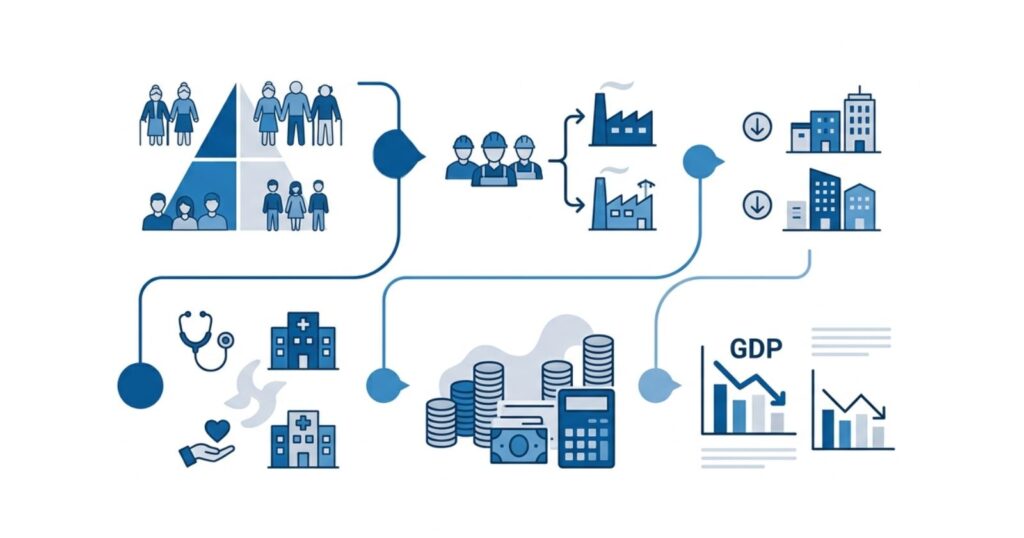
A government budget does not grow automatically to match a population’s changing needs. When the share of citizens over 65 rises, and the share of school-age children falls, something else in the budget has to give unless total spending, and therefore taxation or borrowing, rises to match. OECD pension spending is projected to climb from 8.8% of GDP in 2023-24 to 10.0% by 2050. Public health spending already exceeds 8% of GDP in France, Germany, Japan and the United States. Neither of those trajectories leaves room for other categories to grow at the same pace without a corresponding increase in total government spending, a tax increase, or new borrowing.
This is the mechanism behind what might be called the generational budget battle: not a literal conflict between age groups, but a structural competition for a limited pool of public resources, intensified as demographic change pushes the cost of some categories up faster than others.
Key Facts
| Category | OECD average spending, % of GDP | Trend |
|---|---|---|
| Old-age pensions | 8.8 (2023-24) | Rising, projected 10.0 by 2050 |
| Public health | 5.8 | Rising with age structure |
| Education (primary–tertiary) | 4.9 | Roughly stable, tracking GDP growth |
| Family benefits | 2.35 | Wide variation, no clear universal trend |
| Total public social spending | ~20–22, above 30 in some countries | Gradually rising since 1960s |
Why Government Budgets Become More Difficult as Populations Age
Public budgets are finite in a way that population needs are not automatically. As the population’s age composition shifts toward older brackets, the categories of spending most sensitive to age, pensions and healthcare, mechanically claim a larger share of the budget even if policy generosity per person stays constant.
Public social spending across the OECD has more than doubled as a share of GDP since 1960, from under 10% to just over 20% on average, and demographic change accounts for a substantial part of that long-run growth, alongside the broader expansion of welfare state coverage over the same period.
The Main Spending Categories Competing for Money
Six broad categories typically compete for the same pool of public resources in an aging society: pensions, healthcare, long-term care, education, family and childcare benefits, and housing and infrastructure investment. Pensions and health together already claim roughly two-thirds of OECD public social spending.
Long-term care remains smaller today but is widely projected to grow fastest, since demand for sustained daily care assistance concentrates heavily in the oldest age brackets, a group expanding faster than any other in most high income countries.
Why Pensions Can Be Politically Difficult to Change
Pension commitments function differently from most other government spending because they represent promises made years or decades in advance, often codified in law and built into individual retirement planning. Reducing pension benefits for people already retired, or close to retirement, is politically difficult and in some countries legally constrained.
This makes pension reform, when it happens, more likely to affect future retirees through changes to retirement age, contribution requirements, or benefit formulas than to reduce payments to current pensioners directly, a pattern visible in the pension reforms most OECD countries have pursued over the past two decades.
Healthcare Versus Education
Healthcare and education represent two of the largest discretionary-adjacent categories in most budgets, and they draw on overlapping revenue sources even though they serve different age groups. Health spending, at an OECD average of 5.8% of GDP and exceeding 8% in several major economies, tends to rise with a population’s age structure.
Education spending, at 4.9% of GDP on average, is tied more closely to the size of the school-age and university-age population, which is shrinking in most of the same countries where the older population is growing. In some countries, this creates a mechanical scissor effect: rising demand-driven costs on one side of the ledger and a shrinking client base, at least numerically, on the other, though education systems rarely see proportional budget reductions when enrollment falls, since costs like teacher salaries and facilities are not fully variable with student numbers.
How Debt Changes the Generational Equation
Government borrowing offers a mechanism to avoid an immediate, difficult tradeoff between competing spending categories, at the cost of shifting some portion of today’s fiscal pressure onto future budgets through debt service obligations. This does not resolve the underlying competition for resources; it defers it, and adds an additional fixed cost, interest payments, that itself then competes with pensions, healthcare and education for room in future budgets.
Why Demographic Change Is Also a Political Choice
It is tempting to treat rising pension and health costs as a purely mechanical consequence of an aging population, but the size of that cost is also shaped by policy choices: how generous benefit formulas are, at what age eligibility begins, how healthcare systems are structured and priced, and how much of the cost is shifted to individuals through co-payments or private insurance versus absorbed by public budgets.
Two countries with similar age structures can show very different levels of age-related public spending, as the gap between Italy’s pension spending, over 15% of GDP, and the Netherlands’ considerably lower public pension outlay despite a broadly similar population age profile illustrates.
How Different Countries Handle the Tradeoffs
National responses to the generational budget squeeze differ substantially, reflecting different starting points, political systems and fiscal capacity.
| Country | Approach to budget competition | Notable feature |
|---|---|---|
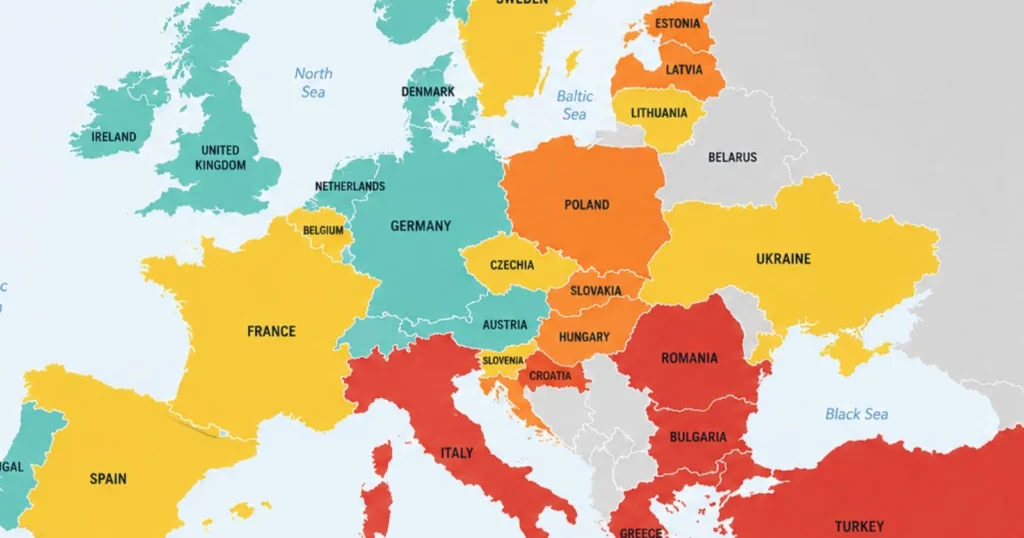
| Greece, Italy | High pension spending, comparatively lower family benefit spending | Public pension spending over 15% of GDP |
| Netherlands | Shift toward funded, private pension provision | Similar age structure to Italy, lower public pension outlay |
| Iceland, Poland | High family benefit spending alongside more moderate pensions | Family benefits over 3.5% of GDP |
| United States | Comparatively lower family and education-adjacent social spending; high health spending | Health spending driven substantially by system design, not age alone |
| Nordic countries broadly | Balanced investment across pensions, family services and education | High overall tax-to-GDP ratios support broader spending |
Can Economic Growth Reduce the Conflict?
Faster GDP growth expands the total resource pool available for public spending, which can reduce the relative severity of competition between categories even if the absolute cost of pensions and healthcare keeps rising. OECD analysis for its 2025 Employment Outlook found that demographic change alone is projected to meaningfully slow GDP per capita growth across member countries through 2060 absent significant reform, and that even ambitious productivity and labor market policy changes would offset only a portion, not all, of that projected slowdown. Growth can ease the budget battle at the margins; it does not eliminate the underlying demographic arithmetic driving pension and health costs higher.
Conclusion
The generational budget battle is less a fight between people of different ages and more a structural competition for a limited share of national income, intensified by demographic change that raises the cost of some categories, pensions and health chief among them, faster than others.
Italy and the Netherlands show that similar demographics do not force identical fiscal outcomes, and OECD-wide projections showing pension spending headed toward 10% of GDP by 2050 make clear that the pressure is not going away on its own. How much room remains for education, family benefits and infrastructure over the next two decades depends less on demographic destiny than on the specific reform choices governments make in the years ahead.
The Future Budget Under Continued Aging
If current trends continue largely unaltered, pension spending reaching 10% of GDP across the OECD by 2050, combined with health spending that has historically tracked or exceeded age-driven cost growth, would leave a materially smaller share of most government budgets available for education, family benefits, housing and infrastructure investment than is available today, unless total government spending, and the taxation or borrowing that funds it, rises correspondingly. This is a projection based on the continuation of current policy settings, not a certainty; the scale and direction of pension reform, healthcare system changes, and tax policy adopted over the next two decades will materially shape how this plays out in any given country.
Frequently Asked Questions
1. Why does aging change government budgets?
Because pension and healthcare spending, the two largest categories tied closely to age structure, rise mechanically as the share of the population aged 65 and older grows, competing for the same limited pool of public resources as education, family benefits and infrastructure spending.
2. Do older people receive too much government spending?
This is a normative question that depends on values and measurement approach; what the data shows objectively is that pension spending is significantly larger than education or family benefit spending in most OECD countries, and is projected to keep growing as a share of GDP.
3. Can governments avoid generational budget tradeoffs entirely?
Not entirely, but they can manage the intensity of the tradeoff through pension reform, productivity growth, immigration policy, and choices about how much to fund through taxation versus borrowing.
4. Why is pension reform politically difficult?
Pension benefits are long-standing commitments that people plan their retirement around, and reducing benefits for current or near-term retirees is both politically unpopular and, in some countries, legally constrained, which pushes most reform toward future retirees instead.
5. Does declining school-age population reduce education budgets automatically?
Not proportionally. Costs like teacher salaries, school buildings and administrative infrastructure are only partially variable with enrollment, so education budgets typically shrink more slowly than the school-age population itself.
6. How much does public debt factor into the generational budget battle?
Debt allows governments to defer difficult spending tradeoffs by borrowing, but this shifts part of the cost onto future budgets through interest payments, which then compete with other spending categories in later years.
7. Which countries manage the tradeoff most differently from each other?
Italy and the Netherlands offer a clear contrast despite similar age structures: Italy relies heavily on public pension spending exceeding 15% of GDP, while the Netherlands shifts much of its pension provision into private, funded plans, resulting in lower public pension outlays.
8. Can productivity growth solve the budget squeeze?
It helps at the margins. OECD modeling suggests demographic change will meaningfully slow GDP per capita growth through 2060 even with ambitious productivity reforms, meaning growth alone is unlikely to fully resolve the underlying fiscal pressure.
9. Is the generational budget battle the same in every country?
No. Welfare state design, tax capacity, retirement age policy and the balance between public and private pension provision all vary widely, producing quite different national experiences of the same underlying demographic pressure.
10. What could change the trajectory of pension and health spending by 2050?
Retirement age increases, pension formula reforms, healthcare system efficiency changes, expanded working-age immigration, and productivity growth are the primary levers currently in active use or discussion across OECD countries facing this pressure.
Sources
- OECD, Pensions at a Glance 2025, “Public expenditure on pensions” and “Long-term projections of public pension expenditure”
- OECD, Society at a Glance 2024, “Social spending”
- OECD Family Database, “PF1.1: Public spending on family benefits” and “PF1.2: Public spending on education”
- OECD, Employment Outlook 2025, “Setting the scene: Demographic change, economic growth and intergenerational inequalities”
- OECD, “Sizing up Welfare States: How do OECD countries compare?”, OECD Statistics Blog