
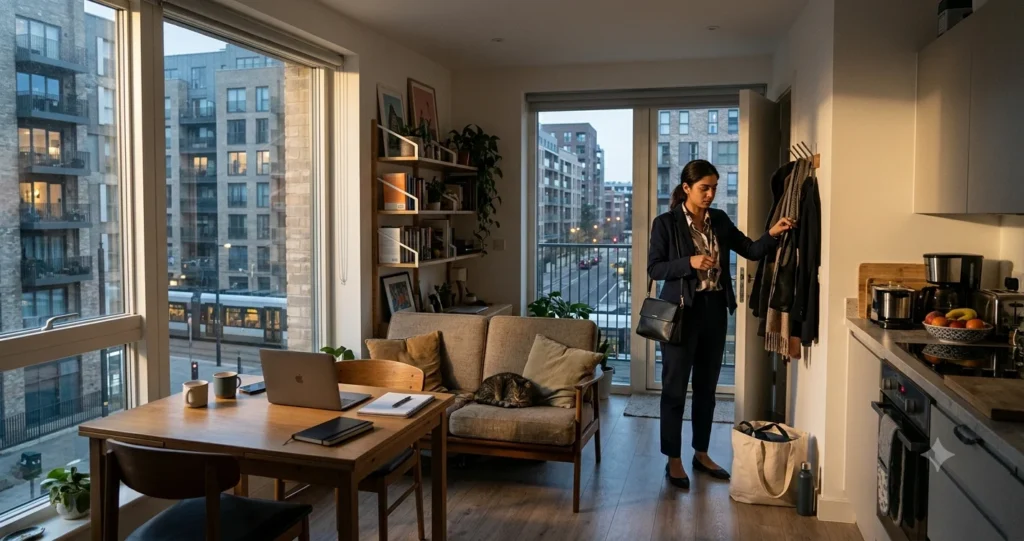
In Finland, 41% of all households now consist of a single person. In Norway, the figure is 40%. Across a cluster of twelve countries, nearly all of them in Northern and Western Europe, more than a third of households are occupied by just one resident, according to UN Economic Commission for Europe data. At the other extreme, in countries such as Afghanistan, solo living remains rare, often in the low single digits of all households.
What Makes a Single Person Society?
There is no official, universally agreed threshold at which a country becomes a “single person society.” This article treats countries where one-person households exceed roughly a third of all households, the point at which solo living moves from a common arrangement to arguably the modal experience of independent adulthood, as the clearest cases, while acknowledging this is an analytical framing rather than a formal demographic classification.
Countries With High Rates of One-Person Households
The UN Economic Commission for Europe’s household composition data identifies twelve European countries exceeding one-third one-person households: Finland (41%), Norway (40%), Switzerland (38%), Germany (37%), Austria (36%), the Netherlands (35%), and a cluster at 33-34% comprising Luxembourg, Belgium, Estonia, France, Latvia, and Liechtenstein. National data places Sweden in a similar range, close to 40% as of 2024, while South Korea, at 36.1% in 2024, has emerged as a major non-European member of this group, driven by its own combination of population aging and a stagnant birth rate.
The United States, while not among this highest tier, has nonetheless reached roughly 29% of households consisting of a single person, nearly triple its 1960 rate, and solo living became the single most common U.S. household type in 2015. At the opposite extreme, Afghanistan’s 0.2% one-person household rate, and comparably low rates across Pakistan (1.1%), Iraq (1.2%), and more than a dozen other countries in South Asia, the Middle East, and Africa, illustrate just how wide the global range runs.
One-Person Households by Country: Highest to Lowest Worldwide
| Rank | Country | Share of One-Person Households |
|---|---|---|
| 1 | Finland | 41% |
| 2 | Norway | 40% |
| 3 | Sweden | ~40% (national data, 2024) |
| 4 | South Korea | 36.1% |
| 5 | Switzerland | 38% |
| 6 | Germany | 37% |
| 7 | Austria | 36% |
| 8 | Netherlands | 35% |
| 9 | Luxembourg | 33-34% |
| 10 | Belgium | 33-34% |
| 11 | Estonia | 33-34% |
| 12 | France | 33-34% |
| 13 | Latvia | 33-34% |
| 14 | Liechtenstein | 33-34% |
| 15 | Iceland | 31.0% |
| 16 | United Kingdom | 29.5% |
| 17 | United States | ~29% |
| 18 | Canada | ~25-33% (comparative range) |
| 19 | Australia | ~25-33% (comparative range) |
| 20 | South Africa | ~25-33% (comparative range) |
| … | Philippines | Under 5% |
| … | Comoros | Under 5% |
| … | Nicaragua | Under 5% |
| … | Guinea | Under 5% |
| … | Jordan | Under 5% |
| … | South Sudan | Under 5% |
| … | Guatemala | Under 5% |
| … | Sierra Leone | Under 5% |
| … | Palestine | Under 5% |
| … | Cambodia | Under 5% |
| … | Niger | Under 5% |
| … | Tajikistan | Under 5% |
| … | Yemen | Under 5% |
| … | Bangladesh | Under 5% |
| … | Iraq | 1.2% |
| … | Pakistan | 1.1% |
| Lowest | Afghanistan | 0.2% |
Note: Compiled from multiple sources spanning approximately 2018-2024; figures are directional indicators of relative country ranking rather than precisely synchronized to a single reference year. Sources: UN Economic Commission for Europe, Data Portal; Our World in Data, “Percentage of one-person households”; South Korea Ministry of Health and Welfare, 2024; UK Office for National Statistics, 2024; U.S. Census Bureau.
Countries Where Household Sizes Remain Large
By contrast, countries with strong extended-family living norms and, in many cases, lower per-capita income show dramatically lower rates of solo living. Afghanistan (0.2%) is the lowest documented rate of one-person households globally, followed closely by Pakistan (1.1%) and Iraq (1.2%).
A wider band of countries, including Bangladesh, Yemen, Tajikistan, Niger, Mali, Cambodia, Palestine, Sierra Leone, Guatemala, South Sudan, Jordan, Guinea, Nicaragua, Comoros, and the Philippines, all show under 5% of households consisting of a single person. Broadly across South Asia, the Middle East, and much of sub-Saharan Africa, extended-family and multigenerational co-residence remain the dominant household pattern.
Why Countries Differ
Several factors, operating together rather than independently, explain the sharp geographic divide:
- Marriage patterns: Countries with earlier and more near-universal marriage tend to have lower rates of solo living among working-age adults; countries with later or less universal marriage show higher rates.
- Fertility: Lower fertility reduces average household size across the board and, combined with population aging, expands the pool of older adults whose children have left home, one direct contributor to one-person households.
- Aging and widowhood: Countries with older population structures and strong sex gaps in life expectancy tend to have larger populations of widowed individuals, most often women, living alone in later life.
- Housing: The availability and affordability of small, single-occupant housing units strongly shapes whether solo living is a practical option, independent of whether people might prefer it.
- Income: Higher per-capita income generally enables more people to afford independent housing rather than sharing costs with family members.
- Culture: Norms around when young adults are expected to leave the parental home, and around multigenerational care obligations for aging parents, vary substantially and directly affect solo-living rates independent of income.
- Urbanization: Denser, urbanized countries typically show higher rates of solo living than predominantly rural countries, reflecting both housing stock and labor market structure.
- Welfare systems: Countries with strong public pension and social care systems make independent living financially viable for older adults who might otherwise need to live with family for economic reasons, a pattern consistent with the concentration of high solo-living rates in Nordic countries with well-developed welfare states.
The Role of Older Populations
Widowhood and longevity are central to understanding why Northern European countries in particular show such high solo-living rates. As populations age and life expectancy rises, more people, disproportionately women, who outlive male partners in virtually every country, spend a growing number of years living alone following a spouse’s death. Countries with both older population structures and strong pension systems that make independent living financially feasible for widowed older adults consistently show among the highest solo-living rates globally.
The Role of Young Adults
A separate driver operates among younger adults: delayed marriage combined with sufficient income and housing availability to live independently before partnering, rather than remaining in the parental home. This pattern is notably weaker in countries where young adults commonly remain with parents until marriage, a contrast explored in detail in coverage of young adults living with parents longer, illustrating that high overall solo-living rates and high rates of adults living with parents are largely mutually exclusive national patterns rather than independent variables.
How Household Size Has Changed Historically
Nearly every country now exhibiting high rates of solo living has followed a similar historical trajectory: household sizes were substantially larger a century ago, with one-person households representing under 10% of the total in most places as recently as the mid-twentieth century. The United States illustrates the pace of change clearly, moving from about 13% one-person households in 1960 to roughly 29% today. European countries followed comparable, though not identical, trajectories, generally beginning their most rapid growth in solo living somewhat earlier, through the postwar decades of rising incomes and expanding welfare states.
Is Living Alone Becoming a Global Norm?
The evidence does not support treating solo living as a universal global trajectory that every country is simply on a delayed path toward. Countries with strong extended-family cultural norms, lower per-capita income, or both, much of South Asia, large parts of Africa, and portions of the Middle East, show no clear sign of converging toward the Northern European pattern in available data, and multigenerational and extended-family living remain the norm in these regions, examined further in coverage of the global multigenerational population.
What can be said with more confidence is that within the specific set of countries where solo living has already become common, mostly high-income, aging, urbanized societies, the trend continues to intensify rather than plateau: EU data shows single-adult households grew 16.9% between 2015 and 2024, compared with 5.8% growth in households overall.
Conclusion
The countries where living alone has become the norm share a consistent demographic and economic profile: high income, aging populations, strong welfare states, and later marriage, a profile concentrated overwhelmingly in Northern and Western Europe, with the United States following a similar but less extreme trajectory. This is not evidence of a universal global convergence toward solo living; countries with strong extended-family norms and lower incomes show no comparable trend in available data.
What the geography makes clear is that solo living is less a single global phenomenon than the predictable outcome of a specific combination of demographic and economic conditions, conditions that, where they exist, continue to push one-person households higher rather than toward any apparent ceiling.
Key Findings
- Twelve countries, overwhelmingly Northern and Western European, now report more than a third of households consisting of a single person, led by Finland (41%) and Norway (40%).
- The United States has reached roughly 29% one-person households, up from 13% in 1960, and became the country’s most common household type by 2015.
- Countries with the highest solo-living rates share a common profile: high per-capita income, older population structures, strong welfare states, and later or less universal marriage patterns.
- Countries with strong extended-family cultural norms and lower per-capita income, such as Afghanistan, show dramatically lower rates of solo living, often in the low single digits.
- High national rates of solo living and high rates of adults living with parents tend to be mutually exclusive patterns, reflecting different cultural and economic norms around household independence.
- Solo living continues to intensify, not plateau, in the countries where it is already common, EU single-adult households grew nearly three times faster than overall households between 2015 and 2024.
Frequently Asked Questions
1. Which country has the most one-person households?
Finland, at 41% of all households, followed closely by Norway at 40%, according to UN Economic Commission for Europe data.
2. Why are household sizes shrinking in some countries?
Declining fertility, population aging, delayed and less universal marriage, rising incomes enabling independent living, and urbanization are the primary documented drivers.
3. Why do some countries have larger households?
Strong extended-family cultural norms, lower per-capita income limiting access to independent housing, and earlier or more universal marriage patterns sustain larger average household sizes in many parts of Asia, Africa, and the Middle East.
4. Are single-person households increasing worldwide?
The trend is strongest and most consistently documented in high-income, aging, urbanized countries; available data does not show a comparable trajectory in countries with strong extended-family living norms.
5. What does a single-person society mean?
It is not a formal demographic category, but refers here to countries where one-person households exceed roughly a third of the total, a threshold currently met by twelve countries, mostly in Northern and Western Europe.
6. Do older or younger people drive high solo-living rates?
Both, though for different reasons: widowhood and longevity drive high rates among older adults, while delayed marriage combined with sufficient income and housing drives rates among younger adults.
7. Is the United States a single-person society?
Not by the roughly one-third threshold used here, though at 29% of households, the U.S. has one of the higher documented solo-living rates globally, and living alone has been its most common household type since 2015.
8. Which countries have the lowest rates of people living alone?
Afghanistan is frequently cited among the lowest, alongside many countries across South Asia, the Middle East, and sub-Saharan Africa with strong extended-family household norms.
9. Does welfare state strength affect solo-living rates?
Yes. Countries with strong public pensions and social care systems make independent living more financially feasible for older adults, contributing to the concentration of high solo-living rates in Nordic welfare states.
10. Is solo living still increasing in countries where it’s already common?
Yes. EU data shows single-adult households grew 16.9% between 2015 and 2024, compared with 5.8% growth in households overall, indicating the trend remains in an active growth phase rather than leveling off.
Sources
- United Nations Economic Commission for Europe (UNECE), Data Portal, “Proportion of one-person households in all households.”
- United Nations, “Household Size and Composition,” Technical Report, UN DESA Population Division.
- Eurostat, “Household composition statistics,” 2025.
- U.S. Census Bureau, household composition historical data.
- Psychology Today, “Where in the World Do People Live Alone?”
- Our World in Data, “Percentage of one-person households.”





