
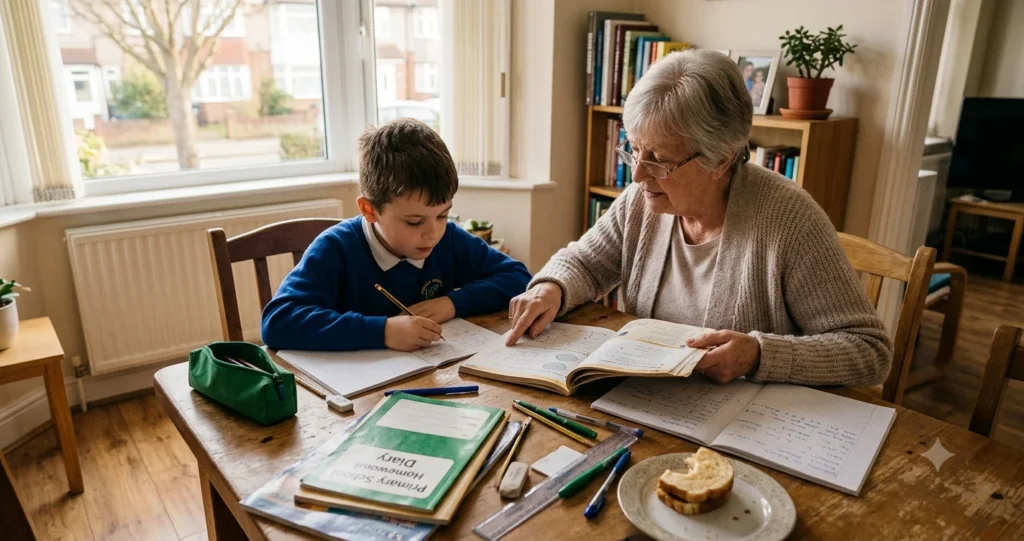
Nearly 30% of U.S. children live with a grandparent at some point during childhood, according to longitudinal research tracking children’s living arrangements over time, a figure far higher than the roughly 3% of U.S. children living in kinship care at any single point in 2023. That gap between the point-in-time snapshot and the lifetime prevalence is one of the central facts of this topic: cross-sectional statistics dramatically understate how many children ever experience being raised primarily by a grandparent, because these arrangements are often temporary, triggered by a specific family crisis, and resolved within a matter of years.
Skip-generation households, where grandparents raise grandchildren with no parent present in the home, represent a distinct and measurable demographic pattern shaped by migration, parental mortality, incarceration, and economic hardship. This article treats grandparent caregiving as a population and household phenomenon linked to broader demographic forces, not as a lifestyle choice or a purely cultural custom.
What Does It Mean for Grandparents to Raise Grandchildren?
Researchers distinguish between several related but statistically separate categories of grandparent involvement in a grandchild’s life:
- Occasional or supplemental childcare, where grandparents provide regular but not primary care, common across most cultures and not counted as a distinct household type.
- Multigenerational co-residence, where grandparents live with both a parent and grandchild, sharing but not solely bearing caregiving responsibility.
- Skip-generation (or “grandfamily”) households, where grandparents are the primary caregivers and no parent is present in the home.
Research using American Community Survey data indicates that of all U.S. children who ever live with a grandparent, approximately 5% experience it in a skipped-generation arrangement, while 24.6% experience it in a multigenerational household with a parent also present, meaning multigenerational co-residence, not skip-generation caregiving, is the more common form of grandparent involvement in children’s living arrangements.
How Large Is the Population?
U.S. Census Bureau data indicate that in 2024, approximately 2 million grandparents were responsible for their grandchildren, and almost 1 million grandchildren were being raised by grandparents with no parent present in the household. Separately, the Grandfamilies and Kinship Support Network reports that more than 2.4 million children, about 3% of all U.S. children, lived in kinship care or “grandfamily” arrangements in 2023, down from 4% in 2021. The share of U.S. households consisting solely of grandparents raising grandchildren roughly doubled from 3% in 1970 to 6% by 2012, according to Census Bureau historical data, though it remains a small share of all households even after that doubling.
U.S. Skip-Generation and Kinship Care Estimates
| Measure | Figure | Year |
|---|---|---|
| Children ever living with a grandparent (lifetime prevalence) | ~30% | Longitudinal estimate |
| Children in skip-generation households (lifetime prevalence) | ~5% | Amorim et al., 2017 |
| Children in multigenerational households with a parent present (lifetime) | ~24.6% | Amorim et al., 2017 |
| Children in kinship care / grandfamilies (point-in-time) | ~3% (2.4 million) | 2023 |
| Grandchildren with no parent present, grandparent-headed household | ~1 million | 2024 |
| Grandparents responsible for grandchildren | ~2 million | 2024 |
| Households of grandparents solely raising grandchildren | 3% (1970) → 6% (2012) | Historical trend |
Source: U.S. Census Bureau; Grandfamilies and Kinship Support Network; Amorim, Dunifon & Pilkauskas research.
Where Are Skip-Generation Households Found?
Skip-generation living arrangements are not a uniquely American phenomenon; research published through N-IUSSP identifies a growing global prevalence of skip-generation households across low- and middle-income countries, driven substantially by labor migration patterns in which working-age parents relocate for employment while grandparents remain with children in the origin community.
China’s internal rural-to-urban labor migration is among the most extensively documented examples, producing large populations of children, sometimes called “left-behind children”, raised by grandparents while parents work in distant cities. Similar patterns have been documented in rural Cambodia, where economic migration of working-age adults has driven a rise in skip-generation households, and in parts of Southeast Asia more broadly.
Why Do Grandparents Become Primary Caregivers?
No single cause dominates globally, and researchers caution against treating any one explanation as universal. Documented drivers include:
- Parental labor migration, where parents relocate for work, domestically or internationally, and leave children with grandparents, a pattern especially well documented in China, Cambodia, and other migration-sending economies.
- Parental death, leaving grandparents as the nearest or most appropriate caregivers, particularly significant historically in regions affected by disease epidemics.
- Parental incarceration, a documented driver in the United States and elsewhere.
- Economic hardship, where parents are unable to independently support children.
- Substance use and family disruption, cited in U.S. research as a contributing factor in a meaningful share of skip-generation arrangements, though its relative weight compared with other causes varies by study and region.
The relative importance of each factor differs substantially by country and region; migration is the dominant driver in much of the developing world’s skip-generation household growth, while family disruption factors feature more prominently in high-income country research.
The Role of Older Women
Caregiving responsibility within grandparent-headed households is not evenly distributed by gender. U.S. research finds that although most grandparents raising grandchildren are married (65.7%), women shoulder the bulk of direct caregiving responsibility, 63% versus 36.6% for men, according to 2024 research. This mirrors the broader gender pattern documented across the global care economy, where women perform the majority of both paid and unpaid caregiving labor across virtually every measured context.
The Economic and Social Role of Grandparent Care
Skip-generation and grandparent-involved households frequently substitute for formal childcare and, in cases involving parental death, incarceration, or incapacity, substitute for the child welfare and foster care systems entirely. U.S. federal policy has recognized this role explicitly: a 2008 federal law specifically eased pathways for grandparents to adopt or foster grandchildren already in their care, reflecting policy recognition that kinship care by grandparents is generally preferable to formal foster placement when grandparents are willing and able to provide it.
Economically, grandparent caregivers, many of whom are on fixed retirement incomes, absorb costs that would otherwise fall on public child welfare systems, representing a meaningful, if largely uncompensated, contribution to social welfare infrastructure.
How the Pattern Changes With Population Aging
Rising life expectancy directly expands the pool of grandparents available to provide care, simply by increasing the number of years grandparents remain alive and healthy enough to take on caregiving responsibility. At the same time, the same demographic forces are increasing the average age of grandparents at the point children are born, since delayed childbearing among parents pushes grandparenthood later in life, a trend that can reduce grandparents’ physical capacity for intensive, full-time caregiving even as it increases the raw number of living grandparents overall.
What the Data Cannot Tell Us
Skip-generation and kinship care statistics are widely understood among researchers to undercount the true population, for several reasons. Point-in-time household surveys, including the U.S. Census Bureau’s standard estimates, miss temporary or informal arrangements that do not persist across a full survey year. Many grandparent caregiving arrangements are informal, without legal custody or foster status, making them invisible to administrative data systems that track only formal kinship care placements.
Cross-national comparisons are further complicated by inconsistent definitions: what counts as a “skip-generation household” in Census Bureau data may not match the definition used in Chinese rural migration studies or Cambodian nutrition research, limiting the reliability of any global aggregate figure.
Conclusion
Grandparents raising grandchildren is a far larger demographic phenomenon than point-in-time statistics suggest, nearly a third of U.S. children experience it in some form, even though formal skip-generation households remain a small share of all family arrangements at any given moment. Migration, mortality, incarceration, and economic hardship each drive the pattern in different regions and contexts, and women, usually grandmothers, bear the large majority of the direct caregiving burden wherever the arrangement occurs.
As global life expectancy continues to rise, the pool of grandparents available to step into this role will keep expanding, even as delayed parenthood pushes the typical age of grandparenthood later into life.
Key Findings
- Nearly 30% of U.S. children live with a grandparent at some point in childhood, though only about 5% ever experience a true skip-generation (no-parent) arrangement.
- Roughly 1 million U.S. grandchildren were being raised by grandparents with no parent present as of 2024, and about 2 million grandparents held that responsibility.
- The share of U.S. households consisting solely of grandparents raising grandchildren doubled from 3% in 1970 to 6% by 2012.
- Women provide the substantial majority of direct caregiving in grandparent-headed households, 63% versus 36.6% for men, even though most such grandparents are married.
- Skip-generation households are a documented and growing pattern across low- and middle-income countries, driven substantially by labor migration, notably in China and Cambodia.
- Point-in-time survey data significantly understate lifetime prevalence, since many grandparent caregiving arrangements are temporary or informal.
Frequently Asked Questions
1. How many grandparents raise grandchildren?
In the United States, approximately 2 million grandparents were responsible for their grandchildren as of 2024, with about 1 million grandchildren living in households with no parent present.
2. What is a skip-generation household?
A household in which one or more grandparents live with one or more grandchildren while the children’s parents are absent from the home, distinct from multigenerational households, where a parent is also present.
3. Why do grandparents raise grandchildren?
Documented reasons include parental labor migration, death, incarceration, economic hardship, and substance use or family disruption, with the relative importance of each cause varying substantially by country and region.
4. Are grandmothers more likely to provide care than grandfathers?
Yes. U.S. research shows women handle 63% of direct caregiving in grandparent-headed households versus 36.6% for men, even though most such grandparents are married.
5. How is grandparent caregiving measured?
Primarily through census and household survey data on household composition, though researchers note these point-in-time measures substantially undercount lifetime prevalence and miss informal or temporary arrangements.
6. Is skip-generation living more common in certain countries?
Research shows a growing global prevalence in low- and middle-income countries, with labor migration, such as China’s rural-to-urban migration, identified as a major driver in several documented cases.
7. What is the difference between kinship care and a skip-generation household?
Kinship care is a broader term covering children raised by any relative, including grandparents, outside the child welfare system; skip-generation specifically refers to grandparent-headed households with no parent present.
8. How common is it for U.S. children to ever live with a grandparent?
Nearly 30% of U.S. children live with a grandparent at some point in childhood, far higher than the roughly 3% counted in any single point-in-time survey.
9. Does population aging increase grandparent caregiving?
Longer life expectancy expands the pool of grandparents alive and available to provide care, though delayed childbearing among parents also pushes the average age of grandparents higher, which can affect their capacity for intensive caregiving.
10. Do grandparent caregivers receive financial support?
Support varies significantly by country and, within the U.S., by state; a 2008 federal law eased legal pathways for grandparents to formally adopt or foster grandchildren already in their care, but many arrangements remain informal and without dedicated financial support.
Sources
- U.S. Census Bureau, “America’s Families and Living Arrangements,” 2023–2024 data tables.
- Grandfamilies and Kinship Support Network, “Kinship/Grandfamilies Data,” 2024.
- Amorim, M., Dunifon, R., & Pilkauskas, N., “The Magnitude and Timing of Grandparental Coresidence During Childhood in the United States,” 2017.
- ASA Generations, “Skipped Generation Households: A Snapshot,” 2025.
- N-IUSSP, “Skip-generation household trends in low- and middle-income countries,” Zimmer & Treleaven.
- Institute for Research on Poverty (IRP), University of Wisconsin, “Children Living with Grandparents,” 2023 presentation slides (Pilkauskas).