
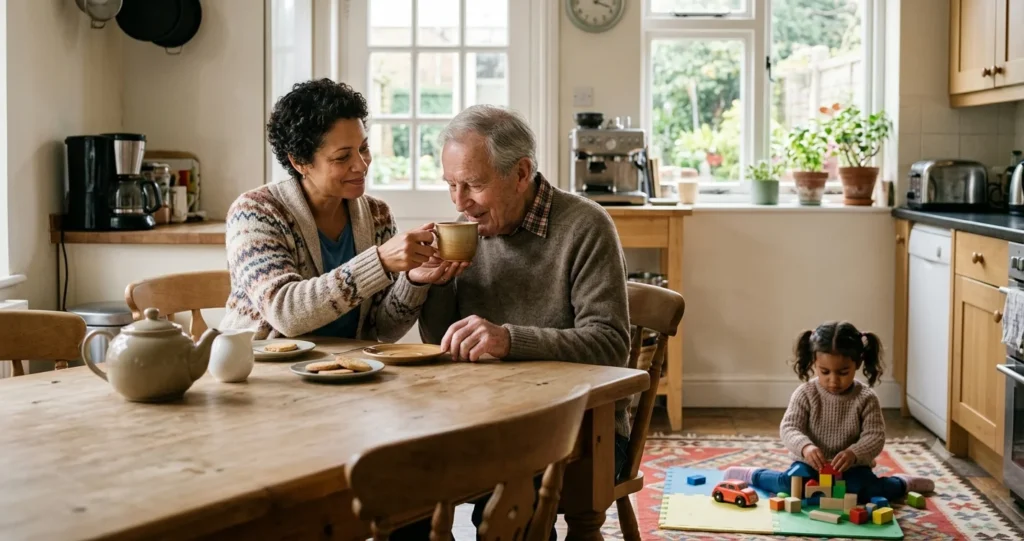
The 25% of U.S. adults classified in Pew Research Center’s “sandwich generation” survey is a statistical label built around household composition; a living parent aged 65 or older plus a dependent child. The lived reality behind that label is a caregiving relationship: actual hours spent coordinating medical appointments, providing hands-on assistance, managing finances, and offering emotional support to people at opposite ends of the age spectrum, often on the same day.
What Dual Caregiving Looks Like
Adults providing simultaneous childcare and eldercare typically manage a mix of responsibilities that differ substantially by generation. Childcare tends to be more capital-intensive, school fees, extracurricular costs, and, for many, ongoing financial support even after a child reaches adulthood. Eldercare tends to be more labor- and time-intensive, daily or weekly hands-on assistance, medical appointment coordination, and, in a meaningful share of cases, help with basic activities of daily living.
Pew’s research finds that among adults with at least one parent aged 65 or older, 30% say that parent needs help handling their affairs or caring for themselves, while 69% say their parents can currently manage independently, meaning eldercare responsibility within dual-caregiving households ranges from occasional support to intensive daily care.
How Common Is Dual Caregiving?
Depending on definition, estimates of dual caregiving prevalence in the United States range from roughly 23% to 25% of all adults, per Pew’s most recent survey, to over 50% among adults specifically in their 40s. A Canadian analysis found that among caregivers providing simultaneous support to two generations, 34% were caring for a parent or parent-in-law alongside their own child under 15, 15% were caring for a parent alongside a grandchild under 15, and 8% were caring for a spouse or partner alongside their own child under 15, illustrating that “dual caregiving” spans several distinct household configurations beyond the classic parent-plus-minor-child model.
Why the Two Responsibilities Are Overlapping
The overlap between childcare and eldercare responsibilities within the same cohort of adults is a direct consequence of two demographic shifts moving in parallel: rising parental longevity, which extends the years an adult has a living parent likely to need some form of support, and delayed childbearing, which pushes the years of active child-rearing later into an adult’s own life.
Where earlier generations typically completed active parenting before their own parents reached advanced old age, longer lifespans and later childbearing have compressed these two life stages into substantial overlap for a large share of the population, the same dynamic examined from a household-labeling perspective in coverage of the sandwich generation.
Who Provides the Care?
Dual caregiving responsibilities are not evenly distributed. Women make up 60% of sandwich generation caregivers and spend, on average, 45 more minutes per day on caregiving tasks than men in comparable circumstances, according to Pew’s research, consistent with the broader gender pattern documented across the global care economy, in which women perform the substantial majority of unpaid care work worldwide.
Employment status also shapes caregiving capacity: caregiving research finds that a large majority of family caregivers, including many in dual-caregiving roles, are simultaneously managing paid employment, contributing to the time pressure and stress documented among this population, family caregiver research finds roughly 77% report significant emotional stress.
The Time Economy of Dual Caregiving
Dual caregivers spend, on average, an estimated $10,000 and 1,350 hours annually across both caregiving roles combined, according to Pew-based estimates cited in caregiving research, a figure that combines direct financial outlay with the time cost of hands-on care, medical coordination, and household management. Nearly a third of dual caregivers report feeling constantly pressed for time.
Costs of formal alternatives illustrate why so much of this labor remains unpaid within families: Genworth’s 2024 Cost of Care data estimated in-home care for an aging relative at roughly $6,000 per month for 44 hours of weekly care, with assisted living communities averaging about $5,500 monthly and 24-hour skilled nursing facilities running $9,000 to $10,000 monthly, costs substantial enough that many families rely on unpaid dual caregiving as the practical alternative to formal paid care.
Financial Transfers Across Three Generations
Money moves in both directions across a dual-caregiving household. Nearly half of adults in the sandwich generation provide financial support to a grown child, while separate Pew survey data has found that a significant share of adults aged 65 and older with grown children, 44% in one survey, report giving financial support to an adult child in the past year, indicating that financial transfers between generations often flow from older to middle generations even as middle-generation adults simultaneously provide care and support to those same older relatives. This bidirectional flow complicates any simple narrative in which support runs strictly downward from older to younger generations, or strictly upward from younger to older.
How Family Structure Changes the Burden
Family size directly shapes the individual caregiving load: fewer siblings among adult children means eldercare responsibilities, when needed, are divided among fewer people. Geographic distance compounds this, adult children living far from aging parents face logistical caregiving challenges regardless of willingness to help, a dynamic sometimes described as long-distance caregiving, which typically substitutes financial support and periodic visits for the daily hands-on assistance available to nearby family members.
Household structure also matters: dual caregivers living in multigenerational households, where a parent, adult child, and grandchild share a home, face a different caregiving logistics profile than dual caregivers coordinating care across separate households.
What Happens as Populations Age Further?
Continued gains in life expectancy combined with continued delays in childbearing point toward a larger, not smaller, population of adults managing simultaneous childcare and eldercare responsibilities in coming decades, though the precise scale depends on variables that remain genuinely uncertain, including future fertility timing, retirement-age labor force participation among older adults, and the pace of formal care system expansion.
Regional workforce planning already reflects this trajectory in some jurisdictions: one Canadian analysis projected the need for thousands of additional home care workers in a single province by 2028 simply to maintain current service levels as the population needing care grows alongside the population providing informal dual care.
Conclusion
Behind the sandwich generation statistic is a specific, demanding caregiving relationship: adults coordinating medical care for a parent, managing a child’s needs, and often working full-time, all at once. The $10,000 and 1,350 hours that dual caregivers spend annually, on average, represent real economic value substituting for formal care services that would otherwise cost thousands of dollars monthly per person.
As longer lifespans and delayed childbearing continue pushing these two caregiving responsibilities into the same years of adult life, the practical demands of intergenerational caregiving, not just the demographic label describing it, deserve equal attention from researchers and policymakers alike.
Key Findings
- Between roughly a quarter and over half of U.S. adults, depending on age group, are managing simultaneous childcare and eldercare responsibilities, per Pew Research Center data.
- 30% of adults with a parent aged 65 or older say that parent needs help with daily affairs or self-care, while 69% say parents remain independent.
- Dual caregivers spend an estimated $10,000 and 1,350 hours annually, on average, across both caregiving roles combined.
- Women provide 60% of dual caregiving and spend 45 more minutes daily on caregiving tasks than men in comparable roles.
- Formal care alternatives, $6,000 monthly for in-home care, $5,500 for assisted living, $9,000–$10,000 for skilled nursing, are expensive enough that unpaid family caregiving remains the practical default for many households.
- Financial support often flows in both directions: nearly half of dual caregivers support a grown child financially, while a significant share of older parents separately report giving financial support to their own adult children.
Frequently Asked Questions
1. What is intergenerational caregiving?
The simultaneous provision of care, financial, hands-on, or emotional, to both a dependent or semi-dependent child and an aging parent by the same adult, distinct from the broader demographic label of the “sandwich generation.”
2. How common is caring for both parents and children?
Estimates range from roughly a quarter of U.S. adults overall to more than half among adults specifically in their 40s, depending on the definition used.
3. What age group is most affected?
Adults in their 40s, who are most likely to simultaneously have a living parent aged 65 or older and a dependent or financially supported child.
4. Does caregiving reduce employment?
Caregiving research finds substantial overlap between dual caregiving and paid employment, with many caregivers managing both simultaneously, contributing to documented time pressure and stress rather than typically leading to full employment exit.
5. How does family size affect caregiving?
Smaller sibling networks mean eldercare responsibilities, when needed, are divided among fewer adult children, increasing the individual caregiving burden per person compared with earlier generations with larger families.
6. Who bears most of the caregiving burden in dual-caregiving households?
Women, who make up 60% of sandwich generation caregivers and report spending more daily time on caregiving tasks than men in comparable circumstances.
7. What does eldercare typically involve in dual-caregiving households?
It ranges from occasional support to intensive daily assistance; about 30% of adults with a parent 65 or older report that parent needs help with daily affairs or self-care.
8. How much does dual caregiving cost financially?
Roughly $10,000 annually on average, combined with about 1,350 hours of caregiving time per year, according to Pew-based estimates cited in caregiving research.
9. Does financial support only flow from adult children to aging parents?
No. A meaningful share of older parents report providing financial support to their own adult children, meaning money often flows in both directions within the same dual-caregiving family.
10. Will intergenerational caregiving become more common?
Continued gains in life expectancy alongside continued delays in childbearing point toward growth in the population managing simultaneous caregiving responsibilities, though the precise future scale remains uncertain.
Sources
- Pew Research Center, “More than half of Americans in their 40s are ‘sandwiched’ between an aging parent and their own children,” 2025.
- Pew Research Center, “The Sandwich Generation,” 2013.
- Genworth Financial, Cost of Care Survey, 2024.
- Global News (Canada), reporting on dual caregiving and home care workforce projections, McMaster University research.
- Family Caregiver Alliance, “Caregiver Health,” 2025 annual report.