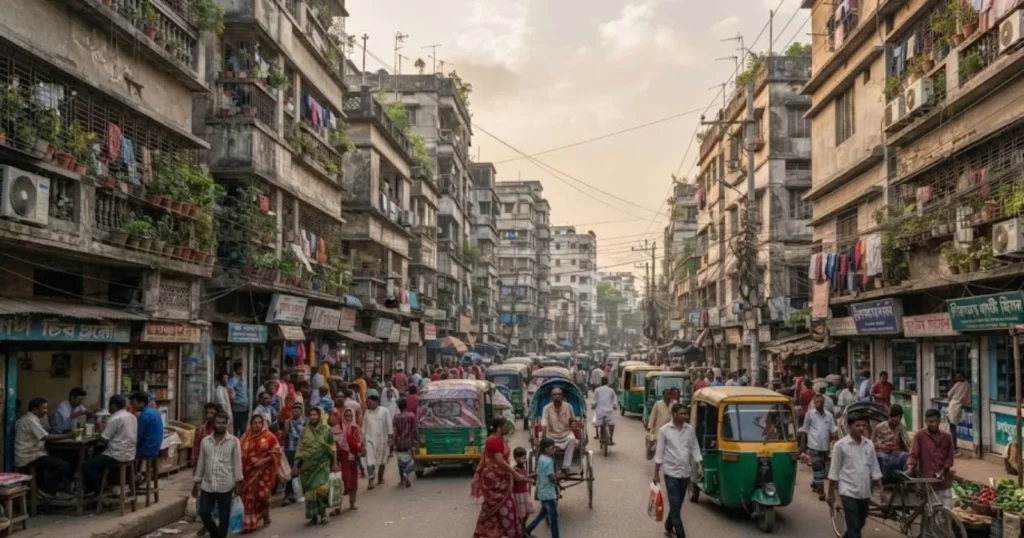
For decades, Bangladesh was a symbol of crowding. The 2022 Population and Housing Census counted about 169.8 million people on roughly 148,000 square kilometers, a density of about 1,119 people per square kilometer, among the highest of any large country. That image is out of date as an account of demographic pressure. Fertility has fallen from about 6.9 births per woman in the early 1970s to near replacement, annual growth has slowed to about 1.22 percent, and the age structure is moving from a youth-dominated profile toward a larger working-age share and, later, an older one.
Density describes how many people live on a given area. It does not describe the pace of growth, the age mix or economic opportunity. This article explains why Bangladesh’s demographic story is changing, how fertility fell, what the working age population can and cannot deliver, where aging and urbanization fit, how climate exposure interacts with settlement, and what official and international projections say. Sources include the Bangladesh Bureau of Statistics (BBS), the Bangladesh Demographic and Health Survey (BDHS), the Sample Vital Statistics, the World Bank, UNFPA and the United Nations World Population Prospects. Reference years are stated, and projections are treated as scenarios.
Why Bangladesh’s Demographic Story Is Changing
Bangladesh’s population was about 70 million at independence in 1971, 144 million in the 2011 census and about 169.8 million in 2022. Growth rates fell from above 2.5 percent in the 1970s to 1.22 percent in the 2022 census period. Child survival improved, family planning spread through a large community-based program, girls’ schooling expanded, and women entered the garment industry in large numbers.
| Indicator | Earlier | Recent | Source |
|---|---|---|---|
| Population | About 144 million (2011) | About 169.8 million (2022) | Census 2011, 2022 |
| Annual growth | Above 2.5% in the 1970s | About 1.22% | BBS |
| Density | About 976 per sq km (2011) | About 1,119 per sq km (2022) | BBS |
| Fertility | About 6.9 (early 1970s) | About 2.0 to 2.3 | BDHS, Sample Vital Statistics |
| Urban share | About 23% (2011) | About 31 to 32% (2022) | Census |
Density alone does not describe demographic pressure. Japan and the Netherlands are also dense, and densities in Dhaka or Narayanganj are far higher than the national average. Pressure on land, services and jobs depends on income, productivity, housing and governance, not only on headcount per square kilometer.
Is Bangladesh’s Population Growth Slowing?
Yes. Growth has declined across successive censuses and surveys, and slowing growth is not the same as decline. A population can keep rising for decades after fertility nears replacement because of population momentum.
| Period | Approximate annual growth | Context |
|---|---|---|
| 1974 to 1981 | About 2.3% | High fertility |
| 1991 to 2001 | About 1.5% | Rapid fertility decline |
| 2001 to 2011 | About 1.4% | Continued slowing |
| 2011 to 2022 | About 1.2% | Near replacement fertility |
The UN World Population Prospects 2024 medium variant projects continued growth for some decades, with a peak around the middle of the century at roughly 200 million or slightly above, followed by gradual decline. National projections by the BBS and others vary with assumed fertility and migration. Each projection should be cited with its year and scenario, and none should be read as a precise forecast.
How Fertility Decline Changed Bangladesh’s Population Trajectory
Bangladesh’s fertility transition is among the most studied in the developing world because it occurred with low income and a largely rural population. Total fertility fell from about 6.3 in the mid 1970s to about 3.4 around 1993, to about 2.3 in recent BDHS rounds. Survey based estimates differ: the BDHS 2022 reported about 2.3, while the Sample Vital Statistics reported figures near 2.0 in some years.
| Factor | Role in fertility decline | Evidence |
|---|---|---|
| Family planning outreach | Door-to-door services, contraception access | Contraceptive prevalence rose from under 10% to more than 60% |
| Female education | Delayed marriage, smaller families | Strong association across districts |
| Child survival | Lower need for replacement births | Under five mortality fell sharply |
| Women’s employment | Garment sector jobs, income | Associated with later marriage and fewer births |
| Urbanization | Higher costs of children | Moderate |
| Community health workers | Trusted local delivery | Documented in program evaluations |
Researchers debate how much each factor contributed, and the best reading is that several reinforced one another. Child marriage remains common compared with many countries, and recent decades have seen a plateau in contraceptive use and fertility around replacement level, which suggests that the easy gains have been made.
The Demographic Dividend and the Changing Working Age Population
Bangladesh’s working-age population (15 to 64) is near 66 to 68 percent of the total, and its dependency ratio is low. Analysts often describe the demographic window as lasting until around 2040, though estimates vary. The window is a demographic fact. The dividend is an economic outcome.
The ready-made garment industry is the clearest example of how workers have been absorbed, with roughly four million workers, most of them women. Remittances from migrant workers abroad add household income. Female labor force participation is around 43 percent in recent labor force surveys, higher than in most of South Asia but still below the male rate.
| Dividend condition | Status | Gap |
|---|---|---|
| Large working age share | Present | Window closes in the 2040s |
| Job creation | Strong in garments, services | Concentration in one export sector |
| Female participation | About 43% | Quality of jobs, safety |
| Education and skills | Rising enrollment | Learning quality, technical skills |
| Productivity | Growing but low | Diversification needed |
Many young workers are in informal jobs with low wages, and youth unemployment among educated graduates is a recurring concern. Demographic opportunity depends on productivity, investment, and job availability, and a shrinking window raises the stakes.
Bangladesh’s Emerging Population Aging Challenge
Bangladesh is still young, with a median age in the high 20s, but aging has started. The population aged 60 and above is about 9 percent by some estimates, and projections show it rising to about a fifth or more by 2050 as fertility stays low and life expectancy approaches 73 to 75 years. Aging can matter before total growth stops, because the older population grows quickly from a small base.
| Aging issue | Present condition | Pressure |
|---|---|---|
| Longevity | Life expectancy in the low 70s | More years in old age |
| Pension coverage | Limited, mostly civil servants | Weak income security |
| Family support | Strong tradition, weakening with migration | Left behind elders |
| Healthcare demand | Rising chronic disease | Limited geriatric services |
| Employment | Many older adults work informally | Low earnings |
The government introduced an old age allowance and a national social security strategy, but coverage and benefit levels are small compared with need. Planning for aging while the population is still young offers an opportunity to build systems before pressure peaks.
Urbanization and Population Concentration
About a third of Bangladeshis lived in urban areas in 2022. Dhaka is the dominant city, with more than ten million people in the city corporations and a much larger metropolitan region, and Chattogram, Khulna, Rajshahi, Sylhet and Narayanganj are other major urban centers. Growth is driven by migration for jobs in garments and services, natural increase and reclassification.
| Urban issue | Condition | Effect |
|---|---|---|
| Congestion | Among world’s most crowded cities | Lost time, pollution |
| Housing | Informal settlements, high rents | Overcrowding |
| Transport | Limited mass transit, new metro line opened | Commuting costs |
| Sanitation and water | Groundwater depletion, sewage gaps | Health risks |
| Flooding | Drainage limits | Seasonal damage |
Urbanization reshapes demographic pressure without necessarily raising national growth. Concentration in a few cities strains services, while rural areas may see aging and labor shortages in some seasons.
Climate Vulnerability, Displacement, and Demographic Change
Bangladesh is a low lying delta exposed to floods, cyclones, riverbank erosion and salinity. These hazards interact with settlement and livelihoods. The World Bank’s Groundswell report estimated that climate change could lead to as many as 13 million internal climate migrants in Bangladesh by 2050 under pessimistic scenarios, a projection that depends on emissions and policy.
Observed migration is not the same as projected displacement. Many moves to Dhaka and other cities involve several causes, including income, education and family networks, and attributing each move to climate would overstate the evidence. Coastal salinity, riverbank erosion in the Jamuna and Padma basins, and cyclone damage are documented drivers of local displacement.
| Hazard | Documented effect | Demographic link |
|---|---|---|
| River erosion | Loss of land and homes | Local displacement |
| Cyclones and storm surge | Damage, evacuation | Temporary displacement |
| Salinity | Lower crop yields | Livelihood change, migration |
| Flooding | Seasonal inundation | Short term movement |
| Sea level rise | Projected long term loss | Scenario based |
Women, Work, and the Garment Sector’s Demographic Role
One feature sets Bangladesh apart from most countries at a similar income level: women’s mass entry into paid work through the ready made garment industry. Since the 1980s, factories around Dhaka, Gazipur, Narayanganj and Chattogram have recruited young rural women, who in turn have married later and had fewer children on average than earlier cohorts. This link between employment, delayed marriage and fertility is one of the better documented parts of the country’s transition, though researchers caution that rising wages, schooling and health programs worked at the same time.
The sector also shows the limits of a single export engine. A large share of manufacturing jobs sits in one industry, which is exposed to global buyer demand, wage disputes and trade rules, and automation could reduce labor needs over time. A workforce that grows more slowly in the 2030s and 2040s will need higher productivity per worker, more varied industries such as light engineering, food processing, leather, pharmaceuticals and digital services, and better technical training. Women’s participation, now around 43 percent, still trails the male rate, and safety, transport and child care affect whether women stay in work after marriage.
| Employment factor | Demographic link | Policy question |
|---|---|---|
| Garment employment | Raised women’s age at marriage | Diversify beyond one sector |
| Remittances | Support rural household income | Protect migrant workers |
| Informal work | Large share of jobs | Social protection coverage |
| Youth skills | Window closes in the 2040s | Technical and digital training |
Regional Differences Within Bangladesh
Divisions differ in urbanization, livelihoods and health. Dhaka division is the most populous and urbanized, Chattogram has a large port and migrant source districts, Rajshahi and Rangpur in the north have lower incomes and seasonal poverty, Khulna and Barishal in the south face salinity and cyclone risk, Sylhet has high international migration, and Mymensingh is largely rural. The 2022 census and BDHS provide division level figures, which should be consulted for exact numbers.
| Region | Characteristic |
|---|---|
| Dhaka | Largest population, highest urbanization, industrial base |
| Chattogram | Port economy, high migration abroad from some districts |
| Rajshahi and Rangpur | Agricultural, seasonal poverty, out-migration to cities |
| Khulna and Barishal | Coastal, climate exposed |
| Sylhet | Large overseas diaspora, remittances |
| Mymensingh | Rural, mixed livelihoods |
What Bangladesh Must Prepare for Next
| Area | Need | Why |
|---|---|---|
| Workforce productivity | Skills, diversification beyond garments | Window closes in 2040s |
| Elderly care | Pensions, geriatric services | Rapid growth in older population |
| Healthcare financing | Primary care, non-communicable disease | Epidemiological shift |
| Urban planning | Housing, transit, drainage | Concentration in Dhaka |
| Education | Learning quality, technical skills | Productivity |
| Migration management | Worker protection, return programs | Remittance dependence |
| Climate adaptation | Protective infrastructure, relocation planning | Hazard exposure |
Bangladesh’s Population Outlook Through 2050 and Beyond
Projection scenarios differ in fertility assumptions. If fertility stays near replacement and migration is modest, population growth continues slowly and peaks around mid century. If fertility falls further, the peak is earlier and aging faster. If fertility rises, growth continues longer.
| Scenario | Fertility | Population path | Aging |
|---|---|---|---|
| Low | Below replacement | Earlier peak, decline after | Faster |
| Medium | Near replacement | Peak mid century | Moderate |
| High | Above replacement | Later peak | Slower |
Population decline is not certain and depends on the specified projection. Uncertainty includes fertility, mortality, migration and data quality.
Frequently Asked Questions
1. Is Bangladesh’s population growth slowing?
Yes. Growth fell from above 2.5 percent in the 1970s to about 1.22 percent in the 2022 census period.
2. Why is Bangladesh entering a new demographic phase?
Fertility decline, better survival and a changing age structure.
3. Will Bangladesh’s population decline?
Most projections show growth continuing for some decades, then a peak and possible decline, depending on the scenario.
4. Is Bangladesh’s demographic dividend ending?
The working age share is high and the window is often put at about 2040, so the dividend depends on productive jobs soon.
5. How will aging affect Bangladesh?
It will raise demand for healthcare, pensions and care and reduce workforce growth.
6. What is Bangladesh’s population density?
About 1,119 people per square kilometer in the 2022 census.
7. What is the fertility rate?
About 2.0 to 2.3, depending on the survey.
8. How urbanized is Bangladesh?
About a third of the population was urban in 2022.
9. Is climate migration large?
Observed climate related displacement exists, and large projections of future internal migration are scenarios.
10. How many people live in Bangladesh?
About 169.8 million in the 2022 census.
Sources and Data Notes
- Bangladesh Bureau of Statistics, Population and Housing Census 2022; Sample Vital Statistics.
- National Institute of Population Research and Training, Bangladesh Demographic and Health Survey 2022.
- World Bank, Groundswell report and Bangladesh country reports; UNFPA Bangladesh.
- United Nations, World Population Prospects 2024.
- Data note: fertility estimates differ by survey. Verify the latest BBS release and projection scenario before publication.