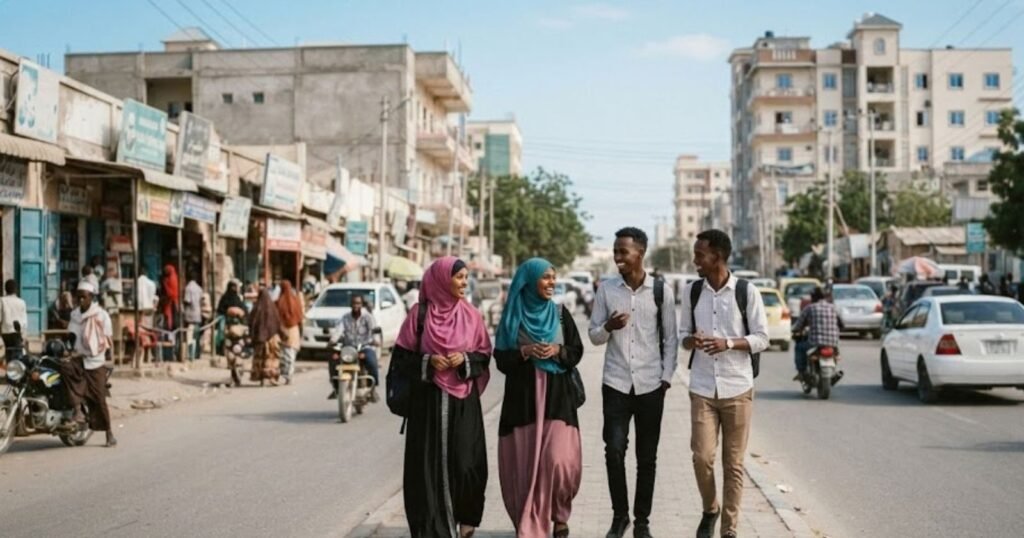
Somalia has not conducted a full national census since 1975. Every population figure cited for the country today, whether it is 18.36 million, 19 million, or over 20 million, is a demographic estimate built on surveys, satellite settlement mapping, and UN modeling, not a headcount. What is not in dispute is the shape of the population: a median age of roughly 15.6 to 16.6 years, among the youngest of any country on earth, sitting atop a fertility rate that, while falling, remains one of the highest globally at just under six children per woman.
Somalia’s Demographic Profile Today
Estimates of Somalia’s current population vary by several million depending on source and methodology. The World Bank’s World Development Indicators put total population at 19,009,151 in 2024. The UN Population Division’s World Population Prospects (2024 Revision), as reflected in Our World in Data’s compilation, estimated Somalia’s 2023 population at 18.36 million, while independent modeling from World Population Review projects a 2026 figure of roughly 20.3 million. Grokipedia’s demographic summary, drawing on the same UN dataset, cites a mid-2025 population of 19,654,739. The spread across these figures, roughly 18.4 to 20.3 million for dates within a three-year span, is itself informative: it shows the scale of uncertainty inherent in projecting population for a country without a recent census, compounded by nomadic pastoralist communities, cross-border mobility, and large-scale internal displacement that make consistent counting difficult.
What the sources agree on is the trajectory and the shape. Somalia’s population has grown from approximately 2.26 million in 1950 to roughly 18–20 million today, an increase on the order of 700–790% over 75 years, according to figures compiled by populationpyramids.org. The median age was estimated at 15.6 years for 2026 by Worldometer’s UN-based calculation, among the two or three youngest national populations in the world alongside Niger and Chad.
Key Facts
| Metric | Figure | Year |
|---|---|---|
| Total population (World Bank estimate) | 19.0 million | 2024 |
| Total population (UN WPP, alternative estimate) | 18.4–20.3 million | 2023–2026 (range across sources) |
| Median age | 15.6–16.6 years | 2026 |
| Total fertility rate | 5.9–6.1 children/woman | 2024–2025 |
| Population under age 15 | 42.4%–46.6% of total | 2010–2024 |
| Life expectancy at birth | 55.7–58.8 years | 2022–2023 |
| Population growth rate | 2.4%–3.1% annually | 2022–2025 |
| Estimated internally displaced persons | approx. 4 million | 2024–2025 |
| Projected population | 25 million (2035); 37 million (2050) | UN medium-variant projections |
Sources: World Bank World Development Indicators; UN DESA World Population Prospects (2024 Revision); Our World in Data; Joint IDP Profiling Service (JIPS).
Why Somalia Has a Youthful Population
Somalia’s total fertility rate has been falling for more than two decades but remains extraordinarily high in absolute terms. Statbase’s compilation of UN Population Division data puts the 2025 rate at 5.91 children per woman, down from a peak of 7.66 in 1999, a decline of roughly 23% over a quarter-century, but still nearly three children above the global replacement level of 2.1.
Our World in Data’s independent estimate for 2023 put the rate slightly higher, at 6.13. Populationpyramids.org’s 2024 estimate of 6.02 sits between the two, suggesting the true current rate is very likely in a narrow band around 5.9 to 6.1, whichever exact revision is used.
Mortality has improved substantially but from a very low base. Life expectancy at birth was estimated at 58.8 years for 2023 by Our World in Data, versus 55.7 years in a 2022 CIA-sourced estimate, a difference that likely reflects both genuine year-on-year improvement and normal variation between estimation methods. Infant mortality remains high, at roughly 86.5 deaths per 1,000 live births according to 2022 estimates, and under-five mortality stood at 10% in 2024 per Our World in Data, meaning one in ten Somali children born does not reach their fifth birthday, a rate that, while a marked improvement from historical levels, remains among the highest recorded globally.
The combination of a birth rate near 38 per 1,000 population and a death rate around 11–12 per 1,000 sustains rapid natural increase even as fertility gradually declines, because Somalia’s population pyramid is so heavily weighted toward children and young adults entering their own reproductive years. Populationpyramids.org notes that 46.6% of Somalis are under age 15, a share so large that demographic momentum alone, independent of any further fertility change, will drive continued population growth for at least two to three more generations.
Youth, Education, and Employment
A population this young places enormous and disproportionate demand on schooling and, within a decade or two, on labor markets that have historically struggled to absorb new entrants. Precise, current national data on school enrollment and youth employment are harder to source reliably for Somalia than for most countries in this cluster, reflecting the same institutional fragility that limits census-taking; readers should treat any single enrollment or unemployment percentage for Somalia with more caution than equivalent figures from countries with functioning national statistics offices.
What is well documented is the underlying demographic pressure: with close to half the population under 15, the school-age and soon-to-be working-age cohorts are each larger than the cohort before them, meaning the number of young people needing education and eventually jobs continues to expand mechanically even before considering any policy response.
Urbanization and Population Concentration
Urbanization estimates for Somalia also vary sharply by source, again reflecting definitional and data-quality differences rather than a real underlying disagreement about direction. Worldometer’s UN-based figures put the 2026 urban share at 47.1% (approximately 9.55 million people), while World Population Review’s independent estimate claims 100% urban residence for 2026, a figure that is almost certainly a data or classification anomaly rather than a genuine finding, since large shares of Somalia’s population are documented as rural or nomadic pastoralist. This article treats the Worldometer/UN figure of roughly 47% urban as the more credible estimate, while flagging that Somalia’s urbanization data overall should be read with real caution pending a fresh, complete census.
Mogadishu is by far Somalia’s largest population center. World Population Review’s estimate puts the capital’s metropolitan population at 3,307,421 as of 2026, or about 16.3% of the national total, a very high degree of primacy, meaning the capital alone houses a substantially larger share of the national population than is typical even among other highly centralized African capitals. Much of Mogadishu’s growth reflects displacement rather than voluntary rural-to-urban migration in the conventional economic-opportunity sense.
Migration, Displacement, and Demographic Change
Somalia’s demographic story cannot be separated from displacement. The Joint IDP Profiling Service (JIPS), a UN-affiliated body, estimated in recent reporting that Somalia has approximately 4 million internally displaced persons, a figure driven by a combination of armed conflict and climate-related shocks, particularly recurring droughts and floods. JIPS notes a clear pattern of IDPs moving from rural areas into informal settlements within cities, particularly Mogadishu, which helps explain why the capital’s population share is so disproportionately large relative to the country’s overall (still-debated) urbanization rate.
This is distinct from international migration. CIA-sourced 2022 estimates put Somalia’s net migration rate at -2.18 per 1,000 population, indicating modest net outward movement, while World Population Review’s 2026 estimate suggests a small net positive inflow of about 42 people per day nationally, figures that are not necessarily contradictory, since they may reflect different reference periods and different treatment of temporary versus permanent movement. The immigrant share of Somalia’s own population was estimated at just 0.4% in 2024, underscoring that Somalia is overwhelmingly a origin and transit country for migration and displacement rather than a destination.
Displacement and Migration Snapshot
| Category | Estimate | Reference Period |
|---|---|---|
| Internally displaced persons | approx. 4,000,000 | 2024–2025 |
| Immigrant share of population | 0.4% | 2024 |
| Net migration rate | -2.18 per 1,000 (2022 est.) to +42/day (2026 est.) | 2022–2026 |
| Mogadishu metropolitan population | 3,307,421 | 2026 |
| Mogadishu share of national population | approx. 16.3% | 2026 |
Sources: Joint IDP Profiling Service (JIPS); CIA World Factbook-derived estimates; World Population Review (UN WPP 2024 Revision elaboration).
Somalia and the Demographic Dividend
A demographic dividend requires a falling dependency ratio combined with productive employment for an expanding working-age population, conditions that depend on sustained investment in education, health, and formal-sector job creation. Somalia’s current age structure, with close to half the population under 15, means the country’s dependency ratio remains extremely high and is not yet declining in a way that would signal an approaching dividend window.
Fertility decline of roughly 1.5–1.7% per year, as reflected in the 2024-to-2025 change from about 6.01 to 5.91 children per woman, is real but slow; at that pace, reaching a fertility rate closer to 3, which many demographers associate with the start of a meaningful dividend window, would take well over a decade even if the rate of decline accelerated somewhat.
The precondition problem is compounded by fragile state capacity. A country still managing active security challenges, recurrent climate shocks, and one of the world’s largest internal displacement caseloads has limited fiscal and administrative room to expand schooling and healthcare at the pace its youth population requires. This does not mean a dividend is impossible, countries have transitioned from comparable starting points, but it does mean that treating Somalia’s youthfulness as an automatic economic asset would be premature given the current state of its underlying institutions.
What Somalia’s Demographics Mean for the Horn of Africa
Somalia’s population dynamics have regional implications beyond its borders. Continued rapid population growth, combined with climate-driven displacement, has historically translated into cross-border movement toward Kenya, Ethiopia, and Djibouti, as well as onward migration further afield. A country adding population at 2.4–3.1% annually, while its neighbors grow more slowly, will represent an increasing share of the Horn of Africa’s total population and labor force over coming decades, with implications for regional labor markets, humanitarian planning, and cross-border trade that extend well beyond Somalia’s own development trajectory.
Future Population Scenarios
UN medium-variant projections, as cited in Grokipedia’s demographic summary drawing on WPP 2024, put Somalia’s population at approximately 25 million by 2035 and 37 million by 2050, roughly double the current estimated population within 25 years. Our World in Data’s independent long-range projection puts the 2100 figure at 67.36 million, up from 18.36 million in 2023, a nearly fourfold increase over the century. These are explicitly medium-variant, assumption-dependent projections: they assume gradual fertility decline continues roughly on its current trajectory, with no major additional mortality or displacement shocks, an assumption that recent Somali history suggests should be treated with some caution.
Population Growth and Projection Table
| Year | Population | Basis |
|---|---|---|
| 1950 | 2,264,000–2,213,000 | UN WPP historical estimate |
| 2021 | 17,065,581 | UN WPP estimate |
| 2023 | 18,360,000 | UN WPP / Our World in Data |
| 2024 | 19,009,151 | World Bank WDI |
| 2026 | 19,654,739–20,305,907 | UN WPP medium-variant range (source-dependent) |
| 2035 | approx. 25,000,000 | UN WPP medium-variant projection |
| 2050 | approx. 37,000,000 | UN WPP medium-variant projection |
| 2100 | approx. 67,360,000 | UN WPP medium-variant projection |
Sources: UN DESA World Population Prospects (2024 Revision); World Bank World Development Indicators; Our World in Data; Grokipedia demographic compilation.
Conclusion
Somalia’s demographic profile is defined less by any single precise figure than by the scale of what is not yet known. What the range of credible estimates agrees on is a median age among the youngest in the world, a fertility rate still close to six children per woman, and a population expected to roughly double by mid-century under UN medium-variant assumptions.
Whether that growth becomes a source of economic dynamism or continued strain on fragile institutions depends on factors the population data alone cannot answer, chiefly, whether Somalia can rebuild the census-taking, schooling, and labor-market infrastructure needed to convert demographic momentum into a genuine dividend rather than an ever-larger population living with the same institutional constraints it has today.
Key Findings
- Somalia’s median age of roughly 15.6–16.6 years is among the youngest nationally recorded populations, reflecting a fertility rate still close to six children per woman as of 2024–2025.
- Population estimates for Somalia diverge by nearly two million people across major sources for dates within the same three-year window, reflecting the absence of a full census since 1975.
- An estimated 4 million people are internally displaced, driving disproportionate growth in Mogadishu, which now holds roughly 16% of the national population.
- Fertility has fallen by only about 1.5–1.7% per year in the most recent data, a pace that means Somalia’s dependency ratio is likely to remain very high for at least another decade.
- UN medium-variant projections put Somalia’s population at approximately double its current size by 2050, driven overwhelmingly by demographic momentum from an already very young population.
Frequently Asked Questions
1. What is Somalia’s current population?
Estimates range from about 18.4 million (UN WPP 2023 figure) to over 20 million (2026 projections), depending on source and methodology. The World Bank’s 2024 estimate is 19,009,151. Somalia has not held a full census since 1975, so all figures are modeled estimates.
2. Why is Somalia’s population so young?
A total fertility rate of roughly 5.9–6.1 children per woman as of 2024–2025, combined with improving but still elevated child mortality, produces a population heavily weighted toward children, giving Somalia a median age of about 15.6–16.6 years.
3. Is Somalia’s population growing rapidly?
Yes. Estimates put annual growth at 2.4% to 3.1% depending on the year and source, among the higher growth rates globally, driven by high fertility and continuing demographic momentum from a very young population base.
4. How many people are displaced within Somalia?
The Joint IDP Profiling Service estimates approximately 4 million internally displaced people as of recent reporting, driven by conflict and by recurring droughts and floods linked to climate variability.
5. What is the population of Mogadishu?
World Population Review estimates Mogadishu’s metropolitan population at approximately 3.3 million as of 2026, or about 16% of Somalia’s total population, a disproportionately large share reflecting displacement-driven urban growth.
6. Could Somalia experience a demographic dividend?
Potentially, but not imminently. A demographic dividend requires falling dependency ratios alongside productive employment growth. With nearly half the population under 15 and fertility declining only slowly, Somalia is likely a decade or more away from the conditions typically associated with a dividend window.
7. How reliable are Somalia’s population statistics?
Less reliable than most countries’, since Somalia has not conducted a complete census since 1975. Figures from the UN, World Bank, and independent demographic trackers can differ by one to two million people for population estimates within the same reference period.
8. What is Somalia’s population projected to be by 2050?
UN medium-variant projections estimate approximately 37 million people by 2050, roughly double the current population, assuming continued gradual fertility decline and no major additional shocks to mortality or displacement.
9. How urbanized is Somalia?
Estimates vary considerably: a UN-based figure suggests about 47% urban as of 2026, though other sources report figures that likely reflect data or classification limitations rather than genuine measurement. Somalia’s urban share is best understood as uncertain pending a fresh census.
10. Is migration a major factor in Somalia’s demographics?
Yes, though primarily as displacement rather than conventional migration. Somalia’s immigrant share of population is just 0.4%, but internal displacement affecting an estimated 4 million people, plus historical outward refugee flows, has significantly reshaped where and how Somalis live.
Sources
- UN Department of Economic and Social Affairs, Population Division, World Population Prospects: The 2024 Revision
- World Bank, World Development Indicators (data.worldbank.org / tradingeconomics.com elaboration), Somalia population totals
- Our World in Data, Somalia Population and Demography Country Profile
- UNFPA World Population Dashboard, Somalia
- Joint IDP Profiling Service (JIPS), Somalia displacement estimates
- Worldometer and World Population Review, UN WPP 2024 Revision elaborations (population, median age, urbanization, Mogadishu population)
- Wikipedia, “Demographics of Somalia”, historical population and age structure tables
- Statbase.org and populationpyramids.org, total fertility rate compilations from UN data
- Grokipedia, Demographics of Somalia (population projections, methodology notes)