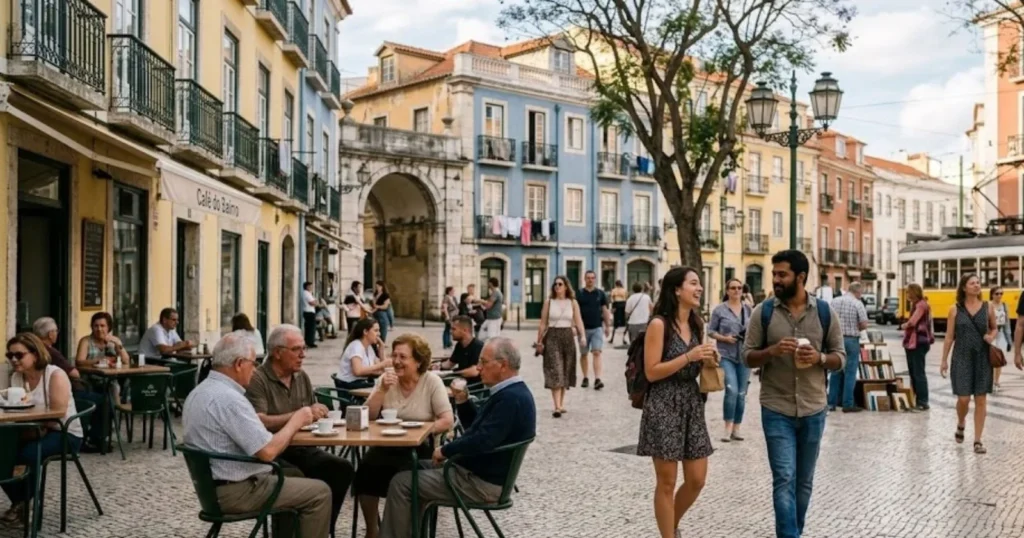
Portugal now counts 188.8 elderly residents for every 100 young people, according to Statistics Portugal’s 2025 estimates, up from 178.3 just four years earlier. At the same time, the country’s total population has grown by nearly 825,000 people since 2021, an increase driven almost entirely by immigration. Portugal is demonstrating, in real time, that a country can add population and grow structurally older simultaneously, two trends normally treated as opposites.
Key Facts & Findings
- Portugal’s population grew by 824,914 people between 2021 and 2025, reaching 11.42 million, with growth driven almost entirely by immigration rather than natural increase.
- The aging ratio rose from 178.3 to 188.8 elderly people per 100 young people between 2021 and 2025, even as the population grew.
- Foreign residents more than doubled in four years, from roughly 7.1 percent of the population in 2021 to 14.0 percent, or 1,597,539 people, by the end of 2025.
- Brazilians represent by far the largest foreign nationality group in Portugal, at 31.4 percent of foreign residents in AIMA’s 2024 report.
- UN medium-variant projections still anticipate long-term population decline for Portugal, to approximately 10 million by 2050, despite continued immigration.
Portugal’s Current Population Picture
Statistics Portugal (INE) estimated the resident population at 11,424,031 people as of its 2025 report, published June 22, 2026. Between 2021 and 2025, that population grew by 824,914 people, with the strongest annual gains coming in 2022, 2023, and 2024, when unusually high migration flows added 330,587, 274,643, and 182,875 people, respectively. Growth slowed somewhat in 2025 but remained positive, continuing a pattern in which migration inflows have consistently outpaced Portugal’s negative natural population change.
Portugal’s Population Is Aging
Portugal’s median age reached 45.8 years in 2025, among the highest in the European Union, though it has ticked down slightly from 46.1 in 2021 as working-age immigration has partially rejuvenated the population’s age structure. The aging ratio, elderly people per 100 young people, climbed to 188.8 in 2025 from 178.3 in 2021, meaning Portugal now has nearly two elderly residents for every young person, one of the starker demographic imbalances recorded anywhere in Europe. Separate estimates put the 65-and-over share of Portugal’s population at roughly 23 percent, with life expectancy at approximately 82 years overall, 85 years for women and 79 years for men.
Portugal’s Age Structure Indicators, 2021 vs 2025
| Indicator | 2021 | 2025 |
|---|---|---|
| Aging ratio (elderly per 100 young) | 178.3 | 188.8 |
| Median age | 46.1 | 45.8 |
| Foreign resident share | ~7.1% | 14.0% |
| Total population | ~10.6 million | 11.42 million |
Fertility and Natural Population Change
Portugal’s total fertility rate sits at approximately 1.45 children per woman as of the mid-2020s, well below the 2.1 replacement level, though comparatively higher than Spain or Italy. Because of this persistently sub-replacement fertility, Portugal has recorded negative natural population change, more deaths than births, in every recent year.
Without immigration, Statistics Portugal’s own reporting frames the resulting dynamic plainly: Portugal’s population would be declining. Instead, migration inflows have not only offset that natural deficit but pushed the total population to a new high.
Immigration Is Reshaping Portugal
Statistics Portugal reported that the resident population of foreign citizenship stood at 1,597,539 as of December 31, 2025, representing 14.0 percent of Portugal’s total population. That figure has more than doubled since 2021, when foreign residents made up roughly 7.1 percent of the population, an increase of 849,384 people in just four years, a 6.9 percentage-point rise in the foreign resident share.
Separate reporting from Portugal’s Agency for Immigration, Migration, and Asylum (AIMA) put the resident foreign population at 1,543,697 as of its 2024 annual report, with Brazilians representing 31.4 percent of that total, by far the largest single nationality group. Indians and Angolans followed as the next largest groups of third-country nationals. By broader region of origin, South Americans accounted for 34.2 percent of foreign residents, followed by Africans at 20.4 percent and Asians at 20.2 percent.
Foreign Resident Population in Portugal, Selected Years
| Year | Foreign Residents | Share of Total Population |
|---|---|---|
| 2021 | ~772,600 | ~7.1% |
| 2024 (AIMA) | 1,543,697 | ~13.5% |
| 2025 (INE) | 1,597,539 | 14.0% |
The age profile of Portugal’s foreign population skews sharply toward working-age adults: AIMA’s 2024 data show the 18 to 34 age bracket as the single largest migrant group, at 640,914 people, and those aged 18 to 64 account for 85.5 percent of all foreign residents, a far younger profile than Portugal’s native population. Men made up 56.1 percent of migrant residents in 2024, up from 53 percent the year before.
Where Population Change Is Concentrated
Foreign residents in Portugal are concentrated in a small number of districts. AIMA’s 2024 report identified Lisbon, Setúbal, Faro, and Porto as the districts with the largest foreign resident populations, a pattern already visible as far back as the 2021 census, when the Algarve, whose largest district is Faro, and the Lisbon Metropolitan Area recorded the country’s highest shares of foreign citizens, at 14.7 percent and 8.9 percent respectively. These regions combine established migrant communities, tourism-driven service-sector labor demand, and, in Lisbon’s case, a concentration of higher-skilled international employment.
Can Immigration Offset Population Aging?
Statistics Portugal’s own framing describes demographic aging as continuing but “somewhat mitigated by a relative increase in the working-age population,” a direct consequence of migration inflows skewed heavily toward working-age adults. This is an important distinction: immigration has not reversed Portugal’s aging trend, evident in the rising aging ratio even through the years of highest migration, but it has slowed the pace at which the working-age population would otherwise be shrinking, and it has kept Portugal’s total population growing rather than contracting.
UN medium-variant projections suggest Portugal’s population will nonetheless decline gradually over the coming decades, to approximately 10 million by 2050 and 8.7 million by 2100, even accounting for continued immigration, since sub-replacement fertility exerts a compounding downward pressure that migration inflows at current levels are not projected to fully offset over the long run.
Housing, Labor and Public Services
Portugal’s rapid increase in foreign residents, more than doubling in four years, has coincided with well-documented strain on housing affordability, particularly in Lisbon and the Algarve, and with administrative backlogs at AIMA, which as of early 2026 still had an estimated 40,000 to 60,000 immigration cases pending despite resolving the vast majority of a large inherited caseload. On the labor side, migration has directly supported sectors including tourism, agriculture, construction, and healthcare, where Portugal’s aging native workforce has struggled to fill positions.
Portugal’s Demographic Outlook
The trajectory Portugal is on, a population that grows only because of immigration while aging structurally in the background, is unlikely to reverse without either a substantial and sustained rise in fertility or continued high immigration indefinitely.
Given that Portuguese fertility has remained below replacement for decades with no clear recovery signal, immigration is likely to remain the determining factor in whether Portugal’s population continues growing, stabilizes, or begins the gradual decline that UN projections currently anticipate for the second half of the century.
Conclusion
Portugal’s population data captures a demographic pattern likely to recur across Southern Europe in the years ahead: immigration strong enough to produce real population growth, while the underlying age structure continues aging regardless. The country added more people between 2021 and 2025 than in almost any comparable stretch in its recent history, and it also became more imbalanced between old and young over that same period. Both statements are accurate, and neither cancels the other out.
Frequently Asked Questions
1. Is Portugal’s population growing?
Yes. Portugal’s population grew by 824,914 people between 2021 and 2025, reaching 11.42 million, though the growth has come entirely from immigration rather than from births exceeding deaths.
2. Why is Portugal aging despite population growth?
Portugal’s fertility rate, at approximately 1.45 children per woman, remains well below the 2.1 replacement level, so the population continues aging structurally even as immigration adds people and slightly rejuvenates the working-age share.
3. How important is immigration to Portugal’s population?
Immigration is the sole source of Portugal’s recent population growth; without it, the country’s negative natural population change, more deaths than births, would produce an outright population decline.
4. What share of Portugal’s population is foreign?
Foreign residents made up 14.0 percent of Portugal’s population at the end of 2025, or 1,597,539 people, more than double the roughly 7.1 percent share recorded in 2021.
5. Which nationality has the largest foreign community in Portugal?
Brazilians are by far the largest foreign nationality group in Portugal, representing 31.4 percent of foreign residents according to AIMA’s 2024 annual report.
6. Where do most foreign residents live in Portugal?
Foreign residents are concentrated in the Lisbon, Setúbal, Faro, and Porto districts, with the Algarve and Lisbon Metropolitan Area historically recording the highest shares of foreign citizens as a percentage of local population.
7. What is Portugal’s median age?
Portugal’s median age was 45.8 years in 2025, among the highest in the European Union, though slightly lower than the 46.1 recorded in 2021 due to working-age immigration.
8. Is Portugal’s population projected to decline?
Yes. UN medium-variant projections anticipate Portugal’s population will decline to approximately 10 million by 2050 and 8.7 million by 2100, even factoring in continued immigration, due to persistently low fertility.
9. What is Portugal’s aging ratio?
Portugal’s aging ratio reached 188.8 elderly people per 100 young people in 2025, up from 178.3 in 2021, one of the more pronounced demographic imbalances in Europe.
10. How has the Golden Visa program affected Portugal’s population?
Portugal’s Golden Visa investment residency program, introduced in 2012, attracted substantial migration particularly from China and Brazil, though 2023 changes ended the residential property investment route that had driven much of that earlier flow.
Sources
- Statistics Portugal (Instituto Nacional de Estatística, INE), Population Estimates 2025, press release, June 22, 2026
- Portugal’s Agency for Immigration, Migration, and Asylum (AIMA), 2024 Annual Report on Migration and Asylum
- European Commission, Directorate-General for Migration and Home Affairs, “Key integration developments and research in Portugal,” January 26, 2026
- European Website on Integration, “Portugal: 2021 census confirms growth in immigrant population,” December 2021
- Worldometer, elaboration of UN World Population Prospects: The 2024 Revision, Portugal population data