Key Findings
- Rwanda’s population density reached 503 people per square kilometer at the 2022 census, nearly tripling from 183 in 1978.
- Rwanda’s population grew from 4.8 million in 1978 to 13.2 million by 2022, with growth notably slowing to just 1.2 percent annually between 1991 and 2002 due to the demographic toll of civil war and the 1994 genocide against the Tutsi.
- The urban population share nearly doubled between census periods, from 16.5 percent in 2012 to 27.9 percent in 2022, with Kigali as the primary growth engine.
- Some Kigali sectors record hyperlocal densities exceeding 14,000 people per square kilometer, far above the already-high national average.
- Kigali’s population is projected to grow from 1.8 million to 2.6 million by 2032, according to NISR subnational projections.
- Rwanda’s national population is projected to reach between 23.4 million and 24.2 million by 2052, roughly doubling the 2022 count, with nearly all of that growth expected to be absorbed by expanding urban areas.
Rwanda’s 2022 census recorded 13,246,394 people living on just 26,338 square kilometers, producing a national population density of 503 inhabitants per square kilometer, among the highest of any country in Africa and one of the highest for any country outside a handful of city-states and small island nations. That density has tripled over just 44 years, rising from 183 per square kilometer in 1978 to 503 by 2022. With 72.1 percent of Rwandans still living in rural areas as of the last census, and the population projected to nearly double again by 2052, Rwanda’s development strategy has had to treat population density not as a background statistic but as a central planning variable shaping everything from land policy to urban design.
Rwanda Is One of Africa’s Most Densely Populated Countries
Rwanda’s population density has climbed steadily and rapidly across every census period since 1978, a trajectory that reflects sustained population growth within one of Africa’s smallest countries by land area.
Rwanda Population Density Over Time
| Year | Density (per km²) |
|---|---|
| 1978 | 183 |
| 1991 | 272 |
| 2002 | 321 |
| 2012 | 415 |
| 2022 | 503 |
Rwanda’s population itself nearly tripled between 1978, when the country counted 4.8 million residents, and 2022, when it reached 13.2 million, growing at average annual rates of 3.1 percent (1978-1991), 1.2 percent (1991-2002, reflecting the demographic toll of the 1990 civil war and the 1994 genocide against the Tutsi), and 2.3 to 2.6 percent through the two most recent intercensal periods.
Why Rwanda Has Such High Population Density
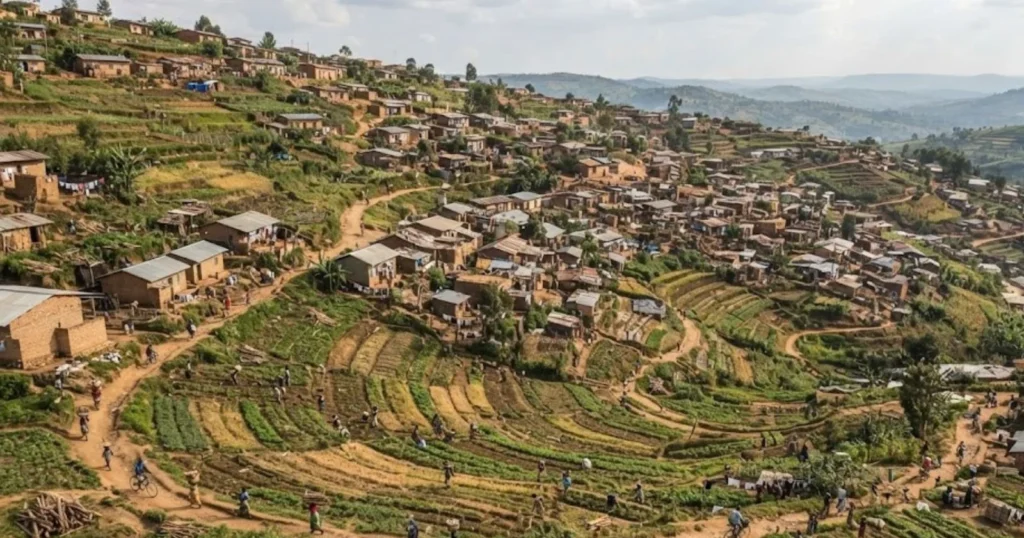
Rwanda’s density stems from a combination of small national land area and sustained population growth rather than any single cause. At just over 26,000 square kilometers, Rwanda ranks among Africa’s smallest countries geographically even as its population has grown to exceed 13 million. Historical settlement patterns rooted in Rwanda’s agrarian economy, in which the great majority of the rural population has traditionally depended on small-scale farming, mean that even Rwanda’s rural areas carry population densities that would be considered urban in many other countries.
The demographic disruption of the 1994 genocide against the Tutsi, which caused a documented slowdown in population growth during the 1991-2002 intercensal period, adds a specific historical dimension to Rwanda’s demographic trajectory that shapes both the age structure and the population recovery patterns visible in subsequent census data.
Population Is Not Distributed Evenly
Even within Rwanda’s already-high national average, population density varies enormously between provinces and, at finer resolution, between individual districts and sectors. The City of Kigali stands out as Rwanda’s most densely populated province by a wide margin, and within Kigali itself, density varies dramatically block by block: the small urban sector of Rwezamenyo, at just over one square kilometer, recorded a density of 14,370 people per square kilometer in the 2022 census, while nearby Gisozi reached 8,300 per square kilometer and Remera 5,300, illustrating how national and even provincial averages can obscure genuinely extreme localized density within Rwanda’s fast-growing capital.
Selected Kigali Sector Density, 2022 Census
| Sector | Population | Density (per km²) |
|---|---|---|
| Rwezamenyo | 14,754 | 14,370 |
| Gisozi | 75,611 | 8,300 |
| Remera | 38,648 | 5,300 |
| Kacyiru | 30,036 | 5,200 |
| Kimihurura | 16,425 | 3,200 |
| Nyarugenge | 16,665 | 3,602 |
Rural Density and Agricultural Pressure
With 72.1 percent of Rwanda’s population still living in rural areas as of the 2022 census, agricultural land pressure remains a defining feature of the country’s development challenge. Rwanda’s rural population continues relying heavily on smallholder farming, and the country’s high overall density means average farm sizes per household are constrained relative to countries with more available agricultural land per capita, a pattern that has shaped decades of Rwandan agricultural and land-use policy aimed at improving productivity per hectare rather than expanding cultivated area, since expansion options are inherently limited by the country’s small total land area and already-high population density.
Kigali and Urban Concentration
Rwanda’s urban population share has grown rapidly in relative terms even though it remains a minority of the total population: urban residents made up just 16.5 percent of Rwanda’s population at the 2012 census but had climbed to 27.9 percent by 2022, a substantial jump reflecting accelerating urbanization concentrated heavily around Kigali.
The City of Kigali’s population reached 1.8 million as of recent NISR subnational projections and is projected to climb to 2.6 million by 2032, continuing its role as Rwanda’s primary urban growth engine and drawing migrants from across the country’s rural provinces in search of employment and services not available in more rural districts.
Population Growth Is Changing Development Requirements
Rwanda’s continued population growth, projected by NISR to reach between 23.4 million and 24.2 million by 2052 depending on the fertility scenario used, roughly doubling the 2022 population over thirty years, requires sustained expansion of infrastructure, housing, healthcare and education capacity at a pace matching one of Africa’s highest population growth trajectories relative to available land.
NISR’s own projections anticipate the urban population specifically will grow from 3.7 million in 2022 to somewhere between 16.2 million and 16.8 million by 2052, meaning nearly all of Rwanda’s substantial population growth over the coming three decades is expected to be absorbed by expanding urban areas rather than further intensifying an already dense rural population base.
Rwanda’s Young Population Adds Another Dimension
Rwanda’s age structure, illustrated at fine resolution in individual sector-level census data such as Kigali’s Rwezamenyo sector, where 24.1 percent of the population is under 15 and 73.3 percent is between 15 and 64, reflects a population that remains relatively young by international standards even as it has moved further through demographic transition than several of its regional neighbors. That youthful working-age-heavy structure adds a labor force dimension to Rwanda’s density challenge: not only does the country need to house and feed a rapidly growing population on limited land, it also needs to generate employment for an expanding working-age cohort within an economy still substantially anchored in land-constrained smallholder agriculture.
How Development Policy Responds to Demographic Pressure
Rwanda’s government has explicitly incorporated population density and projected growth into national development planning, including through NISR’s detailed subnational population projections by province through 2032 and national projections through 2052, explicitly designed to inform infrastructure, land-use and urban planning decisions years in advance of the population changes they anticipate.
Urban planning around Kigali has aimed to accommodate substantial projected population growth, from 1.8 million toward 2.6 million by 2032 alone, through structured urban expansion rather than unplanned informal settlement growth, while agricultural policy has continued emphasizing productivity gains per hectare given the country’s inherent land constraints.
Human capital investment, particularly in education and skills development for Rwanda’s large youth cohort, has also featured prominently in national planning as a complement to physical infrastructure investment, reflecting recognition that Rwanda’s density challenge is as much about generating productive employment for a growing population as it is about physical space itself.
Rwanda’s Future Demographic Outlook
NISR’s official projections place Rwanda’s population at somewhere between 23.4 million and 24.2 million by 2052, depending on fertility assumptions, essentially doubling the 2022 census count of 13.2 million over three decades. Given Rwanda’s fixed land area, that trajectory implies population density will continue climbing substantially beyond the 503 per square kilometer recorded in 2022, reinforcing rather than easing the density pressures already central to Rwanda’s development planning, unless urbanization proceeds fast enough, as NISR’s own urban population projections anticipate, to concentrate a large share of that growth into more vertically developed urban areas rather than further intensifying rural land pressure.
Conclusion
Rwanda’s population density statistics describe a country whose development strategy has had to account for land constraints that few other nations face at a comparable scale. A national density that has tripled since 1978, hyperlocal density exceeding 14,000 people per square kilometer in parts of Kigali, and a population projected to nearly double again by 2052 together mean population density is not a peripheral statistic in Rwanda but a central input into how the country plans agriculture, housing, urban growth and human capital investment.
How effectively Rwanda manages the continued growth its own projections anticipate will substantially determine whether rising density becomes a manageable feature of a modernizing, increasingly urban economy or a deepening constraint on rural livelihoods.
Frequently Asked Questions
1. Why is Rwanda so densely populated?
Rwanda combines a small national land area, just over 26,000 square kilometers, with sustained population growth that has nearly tripled the country’s population since 1978, producing a national density of 503 people per square kilometer by 2022, among the highest in Africa.
2. Where is Rwanda most densely populated?
The City of Kigali is Rwanda’s most densely populated province overall, and within Kigali specific sectors reach extreme densities, including Rwezamenyo at 14,370 people per square kilometer as of the 2022 census.
3. Does high population density help or hurt development?
High density creates land pressure on agriculture and housing, requiring sustained infrastructure investment, but it can also support efficiencies in service delivery and urban economic activity when accompanied by structured planning, a balance Rwanda’s national development strategy has explicitly tried to manage.
4. What is Rwanda’s total population?
Rwanda’s population reached 13,246,394 at the 2022 census, and is projected by NISR to reach between 23.4 million and 24.2 million by 2052.
5. How urban is Rwanda?
Rwanda remains predominantly rural, with 72.1 percent of the population living in rural areas as of the 2022 census, though the urban share rose sharply from 16.5 percent in 2012 to 27.9 percent in 2022.
6. How big is Kigali?
Kigali’s population stood at approximately 1.8 million as of recent NISR projections and is expected to grow to 2.6 million by 2032.
7. How did the 1994 genocide affect Rwanda’s population growth?
Rwanda’s population growth slowed sharply to just 1.2 percent annually between the 1991 and 2002 census periods, reflecting the demographic toll of the 1990 civil war and the 1994 genocide against the Tutsi, a marked deceleration from the 3.1 percent growth rate recorded in the preceding period.
8. Will Rwanda’s population density keep rising?
Yes. With national population projected to nearly double by 2052 on a fixed land area, density is expected to continue rising substantially beyond the 503 per square kilometer recorded in 2022, unless urbanization absorbs most of that growth into more vertically developed urban areas as NISR’s own projections anticipate.
9. How does Rwanda’s density compare with its neighbors?
Rwanda’s national density of 503 people per square kilometer is substantially higher than most of its East African neighbors, including Uganda, Tanzania and Kenya, reflecting Rwanda’s comparatively small land area relative to its population.
10. What is Rwanda doing to manage population density?
Rwanda’s government has incorporated detailed population projections into national and subnational planning, emphasized agricultural productivity gains given fixed land constraints, pursued structured urban expansion around Kigali, and invested in education and skills development for its large youth cohort as complementary responses to sustained density pressure.
Sources
- National Institute of Statistics of Rwanda (NISR), Fifth Rwanda Population and Housing Census (RPHC5), Main Indicators Report, 2022
- NISR, Population size and Population characteristics statistical publication
- NISR, Rwanda Subnational Population Projections by Provinces (2023-2032)
- Wikipedia/Kigali sector-level census data (Rwezamenyo, Gisozi, Remera, Kacyiru, Kimihurura, Nyarugenge, Kigali sector)