Colombia’s population reached an estimated 53.4 million in 2026, but the number driving the country’s future is not its size, it is the collapse in its fertility rate, down to just 1.01 children per woman in 2025, a level associated with rapidly aging societies rather than the young, fast-growing Colombia of a generation ago. At the same time, Colombia is already deeply urban, with Greater Bogotá alone approaching 11.8 million residents. The country is living through two demographic stories simultaneously: a transition from high to very low fertility, and the maturation of an urban system built around a handful of dominant metropolitan areas that will absorb most of whatever population growth remains.
Key Facts & Findings
- Colombia’s fertility rate has fallen to 1.01 children per woman in 2025, less than half the replacement level and among the lowest in Latin America.
- Population growth has decelerated from over 2 percent annually in the mid-twentieth century to roughly 0.54 percent today.
- Greater Bogotá’s metropolitan population reached an estimated 11.8 million by October 2025, making it Colombia’s dominant urban center by a wide margin.
- More than 1.3 million Colombians emigrated between January 2019 and July 2023, with some estimates putting total departures above two million by early 2025.
- Colombia’s net migration rate was negative 6.7 per 1,000 population as of 2023, despite substantial Venezuelan immigration, reflecting even larger Colombian outmigration.
- The under-15 population share has fallen to 24.5 percent, while the 65-and-over share has reached 11.4 percent, marking Colombia’s ongoing shift toward an older age structure.
Colombia’s Demographic Profile Today
Colombia’s population, age structure and vital rates now sit at a pivot point. The country still shows 24.5 percent of its population under age 15, a legacy of higher fertility in past decades, but the working-age share, 64.1 percent, and the fast-falling fertility rate mean that youthful profile will not persist for long. Annual population growth has slowed to roughly 0.54 percent, well down from the 2 percent-plus rates Colombia recorded through most of the twentieth century.
Colombia Key Facts
| Metric | Figure | Year |
|---|---|---|
| Total population | 53.4 million | 2026 |
| Population density | 46.2/km² | 2024 |
| Total fertility rate | 1.01 | 2025 |
| Population growth rate | 0.54% | 2025 |
| Median age | 33 years | 2026 |
| Population 0-14 | 24.5% | 2024 |
| Population 65+ | 11.4% | 2024 |
| Life expectancy | 74.9 years | current |
Colombia’s Transition From Rapid Growth to Slower Growth
Colombia’s population history shows one of the clearest twentieth-century demographic accelerations and subsequent decelerations in the Americas. The population grew from 5.86 million in 1951 to 33.1 million by 1993, a nearly sixfold increase in just over four decades, driven by high fertility and falling mortality, the classic middle phase of demographic transition.
Growth then began decelerating: the annual growth rate fell from 2.19 percent around 1993 to 1.17 percent by 2018 and to roughly 0.54 percent today. That deceleration reflects fertility decline finally catching up with, and then overtaking, the earlier mortality decline that had driven the population boom.
Colombia’s Population Growth Over Time
| Year | Population | Annual Growth Rate |
|---|---|---|
| 1951 | 11,548,172 | +2.20% |
| 1973 | 20,785,235 | +1.94% |
| 1993 | 33,109,839 | +2.19% |
| 2005 | 41,468,384 | +1.89% |
| 2018 | 48,258,494 | +1.17% |
| 2026 | 53,399,171 | +1.27%* |
Falling Fertility Is Changing Colombia’s Age Structure
Colombia’s fertility decline over the past half-century has been dramatic even by regional standards. The country’s total fertility rate has fallen to 1.01 children per woman as of 2025, less than half the replacement level of roughly 2.1, placing Colombia among the lowest-fertility countries in Latin America alongside Chile, Cuba and Uruguay. That decline reflects broadly familiar drivers: expanded access to contraception, rising female educational attainment and labor force participation, later marriage and childbearing, and the general economic and social shift that accompanies urbanization.
The consequence for Colombia’s age structure will unfold over the coming two to three decades. The relatively large cohort of children and young adults born during higher-fertility years will continue moving through the population pyramid, temporarily sustaining a favorable working-age share even as new births fall. But the shrinking base of children being born today means that favorable ratio is a temporary demographic dividend window rather than a permanent structural feature, and Colombia’s population will begin aging more visibly as today’s under-15 cohort, already down to 24.5 percent of the population, ages into adulthood without an equivalently sized cohort behind it.
Colombia Is Already Highly Urban
Colombia entered its demographic transition’s later stages already a heavily urbanized country, a pattern that shapes how population change will play out geographically. Decades of rural-to-urban migration, driven by agricultural mechanization, internal conflict displacement, and the pull of urban employment, concentrated Colombia’s population growth in and around its largest cities well before fertility began its recent collapse.
Bogotá and the Major Metropolitan Areas
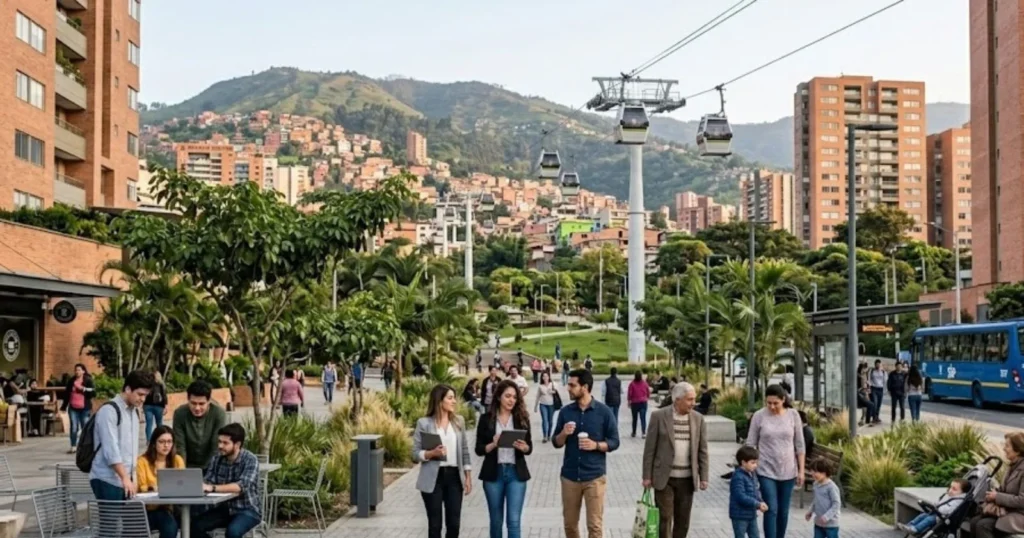
Greater Bogotá, officially the Metropolitan Region Bogotá-Cundinamarca, reached an estimated 11.8 million residents by October 2025, encompassing the capital and surrounding municipalities such as Soacha, Chía and Zipaquirá. That makes it by far Colombia’s largest urban agglomeration and one of the largest in South America.
Colombia’s Major Metropolitan Areas
| Metropolitan Area | 2025 Population Estimate |
|---|---|
| Greater Bogotá | 11,796,000 |
| Greater Medellín | 4,435,922 |
| Greater Cali | 4,202,074 |
| Barranquilla (city) | 1,342,818 |
| Cartagena (city) | 1,065,881 |
Medellín and Cali each anchor their own metropolitan economies, distinct from Bogotá’s national administrative and financial dominance: Medellín built around manufacturing and, more recently, a growing technology and services sector, and Cali around agro-industry and its role as Colombia’s principal Pacific-facing commercial hub. Barranquilla and Cartagena, on the Caribbean coast, round out Colombia’s tier of million-plus metropolitan areas, each shaped by port trade and, in Cartagena’s case, tourism.
Regional Demographic Differences Across Colombia
Colombia’s departments vary considerably in age structure and fertility, generally along a pattern common across Latin America: more urbanized, wealthier departments centered on Bogotá, Antioquia (Medellín) and Valle del Cauca (Cali) show lower fertility and older age structures, while more rural, historically conflict-affected departments in the Pacific and Amazon regions tend to retain younger populations and higher fertility, reflecting slower progress through the demographic transition tied to lower education access, weaker healthcare infrastructure and, in some areas, continued instability.
Migration and Colombia’s Population Structure
Colombia’s population dynamics over the past decade have been reshaped by two overlapping migration stories. The first is the large-scale arrival of Venezuelan migrants and refugees fleeing economic collapse, which added several million people to Colombia’s resident population over the 2010s and 2020s, concentrated disproportionately in border departments and major cities, and contributing to Colombia’s current immigrant population share of roughly 5.8 percent.
The second is a countervailing wave of Colombian emigration: more than 1.3 million Colombians left the country between January 2019 and July 2023 alone, and some estimates put total departures over a roughly 30-month period through early 2025 above two million, driven by a mix of pandemic-era economic hardship, renewed political violence in some regions, and the broader pull of opportunities abroad. Colombia’s net migration rate stood at negative 6.7 migrants per 1,000 population as of 2023, indicating that despite the high-profile Venezuelan inflow, outward emigration of Colombians has outweighed it in net terms.
What Demographic Transition Means for Colombia’s Cities
The combination of a shrinking fertility rate and continued metropolitan concentration points toward a specific set of pressures for Colombia’s largest cities over coming decades. Housing demand in Bogotá, Medellín, and Cali will likely keep rising even as national population growth slows, since urban migration continues pulling people from rural and smaller-town Colombia even as the overall national population growth rate decelerates.
Public transit systems, already strained in Bogotá, where TransMilenio and the under-construction metro system serve a metropolitan population approaching 12 million, face growing demand from a population base that will keep concentrating geographically even as it grows more slowly in aggregate. School enrollment will likely peak and then contract over coming decades as smaller birth cohorts move through the education system, while healthcare systems will need to reorient gradually toward the chronic disease and elder care needs of an aging population, particularly in already-older departments and cities.
Colombia’s Future Population Outlook
UN medium-variant projections, along with national estimates, suggest Colombia’s population growth will continue slowing over coming decades as the fertility rate, already below replacement, keeps population momentum as the primary source of further growth rather than new births outpacing deaths.
Colombia’s median age of 33 in 2026 is expected to rise steadily, following the same trajectory already visible in Chile, Uruguay and, more recently, Brazil’s Southeast and South. The country is unlikely to see the population declines Chile now projects within the next decade, given Colombia’s still-younger overall age structure, but the underlying fertility and urbanization trends point in the same direction over a longer horizon.
Conclusion
Colombia’s demographic story has flipped in the space of a single generation, from one of Latin America’s higher-fertility, fastest-growing countries to one posting a fertility rate barely above one child per woman. That collapse, combined with a metropolitan system already dominated by Bogotá, Medellín and Cali, means Colombia’s cities will keep absorbing population even as national growth slows toward zero over coming decades. The country’s near-term challenge is less about accommodating rapid growth and more about managing an aging transition that its urban infrastructure, built for an era of high fertility and rural-to-urban migration, was not originally designed around.
Frequently Asked Questions
1. Is Colombia’s population still growing?
Yes, but slowly. Colombia’s population reached an estimated 53.4 million in 2026, with annual growth now around 0.5 to 1.3 percent depending on the measurement period, down sharply from over 2 percent through much of the twentieth century.
2. What stage of demographic transition is Colombia in?
Colombia has moved into the later stages of demographic transition, marked by a fertility rate, 1.01 children per woman in 2025, that has fallen well below replacement level, even as the population continues growing modestly due to demographic momentum from earlier higher-fertility decades.
3. Which Colombian cities are growing fastest?
Greater Bogotá remains Colombia’s largest and most dominant metropolitan area at roughly 11.8 million residents, with Medellín and Cali each exceeding 4 million; continued urban migration keeps these metro areas growing even as national population growth slows.
4. Why has Colombia’s fertility rate fallen so far?
Rising female education and labor force participation, expanded contraceptive access, later marriage and childbearing, and continued urbanization have combined to push Colombia’s total fertility rate down to 1.01 children per woman, among the lowest in Latin America.
5. How many Venezuelans have migrated to Colombia?
Colombia has received one of the largest Venezuelan migrant and refugee populations of any country in the region over the 2010s and 2020s, contributing to an immigrant population share of roughly 5.8 percent as of 2024, though the exact current figure fluctuates with migration and regularization policy.
6. How many Colombians have emigrated in recent years?
More than 1.3 million Colombians left the country between January 2019 and July 2023, and some estimates put total departures at over two million during a roughly 30-month period through early 2025.
7. What is Colombia’s median age?
Colombia’s median age was approximately 33 years as of 2026, up from a considerably younger median in past decades, reflecting the country’s ongoing fertility decline.
8. Will Colombia’s population start declining like Chile’s?
Colombia’s population is not currently projected to decline as soon as Chile’s; Colombia’s age structure remains somewhat younger, but its below-replacement fertility rate points toward the same eventual trajectory over a longer timeframe.
9. How urban is Colombia?
Colombia is highly urbanized, with Greater Bogotá alone approaching 11.8 million residents and Medellín and Cali each exceeding 4 million, reflecting decades of rural-to-urban migration.
10. What is Colombia’s population density?
Colombia’s national population density is approximately 46.2 people per square kilometer as of 2024, though this figure masks large variation between densely populated Andean and urban areas and sparsely populated Amazon and Pacific regions.
Sources
- Departamento Administrativo Nacional de Estadística (DANE), Population and Demography statistics
- United Nations Population Fund (UNFPA), Colombia Population 2025 data sheet, based on UN World Population Prospects 2024 revision
- United Nations, World Population Prospects 2024 Revision
- Wikipedia/Demographics of Colombia, compiled from DANE and UN sources
- Metropolitan areas of Colombia, 2025 population estimates