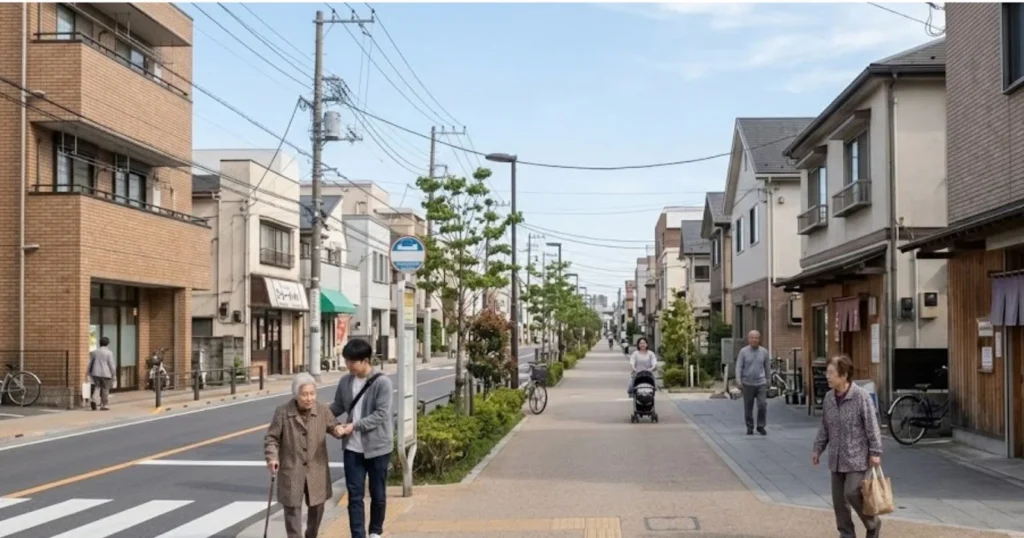
Population at a Glance
- Total population (April 2025): approximately 123.4 million, 11th largest in the world
- Population growth rate: -0.44% (2024)
- Births (2025): 671,236, a record low for the 10th consecutive year
- Deaths (2025): approximately 1.59 million (implied by the natural decrease figure)
- Natural population decline (2025): 918,253, the 19th consecutive year of decline
- Total fertility rate (2025): 1.14, down from 1.15 in 2024 and 1.2 in 2023
- Population aged 0-14: 10.9%
- Population aged 15-64 (working age): 59.7%
- Population aged 65 and older: 29.4%, crossing the “super-aged society” threshold of 21% back in 2007
- Life expectancy: 84.8 years overall (81.0 male, 87.0 female)
Japan’s birthrate peaked in 1973 at approximately 2.09 million births. By 2016, annual births had fallen below 1 million for the first time. They fell below 800,000 for the first time in 2022, and below 700,000 for the first time in 2024, meaning Japan crossed two major symbolic thresholds, dropping below 1 million and then below 700,000, within less than a decade of each other, a pace of acceleration that has repeatedly outrun the government’s own forecasts: the National Institute of Population and Social Security Research had projected births would fall to around 680,000 by 2039, a level Japan’s 2024 data reached roughly 15 years sooner than expected.
Japan Is One of the World’s Oldest Populations
Japan recorded 671,236 births in 2025, a record low for the tenth consecutive year, based on comparable statistics available since 1899. Deaths outnumbered births by 918,253, extending Japan’s run of consecutive annual population decline to 19 years. The total fertility rate fell to 1.14, itself a new record low. These are not projections or warnings about a future crisis; they are confirmed government figures describing a demographic transition that has been unfolding, largely on schedule with official forecasts and in some respects faster than them, for two full decades.
Japan’s population, approximately 123.4 million as of April 2025, is projected by the country’s own National Institute of Population and Social Security Research to fall to roughly 87 million by 2070, with 40 percent of the population over 65 by that point, according to United Nations-referenced projections. Japan is not approaching super-aged status; it has been there since 2007, when its 65-and-older population share first crossed 21 percent. What Japan offers the rest of the world, including several countries covered elsewhere in this series, from South Korea to Thailand to China, is the closest thing available to a real-world preview of where sustained sub-replacement fertility eventually leads.
How Japan Became a Super Aged Society
Japan’s demographic transition traces back to a fertility decline that began in earnest in the 1970s, following the postwar baby boom, and has continued essentially uninterrupted for half a century despite a wide range of government interventions attempted along the way. Japan’s total fertility rate has now declined for ten straight years to its current record low of 1.14, a rate roughly half the 2.1 needed for population replacement.
Marriage patterns sit close to the center of Japan’s fertility story. Japan has historically had a comparatively low rate of births outside marriage relative to many Western countries, meaning the country’s fertility trajectory tracks its marriage trends unusually closely.
Marriages did rise for a second consecutive year in 2025, climbing by 4,027 to 489,119, following a similar increase in 2024 to 485,063, but researchers, including those cited by CNN’s coverage of Japan’s 2025 data, note that government policy has focused overwhelmingly on supporting already-married couples through financial incentives, parental leave, and childcare subsidies, while doing comparatively little to address the more fundamental and harder-to-solve trend of a growing number of young Japanese people delaying or forgoing marriage altogether.
Japan’s Working Age Population Has Been Shrinking
Japan’s working-age population, defined as ages 15 to 64, made up 59.7 percent of the total population according to recent estimates, having declined steadily for decades as smaller birth cohorts replace larger retiring ones. A closer breakdown of Japan’s age structure reveals that even within the working-age bracket itself, the population skews notably older:
Japanese government data from October 2023 showed the working-age population dominated by those aged 45 to 54, with the number of younger working-age individuals, particularly those under 40, considerably smaller by comparison, meaning Japan’s labor force is aging internally even before accounting for the separate pressure of the shrinking youth population behind it.
This compounding effect has already produced visible labor market strain: according to World Economic Forum research cited in 2023, almost half of Japanese companies reported relying on workers over age 70 to fill staffing needs, illustrating how directly Japan’s demographic structure has begun reshaping ordinary business operations rather than remaining an abstract long-term concern.
Healthcare and Long Term Care Have Become Central Policy Issues
With more than 1 in 10 people in Japan now aged 80 or older, according to World Economic Forum reporting on Japanese government statistics, healthcare and long-term care demand has expanded to become one of the central organizing pressures on Japanese public policy and spending.
Japan’s declining births compound this pressure from the funding side: the number of people paying into Japan’s social security system has fallen by approximately 3 million even as the number of benefit recipients has grown by roughly 40 percent, according to demographic reporting on Japan’s 2024 data, a structural imbalance that has led Japanese officials and outside observers alike to describe the pension and social security funding gap as, in the words of one 2023 World Economic Forum analysis, “a ticking time bomb.”
Japan Is Adapting Through Technology and Automation
Japan’s response to its shrinking and aging workforce has included substantial investment in workplace automation and robotics, particularly in manufacturing and, increasingly, in eldercare settings themselves, where robotic assistance technologies have been deployed to help offset shortages of human caregiving staff. These investments represent a genuine adaptation strategy rather than a full solution: automation can meaningfully improve productivity per worker and reduce some categories of labor demand, but it does not directly address the funding shortfall in pension and social security systems that depends on the number of active taxpaying contributors rather than on aggregate economic output alone.
Immigration Has Played a Limited but Growing Role
Japan’s net migration rate stood at approximately 0.74 migrants per 1,000 population according to recent CIA World Factbook estimates, indicating Japan has, in recent years, become a modest net recipient of migrants, a meaningful shift for a country long associated with one of the most restrictive immigration policies among advanced economies.
This shift has been driven substantially by targeted visa programs aimed at specific labor shortage sectors, including caregiving, construction, and hospitality, rather than a broad-based opening to immigration comparable to Singapore’s approach documented elsewhere in this series. Japan’s cautious, sector-specific approach to immigration reflects ongoing domestic political sensitivity around large-scale demographic change through migration, even as labor shortages continue building pressure toward further, if gradual, liberalization.
Rural Japan Is Aging Differently From Major Cities
Japan’s demographic decline is not distributed evenly across its 47 prefectures. According to 2025 census-linked data, Tokyo and Okinawa were the only two of Japan’s 47 prefectures to show population growth between the 2020 and 2025 national censuses, meaning 45 of 47 prefectures recorded population decline over that five-year period.
Fertility rates similarly diverge sharply by region: Tokyo recorded Japan’s lowest prefectural fertility rate for the second consecutive year in 2025, at just 0.96, a rate below even South Korea’s national average in some recent years, while Okinawa recorded Japan’s highest prefectural fertility rate at 1.52, alongside Miyazaki at 1.46 and Fukui at 1.45.
This pattern, in which Japan’s most economically dynamic and expensive major metropolitan area records the country’s lowest fertility while more rural, lower-cost prefectures maintain comparatively higher rates, echoes patterns documented throughout this series, from Ho Chi Minh City’s unusually low fertility within Vietnam to Beijing and Shanghai’s negative natural population growth within China.
What Japan’s Experience Shows About Fertility Policy
Japan has deployed a wide range of pronatalist policies over multiple decades, including child allowances, tuition-free high school, full wage compensation for some couples on parental leave, and improved childcare working conditions, and the country’s fertility rate has nonetheless continued declining for ten consecutive years to its current record low.
This extended policy record makes Japan one of the most instructive real-world case studies available for understanding the practical limits of pronatalist intervention: substantial, sustained government investment in family-support policy has, at best, moderated rather than reversed Japan’s fertility decline, a pattern that international demographers increasingly view as the realistic ceiling for what policy alone can achieve once a society’s fertility rate has fallen as far as Japan’s has.
Which Lessons Apply to Other Countries?
Japan’s trajectory offers a genuine preview for several countries covered elsewhere in this series that are earlier in a broadly similar demographic transition. South Korea, whose fertility rate has fallen even further below Japan’s current level, and China, whose fertility rate of approximately 1.0 sits close to Japan’s own, both face compressed versions of the aging and workforce-contraction dynamics Japan has been managing for two decades already, but on considerably faster timelines given their more recent and, in China’s case, more abrupt fertility declines. Thailand, further along its own transition than Vietnam or Malaysia but still considerably younger than Japan, offers a useful midpoint comparison, aging rapidly but from a lower income base than Japan had when it crossed the same demographic thresholds, a distinction this series’ Thailand article addresses directly. Italy and other rapidly aging Southern and Eastern European economies, while outside this series’ primary geographic focus, share Japan’s combination of very low fertility and limited historical reliance on immigration as an offsetting mechanism.
Japan’s Demographic Future
Japan’s own National Institute of Population and Social Security Research projects the country’s population will continue falling toward roughly 87 million by 2070, with the 65-and-older population share climbing from its current 29.4 percent toward approximately 40 percent by that point, according to United Nations-referenced benchmarks cited in recent reporting. These are long-range projections built on current fertility, mortality, and migration assumptions rather than certainties, and Japan’s own history, in which births have repeatedly fallen faster than official forecasts anticipated, suggests these projections could plausibly prove conservative rather than overly pessimistic.
What is not in serious dispute among Japanese demographers and international researchers alike is the underlying direction: Japan will continue aging and shrinking for decades to come, and the adaptation strategies it develops, from automation to targeted immigration to eldercare innovation, are likely to be closely studied by the considerably larger cohort of countries now entering earlier stages of the same demographic transition.
Frequently Asked Questions
1. Why is Japan’s population so old?
Japan’s population is old because of a fertility rate that has been below replacement level for approximately five decades, combined with one of the world’s highest life expectancies at 84.8 years, a combination that has pushed the 65-and-older population share to 29.4 percent, among the highest of any country in the world.
2. What percentage of Japan is elderly?
Approximately 29.4 percent of Japan’s population is aged 65 or older as of recent estimates, and more than 1 in 10 Japanese people are aged 80 or older, according to World Economic Forum reporting on Japanese government statistics.
3. Why is Japan’s fertility rate low?
Japan’s fertility rate, at a record low of 1.14 in 2025, reflects a combination of delayed and declining marriage rates, high costs of raising children, demanding work culture, and government policies that have focused mainly on supporting already-married couples rather than addressing the underlying trend of fewer young people marrying at all.
4. Is Japan’s population declining?
Yes. Japan’s population has declined for 19 consecutive years as of 2025, with deaths outnumbering births by 918,253 that year, and the country’s population is projected by its own National Institute of Population and Social Security Research to fall from approximately 123.4 million to roughly 87 million by 2070.
5. How does Japan manage elderly care?
Japan faces significant strain on its healthcare and pension systems, with the number of people paying into social security falling by approximately 3 million even as benefit recipients have grown by roughly 40 percent, prompting increased investment in robotic caregiving technology and targeted immigration programs for caregiving-sector workers.
6. Can immigration solve Japan’s labor shortage?
Japan has become a modest net recipient of migrants, with a net migration rate of approximately 0.74 per 1,000 population, driven by targeted visa programs for specific labor shortage sectors including caregiving and construction, though Japan’s approach remains considerably more cautious and sector-specific than large-scale immigration-driven models such as Singapore’s.
7. How is technology helping Japan’s aging society?
Japan has invested substantially in workplace automation and robotics, including in manufacturing and eldercare settings, to help offset labor shortages, with nearly half of Japanese companies reportedly relying on workers over age 70 as of 2022, though automation addresses productivity and labor supply more directly than the separate funding shortfall facing Japan’s pension system.
8. What can other countries learn from Japan?
Japan’s decades-long experience shows that sustained, substantial pronatalist policy investment, including child allowances and parental leave support, has moderated but not reversed fertility decline once it falls to very low levels, offering a cautionary and instructive reference point for South Korea, China, and other countries now navigating earlier stages of similar demographic transitions.
Sources
- Japan Ministry of Health, Labour and Welfare, 2025 demographic statistics, reported via Nippon.com, June 2026.
- CNN, “Japan’s annual births fall to record low as population emergency deepens,” June 2025.
- Newsweek, “Japan’s Births Predicted to Hit Lowest Level Since Records Began,” citing Financial Times analysis, December 2025.
- CIA World Factbook, Demographics of Japan, 2022-2025 estimates.
- UPI, “Japan 2024 births fell 5.7% to 686,061, population drops for 18th year,” June 2025.
- World Economic Forum, “More than 1 in 10 people in Japan are aged 80 or over,” September 2023, reported via Databoks/Katadata.
- Japan Today, Japan births and fertility rate 2025 coverage, June 2026.