Nearly half of everyone in Mongolia lives in a single city. Ulaanbaatar’s metropolitan population reached approximately 1.68 million as of the mid-2020s, equivalent to roughly 47.3 percent of Mongolia’s entire national population of about 3.6 million, packed into a country that spans 1.56 million square kilometers, the 18th largest territory on Earth.
The result is one of the most extreme combinations of national emptiness and urban concentration found anywhere in the world: a population density nationally of just 2.2 to 2.3 people per square kilometer, ranking Mongolia among the most sparsely populated countries globally, sitting alongside a capital city so dominant that most of the rest of the country functions almost as its rural periphery.
Mongolia Has One of the World’s Lowest Population Densities
Population at a Glance
- Total population (2025): approximately 3.59 to 3.6 million
- Total land area: 1,564,116 square kilometers (18th largest country by area globally)
- Population density: approximately 2.24 to 2.3 people per square kilometer, among the lowest in the world
- Ulaanbaatar metropolitan population: approximately 1.68 million, roughly 47.3% of the national total
- Urban population share (nationally): approximately 73.8%
- Median age: approximately 28.0 years, below the global average of 31
- Total fertility rate: 2.87 (2019 estimate), among the higher rates in East Asia
- Life expectancy: approximately 72.5 years (68.0 for males, 77.1 for females)
Sources: National Statistics Office of Mongolia; UN World Population Prospects 2024 revision; World Population Review compilation.
Mongolia’s population density has grown roughly 4.5-fold since 1950, when it stood at just 0.5 people per square kilometer, to approximately 2.26 in 2025, according to UN-sourced estimates, an increase that reflects substantial population growth over 75 years even as Mongolia remains, in absolute terms, one of the emptiest countries on the planet relative to its landmass.
Where Mongolia’s Population Actually Lives
Mongolia’s population geography is defined almost entirely by the gap between Ulaanbaatar and everywhere else. With the capital holding close to half the national population, the remaining roughly 1.9 million Mongolians are spread across Mongolia’s 21 provinces, or aimags, at densities that, outside of a handful of secondary cities and mining centers, fall to a small fraction of even the low national average.
Töv Province, which surrounds Ulaanbaatar geographically even though the capital itself is administered as an independent municipality, recorded a population density of just 1.28 people per square kilometer as of 2017 across its roughly 94,000 residents, illustrating how quickly density falls away just beyond the capital’s borders.
Why Mongolia Is So Sparsely Populated
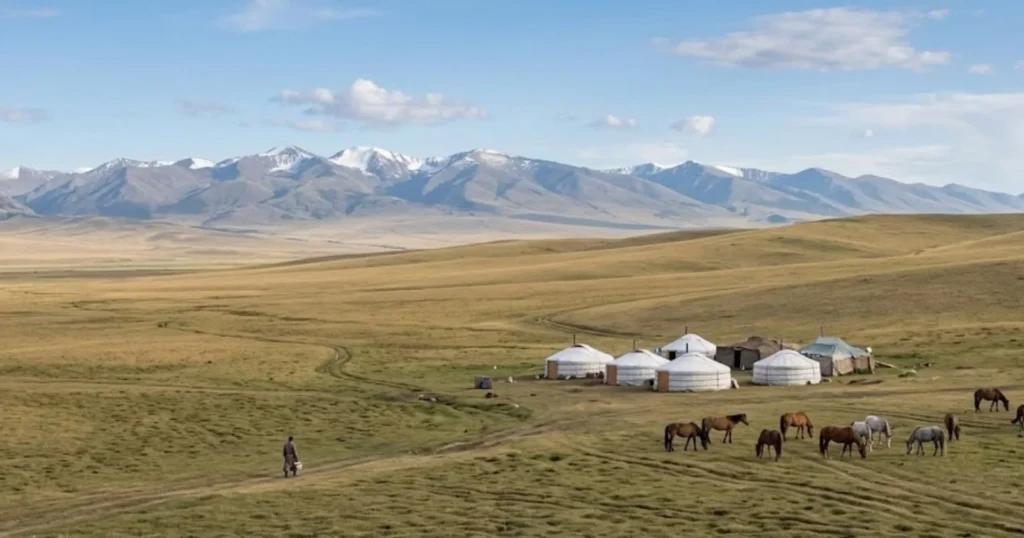
Mongolia’s extreme sparseness stems from a combination of climate, geography, and historical settlement patterns that have persisted across centuries. Much of the country consists of steppe grassland, the Gobi Desert in the south, and mountainous terrain in the west and north, environments that historically supported only extensive pastoral nomadism rather than the dense agricultural settlement that produced high population densities in neighboring China.
Mongolia’s continental climate, with extremely cold winters and hot summers, and limited reliable water availability across much of the territory further constrained the carrying capacity of the land for both traditional pastoral livelihoods and modern permanent settlement.
Historically, Mongolia’s population organized itself around mobile pastoral herding, moving livestock seasonally across vast grazing territories rather than concentrating in fixed agricultural settlements, a pattern that inherently produces low measured population density even where the total population supported by the land is not insignificant relative to the resource base available.
Ulaanbaatar Is Pulling Population Toward One Urban Center
Ulaanbaatar’s dominance has intensified substantially in recent decades, driven by internal migration from rural provinces toward the capital in search of education, employment, and modern services. Mongolia’s overall urbanization rate reached approximately 73.8 percent nationally by the mid-2020s, a figure heavily weighted by Ulaanbaatar’s own scale: because the capital alone holds nearly half the national population, Mongolia’s urbanization statistics are, in practical terms, substantially a story about one city’s growth rather than broad-based urban development spread across multiple regional centers.
This concentration has produced well-documented strains on Ulaanbaatar’s infrastructure, including its ger districts, informal settlements on the city’s outskirts where many rural migrants retain traditional Mongolian gers (yurts) while lacking full access to centralized heating, water, and sanitation infrastructure, and the city’s severe winter air pollution, driven substantially by coal-burning stoves used for heating in these ger districts, which has made Ulaanbaatar’s air quality among the worst of any capital city globally during winter months.
Mongolia’s Nomadic Population and Rural Demographics
Traditional nomadic and semi-nomadic pastoralism remains a meaningful part of Mongolia’s rural economy and identity, though the share of the population engaged in this lifestyle has declined substantially as rural-to-urban migration, and particularly migration to Ulaanbaatar, has accelerated over recent decades. Measuring the precise nomadic population is methodologically difficult, since Mongolia’s statistical system counts residents by registered location rather than by pastoral mobility status, meaning official rural population figures capture both settled rural residents in provincial towns and genuinely mobile pastoral herding households under the same administrative categories.
Population Density Creates Infrastructure Challenges
Mongolia’s combination of vast territory and low rural population density creates distinctive infrastructure and service delivery challenges. Extending paved roads, reliable electricity, healthcare facilities, and educational infrastructure across a landmass the size of Mongolia’s, when the population outside Ulaanbaatar is so thinly spread, involves substantially higher per-capita infrastructure costs than in more densely populated countries, a dynamic that has historically pushed successive Mongolian governments toward concentrating investment in Ulaanbaatar and a small number of secondary cities and mining centers rather than achieving even geographic infrastructure coverage.
Mining Is Changing Mongolia’s Population Geography
Mongolia’s substantial mineral wealth, including major coal, copper, and gold deposits, has created new, geographically specific population concentrations outside Ulaanbaatar, particularly around large-scale mining operations such as the Oyu Tolgoi copper-gold mine in the South Gobi region. These mining-driven population centers represent a distinct and relatively recent addition to Mongolia’s population geography, drawing both domestic internal migration and, in some cases, foreign technical labor, though their populations remain small relative to Ulaanbaatar’s dominant scale and have not meaningfully altered the overall national concentration pattern.
Mongolia’s Population Outlook
Mongolia’s population is projected to continue growing modestly given a fertility rate of approximately 2.87, notably above replacement level and considerably higher than the sub-replacement rates documented throughout most of East and Southeast Asia in this series. Mongolia’s youthful median age of approximately 28.0 years, below the global average, suggests continued natural population growth over the coming decades, even as urbanization toward Ulaanbaatar likely continues to intensify the country’s already stark population concentration pattern rather than reversing it.
The Mongolian diaspora, meanwhile, though modest at approximately 122,550 to over 211,000 people depending on the source and year measured, has grown steadily, with 74.5 percent of diaspora members originating specifically from Ulaanbaatar according to Mongolia’s 2020 census, indicating that even outward emigration from Mongolia is disproportionately a story about the capital rather than the rural provinces.
Frequently Asked Questions
1. Why is Mongolia so sparsely populated?
Mongolia’s low population density results from its harsh continental climate, extensive steppe and desert terrain unsuited to dense agricultural settlement, and a historical pattern of mobile pastoral herding rather than fixed settlement, all combining to produce a population density of just 2.2 to 2.3 people per square kilometer across a territory of 1.56 million square kilometers.
2. What is Mongolia’s population density?
Mongolia’s population density was approximately 2.24 to 2.3 people per square kilometer as of 2025, among the lowest of any country in the world, and has grown roughly 4.5-fold since 1950, when it stood at just 0.5 people per square kilometer.
3. Where do most Mongolians live?
Most Mongolians live in or around Ulaanbaatar, the capital, whose metropolitan population of approximately 1.68 million represents roughly 47.3 percent of Mongolia’s entire national population of about 3.6 million.
4. How many people live in Ulaanbaatar?
Ulaanbaatar’s metropolitan area population reached approximately 1.68 million as of the mid-2020s, according to Mongolia’s National Statistics Office, making it home to nearly half of the country’s total population.
5. Is Mongolia becoming more urban?
Yes. Approximately 73.8 percent of Mongolia’s population lives in urban areas as of the mid-2020s, a figure driven overwhelmingly by continued migration toward Ulaanbaatar rather than broad-based growth across multiple regional cities.
6. How many nomadic people live in Mongolia?
Precise figures are difficult to establish because Mongolia’s statistical system records residents by registered location rather than by pastoral mobility status, but the share of the population engaged in traditional nomadic and semi-nomadic herding has declined substantially as rural-to-urban migration, particularly toward Ulaanbaatar, has accelerated in recent decades.
7. Why is Mongolia’s population concentrated in Ulaanbaatar?
Ulaanbaatar’s dominance reflects sustained internal migration from rural provinces in search of education, employment, and modern services unavailable across most of Mongolia’s sparsely populated countryside, a pattern that has intensified over recent decades and produced infrastructure strains including the city’s ger district settlements and severe winter air pollution.
8. Will Mongolia’s population grow?
Mongolia’s population is likely to continue growing modestly given a fertility rate of approximately 2.87, well above the 2.1 replacement level, combined with a youthful median age of approximately 28.0 years, though this growth is expected to concentrate disproportionately in Ulaanbaatar given ongoing urbanization trends.
Sources
- National Statistics Office of Mongolia, population and Ulaanbaatar metropolitan data.
- United Nations, Department of Economic and Social Affairs, Population Division. World Population Prospects 2024 Revision.
- World Population Review, Mongolia Population 2026 compilation of National Statistics Office data.
- CIA World Factbook, Demographics of Mongolia.
- Statbase.org, Mongolia population density time series, sourced from UN WPP 2024.
- Wikipedia compilation, Mongolian diaspora, sourced from Mongolia’s 2020 census.