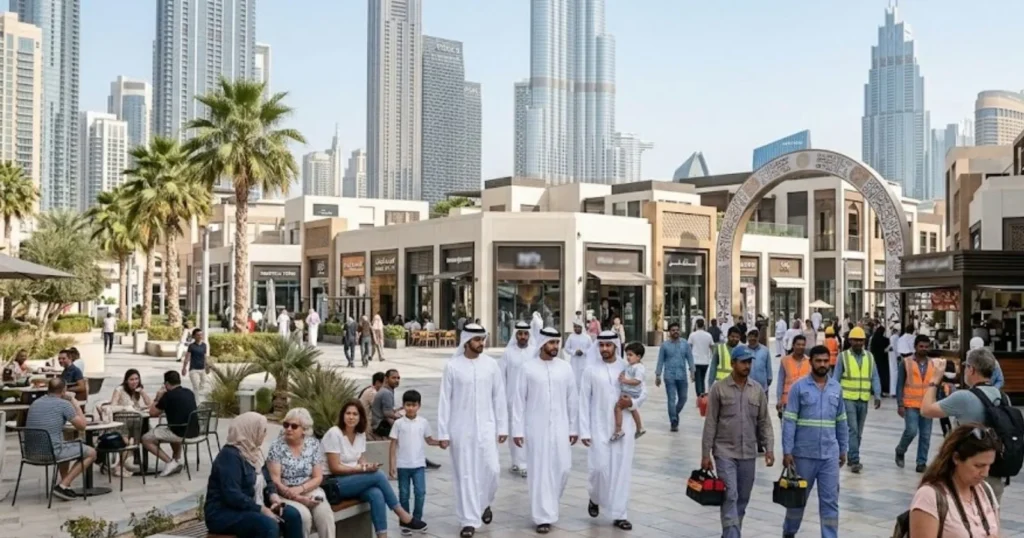
Emiratis make up somewhere between 11 and 12 percent of the people living in their own country. The United Arab Emirates’ total population reached approximately 11.3 million by the end of 2024, according to the Federal Competitiveness and Statistics Centre (FCSC), while the citizen population is estimated at only 1.1 to 1.3 million depending on the source and year. That makes the UAE home to one of the highest expatriate shares of any country on earth, trailing only microstates such as Vatican City and Qatar in the proportion of residents who are foreign born.
This is not a temporary anomaly. It is the deliberate outcome of more than fifty years of an economic model built on importing labor at every skill level, from construction workers to bankers to domestic staff, at a scale that has made the UAE’s demographic structure genuinely unusual by global standards.
The UAE’s Population Is Unusual by Global Standards
Population at a Glance
- Total population (end of 2024): approximately 11.3 million, up from about 10.7 million at the start of the year, a 5.7% annual increase
- Emirati citizen population: approximately 1.1 to 1.3 million, roughly 11 to 12% of the total
- Expatriate population: approximately 10 million, roughly 88 to 89% of the total
- Male share of total population: 64%
- Female share of total population: 36%
- Fertility rate: 1.46 children per woman (CIA World Factbook, 2022 estimate)
- Life expectancy: 79.6 years
- Population in 2000, for comparison: approximately 3.17 million
Source: Federal Competitiveness and Statistics Centre (FCSC), 2024-2025; CIA World Factbook; Global Media Insight compilation of FCSC data.
The UAE’s population has more than tripled since 2000, growing from roughly 3.17 million to over 11 million in a quarter century, almost entirely through immigration rather than citizen births. The country’s own citizen population has grown steadily too, but at nowhere near the pace of the expatriate influx, which is why the citizen share of the total has fallen over time even as the absolute number of Emiratis has risen.
How Many Emiratis and Foreign Residents Live in the UAE?
Different sources place the precise Emirati share of the population in a narrow but not identical range, from about 11 percent to 12 percent, largely because of small variations in when a given count was taken and whether it includes all seven emirates on a uniform basis.
A widely cited estimate for 2025 places the Emirati population at 1.31 million, or 11.5 percent of the total, alongside roughly 10.04 million expatriates. Other tabulations, including some UN-linked estimates, place Emiratis closer to 11 to 12 percent as well, making this one of the more stable figures across sources even though the exact decimal varies.
The male-heavy skew of the total population, 64 percent male against 36 percent female nationally, is a direct reflection of labor migration patterns: a large share of expatriate workers, particularly in construction and manual labor, are single men on employment visas without accompanying family members, while citizen households maintain a roughly even gender balance.
Why the UAE Attracts Such a Large Foreign Workforce
The UAE built its post-oil economic strategy around becoming a regional and global hub for trade, finance, tourism, logistics, and more recently technology, and each of these sectors has required importing skilled and unskilled labor far beyond what the small citizen population could supply.
Construction and infrastructure development, particularly through Dubai and Abu Dhabi’s rapid urban expansion since the 1990s, historically absorbed the largest single share of expatriate labor. Finance, professional services, hospitality, aviation, and increasingly technology and artificial intelligence sectors have driven demand for skilled expatriate professionals from a wide range of countries.
Where the UAE’s Foreign Residents Come From
According to 2024 demographic breakdowns, South Asian nationals make up the largest single origin group among non-UAE nationals, at approximately 68.4 percent of the expatriate population. Within that group, Indians account for roughly 38 percent of all non-citizens, Pakistanis about 16.7 percent, and Bangladeshis about 7.4 percent.
Filipinos make up roughly 6.1 percent of the expatriate population, Iranians about 4.7 percent, and Egyptians about 4.2 percent, with the remainder split among more than 200 other nationalities represented in the country.
| Origin Group | Approximate Share of Non-UAE Nationals |
|---|---|
| South Asian (India, Pakistan, Bangladesh, others) | 68.4% |
| Filipino | 6.1% |
| Iranian | 4.7% |
| Egyptian | 4.2% |
| Other nationalities (200+ represented) | remainder |
Source: Demographics of the United Arab Emirates compilation, 2024 estimates.
The Gender Structure Reflects the Labor Migration Model
The UAE’s population sex ratio, at roughly 2.21 males per female overall according to CIA World Factbook estimates, is among the most male-skewed in the world for a country of its size, driven almost entirely by the composition of labor migration rather than by any imbalance among citizens.
Female citizens and non-citizens combined account for only about 36.2 percent of the UAE’s population, a gap explained by the high concentration of male foreign workers in construction, transport, and manual labor sectors where employment visas are overwhelmingly granted to single men. The majority of the UAE’s population, about 64 percent, falls between the ages of 25 and 54, reflecting a population structure built around active working-age labor rather than family settlement.
Dubai and Abu Dhabi Have Distinct Population Profiles
Dubai’s population was projected to reach approximately 4 million in 2025, making it the UAE’s largest city and the emirate with the highest concentration of expatriate professionals across finance, trade, tourism, and logistics.
Abu Dhabi, the capital, is home to roughly 3.3 million residents and maintains a comparatively higher proportion of Emirati citizens than Dubai, alongside large industrial zones and a heavier concentration of government and energy-sector employment.
Sharjah, with around 1.7 million residents, has a strong South Asian population presence and more affordable housing relative to Dubai, making it a common home base for workers who commute daily into Dubai for employment. The remaining four emirates, Ajman, Ras Al Khaimah, Fujairah, and Umm Al Quwain, together account for just over a million residents.
Citizenship, Residency and Long Term Population Policy
Historically, UAE citizenship has been extremely difficult for foreign residents to obtain, regardless of how long they have lived and worked in the country, reinforcing the sharp and durable divide between citizens and residents.
In recent years, the UAE has introduced limited naturalization pathways for select categories of exceptional talent, alongside long-term residency visa categories such as the Golden Visa program, aimed at retaining skilled professionals, investors, and entrepreneurs for extended periods without offering a path to full citizenship.
These policies represent an attempt to secure the benefits of a stable, long-term skilled workforce without altering the fundamental citizen-to-resident population ratio that has defined the UAE’s demographic model for decades.
Economic Benefits and Demographic Challenges
The UAE’s labor migration model has delivered clear economic benefits: a flexible, scalable workforce that expands and contracts with economic demand, a globally connected talent base spanning finance and technology, and a consumer market whose scale, driven by population growth from 3.17 million in 2000 to over 11 million today, has itself become a major driver of retail, real estate, and services growth.
The same model carries structural demographic dependencies. The UAE’s population growth is driven almost entirely by migration rather than natural increase, given a fertility rate of just 1.46 children per woman among the tracked population, meaning continued population and economic growth depends on sustained labor demand and immigration policy rather than domestic birth trends.
Housing, infrastructure, healthcare, and utilities must be planned around a population that can shift relatively quickly in response to economic cycles or policy changes, a very different planning challenge than in countries where population change is dominated by slower-moving birth and death trends.
How UAE Population Composition Could Change
United Nations and World Health Organization projections cited in UAE demographic reporting suggest the country’s population will continue growing, though more slowly than in past decades, potentially reaching approximately 11.7 to 11.9 million by 2030 and around 15.4 million by mid-century. These projections assume continuity in current migration patterns and do not account for potential economic shocks, shifts in regional labor demand, or major policy changes to residency and citizenship frameworks.
Given that growth is driven overwhelmingly by migrant inflows tied to labor demand rather than citizen births, the UAE’s population trajectory over the coming decades will likely continue to track its economic diversification strategy more closely than any purely demographic trend.
Frequently Asked Questions
1. What percentage of UAE residents are citizens?
Emirati citizens make up approximately 11 to 12 percent of the UAE’s total population, depending on the source and year, with a widely cited 2025 estimate placing the figure at 11.5 percent, or about 1.31 million people out of a total population of roughly 11.3 million.
2. How many foreigners live in the UAE?
Approximately 10 million foreign residents lived in the UAE as of 2025 estimates, making up roughly 88 to 89 percent of the total population of around 11.3 million.
3. Why does the UAE rely on expatriate workers?
The UAE built its economy around trade, finance, tourism, logistics, and construction at a scale far beyond what its small citizen population could staff, requiring large-scale labor importation across all skill levels since the country’s rapid development began in the 1970s.
4. Which emirate has the largest population?
Dubai has the largest population among the UAE’s emirates, projected to reach approximately 4 million by 2025, followed by Abu Dhabi at around 3.3 million and Sharjah at around 1.7 million.
5. Why are there more men than women in the UAE?
The UAE’s population sex ratio is skewed male, roughly 64 percent to 36 percent, because a large share of expatriate labor migrants, particularly in construction and manual labor sectors, are single men on employment visas without accompanying family members.
6. Where do UAE expatriates come from?
South Asian nationals make up the largest expatriate group at approximately 68 percent of non-citizens, led by Indians at about 38 percent, Pakistanis at about 17 percent, and Bangladeshis at about 7 percent, followed by Filipinos, Iranians, and Egyptians.
7. Can foreigners become UAE citizens?
UAE citizenship has historically been very difficult for foreign residents to obtain regardless of length of residency. In recent years, the UAE introduced limited naturalization pathways for select categories of exceptional talent, alongside long-term residency options such as the Golden Visa that do not lead to citizenship.
8. Will the expatriate population continue growing?
UN and WHO-linked projections suggest continued UAE population growth, potentially reaching 11.7 to 11.9 million by 2030 and around 15.4 million by mid-century, driven overwhelmingly by migration rather than citizen births, meaning the trajectory depends heavily on continued labor demand and immigration policy.
Sources
- UAE Federal Competitiveness and Statistics Centre (FCSC), population data, 2024-2025.
- UAE Ministry of Foreign Affairs, Facts and Figures, population statistics.
- CIA World Factbook, Demographics of the United Arab Emirates, 2022-2024 estimates.
- Global Media Insight, UAE Population Statistics 2026, compilation of FCSC data.
- The National, UAE population growth reporting, 2025, citing World Health Organization projections.
- Wikipedia compilation, Demographics of the United Arab Emirates, sourced from FCSC and CIA data, 2024.