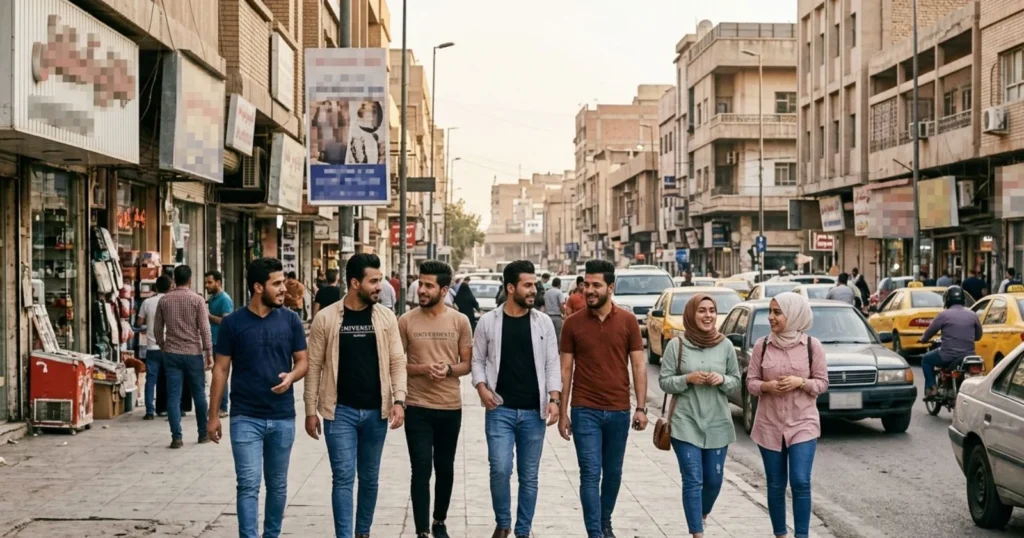
More than 60 percent of Iraqis are under the age of 25, and young people aged 15 to 24 alone make up roughly 37 percent of the population, according to data compiled from UN and ILO sources. That places Iraq among the youngest large populations anywhere in the world, with a median age of just 21.1 years in 2025 to 2026, according to the UN World Population Prospects 2024 revision. For comparison, the global median age is close to 31.
The number attached to that youth is not the interesting part. What matters is what happens next: Iraq’s youth unemployment rate stands at roughly 32 to 36 percent depending on the source, meaning a huge and rapidly growing cohort of young Iraqis is entering adulthood into a labor market that cannot currently absorb them. Whether that translates into a demographic dividend or a prolonged employment crisis will do more to shape Iraq’s next three decades than any other single trend.
Iraq Has One of the Region’s Youngest Population Structures
Population at a Glance
- Total population (2024): approximately 46.1 million (UN WPP 2024 revision; Iraqi government estimates put 2025 figures near 45.5 to 46 million)
- Median age (2025-2026): 21.1 years
- Population aged 0-14: approximately 35.9-36.6% of the total
- Population aged 15-64 (working age): approximately 60.4%
- Population aged 65 and older: approximately 3.7%
- Total fertility rate (2024): 3.17-3.25 children per woman, more than 50% above the 2.1 replacement level
- Life expectancy at birth: 72.3-73.2 years
- Population growth rate: approximately 2.0% annually, among the higher rates in the Middle East
- Projected population (2100, UN medium scenario): approximately 100.6 million, more than double the current total
Iraq’s age structure is what demographers call an expansive pyramid: a wide base of children and young adults tapering quickly toward smaller older cohorts. That structure reflects both continued high fertility and a death rate that has fallen faster than the birth rate, a combination that keeps overall population growth close to 2 percent a year even as fertility itself gradually declines.
Why Iraq Has Such a Young Population
Iraq’s fertility rate has fallen substantially from its historical peak of over 7 children per woman in the late 1960s, but the decline has been slower and less complete than in most of its regional neighbors. Fertility sat at 3.25 in 2023 and an estimated 3.17 in 2025, a drop of roughly 54 percent since 1950, but nowhere near the 75 percent collapse seen in Iran over a similar period.
Several factors explain the slower transition:
- Decades of conflict, sanctions, and instability from the 1980s through the 2010s disrupted the institutional development, healthcare expansion, and female education gains that typically accelerate fertility decline elsewhere
- Rural and religious traditions in many governorates continue to favor larger family sizes
- Access to contraception and reproductive healthcare remains uneven across regions, with rural and southern governorates lagging behind Baghdad and Kurdistan
- Displacement and instability tied to the 2003 invasion, the sectarian conflict of the mid-2000s, and the 2014-2017 war against the Islamic State disrupted family planning infrastructure in affected provinces for extended periods
The consequence is a population that continued growing rapidly through a period when much of the rest of the Middle East began aging. Iraq’s population grew by more than 730 percent between 1950 and 2025, a pace that outstrips Iran, Turkiye, and most Gulf states over the same period.
Historical and Projected Population Growth
| Year | Population | Growth Rate | Fertility Rate |
|---|---|---|---|
| 1990 | 17.4 million | +2.3% | ~6.0 |
| 2000 | 23.5 million | +3.1% | ~5.2 |
| 2010 | 29.7 million | +2.0% | ~4.6 |
| 2020 | 40.2 million | +2.5% | ~3.6 |
| 2024 | 46.1 million | ~2.0% | 3.25 |
| 2100 (projected) | ~100.6 million | declining | uncertain |
Source: UN World Population Prospects 2024 revision; Our World in Data population and demography profile.
Iraq’s Youth Bulge Is Becoming an Economic Test
A youth bulge, in demographic terms, describes a population where children and young adults make up an unusually large share of the total, typically the result of a fertility decline that has not yet caught up with an earlier period of high birth rates. Iraq fits the definition closely: with roughly 36 percent of the population under 15 and another significant share in their late teens and twenties, the number of Iraqis reaching working age each year is large and growing.
The test is whether the economy can generate enough jobs to absorb them. Iraq’s overall unemployment rate stood at approximately 15.5 percent in 2024-2025 according to ILO-based estimates, though Iraq’s own Planning Ministry places the figure closer to 13 percent using national household survey methodology, a routine example of the kind of measurement gap that appears whenever national and international data collection use different definitions.
Youth unemployment, however, is unambiguously worse across every source: the World Bank’s ILO-modeled estimate put it at 32.1 percent in 2024, while a 2026 review compiled from UN and ILO data by the Strategic Center for Human Rights placed it at 35.8 percent.
| Indicator | Iraq | Notes |
|---|---|---|
| Overall unemployment rate | 13-15.5% | Range reflects national vs. ILO-modeled methodology |
| Youth unemployment (15-24) | 32-36% | Roughly double the overall rate |
| Female labor force participation | ~10.6% | Among the lowest rates globally |
| Population under age 25 | 60%+ | |
| Population aged 15-24 | ~37% |
Sources: World Bank/ILO modeled estimates (2024), Iraq Ministry of Planning, Strategic Center for Human Rights compilation of UN/ILO data (2026).
The drivers of this gap are structural rather than cyclical. Iraq’s public sector has historically absorbed a large share of new graduates, but that capacity is now limited by fiscal constraints tied to oil revenue volatility. Private sector job creation has not kept pace, held back by weak non-oil investment, bureaucratic barriers to business formation, and a skills mismatch between what universities produce and what employers need. Vocational and technical training remains underdeveloped relative to the scale of the youth cohort entering the labor market each year.
Education Is the Bridge Between Youth and Demographic Dividend
Iraq has made real gains in access to education since the mid-2000s, but quality and relevance to labor market needs remain uneven. Enrollment in basic education is now close to universal in most governorates, though secondary and higher education completion rates lag, particularly for young women in rural areas and in provinces still recovering from conflict-related displacement, notably parts of Nineveh, Anbar, and Salah al-Din.
A recurring theme across labor economists studying Iraq is the mismatch between what Iraqi universities produce, heavily weighted toward humanities, law, and general administration degrees, and what a diversifying economy would need, including technical, engineering, digital, and vocational skills. This mismatch compounds the unemployment problem: it is not simply that there are too few jobs, but that the jobs available do not match the qualifications young Iraqis hold.
Jobs Will Determine Whether Iraq Captures Its Demographic Dividend
A demographic dividend is not automatic. It requires that a large working-age population actually finds productive employment, generating savings, consumption, and tax revenue that can be reinvested in further growth. Iraq’s dividend window is open on paper: with a median age of 21 and a large youth cohort now moving into their twenties, the working-age share of the population will keep growing for at least another two decades.
Whether Iraq captures this window depends heavily on:
- Private sector development: Oil accounts for the overwhelming majority of Iraq’s export revenue and a large share of government income, but employs a comparatively small share of the workforce. Diversifying beyond oil into manufacturing, agriculture, services, and construction is widely viewed by international financial institutions as the single largest lever for absorbing Iraq’s youth labor supply.
- Public sector limits: Government employment, long the default option for Iraqi graduates, cannot keep expanding at the pace needed given fiscal constraints and oil price volatility.
- Female labor force participation: At roughly 10.6 percent, Iraq’s female labor force participation rate is among the lowest in the world, representing a substantial untapped labor pool that, if mobilized even partially, could materially change the country’s effective working-age labor supply.
- Informal employment: A significant share of Iraqi youth already work in informal, unregistered jobs that lack social protections, a pattern that masks some of the unemployment figures while leaving workers without benefits or job security.
Iraq’s Young Population Is Geographically Uneven
Iraq’s youth and fertility patterns are not uniform across its provinces. Southern and central governorates, along with more rural areas generally, tend to record higher fertility and larger youth shares than Baghdad or the Kurdistan Region. The Kurdistan Region, which has pursued somewhat different education and economic development policies under its regional government, shows demographic patterns that in some respects trend closer to lower fertility and higher female education attainment than the national average, though comprehensive comparative data across Iraq’s 18 governorates is limited and often dated relative to the most recent nationwide surveys.
Baghdad, as the largest urban center, concentrates both the largest number of young job seekers and the largest share of public and private sector employment opportunities, which contributes to internal migration pressure from smaller governorates toward the capital and toward Erbil and Sulaymaniyah in the Kurdistan Region.
Youth Demographics and Iraq’s Regional Role
Iraq’s youthful population stands in sharp contrast to neighboring Iran, where the median age is roughly 34 and fertility has fallen to 1.7, and to Turkiye, where fertility now sits below replacement level. Over a 25 to 30 year horizon, this divergence positions Iraq as one of the last remaining sources of substantial working-age population growth in a region where several of the largest economies, including Iran, Turkiye, and the Gulf states, are moving toward aging population structures.
This dynamic could work in Iraq’s favor if paired with effective economic development: a large, growing labor force positioned near Gulf and Turkish markets, with substantial hydrocarbon reserves to fund development, is a meaningful long-term asset. It could equally become a source of instability if youth unemployment persists at current levels, a pattern that has historically been associated with social unrest and out-migration pressure in multiple Middle Eastern contexts, including Iraq’s own protest movements in 2019.
Iraq’s Population Outlook Through 2050
Under the UN’s medium-fertility scenario, Iraq’s population is projected to continue growing well past 2050, potentially approaching or exceeding 70 to 80 million by mid-century before growth eventually slows in the second half of the century, with longer-range projections putting the total near 100.6 million by 2100. The working-age population will continue expanding in absolute terms for decades even as the youth share of the total population gradually declines as fertility continues its slow downward trend.
These are model projections based on current fertility, mortality, and migration assumptions, not guarantees. Iraq’s demographic history over the past 40 years, marked by wars, sanctions, and periods of mass displacement, illustrates how sensitive actual outcomes can be to events outside the scope of any single demographic model.
The Opportunity and the Risk
Iraq’s youth bulge is neither an automatic asset nor an automatic liability. It is a large, still-growing cohort of young people whose economic future depends on decisions Iraq has not yet fully made: how quickly it diversifies away from oil dependency, how effectively it aligns education with labor market needs, and how successfully it can bring more women into the workforce. The raw demographic potential is significant. The employment gap it currently faces, with youth unemployment running two to three times the overall rate, is the clearest sign that potential and outcome are not yet the same thing.
Frequently Asked Questions
1. How young is Iraq’s population?
Iraq’s median age was 21.1 years in 2025-2026, according to UN World Population Prospects data, making it one of the youngest populations of any country of its size. More than 60 percent of Iraqis are under the age of 25.
2. What percentage of Iraq’s population is young?
Population aged 0-14 makes up approximately 36 percent of Iraq’s total population, while the 15-24 age bracket adds a further 37 percent when combined estimates are used, meaning well over half the country is under 25.
3. Why is Iraq’s population so young?
Iraq’s fertility rate remains elevated at 3.17-3.25 children per woman, more than 50 percent above the replacement level of 2.1, a slower decline than in most regional neighbors due to decades of conflict, sanctions, and uneven access to healthcare and education that disrupted the demographic transition.
4. Is Iraq experiencing a youth bulge?
Yes. A youth bulge describes a population where a fertility decline has not yet caught up with an earlier period of high birth rates, leaving an unusually large share of children and young adults. Iraq’s age structure, with roughly 36 percent under 15 and a median age of 21, fits this pattern closely.
5. How will Iraq’s youth population affect jobs?
Iraq’s youth unemployment rate ranges from roughly 32 to 36 percent depending on the source, more than double the national average, reflecting a public sector that cannot keep expanding, weak private sector job creation, and a mismatch between graduate skills and labor market demand.
6. Can Iraq benefit from a demographic dividend?
A demographic dividend requires that a large working-age population find productive employment. Iraq’s dividend window is open given its age structure, but capturing it depends on diversifying beyond oil, improving education-to-labor-market alignment, and raising female labor force participation from its current low base of roughly 10.6 percent.
7. Where do most young Iraqis live?
Young Iraqis are concentrated across all governorates, but southern and central provinces tend to show higher fertility and youth shares than Baghdad or the Kurdistan Region. Baghdad, Erbil, and Sulaymaniyah act as the primary destinations for internal migration in search of employment.
8. Will Iraq remain a young country?
Iraq’s population is projected to keep growing well past 2050 under the UN’s medium scenario, with the working-age population continuing to expand for decades even as fertility gradually declines, meaning Iraq will likely remain one of the youngest large populations in the Middle East for the foreseeable future.
9. How does Iraq’s fertility rate compare with its neighbors?
At 3.17-3.25 children per woman, Iraq’s fertility rate is nearly double Iran’s 1.7 and well above Turkiye’s sub-replacement level, making Iraq one of the last remaining sources of substantial population and labor force growth in the region.
10. What is Iraq’s unemployment rate?
Estimates vary by methodology: Iraq’s Planning Ministry places overall unemployment around 13 percent based on national surveys, while ILO-modeled estimates used by international databases put it closer to 15.5 percent in 2024-2025. Youth unemployment is consistently higher, in the 32-36 percent range across sources.
Sources
- United Nations, Department of Economic and Social Affairs, Population Division. World Population Prospects 2024 Revision.
- UNFPA World Population Dashboard, Iraq country data, 2025.
- Our World in Data, Population and Demography Country Profile: Iraq, drawing on UN WPP 2024.
- World Bank Open Data, World Development Indicators: Labor Force and Unemployment (Iraq), ILO-modeled estimates, 2024.
- International Labour Organization, ILOSTAT Country Profile: Iraq.
- Strategic Center for Human Rights, compilation of UN and ILO youth unemployment data, reported via Shafaq News, 2026.
- Iraq Ministry of Planning, national unemployment estimates.