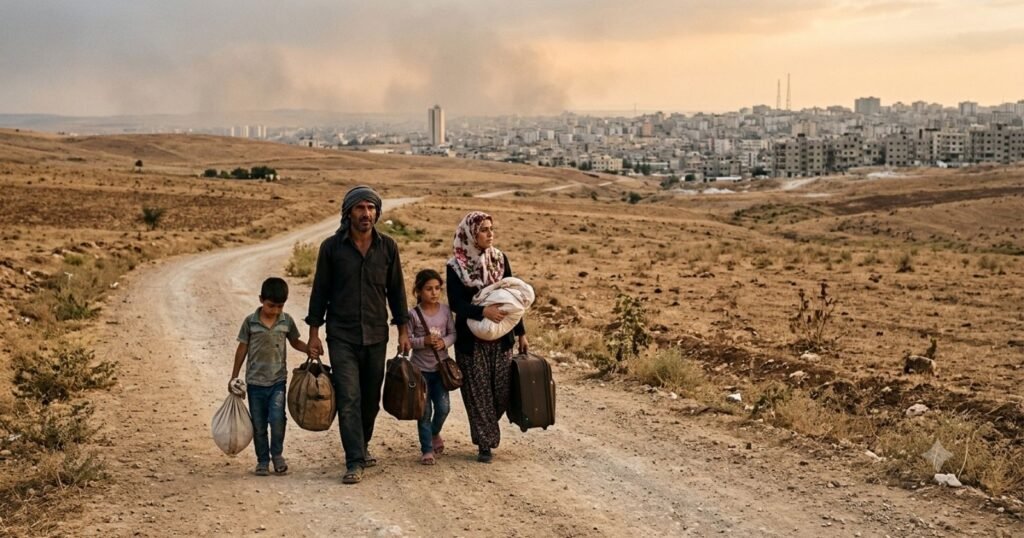
The World Bank’s Groundswell report, first published in 2021 and still the most widely cited projection on this topic, estimates that climate change could force up to 216 million people to migrate within their own countries by 2050 across six regions of the developing world. That figure has circulated widely, often stripped of the scenario assumptions that produced it. Understanding those assumptions matters more than the headline number itself.
Groundswell is explicit that 216 million is a “pessimistic scenario” outcome, not a prediction of what will happen. Under a more optimistic scenario combining strong climate action with inclusive development, the World Bank’s own modeling found that internal climate migration could be reduced by as much as 80 percent, to roughly 44 million people. The gap between those two numbers is the entire policy argument embedded in the report.
What Is Climate Migration?
Climate migration, more precisely termed climate related internal mobility in most of the technical literature, refers to population movement driven wholly or partly by slow onset climate stressors such as water scarcity, declining crop yields, and sea level rise, as distinct from sudden onset disaster displacement or conflict driven refugee movement. It is also, critically, usually internal migration within a country’s own borders rather than international migration, a distinction that gets lost in most popular coverage of the topic.
How Many People Could Move Because of Climate Change
| Scenario | Projected Internal Climate Migrants by 2050 |
|---|---|
| Pessimistic (high emissions, unequal development) | 216 million |
| Optimistic (climate action + inclusive development) | approx. 44 million |
| Reduction possible with strong action | up to 80% |
Source: World Bank Groundswell report, 2021, covering Sub-Saharan Africa, East Asia and the Pacific, South Asia, North Africa, Latin America, and Eastern Europe and Central Asia. These figures were current as of the report’s 2021 publication and should be understood as scenario based modeling rather than an updated real time forecast.
Where Could Climate Migration Hotspots Emerge
Sub-Saharan Africa
The largest projected regional total in the Groundswell analysis, driven by water scarcity, declining crop yields in the Sahel, and sea level rise along low lying coastal areas of West Africa.
South Asia
Water scarcity and declining agricultural productivity are the dominant drivers, compounded by extreme heat that increasingly makes outdoor agricultural labor dangerous during summer months in parts of India, Pakistan, and Bangladesh.
East Asia and the Pacific
Coastal and delta flooding is the primary driver here, particularly in Vietnam’s Mekong Delta and along China’s densely populated eastern coastline.
North Africa
Water scarcity dominates, an intensification of pressures already visible in countries like Morocco and Tunisia where groundwater depletion has become a chronic constraint on agriculture.
Latin America
Crop failure linked to shifting rainfall patterns is the primary internal migration driver identified in the Groundswell modeling, particularly in Central America’s drought prone corridor.
Eastern Europe and Central Asia
The smallest of the six projected regional totals, but water stress in Central Asia’s already strained irrigation systems is a growing factor.
Why People Would Move
Water scarcity is the most consistently cited driver across all six regions in the Groundswell modeling, followed by declining crop productivity, sea level rise in coastal and delta zones, and extreme heat that reduces outdoor labor productivity. Livelihood loss, rather than a single dramatic disaster event, is typically the proximate trigger, meaning climate migration in this framework looks more like a slow, cumulative economic decision than a sudden evacuation.
Climate Migration Is Not Always International Migration
This is arguably the single most important corrective the Groundswell report offers to popular discussion of the topic. The 216 million figure describes people moving within their own country’s borders, typically from rural areas toward secondary cities, not international refugees crossing borders.
Most climate mobility research, including work by the International Organization for Migration, finds that people overwhelmingly prefer to move the shortest distance necessary to escape a stressor, which usually means moving toward the nearest viable city rather than to another country.
Who Is Most Vulnerable
Poverty, dependence on rain fed agriculture, limited access to formal credit or insurance, and low adaptive capacity all increase the likelihood that a household will eventually need to migrate rather than adapt in place. Rural households with diversified income sources, meaning some income beyond agriculture alone, are generally better able to weather climate stress without relocating.
Can Climate Action Reduce Future Migration
The Groundswell modeling’s central finding is that policy choices matter enormously. Emissions reduction, investment in climate resilient agriculture, water infrastructure, and planned, voluntary relocation programs could cut projected internal climate migration by up to 80 percent compared with the pessimistic scenario. This is one of the report’s most consequential findings and one of the least reported, since headline coverage overwhelmingly focused on the 216 million figure rather than the 44 million figure attached to stronger policy action.
What Climate Migration Could Mean for Receiving Cities
Secondary cities in migration destination regions face pressure on housing, water and sanitation infrastructure, and labor markets as internal climate migrants arrive, often faster than urban planning can accommodate. This mirrors, at a smaller scale, the broader rural to urban migration pressures already reshaping cities across the developing world.
Key Findings
- The World Bank’s Groundswell report projects up to 216 million internal climate migrants by 2050 under a pessimistic scenario, but this is explicitly not a prediction.
- Strong climate action and inclusive development could reduce that figure by up to 80 percent, to roughly 44 million people.
- Sub-Saharan Africa carries the largest projected regional total among the six regions studied.
- Climate migration in this framework is overwhelmingly internal, within national borders, not international refugee movement.
- Water scarcity is the most consistently cited driver of projected climate migration across all six regions studied.
Frequently Asked Questions
1. How many people could become climate migrants by 2050?
The World Bank’s Groundswell report projects up to 216 million people under a pessimistic scenario, but as few as 44 million under a scenario with strong climate action and inclusive development, a reduction of up to 80 percent.
2. Where will climate migrants go?
Overwhelmingly to destinations within their own countries, typically from rural areas toward secondary cities, rather than across international borders.
3. Are climate migrants the same as refugees?
No. Refugee status under international law requires crossing an international border due to persecution or conflict. Climate migration as modeled by the World Bank is predominantly internal movement driven by slow onset environmental stress, a legally distinct category.
4. Will climate change cause mass international migration?
Current evidence and modeling, including the Groundswell report, suggest climate driven movement is overwhelmingly internal rather than international, though this could change if internal adaptation options are exhausted in some regions.
5. Which region faces the largest projected climate migration?
Sub-Saharan Africa carries the largest projected regional total among the six regions analyzed in the World Bank’s Groundswell modeling.
6. What is the main driver of projected climate migration?
Water scarcity is the most consistently cited driver across regions, followed by declining crop productivity and, in coastal and delta areas, sea level rise.
7. Can policy actually reduce climate migration?
Yes, according to the Groundswell modeling. Combining emissions reduction with inclusive development and climate resilient agriculture could cut projected internal climate migration by up to 80 percent compared with a high emissions, low investment scenario.
8. Is the 216 million figure a confirmed prediction?
No. It represents the outcome of one modeled scenario among several the World Bank studied, and should be understood as an upper bound warning rather than a guaranteed future.
9. How does climate migration affect destination cities?
Secondary cities receiving internal climate migrants often face increased pressure on housing, water, sanitation, and labor markets, similar to broader rural to urban migration pressures already visible across the developing world.
10. Who is most likely to become a climate migrant?
Households dependent on rain fed agriculture with limited income diversification, low access to credit or insurance, and weak adaptive capacity face the highest likelihood of eventually needing to relocate.
Sources
- World Bank, “Groundswell: Preparing for Internal Climate Migration,” 2021
- World Bank, “Groundswell Part 2: Acting on Internal Climate Migration,” 2021
- International Organization for Migration, climate mobility research