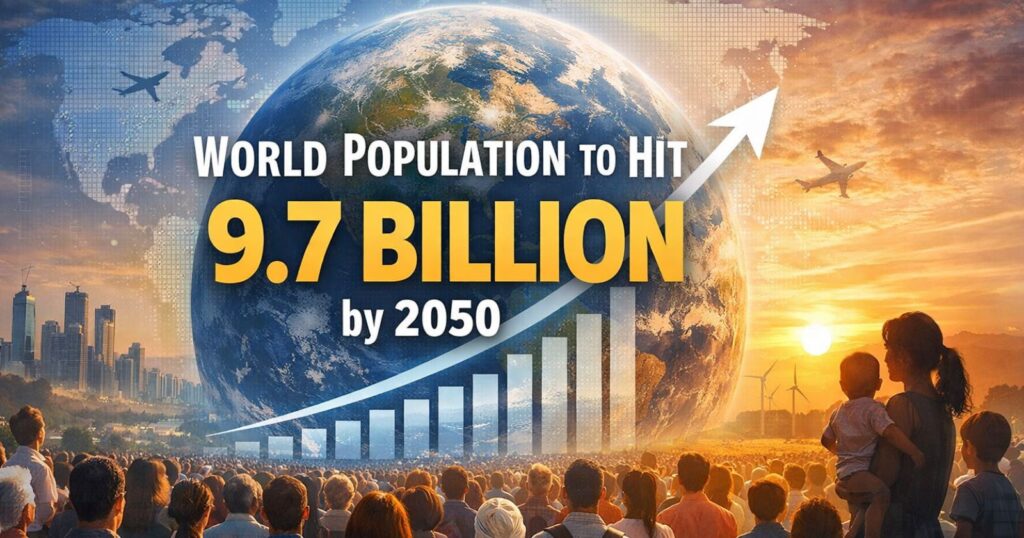
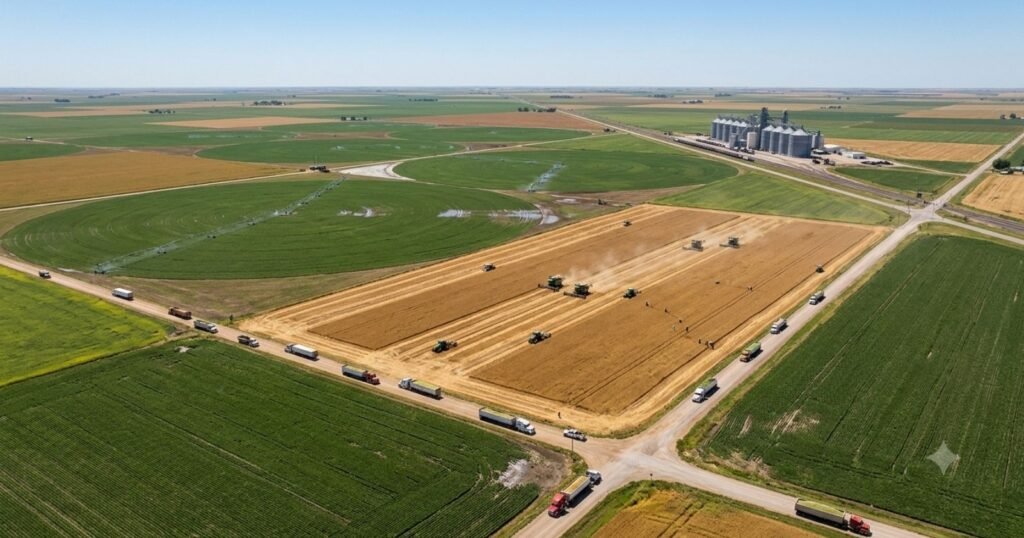
Global food production will need to rise by roughly 70% between 2005/07 and 2050 to feed a projected 9.1-9.7 billion people, according to long-running FAO projections, even though the rate of population growth itself is slowing sharply compared with the explosive expansion of the late 20th century. That gap between a slowing population growth rate and a still-large required increase in food output is the central tension in global food security today, and it exists because population size is only one of several forces driving demand.
The Short Answer:
More people mean more food demand, but population is only part of the story. Rising incomes, urbanization, changing diets, and food waste all shape how much food the world actually needs, often more than population growth alone. A wealthier population eating more meat and dairy requires substantially more agricultural resources per calorie than a poorer population eating mostly grains and vegetables, which is why income growth can raise food demand even faster than headcount growth in some regions.
How Much Is Global Food Demand Expected to Increase
FAO’s long-range agricultural projections, developed over successive analyses through the 2010s and still widely cited, estimate that meeting demand from a global population of roughly 9.1 to 9.7 billion by 2050 will require food production to rise by approximately 70% relative to 2005/07 levels, with production in developing countries needing to nearly double.
Cereal demand, spanning both direct food consumption and animal feed, is projected to reach roughly 3 billion tonnes by 2050, up from close to 2.1 billion tonnes in the reference period, while annual meat production is projected to rise by more than 200 million tonnes to reach around 470 million tonnes, a majority of which will be consumed in developing countries.
| Commodity | Baseline (2005/07, approx.) | Projected 2050 | Increase |
|---|---|---|---|
| Cereals (food + feed) | ~2.1 billion tonnes | ~3.0 billion tonnes | +~40-45% |
| Meat | ~260-270 million tonnes | ~470 million tonnes | +~200 million tonnes |
| Overall agricultural output | Baseline | +~70% above baseline | +70% |
| Arable land (developing countries) | Baseline | +~120 million hectares | Expansion needed |
Figures are drawn from FAO’s “How to Feed the World in 2050” and related global agriculture projections; these are long-standing FAO estimates, and later, more moderate FAO and World Resources Institute estimates put required production growth closer to 50-60% depending on assumptions about waste reduction and yield gains.
Where Will Future Food Demand Grow Fastest
Nearly all future population growth, and therefore a large share of future food demand growth, is concentrated in developing countries, with Sub-Saharan Africa projected to see the fastest population growth of any region and East and Southeast Asia among the slowest.
FAO’s global agriculture analysis projects Sub-Saharan Africa’s population could more than double by mid-century, driving proportionally the largest regional increase in food demand even though the region’s total population and food consumption remain smaller in absolute terms than Asia’s.
Population Growth vs Rising Incomes: Which Matters More
Rising incomes often drive food demand growth more powerfully than population growth alone, particularly through dietary shifts. As household incomes rise, diets typically shift toward more meat, dairy, and processed foods, all of which require substantially more land, water, and grain inputs per calorie delivered than staple crops consumed directly. This is why global GDP growth, projected to roughly 2.5-fold by 2050 in some FAO-cited scenarios, matters as much as population growth for future food demand, and why countries with slowing population growth but rapidly rising incomes, including much of urbanizing Asia, remain major drivers of global food demand growth.
Cereals, Meat, Dairy, Fruits and Vegetables
Different food categories face very different demand trajectories. Cereal demand grows moderately, reflecting its role as both a direct food source and animal feed. Meat and dairy demand grows disproportionately faster relative to population, reflecting income-driven dietary shifts, particularly in urbanizing middle-income countries. Fruit and vegetable demand also tends to rise with income and urbanization, reflecting improved diets and changing consumer preferences, though its resource footprint per calorie is generally far lower than that of meat and dairy.
Can Agricultural Productivity Keep Up
FAO estimates that roughly 90% of the growth in crop production needed by 2050 will need to come from higher yields and increased cropping intensity on existing agricultural land, rather than from bringing new land into cultivation. Improved seeds, irrigation expansion, fertilizer use, mechanization, and climate-resilient crop varieties are the primary tools available to raise yields, though gains have slowed in some regions compared with the rapid yield growth of the mid-20th century Green Revolution era.
The Land Constraint
Even with the emphasis on yield growth, FAO projections estimate arable land will still need to expand by around 120 million hectares in developing countries, concentrated mainly in Sub-Saharan Africa and Latin America, to meet 2050 food demand. Much of the theoretically available additional farmland faces significant constraints, including poor soil quality, endemic disease burden, inadequate infrastructure, or suitability for only a narrow range of crops, meaning the land is not always well matched to where demand growth is highest.
Water Is a Major Constraint on Food Production
Agriculture already accounts for roughly 70-72% of global freshwater withdrawals, according to UN Water and FAO data, making water availability one of the tightest constraints on future food production growth, particularly in already water-stressed regions such as North Africa, Western Asia, and parts of South Asia. Expanding irrigation to help meet rising food demand runs directly into this constraint, requiring efficiency improvements, such as drip irrigation, rather than simply expanding withdrawals in many regions.
Food Waste and Loss Change the Equation
Roughly a third of food produced globally for human consumption is lost or wasted across the supply chain, according to widely cited FAO estimates, meaning reducing waste and loss represents one of the largest available levers for improving food security without requiring proportional increases in production. This is a significant part of why more recent analyses, including work by the World Resources Institute, put the required production increase closer to 50-60% rather than FAO’s earlier 70% figure, since better waste reduction and more efficient consumption patterns could narrow the production gap considerably.
Climate Change Makes Food Production More Uncertain
Rising temperatures, more frequent droughts and floods, and shifting growing-season patterns are expected to reduce yields in some regions, particularly parts of Sub-Saharan Africa, South Asia, and Latin America, while potentially benefiting yields in some higher-latitude regions, at least in the near term. This uncertainty adds a layer of risk to food-demand projections that population and income figures alone cannot capture, and it disproportionately threatens food security in regions that are already among the most food-insecure.
Can Alternative Foods Reduce Resource Pressure
Plant-based diets, alternative proteins, precision fermentation, and improved livestock efficiency are all being explored as ways to reduce the land, water, and emissions footprint of meeting rising food demand, particularly meat and dairy demand. These technologies remain commercially limited in scale relative to the size of the global food system, and while they may play a growing role over coming decades, none currently displaces a significant share of global protein production.
What Would a Food Secure 2050 Require
Meeting future food demand sustainably will likely require a combination of continued yield growth on existing farmland, meaningful reductions in food loss and waste, efficiency improvements in water use, continued but carefully targeted agricultural land expansion, and adaptation to a changing climate, rather than any single intervention. FAO’s own assessments describe the challenge as achievable but not automatic, contingent on sustained investment and policy attention.
Key Findings
- FAO’s long-standing projections estimate global food production must rise by roughly 70% between 2005/07 and 2050 to meet demand from a population of 9.1-9.7 billion, though more recent estimates from FAO and the World Resources Institute put the figure closer to 50-60%.
- Cereal demand is projected to reach roughly 3 billion tonnes by 2050, up from about 2.1 billion tonnes in the mid-2000s baseline.
- Meat production is projected to rise by more than 200 million tonnes to reach around 470 million tonnes by 2050, disproportionate to population growth and driven largely by rising incomes.
- Roughly 90% of required crop production growth is expected to come from higher yields rather than new land, though arable land in developing countries, mainly Sub-Saharan Africa and Latin America, will still need to expand by an estimated 120 million hectares.
- Agriculture already consumes roughly 70-72% of global freshwater withdrawals, making water a binding constraint on further production expansion.
- An estimated one-third of food produced for human consumption is lost or wasted, representing one of the largest available levers to improve food security without expanding production.
Frequently Asked Questions
1. Can the world feed 10 billion people?
Most agricultural economists and FAO analysis suggest it is technically feasible, provided yield growth continues, food waste is reduced, and agricultural land expansion and water use are managed sustainably, though it is not automatic and depends on continued investment.
2. How much food will the world need in 2050?
FAO’s widely cited projections estimate food production will need to rise by roughly 70% above 2005/07 levels, though more recent estimates put the required increase closer to 50-60% when accounting for waste reduction.
3. Does population growth cause food shortages?
Population growth is one driver of rising food demand, but rising incomes and changing diets, particularly increased meat and dairy consumption, often add more pressure on agricultural resources than population growth alone.
4. Which regions will have the greatest food demand growth?
Sub-Saharan Africa is projected to see the fastest population growth and therefore among the fastest-growing food demand, while South Asia also remains a major driver given its large population base.
5. Will climate change reduce food production?
Climate change is expected to reduce yields in a number of regions, particularly parts of Sub-Saharan Africa, South Asia, and Latin America, through more frequent droughts, floods, and shifting growing seasons, adding uncertainty to future food security.
6. How important is food waste to global food security?
Very significant; roughly a third of food produced for human consumption is lost or wasted globally, meaning waste reduction represents one of the largest available levers to improve food security without expanding production.
7. How much will meat demand grow by 2050?
FAO projections estimate meat production will need to rise by more than 200 million tonnes to reach around 470 million tonnes by 2050, disproportionate to population growth due to rising incomes and dietary shifts, particularly in developing countries.
8. How much of future crop production growth will come from new land versus higher yields?
FAO estimates roughly 90% of needed crop production growth will come from higher yields and more intensive cropping on existing land, with the remainder from land expansion, mainly in Sub-Saharan Africa and Latin America.
9. Is water a bigger constraint than land for future food production?
Both are significant constraints, but water is often considered the tighter constraint in already water-stressed regions, since agriculture already consumes roughly 70-72% of global freshwater withdrawals with limited room for expansion in many areas.
10. Can alternative proteins solve the future food demand challenge?
They may play a growing role in reducing the resource footprint of meeting rising protein demand, but they remain commercially limited in scale relative to the size of the global food system and are unlikely to be a complete solution on their own by 2050.
Sources
- Food and Agriculture Organization of the United Nations, “How to Feed the World in 2050” (fao.org)
- Food and Agriculture Organization, “Global agriculture towards 2050” (fao.org)
- Food and Agriculture Organization, “2050: A third more mouths to feed” (fao.org)
- World Resources Institute, food demand and land-use gap analysis (wri.org)
- United Nations, World Population Prospects 2024 (population.un.org)