Christians and Muslims together account for more than half of humanity, yet the fastest-growing major group between 2010 and 2020 was not either of them individually classified as growing fastest by rate, and the third-largest religious category in the world today is not a religion at all. It is the absence of one.
Pew Research Center’s 2025 global religious landscape study, the most comprehensive comparative religion dataset available, drew on more than 2,700 censuses and surveys across 201 countries and territories to map exactly how the world’s 7.9 billion people in 2020 divided among belief systems, and the picture it produced complicates the common assumption that religious identity worldwide is either static or fading.
The Global Religious Landscape
Pew’s 2025 report, covering the decade from 2010 to 2020, groups the world’s population into seven broad categories: Christians, Muslims, the religiously unaffiliated, Hindus, Buddhists, adherents of folk or traditional religions, and a small residual category of other religions that includes Jews and a range of smaller traditions. This classification is based on self-identification collected through censuses and surveys, not on religious belief, doctrinal orthodoxy, or attendance at services, a distinction the report itself emphasizes repeatedly.
World Population by Religion, 2020
| Religion | Population (2020) | Share of World Population |
|---|---|---|
| Christianity | 2.27 billion | 28.8% |
| Islam | 2.02 billion | 25.6% |
| Religiously unaffiliated | 1.91 billion | 24.2% |
| Hinduism | 1.18 billion | 14.9% |
| Buddhism | 324 million | 4.1% |
| Folk or traditional religions | 170 to 200 million | 2.2% |
| Judaism and other religions | roughly 100 million combined | approximately 0.2% (Judaism alone) |
Source: Pew Research Center, Global Religious Landscape 2025 (data for 2020), based on more than 2,700 censuses and surveys covering 201 countries and territories.
Combined, the five major organized religions in this table account for about 73.6 percent of the world’s population, leaving roughly 26.4 percent either religiously unaffiliated or practicing folk and traditional belief systems that fall outside the five major world religion categories.
The World’s Largest Religious Groups
Christianity remains the world’s single largest religious group by a comfortable margin, with roughly 2.27 billion adherents in 2020, though its share of world population has been drifting downward for decades even as its absolute numbers grow, because the global population as a whole is growing faster in regions where Christianity is not the dominant tradition. Islam sits second at approximately 2.02 billion, and it is the group that added the most people of any religious category during the 2010s: Pew’s report found the Muslim population grew by 347 million between 2010 and 2020, more than the combined growth of every other religious group tracked in the study.
The religiously unaffiliated, encompassing atheists, agnostics, and people who simply do not identify with any religion in surveys, ranks third worldwide at roughly 1.91 billion people, or 24.2 percent, making it larger than Hinduism, Buddhism, and Judaism combined. This category is heavily concentrated in a small number of very large countries. China alone accounts for a substantial share of the global unaffiliated population, with unaffiliated adults making up around six in ten of its population, a legacy of both historical religious suppression and rapid secularization among younger generations.
Hinduism, with about 1.18 billion adherents, is overwhelmingly concentrated in a single country, India, and its 14.9 percent global share has remained remarkably stable across the decade even as its absolute numbers rose by roughly 126 million people, evidence that Hindu population growth has tracked closely with population growth in India and neighboring South Asian countries rather than outpacing it. Buddhism, by contrast, is the only one of the five major religions to have declined in absolute number over the decade, a point covered in more detail below.
Where Each Major Religion Is Concentrated
Religious geography remains highly uneven, and that unevenness is central to understanding both current numbers and future growth.
Christianity’s largest national populations by raw count include the United States (about 217 million Christians, 64 percent of the population), Brazil (168 million, 80.7 percent), Mexico (113 million, 89.2 percent), the Philippines (102.5 million, 91.5 percent), and Russia (102.4 million, 69.9 percent). Sub-Saharan Africa has become an increasingly important center of Christian population growth, with Nigeria (92.8 million) and the Democratic Republic of Congo (92.4 million, 96.3 percent of its population) both ranking among the ten largest Christian populations in the world.
Islam’s population is concentrated most heavily in the Asia-Pacific region, home to the world’s largest national Muslim populations, including Indonesia, Pakistan, India, and Bangladesh, and the Muslim population in the Asia-Pacific region grew by roughly 16.2 percent over the decade studied, faster than the global average. The Middle East and North Africa region remains almost uniformly Muslim-majority, with Islam constituting the majority faith in 19 of the region’s 20 countries.
Hinduism’s population is overwhelmingly located in India, with smaller but demographically significant Hindu populations in Nepal, Bangladesh, and the diaspora communities of countries like the United States, United Kingdom, and Gulf states with large Indian migrant labor forces.
Buddhism is concentrated in East and Southeast Asia, with the largest national populations found in China, Thailand, Myanmar, Japan, and Vietnam, though China’s Buddhist population figures are complicated by widespread religious blending with folk traditions and secular identification.
Folk and traditional religions, the category covering indigenous, animist, and syncretic belief systems not captured under the five major world religions, are most prevalent across parts of sub-Saharan Africa, and in China where they blend extensively with both Buddhism and irreligion in ways that make precise categorization difficult.
Religious Demographics by Age
Age structure is one of the strongest predictors of a religious group’s future population trajectory, because a younger population with more women of childbearing age will, all else equal, produce more births over the coming decades regardless of any change in average family size.
Muslims have consistently had the youngest median age of any major religious group tracked by Pew, a pattern documented across multiple editions of this research, and this younger age profile, combined with fertility rates for Muslim-majority populations that remain above the global average, is the primary structural reason Islam is projected to continue growing faster than Christianity through mid-century.
Religiously unaffiliated populations, by contrast, are concentrated disproportionately in aging, low-fertility societies such as China, Japan, and much of Europe, which limits the unaffiliated category’s future growth potential even as it continues gaining members through religious switching in many Western countries.
Fertility, Mortality and Religious Population Change
Three separate mechanisms drive religious population change, and disentangling them matters because they point to very different underlying stories. Natural increase, the surplus of births over deaths within a religious population, is the dominant driver of Muslim and Christian population growth in absolute numbers, particularly in regions like sub-Saharan Africa and South Asia where both fertility and religious identification remain high.
Migration reshuffles religious populations geographically without necessarily changing global totals, most visibly in the growth of Muslim populations in Europe and Christian populations in Gulf states through labor migration. Religious switching, covered in the next section, adds or subtracts population independent of birth and death rates entirely.
It is important not to conflate a religious group’s population growth with growth in religious observance or practice. A religion can add hundreds of millions of adherents purely through the demographic momentum of high-fertility, young populations, even if the intensity of religious belief or practice within that population is simultaneously declining, a distinction Pew’s researchers have been explicit about in presenting this data.
Religious Switching and Changing Identity
Religious switching, the movement of individuals from the religion of their upbringing to a different affiliation or to no affiliation at all, is one of the most methodologically difficult phenomena to measure at global scale, because it requires either longitudinal survey data tracking the same individuals over time or retrospective questions about childhood religion, both of which are unevenly available across the 201 countries and territories in Pew’s dataset.
Where switching has been measured most rigorously, in the United States and much of Europe, the dominant pattern of the past several decades has been net movement away from Christian affiliation and toward the unaffiliated category, a trend Pew’s own U.S.-focused projections describe as continuing under most modeled scenarios: American Christians made up about 64 percent of the population in 2020, down from 78 percent in 2010 under earlier Pew estimates, while the unaffiliated share rose to roughly 30 percent.
Whether this Western pattern of secularization generalizes globally is far less certain, because switching dynamics in much of Asia, Africa, and the Middle East follow different social, legal, and cultural logics, and reliable longitudinal switching data for those regions remains comparatively sparse.
How the Religious Landscape Changed Between 2010 and 2020
Change in Major Religious Group Population, 2010 to 2020
| Religion | Approximate 2010 Population | 2020 Population | Approximate Change |
|---|---|---|---|
| Islam | 1.6 to 1.75 billion | 2.02 billion | +347 million |
| Christianity | 2.17 to 2.2 billion | 2.27 billion | approximately +100 to 122 million |
| Hinduism | approximately 1.05 billion | 1.18 billion | +126 million |
| Buddhism | Higher than 2020 figure | 324 million | Declined in absolute number |
| Religiously unaffiliated | Smaller share of total | 1.91 billion (24.2%) | Grew as a share of world population |
Figures compiled from Pew Research Center’s 2010 and 2020 Global Religious Landscape comparisons; exact 2010 baselines vary slightly by source revision, so the change columns should be read as approximate.
Islam’s growth of 347 million people over the decade exceeded the combined growth of every other religious group Pew tracks, driven primarily by natural population increase in Muslim-majority countries across the Asia-Pacific region and sub-Saharan Africa rather than by conversion.
Buddhism stands out as the only major group in the study to shrink in absolute number over the decade, a consequence of its geographic concentration in East Asian countries, especially China, Japan, and Thailand, where fertility rates have fallen well below replacement level and where secularization has also drawn people away from religious identification more broadly.
Religious Majorities, Minorities and Diversity
Most of the world’s population lives in a country where their own religious identity constitutes the majority faith, a pattern that holds for the large majority of Christians, Muslims, and Hindus given the concentration of those groups in Christian-majority, Muslim-majority, and Hindu-majority states respectively. Religious diversity, meaning the degree to which a country’s population is spread across multiple religious groups rather than concentrated in one, varies enormously by region.
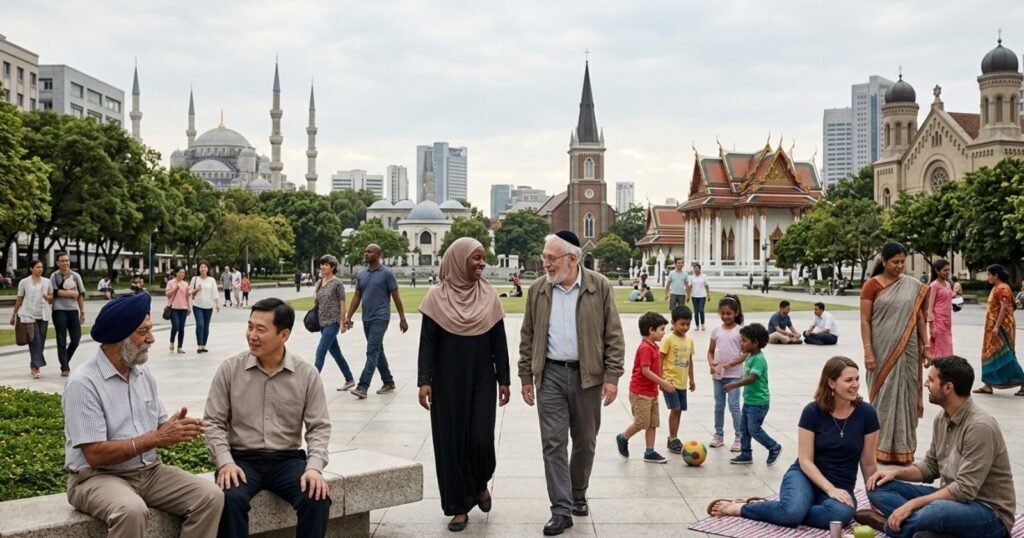
Singapore stands out as one of the most religiously diverse countries measured, with substantial populations of Buddhists, Christians, Muslims, Hindus, Taoists, and unaffiliated residents coexisting within a single small nation, according to its own 2020 census. By contrast, many countries in the Middle East and North Africa, and several in Latin America, show religious concentration levels above 85 to 90 percent in a single tradition.
How to Interpret Global Religion Statistics
Global religion statistics are assembled from an unusually heterogeneous set of sources, and that heterogeneity is the single most important thing for a reader to understand before treating any country-level figure as precise. Some countries collect religious affiliation directly through national censuses with mandatory or near-universal response, producing high-confidence figures. Others rely on periodic household surveys with sampling margins of error, and a smaller number of countries do not collect religious data at all, requiring researchers to build estimates from demographic modeling, migration data, and proxy indicators.
Self-identification is the near-universal basis for these statistics, meaning the numbers reflect what people say about their own religious identity in a census or survey, not independent verification of belief, practice, or doctrinal conformity. A person counted as Christian, Muslim, or Hindu in this data may attend religious services weekly, monthly, or never; the category captures identity, not observance.
Readers interested in religious practice and belief intensity, as distinct from raw population counts, should consult more granular Pew surveys that ask separately about worship attendance, prayer frequency, and belief in God, which consistently show wide variation in practice intensity within every major religious category tracked here.
Conclusion
The most striking finding in Pew’s 2025 comparison is not which religion is largest, Christianity, comfortably, but how close the next two categories sit behind it and how differently they are growing. Islam’s addition of 347 million people in a single decade, more than every other religion combined, reflects a young, high-fertility population structure that shows no sign of reversing soon, while the religiously unaffiliated have become the world’s third-largest category almost entirely through the demographic weight of a handful of large, secularizing countries, China chief among them. Buddhism’s decline in absolute numbers is the clearest reminder in this data that religious population size is, at its core, a function of fertility, mortality, and age structure layered on top of identity, not a simple referendum on belief.
Frequently Asked Questions
1. What is the largest religion in the world?
Christianity is the largest religious group globally, with approximately 2.27 billion adherents in 2020, or 28.8 percent of the world’s population, according to Pew Research Center.
2. How many Muslims are there worldwide?
Approximately 2.02 billion people, or 25.6 percent of the world’s population, identified as Muslim in 2020, making Islam the second-largest religious group globally and the fastest-growing of the major groups by absolute increase during the 2010s.
3. How many Christians are there worldwide?
Approximately 2.27 billion people identified as Christian in 2020, representing 28.8 percent of the global population, though this share has been gradually declining even as the absolute number continues to rise.
4. How many people have no religion?
Around 1.91 billion people, or 24.2 percent of the world’s population, were religiously unaffiliated in 2020, making this the third-largest category tracked by Pew, ahead of Hinduism, Buddhism, and Judaism.
5. Which religion is growing fastest?
Islam added the most people in absolute terms between 2010 and 2020, growing by 347 million, more than every other religious group’s growth combined, driven mainly by natural population increase in young, high-fertility Muslim-majority populations rather than conversion.
6. Which countries are the most religiously diverse?
Singapore is frequently cited as one of the world’s most religiously diverse countries, with substantial Buddhist, Christian, Muslim, Taoist, Hindu, and unaffiliated populations, none commanding an overwhelming majority.
7. Is Buddhism declining?
In absolute population terms, yes. Buddhism was the only one of the five major world religions tracked by Pew to shrink between 2010 and 2020, a result of its concentration in East Asian countries with low fertility and rising secularization.
8. Why is the religiously unaffiliated population concentrated in certain countries?
China alone accounts for a very large share of the global unaffiliated population, with roughly six in ten Chinese residents identifying as unaffiliated, reflecting both a history of religious suppression and rapid secularization, especially among younger urban residents.
9. Does religious population growth mean religion is becoming more important globally?
Not necessarily. Population growth in a religious category reflects birth rates, mortality, and migration among people who already identify with that religion; it does not measure whether religious belief, practice, or importance is intensifying or weakening among individuals.
10. How is religious affiliation measured globally?
Primarily through self-identification collected in national censuses and household surveys, supplemented by demographic modeling in countries that do not collect religious data directly. The measure captures stated identity, not verified belief or attendance.
Sources
- Pew Research Center, The World’s Religious Groups: How Their Sizes Changed From 2010 to 2020, published June 9, 2025
- Pew Research Center, Dataset of Global Religious Composition Estimates for 2010 and 2020
- Singapore Department of Statistics, Census of Population 2020, Religion
- Statistics Canada, Census of Population 2001, 2011, and 2021, religious affiliation tables
- Axios and Pew Research Center reporting on U.S. religious composition and projections to 2070