Burundi’s cities are growing so fast that its urban share is rising by more than 5 percentage points a year, faster than any other country on Earth, even though barely 15% of its population currently lives in an urban area at all. Meanwhile Japan, at nearly 93% urban, is barely moving: its urbanization rate has flattened because there is almost no rural population left to convert. This is the distinction that gets lost in most casual discussion of urbanization: how urban a country is and how fast it is urbanizing are two completely different numbers, and the countries that top one ranking rarely appear anywhere near the top of the other.
What Is the World Urbanization Rate?
Urbanization level and urbanization rate answer different questions. Urbanization level is a snapshot, the percentage of a population currently living in urban areas at a given moment. Urbanization rate measures change, specifically the pace at which that percentage is rising over a defined period, typically expressed as an annual percentage-point increase or, alternatively, as the annual growth rate of the urban population itself.
A country can have a very high urbanization level and a very low urbanization rate simultaneously, as in Japan, or the reverse, a low level and a blistering rate, as in Burundi. Confusing the two produces some of the most common errors in casual readings of urban statistics.
A closely related but distinct concept is urban population growth, the raw annual increase in the number of people living in urban areas, which combines the effects of migration, natural increase (births exceeding deaths among existing urban residents) and reclassification of settlements from rural to urban status.
Urbanization rate and urban population growth can move in different directions: a country’s urban population can keep growing in absolute numbers even after its urbanization rate (in percentage-point terms) has slowed to nearly zero, simply because its overall population is still expanding.
How Urbanized Is the World Today?
As context for the rate of change discussed below, the global urban share stood at roughly 57.5% under traditional national definitions as of 2023, or 45% specifically classified as “cities” under the UN’s newer Degree of Urbanization framework introduced in 2025, with a further 36% in towns. The world crossed the halfway mark, becoming majority urban for the first time in recorded history, around 2007.
How Fast Is Urbanization Happening?
Globally, the urban share has been rising at a pace of roughly 1.75% annually (in relative growth terms) between 2020 and 2025, translating into an average global urban population growth of about 65 million new urban dwellers added every year, or an estimated 1.5 million people moving into urban areas worldwide every week.
That global average, however, conceals an enormous range: developed regions such as North America and Europe, already 74 to 82% urban, are adding urban share only slowly, since so little rural population remains left to convert, while developing regions, especially sub-Saharan Africa and parts of South and Southeast Asia, are urbanizing at several multiples of the global pace.
Global and Regional Urban Growth Rates
| Region/Country | Annual Urban Population Growth Rate |
|---|---|
| Global average | ~2.0% |
| Sub-Saharan Africa | ~4.1% |
| Burundi (highest of any country, 2020-2025) | ~5.43% |
| Uganda | ~5.41% |
Source: CSIS, “Urbanization in Sub-Saharan Africa”; World Population Review, “Most Urbanized Countries 2026.”
Which Countries Are Urbanizing Fastest?
Ranked by the pace of change, urbanization leaders are overwhelmingly low-income, currently low-urbanization-level countries where even modest absolute rural-to-urban movement translates into a large percentage-point shift, since the starting urban base is small.
Fastest Urbanizing Countries, 2020-2025 (Annual Rate)
| Country | Urbanization Growth Rate | Current Urban Share |
|---|---|---|
| Burundi | 5.43% | ~14.8% |
| Uganda | 5.41% | ~26.8% |
| Tanzania, Mozambique, Niger, Malawi | 1.5-2+ percentage points/year through 2035 (projected) | low, rising rapidly |
Source: World Population Review, Most Urbanized Countries 2026; StatRanker, based on UN World Urbanization Prospects 2022 projections.
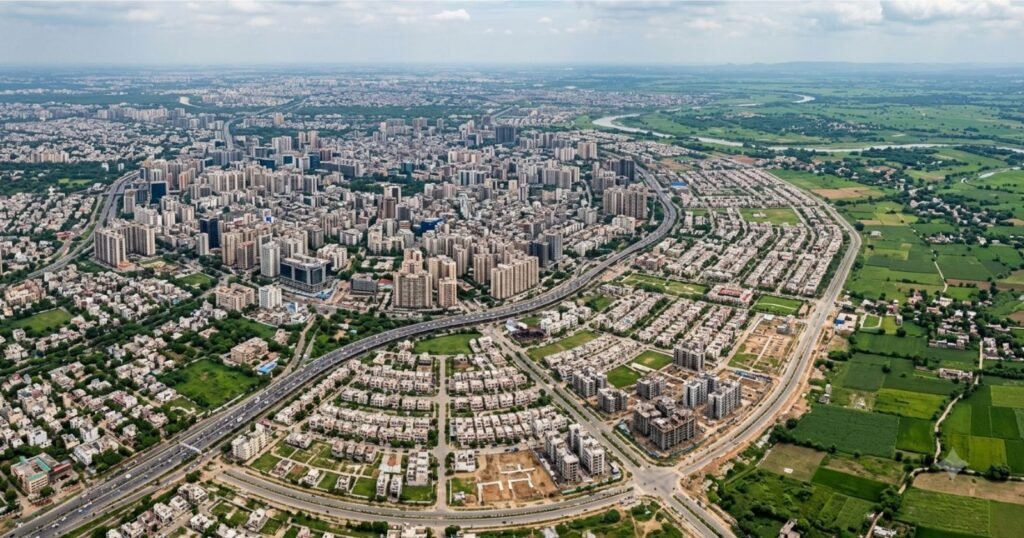
At the city level rather than the country level, the pattern intensifies further: the UN Population Division expects 28 cities worldwide to grow at an average annual rate above 5% during the first half of the 2020s, and 22 of those 28 are in Africa. A further 86 cities are expected to grow between 4 and 5% annually, 58 of them in Africa and 24 in Asia and the Middle East. The single fastest-growing city on the UN’s list is Gwagwalada, a satellite town of Nigeria’s capital Abuja, followed by Kabinda in the Democratic Republic of the Congo.
Notably, several of the world’s fastest-growing cities, including three in Yemen along with Mazar-e-Sharif in Afghanistan and Aleppo in Syria, owe their rapid growth to conflict-driven displacement rather than conventional economic urbanization, a reminder that a high urban growth rate does not always signal economic opportunity.
Where Urbanization Is Already Highly Advanced
At the opposite extreme, countries that are already highly urbanized necessarily show slow urbanization rates, not because their cities have stopped growing, but because there is comparatively little rural population left to convert into urban.
Twelve countries and territories, Singapore, Hong Kong, Anguilla, Bermuda, Gibraltar, the Cayman Islands, Kuwait, Monaco, the Holy See, Macao, Nauru and Sint Maarten, are recorded as effectively 100% urban, leaving essentially zero room for further percentage-point growth in their urban share by definition.
Japan, at roughly 92.7% urban, and other mature, high-income economies show similarly minimal urbanization rate figures despite continuing, if modest, absolute urban population change driven by internal migration between cities rather than genuine rural-to-urban conversion.
Where the Biggest Urban Transition Is Happening
Sub-Saharan Africa is widely regarded as the world’s fastest-urbanizing major region: its urban population has more than doubled over the past 25 years and currently stands at roughly 472 million people, a figure projected to double again over the next 25 years. The region’s global share of urban residents is projected to rise from 11.3% in 2010 to 20.2% by 2050.
Eastern Asia experienced the most rapid urbanization of any region over roughly the past 20 years, driven overwhelmingly by China, which added an estimated 500 million urban residents between 1990 and 2020, the largest sustained rural-to-urban migration in human history, accomplished in part by building hundreds of entirely new cities, complete with highways, metro systems and skyscrapers, in under a decade in some cases.
South Africa, at nearly 69% urban, is already far ahead of the sub-Saharan African regional average, while Ethiopia, at roughly 24% urban, illustrates how much variation exists within the same region even among countries at similar income levels, underscoring that regional averages can obscure enormous underlying diversity.
What Drives Urbanization?
Multiple, often overlapping mechanisms drive urbanization rate specifically, distinct from the broader urban population growth drivers already covered in the companion piece on world urban population:
- Rural-to-urban migration driven by wage differentials, employment opportunities, and access to services such as healthcare and education, remains the dominant classic driver in rapidly urbanizing developing countries.
- High rural birth rates combined with urban migration of young adults compounds urbanization rate specifically, since it is disproportionately working-age adults who relocate to cities, concentrating population growth in urban areas even where overall national fertility remains similar between rural and urban populations.
- Administrative reclassification, where population growth pushes a settlement across a national urban-threshold definition without requiring any migration at all, contributes measurably to recorded urbanization rate in some countries.
- Conflict and displacement, visible in the presence of Yemeni, Afghan and Syrian cities among the world’s fastest-growing, drive urbanization rate through displacement into urban areas perceived as safer, rather than through voluntary economic migration.
- Urban expansion and informal settlement growth, particularly across sub-Saharan Africa, where an estimated 60% of urban residents live in informal settlements or slums, illustrates that rapid urbanization rate does not necessarily correspond to adequate housing or infrastructure investment keeping pace.
Urbanization and Population Growth Are Not the Same
It is worth stating plainly, because the two concepts are routinely conflated: a country’s total population can grow rapidly while its urbanization rate (the percentage-point change in urban share) remains low, if rural and urban populations are both growing at similar rates. Conversely, a country’s total population can be stable or declining while its urbanization rate continues rising, if rural residents are moving to cities even as the overall national population shrinks, a pattern increasingly visible in parts of Eastern Europe and East Asia facing demographic decline.
China illustrates a related but distinct pattern: its urbanization rate has slowed considerably as it approaches roughly 70% urban, not because urban population growth has stopped, but because the country has already completed the bulk of the historic rural-to-urban transition that drove its rapid urbanization rate through the 1990s, 2000s and 2010s.
Future Urbanization
The UN’s central projection anticipates the global urban share reaching 68% by 2050, up from just over half today, adding roughly 2.5 billion people to the world’s urban population, with about 90% of that increase concentrated in Asia and Africa specifically.
Sub-Saharan Africa is projected to reach approximately 50% urban sometime around 2035 to 2040, while South Asia, dominated by India, is projected to cross the same 50% threshold sometime in the 2040s, according to UN World Urbanization Prospects-based projections. These figures should be read as one plausible trajectory rather than a certainty, since urbanization rate is sensitive to economic conditions, conflict, climate pressures and policy choices that can shift meaningfully over a 25-year projection horizon.
What Rapid Urbanization Means for Cities
Fast urbanization rate places acute pressure on infrastructure that, in many of the highest-growth cities, has not kept pace with population change.
Roughly 55% of Africa’s urban population lived in slum or informal-settlement conditions as of the most recent comparative data, compared with around 30% in Asia and 20% in Latin America, a gap that reflects how far infrastructure investment has lagged behind the pace of urban growth specifically in the regions urbanizing fastest.
Transport congestion, strained water and sanitation systems, and housing shortages are common features of cities experiencing rapid urbanization rate, particularly where that growth stems from informal settlement expansion rather than planned urban development.
Employment absorption is a further challenge: cities growing at 4 to 5% annually or faster must generate enough jobs to match population growth simply to hold unemployment steady, a bar that many of the fastest-growing cities in Africa and parts of Asia have struggled to clear.
Key Findings
- Burundi has the world’s fastest urbanization rate, 5.43% annually between 2020 and 2025, despite having one of the lowest urban shares of any country, only about 14.8%.
- Twelve countries and territories, including Singapore, Hong Kong, Kuwait, Monaco and the Holy See, are effectively 100% urban, meaning their urbanization rate has necessarily flattened simply because no further rural population remains to convert.
- Sub-Saharan Africa’s urban population, currently about 472 million, is projected to double again over the next 25 years, with the region’s global share of urban residents rising from 11.3% in 2010 to a projected 20.2% by 2050.
- China added an estimated 500 million urban residents between 1990 and 2020, the largest sustained rural-to-urban migration in human history, but its urbanization rate has since slowed considerably as it approaches roughly 70% urban.
- Of the 28 cities worldwide expected to grow faster than 5% annually in the early 2020s, 22 are in Africa, and several of the world’s fastest-growing cities, in Yemen, Afghanistan and Syria, owe their growth to conflict displacement rather than economic opportunity.
- The global urban share is projected to reach 68% by 2050, adding roughly 2.5 billion people to the world’s urban population, with about 90% of that growth concentrated in Asia and Africa.
Frequently Asked Questions
1. What is the global urbanization rate?
The world’s urban population has been growing at roughly 2% annually in recent years, translating into an urban share rising from just over half today toward a projected 68% by 2050.
2. Which countries are urbanizing fastest?
Burundi currently has the world’s fastest urbanization rate, at 5.43% annually between 2020 and 2025, followed closely by Uganda at 5.41%, both starting from comparatively low urban population shares.
3. What causes urbanization?
The main drivers include rural-to-urban migration for employment and services, natural population increase concentrated in growing cities, administrative reclassification of settlements, and, in some cases, conflict-driven displacement into urban areas.
4. Is urbanization slowing globally?
The pace varies enormously by region. It has slowed considerably in already highly urbanized regions like North America, Europe and China, while continuing rapidly, and in some cases accelerating, across sub-Saharan Africa and parts of South Asia.
5. How urban will the world become?
The UN projects the global urban share will reach 68% by 2050, up from just over half today, with roughly 90% of the additional 2.5 billion urban residents concentrated in Asia and Africa.
6. What is the difference between urbanization level and urbanization rate?
Urbanization level is a snapshot, the current percentage of a population living in urban areas. Urbanization rate measures the pace of change in that percentage over time, and the two can move in opposite directions, as with Japan’s very high level but very low rate.
7. Why do countries with high urban populations sometimes have low urbanization rates?
Because once a country is already highly urbanized, there is little remaining rural population left to convert into urban, mechanically limiting how much further its urban share can rise, even if its cities continue growing in absolute population terms.
8. Which cities are growing fastest in the world?
Gwagwalada, a satellite town of Nigeria’s capital Abuja, and Kabinda in the Democratic Republic of the Congo top the UN’s list of fastest-growing cities, part of a broader group of 28 cities, 22 of them in Africa, expected to grow faster than 5% annually in the early 2020s.
9. Is rapid urbanization always a sign of economic progress?
Not necessarily. While urbanization is broadly associated with economic development, several of the world’s fastest-growing cities, including ones in Yemen, Afghanistan and Syria, owe their rapid growth to conflict-driven displacement rather than voluntary economic migration.
10. Which region will urbanize fastest through 2050?
Sub-Saharan Africa is expected to remain the world’s fastest-urbanizing major region, projected to reach approximately 50% urban sometime between 2035 and 2040, with its urban population roughly doubling from current levels over the next 25 years.
Sources
- United Nations Department of Economic and Social Affairs (UN DESA), Population Division, World Urbanization Prospects 2025: Summary of Results
- CSIS, “Urbanization in Sub-Saharan Africa,” 2026
- World Population Review, “Most Urbanized Countries 2026”
- StatRanker, “TOP 30 Most Urbanized Countries (2025)” and “Top 100 Countries by Urbanization Rate,” citing UN World Urbanization Prospects 2022
- Statista, “The Fastest Growing Cities in the World,” citing UN Population Division data
- Geography Worlds, “Urbanization Trends 2025: How the World Is Moving to Cities”