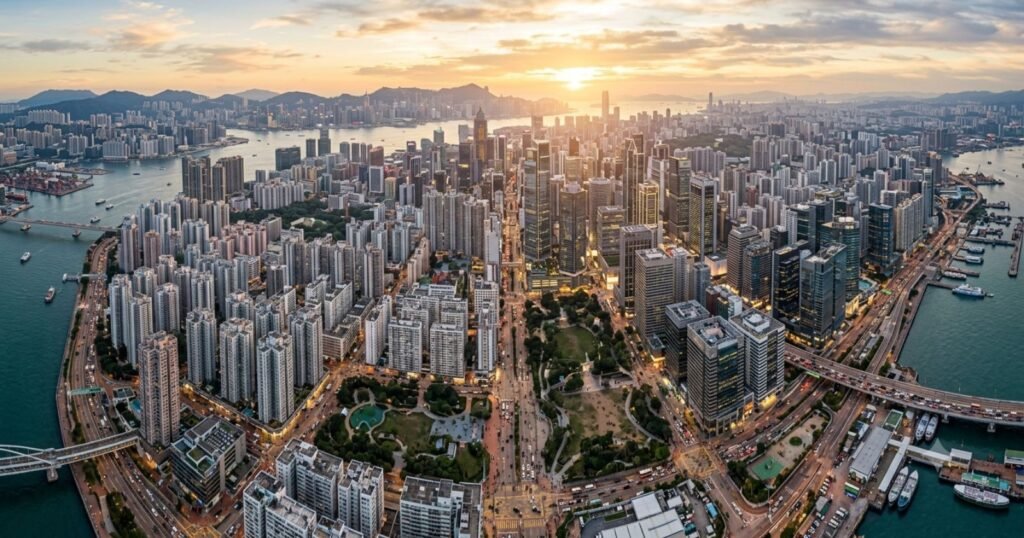
More than 4.7 billion people now live in urban areas, according to World Bank data built on national definitions, putting the global urban share at roughly 57 to 58% as of the mid-2020s. Measured a stricter way, using the United Nations’ newly standardized “Degree of Urbanization” framework introduced in 2025, the figure looks different again: 45% of the world’s 8.2 billion people live specifically in cities, with another 36% in towns and only 19% in rural areas. Both figures are correct. They simply answer slightly different questions, and the gap between them is the first thing anyone trying to understand global urbanization needs to grasp before comparing any two countries’ urban statistics.
How Many People Live in Urban Areas?
Under the traditional, nationally-defined measure that most global databases still report as the headline “urban population” figure, the world crossed the halfway mark, a majority urban planet, sometime around 2007. By 2023, the World Bank recorded the global urban share at 57.5%, on a trajectory of roughly 1.75% annual urban population growth between 2020 and 2025. That translates to well over 4.7 billion urban residents out of a global population of approximately 8.2 billion.
Global Urban Population, Key Figures
| Metric | Figure | Year |
|---|---|---|
| Global urban population (national definitions) | ~4.7 billion | 2024-2025 |
| Global urban share (national definitions) | ~57.5% | 2023 |
| Global urban population, 1950 | 751 million | 1950 |
| Global urban share, 1950 | ~30% (national definitions) / 20% (Degree of Urbanization) | 1950 |
| Global “city” population (UN Degree of Urbanization) | 45% of 8.2 billion | 2025 |
| Global “town” population (UN Degree of Urbanization) | 36% of 8.2 billion | 2025 |
| Global rural population (UN Degree of Urbanization) | 19% of 8.2 billion | 2025 |
Sources: World Bank Open Data (SP.URB.TOTL.IN.ZS); UN DESA, World Urbanization Prospects 2025: Summary of Results.
Whichever framework is used, the underlying story is the same: the share of humanity living outside a rural setting has climbed steadily and consistently since at least 1950, more than doubling under the UN’s new city-specific metric alone.
What Counts as Urban?
This is the single most consequential methodological question in global urban statistics, because “urban” is not defined the same way in every country. Most nations classify settlements as urban or rural using their own criteria, population thresholds that range from as low as 200 residents in some countries to over 50,000 in others, administrative status, population density, or some combination of the three. Because these thresholds differ so widely, comparing the “urban population” of two countries using national definitions alone can be misleading: a settlement of 2,000 people might count as urban in one country and rural in another.
In 2025, the UN Population Division adopted a new, harmonized alternative for its World Urbanization Prospects report: the Degree of Urbanization, a spatially-based method that classifies every settlement worldwide into one of three tiers, cities, towns, or rural areas, using a globally consistent population density and size grid rather than relying on each country’s own definition.
Under this framework, the 2025 global population splits into 45% in cities, 36% in towns, and 19% rural, a meaningfully different picture from the roughly 57.5% urban figure produced by national definitions, because national definitions in many countries classify large numbers of “town”-scale settlements as fully urban, while the Degree of Urbanization keeps them in a distinct middle category.
This matters practically: towns remain the most common settlement type in 71 countries, including large, developed nations as different as Germany, India, Uganda and the United States, meaning a majority of the world’s countries are, by this stricter classification, primarily nations of towns rather than big cities or open countryside.
Where Does the Urban Population Live?
Urbanization is far from evenly spread across world regions. Northern America and Latin America and the Caribbean are the most urbanized major regions, both with roughly 81 to 82% of their population living in urban areas under national definitions, followed by Europe at around 74% and Oceania at around 68%.
Asia, despite having a comparatively lower urbanization level around 50%, is home to more urban residents than any other region in absolute terms, 53% of the entire world’s urban population, simply because of its enormous total population base.
Africa remains the least urbanized major region, with roughly 43% of its population in urban areas, though it is urbanizing faster in percentage-point terms than any other region, a dynamic covered in detail in the companion piece on urbanization rate.
Urban Population Share by Region (Approximate, National Definitions)
| Region | Urban Share |
|---|---|
| Northern America | ~82% |
| Latin America and the Caribbean | ~81% |
| Europe | ~74% |
| Oceania | ~68% |
| Asia | ~50% |
| Africa | ~43% |
Source: UN DESA, World Urbanization Prospects, national-definition estimates.
Countries With the Largest Urban Populations
In absolute terms, urban population size closely tracks total population size among the world’s most populous countries, though not perfectly.
Largest Urban Populations by Country
| Rank | Country | Urban Population |
|---|---|---|
| 1 | China | 944 million |
| 2 | India | 532 million |
| 3 | United States | 280 million |
Source: StatisticsTimes.com, “Countries by urban population 2026,” based on UN data.
China and India together account for more than 1.2 billion urban residents, representing over 40% of the entire world’s urban population under the UN’s newer town/city classification framework, an extraordinary concentration in just two countries. Notably, India also holds the largest rural population of any country, 945 million, followed by China’s 469 million, a reminder that a country can simultaneously have an enormous urban population and an enormous rural one; the two are not mutually exclusive at this scale.
Countries With the Highest Urban Shares
Ranked by percentage rather than absolute size, an almost entirely different group of countries and territories leads the field, small city-states and highly urbanized microstates dominate.
Highest Urban Population Shares
| Country/Territory | Urban Share |
|---|---|
| Hong Kong (and several city-states) | ~100% |
| Several Gulf states and small territories | 90%+ |
| Japan | ~92.7% |
| Brazil | ~87.6% |
| Mexico | ~81% |
Thirty-nine countries and territories have achieved urbanization above 90%, and 71 have surpassed 80%, according to UN-based compilations. At the opposite extreme, 69 of the world’s 237 countries and territories still have more than half their population living rurally, and eight countries have as much as 80% of their population in rural areas. Tokelau and the Wallis and Futuna Islands stand out as the only territories where the UN records 100% of the population as rural.
How Urban Population Has Changed
The long-run trajectory shows both dramatic absolute growth and a steady rise in urban share. The global urban population grew from 746 million in 1950 to roughly 3.9 billion by 2014, and under the UN’s 2025 Degree of Urbanization framework, the “city” share alone has more than doubled since 1950, from about 20% to 45% today.
Under the traditional national-definitions measure, the global urban share climbed from around 30% in 1950 to 57.5% by 2023, a trajectory expected to continue: the UN’s earlier 2018 projections anticipated 66% of the world urban by 2050, and even under the newer, stricter city/town/rural split, the combined city-plus-town share is expected to keep expanding as the rural share continues its gradual decline.
Why Urban Populations Are Growing
Urban population growth reflects several distinct mechanisms operating simultaneously, not a single cause:
- Rural-to-urban migration, the classic driver, remains significant in rapidly urbanizing regions, particularly sub-Saharan Africa and parts of South and Southeast Asia.
- Natural increase within existing urban populations, meaning births to residents already living in cities, now accounts for a substantial share of urban growth in many countries, sometimes exceeding the contribution from migration alone.
- Administrative reclassification, where a settlement’s status changes from rural to urban due to population growth crossing a national threshold or a formal boundary extension, without any physical movement of people at all.
- Urban boundary expansion, where growing metropolitan areas physically annex or absorb previously separate rural or peri-urban settlements.
Seven countries, India, Nigeria, Pakistan, the Democratic Republic of the Congo, Egypt, Bangladesh and Ethiopia, are projected to account for more than half of all new city dwellers added worldwide between 2025 and 2050, according to the UN’s 2025 projections, concentrating future urban growth even more heavily than in past decades.
Urban Versus Rural Population
Under the UN’s newer three-tier classification, the balance among cities, towns and rural areas has shifted decisively over 75 years: the town share held roughly steady at around 40% in earlier periods before easing to 36% by 2025, while the rural share fell by half over the same broad period, from roughly 38% down to just 19%.
Global rural population, in absolute terms, is now approaching what the UN describes as its peak size, expected to plateau and then gradually decline in the coming decades even as the world’s total population continues to grow, meaning essentially all future population growth will be absorbed by cities and towns rather than the countryside.
What a More Urban World Means
A steadily more urban global population carries direct implications across several dimensions of daily life and infrastructure planning. Housing demand concentrates disproportionately in and around expanding cities, often outpacing construction and driving affordability pressure in fast-growing metropolitan areas. Transport networks, water and sanitation systems, and energy grids all face growing load in cities that, in many rapidly urbanizing countries, were not originally built to accommodate current population levels.
Employment patterns shift decisively toward urban labor markets, reinforcing the very migration flows that helped drive urbanization in the first place. And because two-thirds of the world’s population growth between now and 2050 is projected to occur specifically within cities, with most of the remainder in towns, planning capacity in these fast-growing urban centers, particularly across sub-Saharan Africa and South Asia, will substantially determine how well the next few decades of global population growth translate into livable, functional communities.
Key Findings
- Under traditional national definitions, roughly 57.5% of the world’s population, about 4.7 billion people, lived in urban areas as of 2023-2025.
- Under the UN’s newer, harmonized Degree of Urbanization framework introduced in 2025, only 45% of the world’s population lives specifically in cities, with 36% in towns and 19% rural, a materially different picture from the traditional measure.
- China (944 million) and India (532 million) have the largest urban populations of any country, together accounting for more than 40% of the world’s total urban population.
- Northern America and Latin America and the Caribbean are the most urbanized major world regions, both around 81-82%, while Africa remains the least urbanized at roughly 43%, despite urbanizing faster than any other region.
- Seven countries, India, Nigeria, Pakistan, the DRC, Egypt, Bangladesh and Ethiopia, are projected to account for over half of all new urban dwellers added worldwide between 2025 and 2050.
- The global rural population is approaching its historical peak size and is expected to plateau and then decline even as total world population continues growing, meaning nearly all future population growth will occur in cities and towns.
Frequently Asked Questions
1. What percentage of the world lives in cities?
Depending on methodology, roughly 57.5% of the world’s population lives in urban areas under traditional national definitions, or specifically 45% in “cities” under the UN’s newer, stricter Degree of Urbanization framework introduced in 2025, with an additional 36% living in towns.
2. Which country has the largest urban population?
China has the largest urban population of any country, about 944 million people, followed by India at 532 million and the United States at 280 million.
3. Is the world more urban or rural?
The world is majority urban under both major measurement frameworks, though the specific share depends on definition: about 57.5% urban under national definitions, or 45% specifically classified as “city” residents (with another 36% in towns) under the UN’s 2025 Degree of Urbanization standard.
4. How fast is the urban population growing?
The global urban population has been growing at roughly 1.75% annually in the early 2020s, though growth rates vary enormously by country and region, with the fastest expansion concentrated in sub-Saharan Africa and South Asia.
5. What is the difference between a city and a town under UN classifications?
The UN’s 2025 Degree of Urbanization framework distinguishes cities and towns using a standardized, spatially-based population density and size grid rather than relying on each country’s own definition, with towns representing a distinct intermediate settlement type rather than being folded entirely into either “urban” or “rural” categories.
6. Which countries are fully urbanized?
Thirty-nine countries and territories have urbanization levels above 90%, and several small city-states and territories, such as Hong Kong, are effectively at or near 100% urban.
7. Which countries remain mostly rural?
Sixty-nine of the world’s 237 countries and territories still have more than half their population living rurally, and eight countries have as much as 80% of their population in rural areas.
8. Why do urban population figures vary between sources?
Because “urban” is defined differently in different countries and by different international frameworks; a settlement that counts as urban in one country’s national statistics might be classified as a “town” or even rural under the UN’s newer, more standardized Degree of Urbanization method.
9. Why is the urban population growing even where migration to cities has slowed?
In many countries, natural increase, meaning births to people already living in urban areas, now contributes as much or more to urban population growth as new migration from rural areas, alongside administrative reclassification of settlements and physical expansion of city boundaries.
10. Which countries will drive future urban population growth?
Seven countries, India, Nigeria, Pakistan, the Democratic Republic of the Congo, Egypt, Bangladesh and Ethiopia, are projected to account for more than half of all new city dwellers added globally between 2025 and 2050.
Sources
- United Nations Department of Economic and Social Affairs (UN DESA), Population Division, World Urbanization Prospects 2025: Summary of Results, November 2025
- UN DESA, World Urbanization Prospects 2025: Dataset
- World Bank Open Data, “Urban population (% of total population),” SP.URB.TOTL.IN.ZS
- StatisticsTimes.com, “Countries by urban population 2026”
- World Population Review, “Most Urbanized Countries 2026”
- SDG Local Action, “Released: World Urbanization Prospects 2025”