In 2010, three out of four people in Europe identified as Christian. Ten years later, that number had fallen to two out of three, an eight-point drop that Pew Research Center’s senior demographer Conrad Hackett has called one of the fastest religious composition shifts recorded anywhere in the world over such a short period. This is not a story about Christianity disappearing from Europe, it remains by far the continent’s largest religious group, but about a genuine and measurable transformation in how Europeans identify religiously, driven less by migration than by something quieter and more pervasive, millions of people raised Christian simply stopping calling themselves Christian at all.
How Europe’s Religious Population Is Actually Measured
Before any numbers, a methodology note matters more here than in almost any other topic in this data series. Some European countries collect religion directly through their national census, Austria, Czechia, Hungary, and Poland among them. Others rely entirely on survey data, since asking about religion in a census is illegal or politically sensitive in several countries, including France, for constitutional secularism reasons.
Pew Research Center, the primary source for the continent-wide figures in this article, combines census data where available with the European Social Survey, Eurobarometer, and other nationally representative surveys to build a consistent cross-country estimate, but the underlying methodology still varies by country, and self-identified religious affiliation is a different measure entirely from religious belief or practice, a distinction this article maintains throughout.
Europe’s Religious Composition, the Big Picture
| Religious Group | Population, 2020 | Share of Europe | Change Since 2010 |
|---|---|---|---|
| Christian | 505 million | 67% | Down from 74%, population fell 9% |
| Religiously unaffiliated | approx 188 million | 25% | Up from 19%, population grew 37% |
| Muslim | approx 45 million | 6% | Up from approx 4%, population grew 15.9% |
| Jewish | 1.3 million | 0.2% | Down from 1.4 million, population fell 8% |
| Hindu, Buddhist, and other | remainder | approx 1.6% | Modest growth in absolute terms |
Source: Pew Research Center, Religion in Europe, 2010 to 2020 data, published 2025. Europe’s total population in this dataset was approximately 753 million in 2020.
The unaffiliated population’s 37 percent growth stands out as the sharpest movement of any group Pew tracked, a swing entirely disproportionate to Europe’s overall population growth of just 2 percent over the same decade. That mismatch is the clearest evidence that this shift is about religious identification changing, not about which groups are having more children or migrating in greater numbers.
Europe’s Christian Population, Still Dominant, Still Shrinking
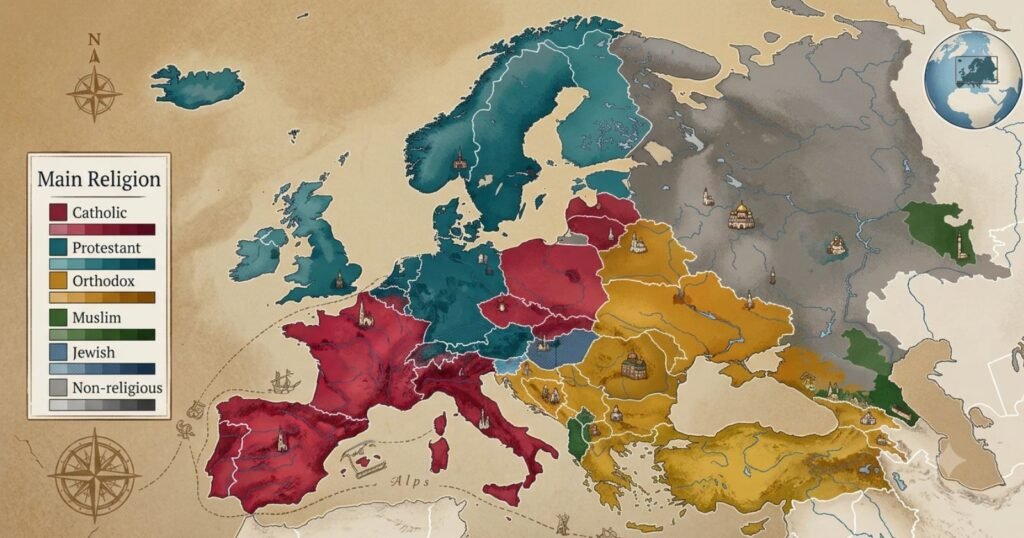
Christianity remains Europe’s majority religion in most individual countries even as its continental share declines, but the decline is neither uniform nor evenly distributed across its major branches. Catholicism remains the largest Christian tradition, dominant across Southern Europe, Ireland, Poland, and much of Central Europe.
Eastern Orthodoxy holds a strong majority across Russia, Greece, Romania, Bulgaria, Serbia, and much of the Balkans and former Soviet space. Protestantism, in its many denominational forms, remains historically dominant across Northern Europe, Scandinavia, the UK, and Germany, though it has also seen some of the steepest disaffiliation rates of any Christian branch, particularly in Sweden, where the state Church of Sweden’s claimed membership fell from 82.9 percent of the population in 2000 to 56.4 percent by 2019.
According to the 2019 Eurobarometer survey, Catholics account for 41 percent of the EU population specifically, Eastern Orthodox 10 percent, Protestants 9 percent, and other Christian denominations a further 4 percent, together still comprising 64 percent of the EU total, itself down from 72 percent in 2012, a seven-point fall in just seven years within the EU alone.
The Rise of the Religiously Unaffiliated
France and the United Kingdom lost their Christian majorities entirely between 2010 and 2020, and the Netherlands crossed into unaffiliated-majority territory over roughly the same period, with its non-religious share climbing from about 45 percent to 56 percent between 2010 and 2024. The United Kingdom recorded the single steepest shift of any country Pew tracked, its Christian share falling by 13 percentage points while its unaffiliated share rose by 11 points in just ten years.
Czechia leads Europe in unaffiliated share by a wide margin, with Pew’s most recent figures placing the country’s non-religious population at 78.4 percent, followed by Estonia at 60.2 percent and Latvia at 45.3 percent. This pattern is generational rather than uniform across age groups, younger Europeans raised nominally Christian are disaffiliating at far higher rates than their parents’ or grandparents’ generations did at the same age, a trend demographers describe as religious switching rather than simple secularization of an unchanging population.
Muslim Population in Europe
Europe’s Muslim population reached approximately 45 to 50 million by the mid-2020s, representing roughly 6 to 7 percent of the continent’s total population, a share that has grown gradually rather than dramatically over the past decade. This growth reflects several overlapping mechanisms rather than migration alone.
Continued migration from Muslim-majority countries in the Middle East, South Asia, and North Africa remains a factor, but Europe’s Muslim population also has a younger age structure and, in the 2010 to 2015 period specifically, a higher fertility rate, 2.1 children per woman against Europe’s overall 1.6, than the continent’s Christian or unaffiliated populations, meaning natural increase now contributes meaningfully to Muslim population growth independent of any new arrivals.
A 2017 Pew study also found that religious conversion works modestly against Muslim population growth in Europe, with roughly 160,000 more people leaving Islam than converting into it between 2010 and 2016, meaning switching is not a growth driver for this particular group the way it has been for the unaffiliated.
Muslim population concentration varies enormously by country. Kosovo and Albania are Muslim-majority by historical Ottoman-era conversion rather than recent migration, with Kosovo’s Muslim share around 94 to 96 percent, the highest in Europe. Albania’s Muslim population has fallen below 50 percent for the first time in centuries according to recent reporting, now forming a plurality rather than a majority.
Bosnia and Herzegovina sits close to a Muslim plurality or narrow majority depending on the source, generally cited between 46.5 and 51 percent. Beyond the Balkans, Muslim population shares run considerably lower, estimated at 7 to 9 percent in France, roughly 6 percent in the Netherlands, around 5 percent in Denmark, the UK, and Germany, and lower still, generally under 5 percent, across most of Southern and Central Europe.
Jewish Population in Europe
Europe’s Jewish population tells a story shaped overwhelmingly by twentieth-century history rather than recent demographic trends. The Holocaust, perpetrated by Nazi Germany, devastated a Jewish population that had once been widely distributed across the continent, and Europe’s Jewish population has never recovered to anything close to its prewar size.
Today’s Jewish population, estimated at 1.3 to 1.4 million, or roughly 0.2 percent of Europe’s total, continues a slow decline, having fallen by 8 percent between 2010 and 2020 alone, driven by an aging population structure, a low fertility rate of 1.8 children per woman, and continued emigration, much of it toward Israel.
France remains home to Europe’s largest Jewish community today, an estimated 483,000 to 500,000 people, about 1 percent of the French population, followed by the United Kingdom at roughly 291,000 and Russia at approximately 194,000, the largest Jewish community in Eastern Europe specifically.
Europe’s Jewish population also carries the highest median age of any religious group tracked in this data, 52 years, reflecting both the community’s demographic history and its low fertility relative to Europe’s other religious groups.
Other Religious Communities
Hinduism, Buddhism, Sikhism, and a range of smaller faiths together account for a modest but growing share of Europe’s population, concentrated overwhelmingly in specific migrant-origin communities rather than distributed evenly across the continent.
Europe’s Hindu population reached an estimated 2.15 million by 2020, growing fastest in the UK, France, the Netherlands, and Italy, with distinct origin communities in different countries, Gujarati migrants from Mozambique concentrated around Lisbon, Punjabi and Sindhi communities in Spain, Sri Lankan Tamil communities in France and Germany, and Surinamese Hindus concentrated in the Netherlands.
Sikhism counts nearly 700,000 adherents across Europe, the large majority, around 450,000, in the United Kingdom, with a further 100,000 in Italy.
Buddhism, often described as Europe’s fastest-growing religion in relative terms, has approximately 3 million adherents, though Kalmykia, a region of Russia, is the only part of Europe where Buddhism forms the predominant local faith historically rather than through recent migration or conversion.
Religion by Country, the Extremes
| Category | Country | Share |
|---|---|---|
| Highest Christian share | Multiple countries above 90%, including Malta, Romania, Poland | 90%+ |
| Highest Muslim share | Kosovo | 94% to 96% |
| Highest unaffiliated share | Czechia | 78.4% |
| Second highest unaffiliated | Estonia | 60.2% |
| Largest Jewish community, absolute | France | 483,000 to 500,000 |
| Largest Jewish community, Eastern Europe | Russia | approx 194,000 |
Source: Pew Research Center and national census data as compiled in Wikipedia’s Religion in Europe overview, various reference years 2019 to 2025.
Europe’s Religious Geography
Europe’s religious map divides fairly cleanly along regional lines shaped by centuries of church history rather than current national borders alone. Catholicism dominates Southern Europe, Ireland, Poland, and much of Central Europe, a legacy of the Latin Church’s historical reach. Eastern Orthodoxy dominates Eastern and Southeastern Europe, tracing the boundary of the 11th century Great Schism that split Western and Eastern Christianity.
Protestantism holds its strongest historical position across Northern Europe and the UK, following the geography of the 16th century Reformation. The religiously unaffiliated are most concentrated in a cluster of countries with a shared history of either state communism, Czechia and Estonia among them, or a strong tradition of secular governance, France and the Netherlands specifically.
Islam’s strongest historical presence sits in the Balkans, a legacy of centuries of Ottoman rule, while its more recent growth is concentrated in Western European countries with large twentieth and twenty-first century migrant communities from Muslim-majority regions.
What Could Europe’s Religious Population Look Like by 2050
Pew Research Center’s long-range modeling, built from a 2010 baseline, projects Christianity’s population falling further, from 553 million in 2010 to approximately 454 million by 2050, even as it likely remains Europe’s single largest religious group throughout that period. The same modeling projects Europe’s Muslim population growing by approximately 63 percent over the same 40-year span, from 43 million to roughly 71 million, driven by the combination of younger age structure, above-average fertility, and continued migration described earlier in this article.
The religiously unaffiliated population is projected to grow more modestly in absolute terms, from 140 million to about 162 million, even as its share of Europe’s total population may plateau somewhat as the continent’s overall population shrinks and ages, a dynamic covered in more depth elsewhere in this data series. Jewish population is projected to continue its slow decline, from 1.4 million to approximately 1.2 million. These figures should be read as one scenario built on 2010 to 2015 fertility and switching assumptions rather than a certainty, since religious switching patterns in particular have historically proven difficult to project accurately over multi-decade horizons.
Key Takeaways
- Christianity fell from 74% of Europe’s population in 2010 to 67% by 2020, still the largest religious group by a wide margin
- The religiously unaffiliated grew 37% in absolute numbers over the same decade, the fastest growth of any group tracked
- France and the UK lost their Christian majorities entirely between 2010 and 2020, and the Netherlands gained an unaffiliated majority
- Europe’s Muslim population reached roughly 6 to 7% of the total by the mid-2020s, growing through fertility and age structure as much as migration
- Europe’s Jewish population, at 1.3 to 1.4 million, remains far below its prewar size and continues a slow decline
- Czechia has Europe’s highest unaffiliated share at 78.4%, followed by Estonia at 60.2%
- Kosovo has Europe’s highest Muslim share at roughly 94 to 96%, a legacy of Ottoman-era history rather than recent migration
- Religious switching, people raised in one tradition adopting another or none, is a larger driver of Europe’s changing religious map than migration alone
- Pew projects Christianity’s population falling to about 454 million by 2050 while remaining Europe’s largest group
- Europe’s religious data should always be read alongside its collection methodology, since census-based and survey-based figures are not directly comparable across countries
Sources
- Pew Research Center, Religion in Europe, published 9 June 2025, covering 2010 to 2020 changes.
- Pew Research Center, Global Religious Futures Project, 2010 to 2050 projections, published 2015.
- Eurobarometer, Discrimination in the European Union, Special Eurobarometer 493, 2019.
- Wikipedia, Religion in Europe, compiled national census and survey data.