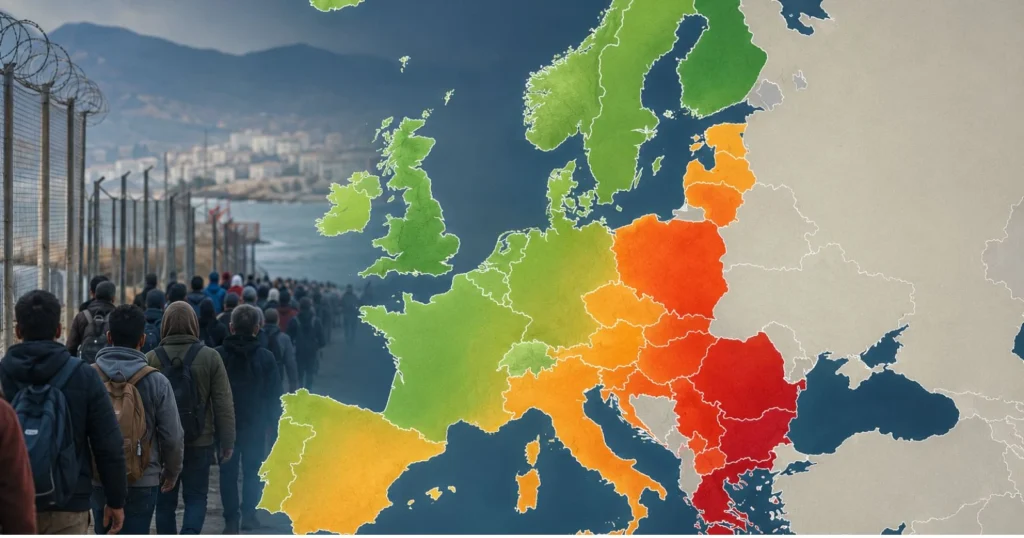
Europe is no longer moving in one direction on migration. While campaign slogans across the continent often sound similar, tougher borders, faster deportations, and stricter asylum rules, the actual policies on the ground in 2026 tell a much more divided story.
Spain is handing legal status to hundreds of thousands of undocumented residents at the same time Greece is suspending asylum applications outright. Ranking five of Europe’s most consequential countries from softest to strictest reveals just how far apart these approaches have grown, and how closely each stance tracks the politics of the party currently in power.
Spain: The Most Welcoming Country in Europe Right Now
Spain sits clearly at the top of the list as Europe’s most accommodating major country on migration in 2026, a direct reflection of Prime Minister Pedro Sánchez’s leftist coalition government. Madrid has moved to grant legal residency and work permits to roughly 500,000 undocumented migrants already living in the country, with more than a million people reportedly applying for the program. Sánchez has defended the policy on economic grounds, arguing that Spain’s aging population and shrinking workforce make sustained immigration a demographic necessity rather than a political favor.
Spain’s judiciary has reinforced this welcoming posture. A June 29 Supreme Court ruling limited the ability of authorities to summarily return migrants who arrive by sea in Ceuta and Melilla without due process, a decision that, however unintentionally, contributed to a historic surge of crossings into Ceuta in late July, when tens of thousands of people entered the enclave in roughly 24 hours. Even amid that crisis, Sánchez avoided rolling back the underlying legal protections, instead blaming smuggling networks for exploiting the ruling rather than calling for its reversal.
This is not a policy without critics. Conservative and far-right opposition figures, including Vox leader Santiago Abascal and Madrid regional president Isabel Díaz Ayuso, have accused the government of inviting chaos through its welcoming stance. But as of mid 2026, Spain’s national policy direction remains firmly the softest on this list.
United Kingdom: Enforcement Focused but Comparatively Moderate
The United Kingdom lands in a notably more moderate position than its tough public rhetoric might suggest. Under the Labour government led by Home Secretary Shabana Mahmood, the UK has pursued a strategy built around cooperation rather than pure deterrence, including a three year, 662 million pound agreement with France to fund expanded beach patrols and a pilot one in, one out returns scheme introduced in August 2025 that allows the UK to return some Channel arrivals to France in exchange for accepting an equal number of asylum seekers who have not attempted the crossing.
The results have been measurable without being harsh in the way continental crackdowns have been. Small boat crossings fell 12 percent in the first half of 2026 compared with the same period in 2024, and overall net migration to the UK dropped 48 percent to about 171,100 in 2025, the lowest level since 2012 outside the pandemic years.
Notably, asylum seekers who do arrive by small boat have historically been granted protection at a rate of 62 percent, a considerably higher approval rate than the general asylum applicant pool, suggesting the UK system remains relatively open to genuine claims even as it works to reduce irregular arrivals.
Mahmood has floated more contentious ideas, including a proposal requiring asylum seekers to eventually repay up to 10,000 pounds toward their own housing and support costs. Still, compared with the outright suspensions and naval blockades seen elsewhere on this list, the UK’s approach in 2026 remains one of managed reduction rather than hard closure.
France: Tough Talk From a Government Under Pressure From the Right
France occupies an increasingly uncomfortable middle position, caught between President Emmanuel Macron’s historically centrist instincts and a government cabinet stacked with hardline voices responding to the rising popularity of Marine Le Pen’s National Rally party.
Interior Minister Bruno Retailleau has pursued an explicitly law-and-order agenda since taking office, warning of what he calls mass immigration overwhelming the country, while Justice Minister Gérald Darmanin called in May 2026 for a three-year halt to legal immigration and proposed amending the French constitution to introduce binding migration quotas.
Yet the numbers tell a more complicated story than the rhetoric implies. More than 380,000 non-European nationals received their first residence permit in France last year, an increase of 40,000 over the year before, and France continues to carry one of the European Union’s largest asylum backlogs, with 148,585 pending applications as of March 2026, the fourth highest total in the bloc. In practice, France’s actual admission numbers have kept climbing even as its political class talks tougher than at almost any point in the Macron era.
This gap between hardline messaging and continued high-volume admissions places France squarely in the middle of the ranking, tougher in tone than Spain or the UK, but not yet matching the concrete restrictive measures adopted in Italy or Greece.
Italy: Hardline Enforcement With a Quiet Exception for Labor Needs
Italy under Prime Minister Giorgia Meloni’s Brothers of Italy-led coalition delivers some of the clearest hardline results on this list, at least when it comes to irregular sea arrivals. Interior Minister Matteo Piantedosi announced a 77 percent reduction in irregular sea arrivals in 2026 compared with 2023, alongside a 52 percent drop compared with the same period in 2025.
Repatriations have surged more than 40 percent since Meloni took office in October 2022, and the government advanced a bill in February 2026 permitting temporary naval blockades on migrant vessels when officials determine there is a serious threat to public order.
The tools behind these numbers are among the most aggressive in Europe, including the controversial offshore migrant processing center built in Albania and continued restrictions on the operations of NGO rescue vessels in the Central Mediterranean. Meloni has repeatedly credited these measures directly, calling the reduction in EU-wide irregular entries in prior years undoubtedly attributable to Italy’s actions.
What keeps Italy from ranking as the single toughest country on this list is a quieter and less publicized policy running in parallel. Meloni’s government has set targets to issue new legal work visas to hundreds of thousands of non-European migrants between 2026 and 2028, aiming to offset labor shortages tied to an aging population and low birth rate. Italy is simultaneously closing its irregular border and opening a legal side door, a contradiction that separates it from Greece’s more uniformly restrictive approach below.
Greece: The Toughest Migration Policy in Europe Right Now
Greece, governed by Prime Minister Kyriakos Mitsotakis and his conservative New Democracy party, sits at the bottom of this ranking as the strictest country in the comparison, and Migration Minister Thanos Plevris has made little effort to soften that positioning publicly.
Facing a sharp surge in arrivals to the island of Crete, which quadrupled between 2024 and 2025 to reach 20,187 landings, Greece suspended asylum applications entirely for arrivals from North Africa in mid 2025, a measure Plevris defended by describing the situation on Crete as resembling an invasion.
The crackdown has only intensified into 2026. Greece implemented a fast-track deportation law in June 2026, giving rejected asylum seekers just 14 days to leave the country, expanded the EU-Turkey return agreement to cover new arrivals after March 20, 2026, and reported a 41 percent jump in forced deportations during the first half of the year compared with the same period in 2025. Plevris has also pursued draft legislation that would mandate imprisonment for migrants whose asylum claims are denied and require ankle monitors during a 30-day compliance period, among the most punitive proposed measures anywhere in the European Union.
International bodies have taken notice. The United Nations High Commissioner for Refugees expressed deep concern over the asylum suspension, and the Council of Europe’s Human Rights Commissioner warned the policy risked returning people to face torture in violation of Greece’s international obligations. Athens has held firm regardless, arguing that deterrence, not accommodation, is now the cornerstone of Greek migration policy.
Related Article:
- Why Tens of Thousands of Migrants Stormed Into Spain’s Ceuta in a Single Day
- Inside the Night Ceuta’s Border Fell: 60,000 Migrants, Dozens Dead
- Europe’s 2026 Migration Crisis: A Country by Country Snapshot
- Inside the Smuggling Networks Turning TikTok Videos Into Ceuta Border Crossings
The Full Ranking at a Glance
| Rank | Country | Governing Party | Signature 2026 Policy | Stance |
|---|---|---|---|---|
| 1 | Spain | PSOE led coalition (Sánchez) | Regularization of roughly 500,000 undocumented migrants | Most welcoming |
| 2 | United Kingdom | Labour (Starmer government) | UK-France one-in, one-out returns pilot | Moderate, enforcement focused |
| 3 | France | Macron centrist alliance, hardline cabinet ministers | Proposed halt to legal immigration; large residence permit volume | Mixed and contradictory |
| 4 | Italy | Brothers of Italy-led coalition (Meloni) | Naval blockade law and Albania offshore processing | Strict enforcement, quiet legal exceptions |
| 5 | Greece | New Democracy (Mitsotakis) | Asylum suspension and 14-day fast-track deportations | Toughest in Europe |
Why the Divide Keeps Growing
The gap between Spain’s amnesty program and Greece’s asylum suspension is not simply a difference in political style. It reflects deeper structural pressures that vary sharply from country to country, including how exposed each nation’s coastline or land border is to irregular crossings, how strong far-right political movements have become domestically, and how each government weighs long-term labor shortages against short-term public anxiety over border control.
What unites nearly every country on this list, regardless of where it lands in the ranking, is a quiet acknowledgment that legal migration remains necessary even where irregular migration is being aggressively restricted. Spain’s regularization, Italy’s new work visa targets, and even France’s continued high volume of residence permits all point to the same underlying reality: Europe’s aging workforce needs new arrivals even as its politics increasingly punish the idea of welcoming them.
Whether this divide narrows or widens further will likely depend on how the European Union’s new Pact on Migration and Asylum, now formally in force since June 2026, is implemented across member states with such fundamentally different starting points. For now, the distance between Madrid’s amnesty program and Athens’ crackdown remains the clearest illustration of just how fractured Europe’s approach to migration has become.